
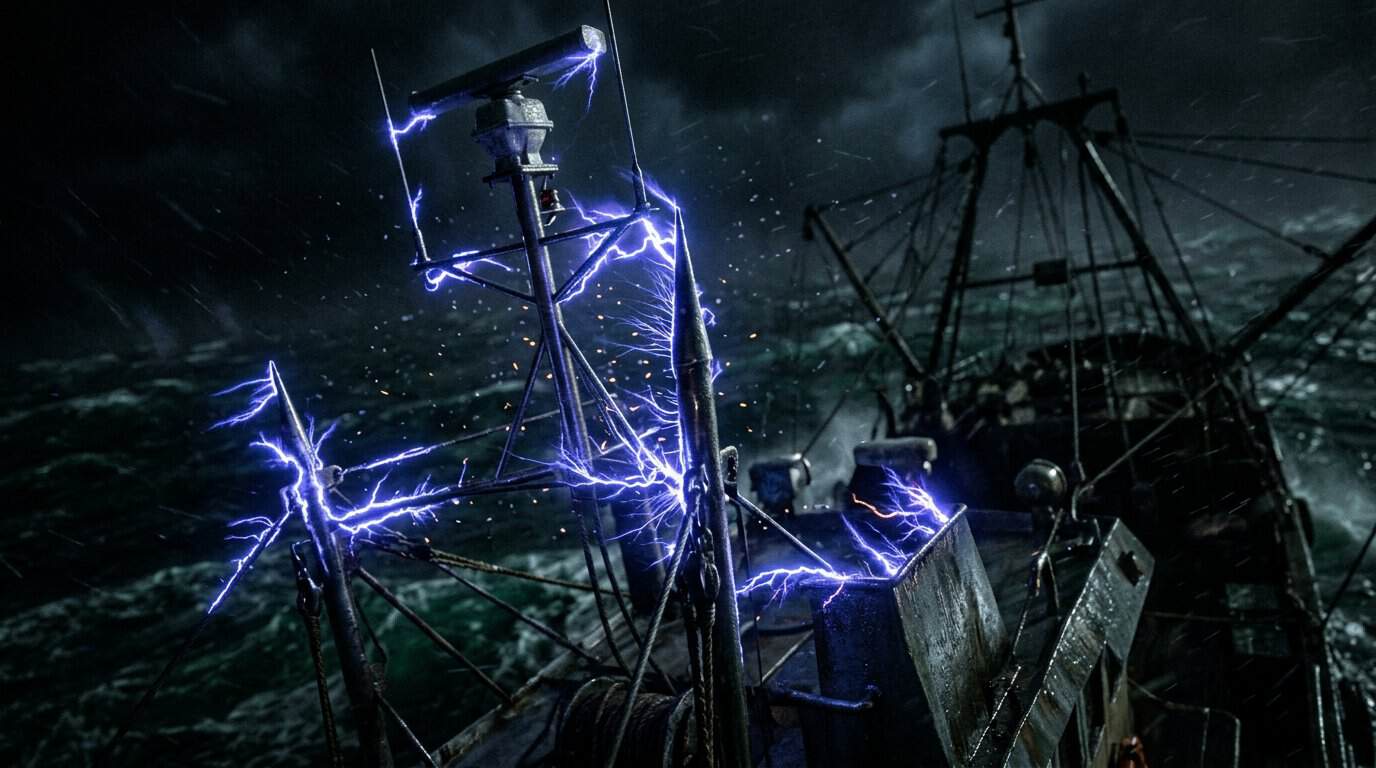
St Elmo’s Fire Sightings: The Science Behind the Strange Glow
A blue-violet glow flickers at a ship’s mast as a storm approaches, or shimmers around an aircraft wing high above the clouds. These St. Elmo’s fire sightings have inspired tales of omens and strange lights for centuries. The phenomenon is a real electrical discharge, not fire or a bolt of lightning. It appears when storm-charged air turns pointed or elevated objects into faint, glowing beacons.
From sailors’ logs to modern instruments, the evidence reveals a phenomenon that is both explainable and surprisingly elusive. Recent observations of corona-like glows on trees during thunderstorms suggest that St. Elmo’s fire may appear in more places than tradition once assumed. These findings raise new questions about what witnesses are actually seeing.
Key Takeaways
- St. Elmo’s fire is a faint, steady corona discharge caused by strong electric fields in storm-charged air around pointed or elevated objects. It is electricity—not combustion or a bolt of lightning—and commonly appears blue or violet, though other colors are possible.
- The phenomenon has been observed around ship masts, aircraft wingtips, towers, mountain equipment, and trees during thunderstorms. Recent instrumented observations on trees show that St. Elmo’s fire is not limited to maritime settings or man-made structures.
- Historical sailors often interpreted St. Elmo’s fire as a warning, blessing, or sign of protection, but modern science connects it to nearby electrically active weather. Its eerie appearance demonstrates how natural events can acquire supernatural meaning in darkness and danger.
- A credible sighting should describe the weather, object, color, duration, attachment, movement, and viewing conditions, while ruling out lightning, reflections, lens artifacts, distant lights, and ball lightning. The glow itself is usually harmless, but it signals strong electrical conditions, so witnesses should move away from exposed objects and seek shelter.
Introduction To St Elmo’s Fire Sightings
As a storm rolled across the sea, a sailor might have looked up to see pale blue flames trembling at the tips of a ship’s mast. A pilot could witness a violet glow gathering around the wingtips while rain and static electricity churned outside the cockpit. Climbers have also reported similar light around exposed gear or mountaintops when severe weather moved in. These St. Elmo’s fire sightings can seem like omens or spirits, but they are real displays of atmospheric electricity.
St. Elmo’s fire is a steady, faint glow caused by an electrical discharge around sharp, elevated objects. The World Meteorological Organization describes it as a luminous discharge that can appear on ship masts, lightning conductors, wind vanes, aircraft, and other exposed points. Its color may be blue, violet, greenish, or reddish, depending on the conditions and the observer’s surroundings. Unlike lightning, it does not usually flash across the sky. Unlike fire, it does not burn fuel.
For centuries, sailors connected the glow with protection, warning, or the presence of a saint, giving the phenomenon its enduring name and religious associations. Modern instruments have strengthened the natural explanation, including recent observations of corona discharges glowing on trees during thunderstorms. Yet the sight remains unsettling because it appears between the familiar and the mysterious, especially when witnessed alone in a storm. What might an earlier observer have believed after seeing blue light dance above a dark sea?
Ancient Accounts And Sailor Legends
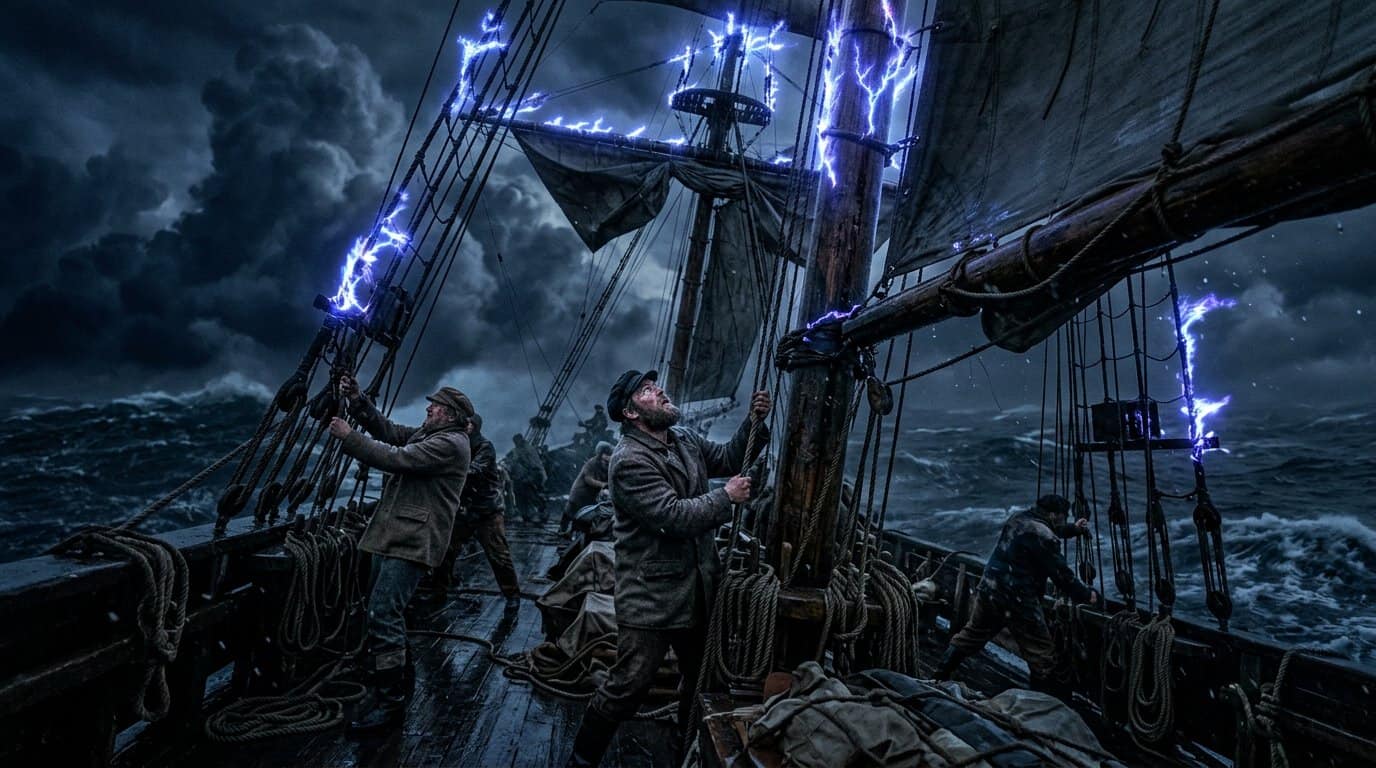
Ancient sailors had names for strange lights that appeared above the sea long before electricity was understood. In Natural History, the Roman writer Pliny the Elder described pairs of glowing lights called Castor and Pollux, which were often seen as favorable signs, while a single light could suggest danger. Centuries later, European mariners connected the glow around a mast or rigging with Saint Erasmus, also known as Saint Elmo, a patron saint of sailors. His name became attached to the phenomenon, turning an unsettling sight into part of a shared maritime tradition.
For a crew caught in rough weather, St. Elmo’s fire could feel like a message written in light. Some sailors read it as a warning that the storm held strong electrical forces, while others saw the blue or violet glow as protection from the saint or a sign that the ship would survive. Because the light often appeared at the highest points of a vessel, it seemed to crown the mast like a small beacon of hope. These interpretations passed through ship logs, oral stories, and later travel accounts, giving future witnesses a familiar way to describe an unfamiliar event.
Modern science explains St. Elmo’s fire as a steady electrical discharge, not a burning flame or ordinary lightning. The World Meteorological Organization describes it as a weak glow that can form around pointed or elevated objects when the surrounding air becomes strongly charged. These objects may include masts, aircraft wingtips, towers, and even trees during thunderstorms. That explanation does not erase the wonder of the old stories, because a real atmospheric effect can still look supernatural in darkness and heavy weather. When modern observers report St. Elmo’s fire sightings, are they seeing only electricity, or also experiencing the same mixture of fear and hope that shaped sailor folklore?
Corona Discharges Behind The Glow
St. Elmo’s fire begins when a strong electric field builds in the air around a storm. The field can strip electrons from nearby air molecules, turning the air into a weakly glowing electrical path called a corona discharge. The glow may appear blue, violet, greenish, or reddish, depending on the air, the object, and viewing conditions. Because pointed shapes concentrate electric charge, sailors have often reported the light around masts, antennas, lightning conductors, church spires, and even sharp rocks.
Aircraft wingtips and other elevated edges can show the same effect when an aircraft passes through electrically charged storm clouds. The World Meteorological Organization describes St. Elmo’s fire as a more or less continuous, weak to moderate discharge from raised objects. Recent instrumented observations have also recorded corona glows on trees during thunderstorms. Unlike lightning, it does not usually flash across the sky or deliver a sudden, powerful strike. It is not burning fuel, wood, or air, so its eerie light is closer to a quiet electrical shimmer than an ordinary flame.
For centuries, these strange lights seemed to confirm sailor legends or religious signs, especially when they appeared high above a dark sea. Modern measurements explain the glow without removing its mystery, since a natural electrical event can still look supernatural in the right conditions. St. Elmo’s fire is a useful reminder that unusual sightings deserve both curiosity and careful testing. Its presence around a ship’s mast or a mountain summit may signal charged, unstable weather nearby, not a fire or a second form of lightning.
Documented Sightings From Ships To Trees
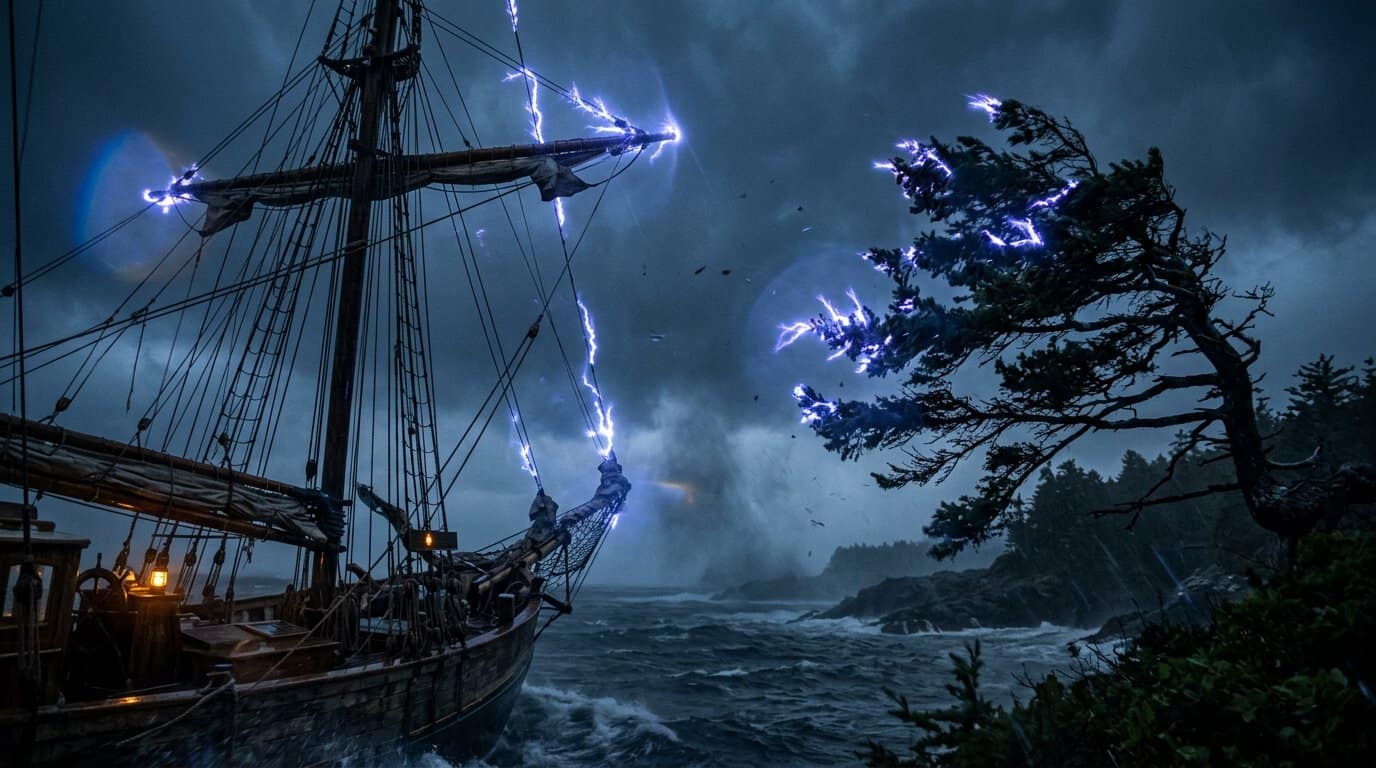
For centuries, sailors described St. Elmo’s fire as a blue or violet glow gathering around mastheads, yardarms, and other high points on storm-tossed ships. Some saw it as a blessing from St. Erasmus, while others treated it as a warning that dangerous weather was close. The World Meteorological Organization now describes the sight as a weak, steady electrical discharge, not a flame or a separate form of lightning. That explanation preserves the wonder while showing how a real natural event could seem supernatural to people watching from a dark deck.
Modern reports have followed the same glow from ships to aircraft wingtips, lightning conductors, towers, wind vanes, and mountain summits. It appears when a strong electric field builds in the atmosphere, causing charged air near a pointed object to glow faintly, often in blue, violet, greenish, or reddish tones. Weather instruments and aviation observations have helped connect these sightings to thunderstorms and other electrically active conditions. A labeled diagram could show the electric field concentrating around a mast, wingtip, or summit. A comparison chart could place common sighting locations beside their typical shape, color, and weather setting.
The newest observations broaden the story beyond metal and stone, with instruments documenting corona discharges glowing on trees during thunderstorms. Small points along branches and leaves can become sites of luminous electrical activity, suggesting that forests may host the same process once associated mainly with ships and towers. This evidence makes the phenomenon less mysterious in mechanism, but no less striking to witness, especially when an ordinary tree appears to shimmer in a storm. A historical illustration beside a modern tree observation would help readers compare sailor legends with measured atmospheric electricity and consider how science can explain the process without taking away its power.
Reading St Elmo’s Fire Reports Carefully
A convincing St. Elmo’s fire report usually begins with the setting: an approaching thunderstorm, strong winds, and a visible glow attached to a pointed or elevated object. The World Meteorological Organization describes it as a weak, more or less continuous electrical discharge, often appearing blue, violet, greenish, or reddish around ship masts, aircraft wingtips, towers, lightning rods, and even tree branches. A sailor who sees a steady glow clinging to a mast is describing something different from a flash of lightning, which is brief and travels across the sky. The effect can feel supernatural, helping explain why earlier witnesses connected it with religious signs and protective spirits. Modern science gives the sighting a natural explanation without taking away its strangeness.
Details about movement and shape can help separate St. Elmo’s fire from other unusual lights. Ball lightning is generally reported as a glowing ball that moves independently, while St. Elmo’s fire follows the shape of an object and may form small tongues, brushes, or a halo at its edges. Ordinary sparks tend to flicker sharply and vanish, whereas corona glow can last for minutes or longer while the electrical conditions remain in place. Reflections in wet glass, aircraft navigation lights, distant towers, and bright raindrops can also create misleading impressions, especially when a witness views a storm at night. Readers comparing accounts with ball lightning, unusual storm phenomena, and other atmospheric mysteries should note whether the light was attached, moving, changing shape, or seen from several angles.
Photographs may strengthen a report, but they do not settle every question. Long exposures, lens flare, autofocus errors, and window reflections can produce convincing false glows. A careful account should record the time, weather, object involved, glow color, apparent size, duration, distance, and whether nearby people saw the same thing. Instrument readings from weather stations, aircraft systems, or electrical sensors are especially useful. Recent direct observations of corona discharges on trees also show that the phenomenon is not limited to ships and mountain towers. Even without instruments, a consistent witness description can preserve valuable evidence when separated from later assumptions or dramatic retellings. What details would make a reported light seem like genuine St. Elmo’s fire rather than another atmospheric mystery?
Conclusion St Elmo’s Fire
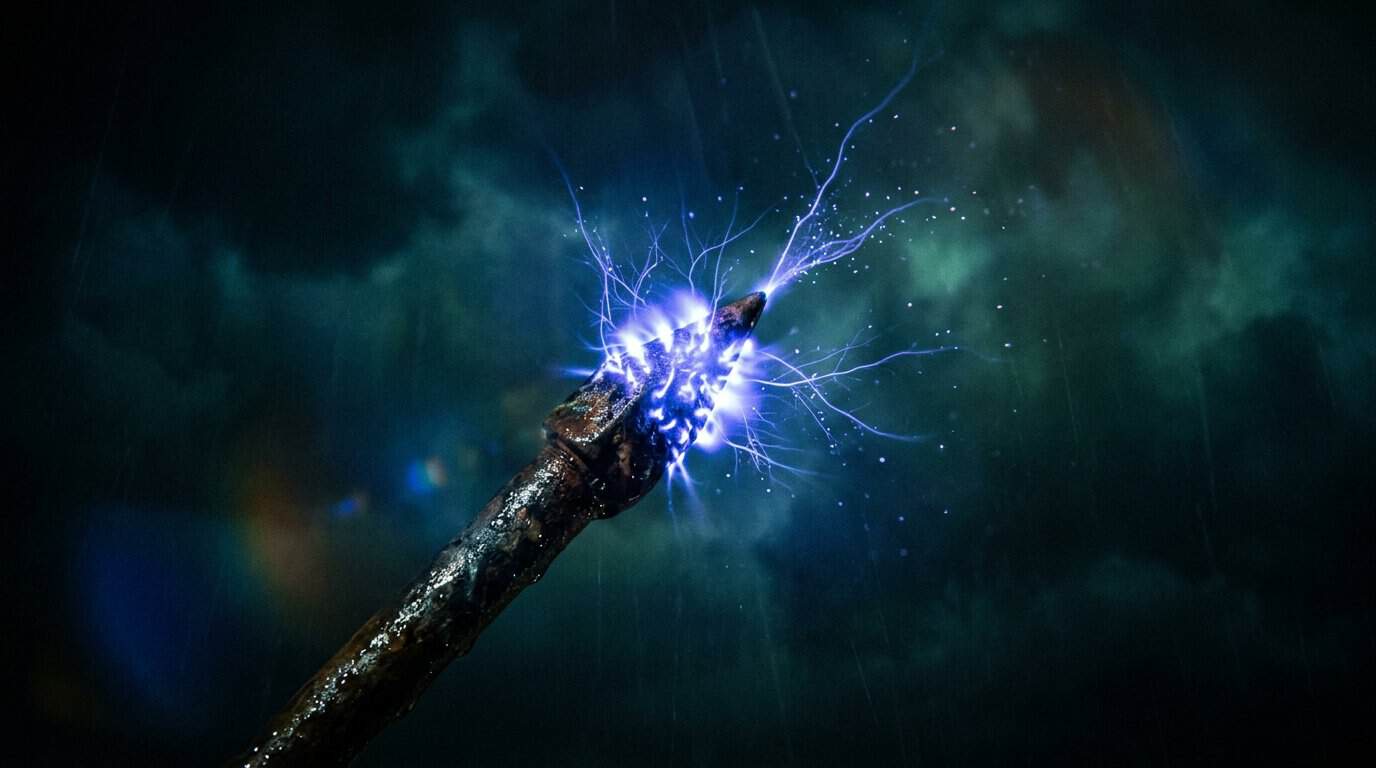
St. Elmo’s fire shows how a real atmospheric event can gather meaning as it passes through history. Sailors once reported blue or violet glows around masts and rigging during turbulent weather, sometimes viewing the light as a warning and sometimes as a sign of protection from St. Elmo, the patron saint of sailors. Today, atmospheric science explains the glow as a quiet electrical discharge, known as a corona discharge, that can form around pointed objects when the air’s electric field becomes strong. Similar reports have come from aircraft, towers, mountain peaks, and, more recently, trees observed during thunderstorms. The science explains the light’s behavior without erasing the sense of wonder felt by those who witnessed it.
St. Elmo’s fire sightings occupy an intriguing space between maritime history, religious storytelling, and careful observation of the natural world. Their unusual appearance reminds readers that unfamiliar lights can seem supernatural when seen in darkness, danger, or isolation, while also showing why each report deserves thoughtful attention rather than instant dismissal. Not every unexplained glow is St. Elmo’s fire, and ordinary sources such as distant lights, reflections, or other electrical effects can create similar impressions. Has anyone witnessed a blue or violet glow around a mast, aircraft, tree, or other elevated object, or encountered a historical account that made the phenomenon memorable? Sharing those experiences may help keep the mystery alive while leaving room for evidence, curiosity, and new discoveries.
What St. Elmo’s Fire Reveals
St. Elmo’s fire sightings show how an ordinary natural process can seem supernatural under the right conditions. The soft blue, violet, greenish, or reddish glow forms when electrical energy in the air creates a weak, steady discharge around pointed or elevated objects, such as ship masts, aircraft wings, towers, mountain peaks, and even trees. It is not a flame or a separate kind of lightning, although stormy weather and strong electric fields often make it more likely. Recent instrumented observations of corona discharges glowing on trees also show that this phenomenon reaches beyond the classic stories told by sailors.
For centuries, crews at sea viewed the glow as a warning, a blessing, or a sign of protection, while religious interpretations gave the strange light deeper meaning. Modern atmospheric science explains the conditions behind the sighting without erasing the sense of wonder that made those accounts memorable. St. Elmo’s fire remains a useful reminder that a real event can look impossible when darkness, storms, and uncertainty shape the observer’s experience. If a future sighting appears on a mast, treetop, or mountain ridge, would it feel more reassuring to understand the science, or more mysterious because of the stories that came before?
Frequently Asked Questions
1. What is St. Elmo’s fire?
St. Elmo’s fire is a faint, steady glow caused by an electrical discharge in storm-charged air. It forms around pointed or elevated objects such as ship masts, aircraft wingtips, lightning rods, wind vanes, and exposed mountain gear. Despite its name, it does not burn fuel and is not a bolt of lightning.
2. Why does St. Elmo’s fire appear during storms?
Thunderstorms separate electrical charges in the surrounding air, creating a strong electric field near sharp objects. That field can make nearby air glow as electricity moves through it, a process known as a corona discharge. The glow often appears when a storm is close, even if no lightning strikes nearby.
3. What colors can St. Elmo’s fire be?
The glow is often blue or violet, but it can also look greenish, reddish, or nearly white. The color depends on the gases in the air, the strength of the discharge, weather conditions, and the way human eyes or cameras detect the light. The World Meteorological Organization recognizes these changing colors as part of the phenomenon.
4. Where have people reported St. Elmo’s fire sightings?
Historical sightings are strongly linked to ships, where sailors saw glowing masts and rigging before or during severe weather. Pilots have also reported glows around aircraft wingtips and propellers, while climbers and storm observers have described light around exposed equipment and mountaintops. Recent observations of corona-like glows on trees suggest that natural objects may produce similar displays during thunderstorms.
5. How is St. Elmo’s fire different from lightning or ordinary fire?
Lightning is a powerful, brief electrical flash that can travel across the sky or strike the ground, while St. Elmo’s fire is usually a quiet, flickering glow attached to an object. Ordinary fire needs fuel and produces heat through combustion, but St. Elmo’s fire comes from electricity passing through ionized air. Its steady appearance can make it look flame-like, which helped create its mysterious reputation.
6. Why did sailors consider St. Elmo’s fire an omen?
For centuries, sailors viewed the blue glow as a warning, a sign of danger, or even protection from a saint during violent weather. The name is linked to St. Erasmus, also called St. Elmo, who became associated with sailors and storms. Modern science explains the electrical process, but the old stories remain important records of how people recognized unusual weather signals before instruments were available.
7. Is St. Elmo’s fire dangerous, and what should a witness do?
The glow itself is usually not harmful, but it signals a strong electrical field and potentially dangerous weather. Anyone who sees it should move indoors or away from exposed peaks, masts, fences, and other conductive objects, especially if thunder is present. Photographs and careful notes can help document a sighting, but personal safety should come before investigation.