
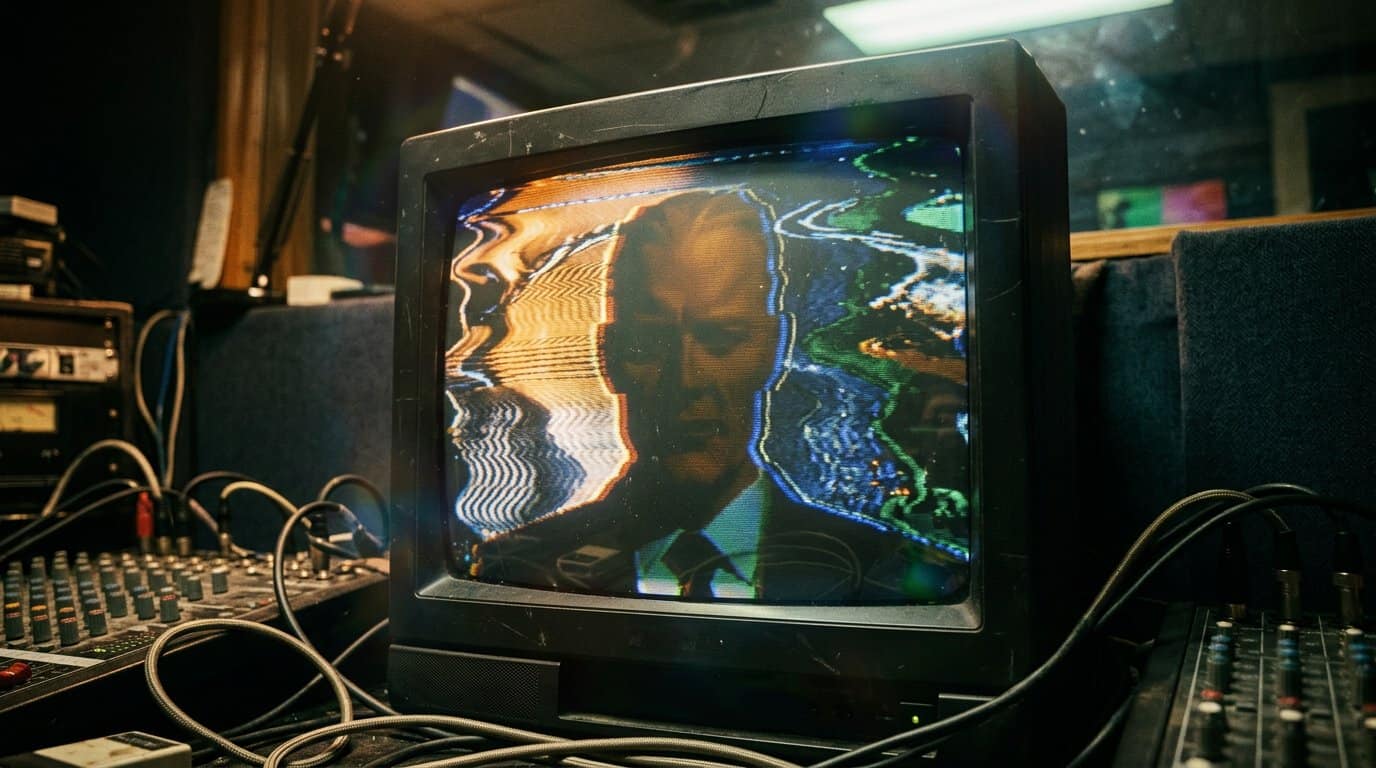
The Max Headroom Incident: Chicago’s Unsolved TV Signal Mystery
The Max Headroom incident began on a November night in 1987, when a masked figure suddenly replaced television broadcasts in Chicago. First, a brief interruption hit one local station. About two hours later, another station was hijacked for roughly 90 seconds by a strange, unsettling performance. The signal intrusions ended as quickly as they began, leaving viewers and investigators with more questions than answers.
Decades later, no one has been publicly identified or charged. The recordings offer clues about the equipment, the planning, and the person behind the mask, but they have never revealed a clear motive. Was it an elaborate prank, a technical stunt, or something more carefully planned?
Key Takeaways
- On November 22, 1987, an unknown masked figure hijacked two Chicago television broadcasts: the first for about 25–30 seconds and the second roughly two hours later for about 90 seconds during Doctor Who.
- The intrusions were deliberate and technically sophisticated, likely involving a prepared videotape, specialized transmission equipment, precise timing, and knowledge of the local broadcast system.
- Surviving recordings confirm the event and reveal clues about the costume, set, and performance, but they do not identify the perpetrators or establish a motive.
- The leading theories—elaborate prank, technical stunt, artistic performance, personal grievance, or coded message—remain unproven; no one has been publicly identified, charged, or convicted.
Introduction To The Max Headroom Incident
On November 22, 1987, Chicago viewers watching ordinary evening television saw something that seemed to come from another world. An unknown person briefly hijacked a local broadcast, interrupting the station’s programming with a distorted image of someone wearing a Max Headroom mask. The interruption lasted less than a minute, but its strange visuals and warped audio made it difficult to dismiss as a simple technical error. About two hours later, a second local station suffered another intrusion during Doctor Who, featuring the same masked figure in an even more bizarre performance.
The incident remains one of television history’s enduring mysteries because no one was publicly identified or charged. The recordings provide clues, including the costume, the unusual set, and fragments of dialogue, but they do not reveal who created the broadcast or how the signal was overtaken. Investigators and researchers have considered several explanations, from an elaborate prank to a carefully planned signal intrusion, while some viewers have searched the performance for coded messages. The available evidence supports the reality of the interruptions, yet the identity and motive behind them remain unknown.
The Signal Intrusions
On November 22, 1987, viewers in Chicago saw a regular broadcast vanish for roughly 25 to 30 seconds. In its place appeared a person wearing a rubber Max Headroom mask, standing before a shifting metallic background that resembled the television character’s familiar digital setting. The figure’s voice was buried under harsh, distorted audio, while quick movements and exaggerated gestures made the interruption feel both staged and strangely mechanical. Station technicians restored the signal before the masked speaker could deliver much more than a few fragmented remarks.
About two hours later, the intruder returned on another local station during a broadcast of Doctor Who. This time, the interruption lasted far longer, commonly reported as about 90 seconds, though some accounts describe it as closer to two minutes because recordings and station recollections do not perfectly agree. The masked figure repeated the unsettling visual style, swaying, pointing, and making abrupt gestures while a distorted voice delivered crude jokes, pop-culture references, and disconnected comments. At one point, a second person’s hand appeared to swat or grab the figure, adding to the bizarre performance before engineers ended the intrusion.
The two incidents showed signs of planning. The unknown perpetrators had to override separate broadcasts and time the second intrusion carefully. The second station’s signal was especially difficult to disrupt, which has led investigators and curious viewers to focus on the equipment, location, and possible insider knowledge required. The available video supports a deliberate prank or signal-intrusion theory, but the strange script has also encouraged speculation about coded messages and hidden motives. Decades later, no one has been publicly identified or charged, leaving the Max Headroom incident suspended between a technically skillful hoax and a mystery whose most important clues may still be buried in the recording.
How The Max Headroom Hijacking Worked
The Max Headroom hijacking likely began with a prepared videotape and a way to reach a station’s transmission path. In 1980s television, stations often sent their programs from a studio to a transmitter through a microwave link, and a strong competing signal could briefly overpower the scheduled broadcast. The intruder would have needed specialized transmission equipment, knowledge of the local broadcast network, and a clear chance to transmit at the right moment. That helps explain why an ordinary prank call could not have caused the interruption. It also suggests planning, even though the exact equipment and location were never confirmed.
The first interruption took over one local station’s signal for roughly 25 seconds during the evening news on November 22, 1987. About two hours later, another station’s broadcast was replaced for around 90 seconds while viewers were watching Doctor Who. The masked figure appeared in front of a plain, shadowy backdrop. The video included distorted speech, bursts of laughter, strange gestures, and references that sounded like private jokes or coded messages, but the poor audio makes some words difficult to identify. Investigators and later researchers have studied the mask, costume, studio-like setting, lighting, tape quality, and background sounds for clues about who made the recording and where it was filmed.
The footage itself points to a finished recording played into the signal rather than a person improvising live in front of a camera. The mask concealed the performer’s identity, while the carefully timed music, gestures, and edits gave the appearance of a staged performance. Technical clues also show that the intruder reached far enough into the broadcast chain to replace station programming, not merely disrupt a viewer’s home television. Theories range from an elaborate prank by people with broadcast experience to a deliberate signal experiment, while some viewers still search the dialogue for a hidden message. Because no reliable suspect or transmission site has been identified, the incident remains a rare blend of practical engineering, unsettling performance, and unresolved mystery.
Theories Behind Chicago’s Unsolved Broadcast Mystery
The documented facts are strange enough without embellishment. On November 22, 1987, an unidentified intruder briefly replaced one local broadcast with a person wearing a Max Headroom mask, then interrupted another station about two hours later for roughly 90 seconds. The recordings show a staged set, distorted speech, and references to television culture, but they do not reveal who created the video or how the signal was taken over. Federal communications regulators and federal investigators examined the interruptions, including the technical path of the broadcast, yet no suspect was publicly identified, arrested, or charged.
Several theories attempt to explain the performance, though none has been proven. It may have been an elaborate prank by people with access to broadcast equipment, a media-industry stunt designed to imitate Max Headroom’s commercial image, or a coded message whose meaning has never been understood. Some viewers have searched the dialogue, props, and gestures for hidden clues, while others see the strange monologue as deliberately meaningless television satire. The available video supports the conclusion that the event was planned, but it does not establish the motive, the participants, or whether anyone involved had professional broadcast experience.
The incident still invites cautious speculation because the intruder reached two major Chicago stations and vanished without leaving a public explanation. An article about unexplained media events could place the case alongside other broadcasts that seemed to break through the normal boundaries of television, while a guide to signal intrusions could explain why tracing the source was so difficult. Until new evidence appears, the prank, industry stunt, coded-message, and imitation theories remain possibilities rather than answers. Which detail in the recordings seems most revealing, and does it point to a private joke, a technical demonstration, or something more deliberate?
Conclusion On The Max Headroom Incident
The confirmed timeline of the Max Headroom incident is strange enough without adding unverified details. On November 22, 1987, an unidentified person briefly interrupted a Chicago television broadcast for about 25 to 30 seconds, then returned roughly two hours later to hijack another station for about 90 seconds. Both broadcasts showed a person wearing a Max Headroom mask, surrounded by distorted images and unsettling audio. The two interruptions are supported by recordings and station accounts, making them documented broadcast intrusions rather than rumors.
Pulling off the stunt required more than a home video and a sense of humor. The perpetrators needed access to specialized equipment, a strong enough signal, careful timing, and a working knowledge of how local television transmissions could be disrupted. The second interruption was especially difficult because the station’s transmitter was powerful and the hijackers had to override the signal without being immediately stopped. That level of preparation supports theories involving an elaborate prank, a personal grievance, or a coded message, but the footage has never revealed who planned it or why.
Decades later, the mystery remains open because no suspect has been publicly identified or charged, and no explanation fully accounts for every detail. The bizarre performance can invite paranormal interpretations, yet the available evidence points to a technically skilled human intrusion, not proof of anything supernatural. The enduring question is whether the broadcast was meant as satire, a private joke, an act of revenge, or a message that was never understood. Which theory best fits the evidence, and what clues seem most important to the case?
The Max Headroom Mystery Endures
The Max Headroom incident remains one of television’s strangest unsolved mysteries. On November 22, 1987, an unknown person interrupted one Chicago station for about 25 seconds, then appeared again roughly two hours later during a longer intrusion on another station. The video showed a figure wearing a Max Headroom mask, surrounded by strange movements, distorted audio, and unsettling remarks. Available recordings support the basic timeline, but they do not reveal who created the broadcast or how the signal was taken over.
The leading explanations include an elaborate prank, a deliberate signal intrusion, or a performance built around a hidden message, yet no theory has been proven. The technical skill and timing suggest planning, while the bizarre imagery leaves room for speculation about personal motives or coded meaning. Investigators never publicly identified or charged the perpetrators, which keeps the case suspended between documented history and modern folklore. Decades later, the most compelling question may be whether the broadcast was meant to communicate something, or simply to prove that an unseen intruder could seize the screen.
Frequently Asked Questions
1. What was the Max Headroom incident?
The Max Headroom incident was a pair of unauthorized television signal interruptions in Chicago on November 22, 1987. A masked person appeared on screen during broadcasts from two local stations, using distorted images, strange movements, and warped audio. The interruptions ended without warning and became one of television history’s most unusual unsolved mysteries.
2. When did the Max Headroom broadcasts happen?
The first interruption affected one Chicago station during its evening programming and lasted less than a minute. About two hours later, another station was interrupted during Doctor Who for roughly 90 seconds. The second broadcast received more attention because the masked figure delivered a longer and more bizarre performance.
3. Why was the figure wearing a Max Headroom mask?
Max Headroom was a recognizable fictional television personality associated with futuristic comedy, music videos, and advertising in the 1980s. The mask allowed the intruder to imitate that character while hiding a real identity. It also gave the interruption a deliberately theatrical quality, suggesting that the visual image mattered as much as the technical stunt.
4. How did someone hijack the television signal?
The intruder appears to have transmitted a stronger signal that temporarily overpowered the station’s normal broadcast, a method often called signal intrusion. The exact equipment and location were never publicly established, but the timing and coordination suggest careful preparation rather than a random equipment failure. Federal communications regulators and other investigators examined the case, yet no public explanation identified the full setup.
5. What happened during the second interruption?
During the second intrusion, the masked figure appeared in front of a homemade-looking background and moved through a series of confusing comments, gestures, and visual jokes. The audio was partly distorted, making some words difficult to understand. The performance ended when the station restored its normal broadcast, leaving viewers with a recording but no clear message or motive.
6. Was anyone ever identified or arrested?
No one has been publicly identified, charged, or convicted for the Max Headroom incident. Investigators and researchers have reviewed the recordings, possible equipment, and people connected to Chicago’s television and video communities, but none of those leads has produced a confirmed culprit. The case remains open in the public imagination because the evidence shows what happened, but not who arranged it.
7. Why did the Max Headroom incident happen?
The strongest explanation is that it was an elaborate prank or technical stunt designed to shock viewers and demonstrate access to broadcast equipment. Other theories suggest an artistic performance, a personal grievance, or a hidden message, but the recording does not prove any of these ideas. Its planning, timing, and unusual presentation leave room for speculation, while the lack of a clear demand or political statement argues against a simple public campaign.
8. What evidence is available about the Max Headroom mystery?
The main evidence consists of surviving recordings, eyewitness accounts, broadcast logs, and technical details about the two interruptions. Those materials confirm that the event was real and that the same masked figure appeared in both incidents, but they do not reveal a name, location, or definite motive. Careful viewing can suggest clues about the costume, set, and preparation, yet every interpretation should be treated as a theory rather than a proven solution.