
EMF Meter Reviews: Comparing Accuracy, Features, and Value
EMF meter reviews cannot identify one best choice for every buyer. The TriField TF2 specifies RF coverage from 20 MHz to 6 GHz and states an accuracy of ±20% at 1 GHz. That claim applies only under the conditions covered by the specifications. TriField’s specifications offer a starting point for comparing what a meter can measure and how precisely it claims to do so.
The GQ EMF-390 can log readings every second, but an independent ARRL review found that its reading in one RF test was about 30 dB below the expected level. ARRL’s review highlights a key distinction: detecting a signal and measuring it dependably are not the same. A useful comparison starts with the signal being examined, then considers the meter’s range, accuracy claims, and calibration evidence. An unexplained spike may spark curiosity, while a careful reading keeps that curiosity grounded.
Key Takeaways
- Buyers should match an EMF meter’s field type and frequency coverage to the signal they want to measure, because a wide detection range alone does not prove accurate readings.
- The TriField TF2 covers AC magnetic and electric fields from 40 Hz to 100 kHz and RF from 20 MHz to 6 GHz, with stated accuracy of ±4% and ±5% at 50/60 Hz and ±20% for RF at 1 GHz under specified conditions.
- The GQ EMF-390 logs readings every second and exports CSV data, but ARRL reports that the meter is uncalibrated, makes no accuracy claims, misses lower HF amateur bands, and read about 30 dB below the expected level in one test near a 7 MHz antenna.
- For readings that need to support safety or compliance decisions, buyers should seek documented calibration and measurement uncertainty, because consumer-meter readings alone do not establish safety or compliance.
Which EMF Meter Fits Your Needs?
Neither the TriField TF2 nor the GQ EMF-390 suits every buyer. The better choice depends on the fields and signals being examined, the relevant frequency range, and how much confidence the readings need to support. Consumer EMF meters are not interchangeable. A meter may measure magnetic fields, electric fields, radio-frequency signals, or a combination, and its sensors may cover different parts of the spectrum. The World Health Organization notes that electric fields are measured in volts per metre, while magnetic fields are measured in tesla or, in some countries, gauss. WHO’s explanation of field units shows why readings from different meters cannot automatically be compared. Published specifications give buyers useful points of comparison, but readers should also consider how much confidence the measurements warrant. These reviews help readers compare products, but they do not replace professional safety assessments or compliance testing.
What Do EMF Meter Reviews Compare?
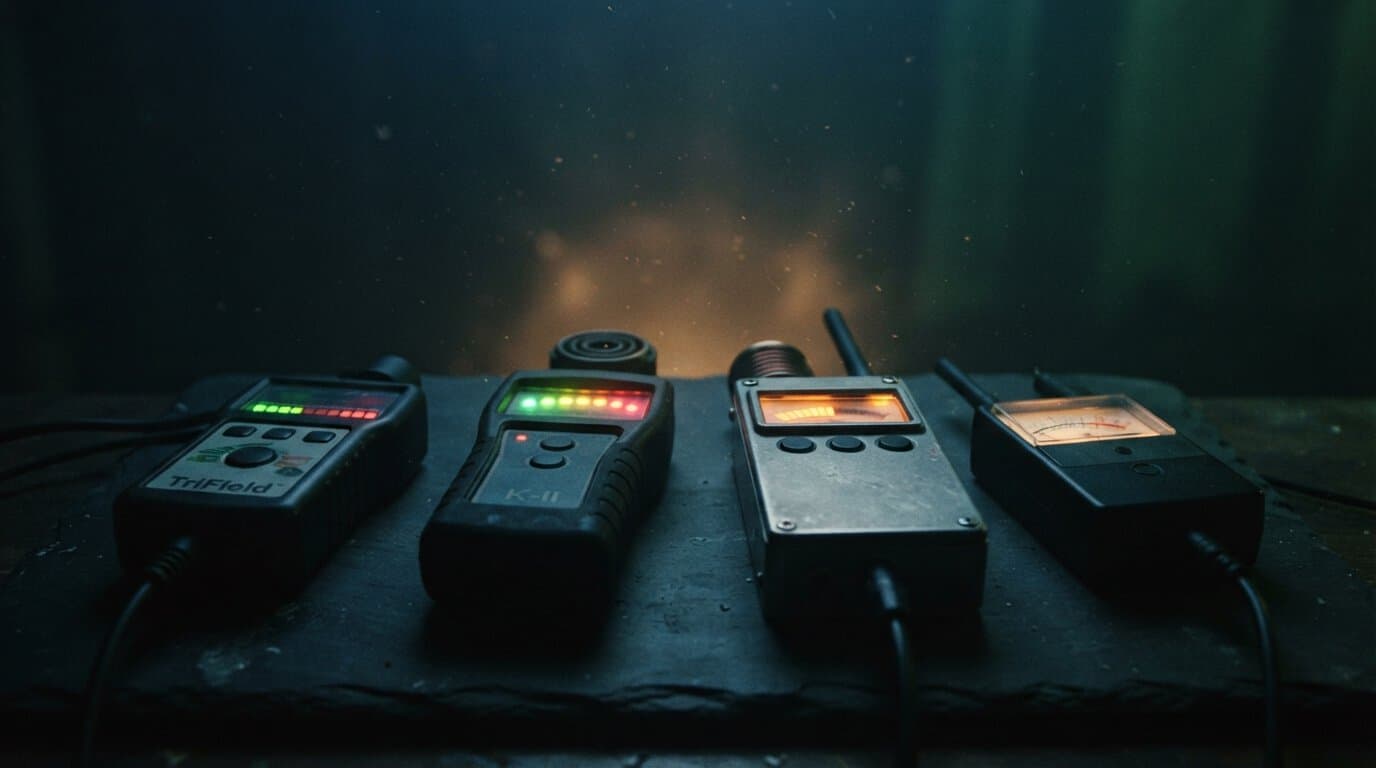
EMF meter reviews compare what each device measures, how it senses a field, and how much confidence its readings deserve. Magnetic, electric, and radio-frequency (RF) measurements are distinct categories, not interchangeable versions of a single “EMF” reading. A review should identify each field separately and explain whether the meter’s sensor design suits the signal being measured.
Units help show what a display is reporting. The World Health Organization says electric fields are measured in volts per metre, while magnetic fields are measured in tesla, commonly microtesla, or sometimes gauss. A review should state the units clearly, especially when comparing readings from different devices.
Frequency coverage matters because a meter designed to detect one part of the spectrum may not detect another. A listed frequency range describes what the meter is designed to detect, but it does not show, by itself, whether the device measures accurately throughout that range. Reviews should check whether accuracy claims apply to the frequencies and conditions buyers care about, rather than treating a wide detection range as proof of dependable measurement.
Calibration records offer another clue. The National Institute of Standards and Technology explains that measurement traceability links a result to a reference through documented calibrations, with uncertainty considered along the way. Calibration documentation and stated measurement uncertainty can help readers judge how much weight to give a displayed number. Data logging is useful for tracking changes over time, but stored readings are only as dependable as the measurements behind them. A review should explain whether a meter records values, how often it logs them, and whether the data can be reviewed later.
TriField TF2 Review: Clear Specifications
The TriField TF2 gives buyers a defined set of frequency ranges to compare. TriField specifies AC magnetic and electric field coverage from 40 Hz to 100 kHz, plus RF coverage from 20 MHz to 6 GHz, on its TF2 product page. These ranges describe different kinds of signals, so RF coverage does not replace magnetic or electric field measurements.
TriField states that magnetic readings are accurate to ±4% at 50/60 Hz and electric readings to ±5% at 50/60 Hz. For RF readings, the stated accuracy is ±20% at 1 GHz. Those figures apply under the specified conditions. Buyers should not assume that the same accuracy holds at every frequency in each range or in every measurement situation.
The specifications make the TF2 easy to compare, but a broad range and an accuracy claim answer different questions. The range indicates which frequencies the meter is designed to cover; the accuracy figure describes performance at a stated frequency or under a stated condition. A signal outside the listed range is not covered by those specifications. A signal inside it may still be measured under conditions different from those used for the accuracy claim.
The TF2 was listed at $186 in October 2026. That is a market snapshot, not a guarantee of a future price. The key question for buyers is whether the TF2’s AC field ranges and RF coverage match the signals they intend to measure. Buyers focused on RF signals should check whether those signals fall within 20 MHz to 6 GHz. Those measuring AC magnetic or electric fields should compare the signal frequencies with the meter’s 40 Hz to 100 kHz coverage.
GQ EMF-390 Review: Features and Limits
The GQ EMF-390 has a broad set of listed functions. Its user guide specifies three-axis magnetic-field readings from 0–500 mG, electric-field readings up to 1,000 V/m, and RF detection up to 10 GHz. These figures describe the meter’s stated ranges, not how accurately it measures throughout them. The GQ EMF-390 user guide maps what the device is designed to detect, but range alone cannot establish confidence in a reading.
For tracking changes in readings, the EMF-390 has a practical feature: ARRL reports that it can log measurements every second and export historical data as a CSV file through companion software. A log can help reveal when readings rise or fall, or whether a pattern repeats. But a detailed record does not prove that the recorded values are accurate; it preserves the meter’s measurements, including any errors. ARRL’s review describes the logging and export functions.
ARRL’s June 2024 review raises a serious concern: the EMF-390 is not calibrated and makes no accuracy claims. ARRL therefore says the meter should not be used to assess RF-source safety or compliance. In a test near a 7 MHz antenna, the meter read approximately 30 dB below the level expected from ARRL’s RF Exposure Calculator. This result warns against relying on the device for RF safety judgments. It is not merely a limitation on how its data can be stored.
The frequency limits matter because “up to 10 GHz” does not mean every RF band is covered. ARRL says the EMF-390’s RF spectrum bands do not cover the lower HF amateur bands and that the meter is not intended for RF testing in the HF range. Someone investigating signals in those bands could miss relevant information or receive a misleading result, even though the guide lists a high upper detection limit. The EMF-390 may suit someone who wants to observe changes in supported readings over time, but its logging and broad range do not make it a dependable HF measurement or safety instrument.
Are EMF Meters Accurate?
EMF meters are accurate only when the device suits the signal and conditions, and its measurement claims have suitable support. A display can look precise without showing how close its reading is to the actual field. A broad frequency specification describes intended coverage, not proof of accuracy across that range.
ARRL’s review of the GQ EMF-390 shows why that distinction matters. The review found that the meter was not calibrated and made no accuracy claims. In a test near a 7 MHz antenna, its reading was about 30 dB below the level expected from ARRL’s RF Exposure Calculator. Although the EMF-390 lists RF detection up to 10 GHz, ARRL also says its spectrum bands do not cover the lower HF amateur bands. A range printed in a guide cannot establish dependable measurement at every frequency. ARRL’s findings show why the evidence behind a reading matters.
Calibration documentation helps readers judge that evidence. The National Institute of Standards and Technology defines metrological traceability as a measurement result linked to a reference through a documented, unbroken chain of calibrations, with each step contributing to measurement uncertainty. In plain terms, the chain explains how a reading relates to a trusted reference and how much uncertainty remains. NIST’s explanation of metrological traceability offers a useful standard for evaluating measurement claims.
Exposure guidance answers a different question from meter accuracy. The World Health Organization identifies ICNIRP’s 1998 guidelines for fields up to 300 GHz and IEEE Std C95.6-2002 for 0–3 kHz as international exposure-guideline references for extremely low-frequency fields. Those references are not ratings for consumer meters, and a meter reading alone cannot diagnose health effects. WHO’s background on exposure distinguishes measurement from guidance.
The FCC’s 2021 RF-exposure guidance addresses transmitter evaluation under 47 C.F.R. § 1.1307(b) and § 1.1310, not consumer-meter ratings. A consumer meter can help identify or compare readings, but its result should not be presented as a safety or compliance determination without suitable measurement evidence. FCC guidance explains the transmitter-evaluation context.
How Should Buyers Compare Models?
Buyers should shortlist EMF meters by matching the signal’s field type and frequency to the meter’s stated coverage, then consider accuracy, calibration evidence, and logging. A high upper-frequency limit does not prove that every band is covered or accurately measured, so the specifications must match the signal of interest.
Mysterious Realms is a publication, not a seller; its product links provide information, and its coverage of unexplained signals offers related context for curious readers.
| Model | Stated ranges and accuracy | Calibration, logging, and cautions |
|---|---|---|
| TriField TF2 | AC magnetic and electric: 40 Hz–100 kHz; RF: 20 MHz–6 GHz. Accuracy claims: ±4% magnetic and ±5% electric at 50/60 Hz; ±20% RF at 1 GHz. | Compare each accuracy claim with the field type and frequency being measured; check calibration and uncertainty documentation. |
| GQ EMF-390 | Magnetic: 0–500 mG; electric: up to 1,000 V/m; RF: up to 10 GHz. | Logs every second and exports CSV data. ARRL says it is uncalibrated, makes no accuracy claims, and is unsuitable for RF safety or compliance assessments; its RF bands miss lower HF amateur bands. |
Choose for the Signal, Not the Hype
Before placing an order, buyers should identify the exact source to be measured and the reason for measuring it. A household reading intended to compare changes over time calls for different evidence than a reading intended to judge transmitter safety or compliance. For compliance questions, buyers should consult the relevant evaluation process rather than treating a consumer-meter display as a verdict. The FCC’s RF-exposure guidance concerns transmitter evaluation.
For a meter used to observe changes, readers can choose one location and one signal to track, then keep the meter position and settings consistent across readings. A simple log can note the time and any nearby device activity. The record may help distinguish a recurring pattern from a one-off change, without turning the reading into a safety conclusion.
Before choosing between models, buyers should look for documentation that explains calibration, measurement uncertainty, and the conditions behind accuracy claims. The National Institute of Standards and Technology’s explanation of traceability shows why a documented link to a reference matters. If the documentation does not answer those questions, the meter is best treated as an exploratory tool, and its readings described accordingly. Which signal would readers investigate first, and what evidence would make them trust the result?
Frequently Asked Questions
1. Can a smartphone app replace an EMF meter?
A smartphone app should not be assumed to replace an EMF meter. A useful comparison depends on whether the phone and meter measure the same field types and frequencies, and whether the app’s measurements are supported by accuracy and calibration information.
2. What does a 30 dB difference mean in an EMF reading?
A 30 dB difference is a substantial mismatch, not a simple percentage difference. In ARRL’s test near a 7 MHz antenna, the GQ EMF-390 read about 30 dB below the expected level. This raises concerns about relying on that result for RF safety or compliance judgments. ARRL’s review describes the test.
3. How often should an EMF meter be calibrated?
The information available here does not establish one calibration interval for every EMF meter. Buyers should check the manufacturer’s guidance and look for documentation linking measurements to a reference, with uncertainty considered. The National Institute of Standards and Technology’s explanation of traceability describes why that evidence matters.
4. Can an EMF meter detect paranormal activity?
An EMF meter can report a field reading, but it cannot identify the cause as paranormal. An unusual result may be worth recording and checking against the meter’s frequency range and calibration evidence. The reading alone cannot distinguish an unexplained event from a measurement limitation.