The Cahokia Decline Mystery: Climate, Conflict, And A Changing Ancient City
The mystery of Cahokia’s decline begins with a haunting question: how did North America’s largest pre-Columbian city change from a thriving center into a place that was largely emptied by the late 1300s? Cahokia once drew thousands of people to the Mississippi River floodplain, where towering earthen mounds, busy markets, and powerful ceremonies shaped life across the region. Yet its decline was not sudden, and no single cause has been proven.
Evidence points to a long, uneven unraveling that began around AD 1150 to 1200. Drought, changing flood patterns, political conflict, migration, and shifts in religious and economic life may all have weakened Cahokia’s ability to support such a large community. The mystery lies not only in why people left, but also in how a remarkable city transformed, and what traces its survivors left behind.
Key Takeaways
- Cahokia reached its peak between AD 1050 and 1200, supporting roughly 10,000–20,000 people and serving as a major political, religious, economic, and trading center in pre-Columbian North America.
- Cahokia’s decline began around AD 1150–1200 and unfolded gradually over generations, with most residents dispersing by approximately AD 1350–1400 rather than abandoning the city after one sudden disaster.
- Environmental pressures—including drought, flooding, shifting river conditions, and soil strain—likely weakened food production and urban stability, but no single climate event explains Cahokia’s decline.
- Political fragmentation, conflict, migration, changing trade networks, and shifts in religious authority worked alongside environmental stress to weaken central leadership and reorganize communities across the region.
Cahokia At Its Urban Peak
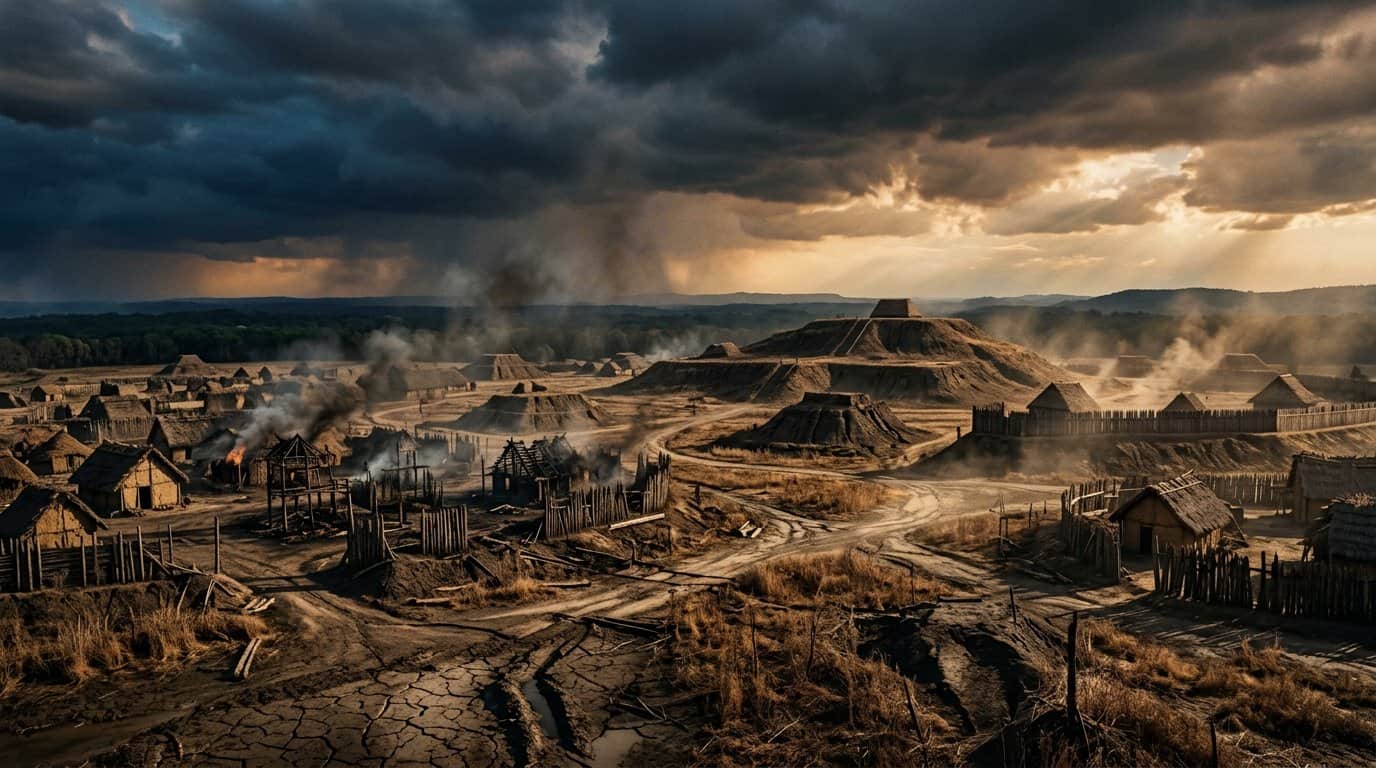
Between about AD 1050 and 1200, Cahokia grew into the largest known urban center in ancient North America. At its height, the city and its surrounding settlements may have supported 10,000 to 20,000 people, with some estimates reaching higher when the wider region is included. More than 100 earthen mounds shaped the landscape, including the enormous Monk’s Mound, which rose above broad central plazas and ceremonial spaces. These plazas likely hosted public gatherings, religious ceremonies, political events, and markets, giving the city a powerful shared center.
Cahokia’s influence extended far beyond the Mississippi River floodplain. Archaeologists have found evidence of trade in materials such as marine shell, copper, stone, and minerals from distant parts of North America. These discoveries suggest well-organized regional connections. Leaders and religious authorities appear to have guided monument construction, managed labor, and reinforced beliefs that helped unite a large and diverse population. Yet the city’s success may also have created pressure. Feeding, governing, and supplying so many people required careful control of land, water, and trade.
The first signs of the Cahokia decline mystery appeared around AD 1150 to 1200, when population patterns and settlement activity began to change. Climate shifts, drought, changing flood patterns, soil exhaustion, political conflict, migration, and changes in religious institutions may all have played a role, but no single explanation has been confirmed. Research suggests a long and uneven fragmentation rather than one sudden disaster, with most residents dispersing by roughly AD 1350 to 1400. A visual timeline could trace this transformation from urban growth to decline, while a map could show Cahokia’s location, major mounds, central plazas, and trade links across the Mississippi region.
Climate Stress And Environmental Change
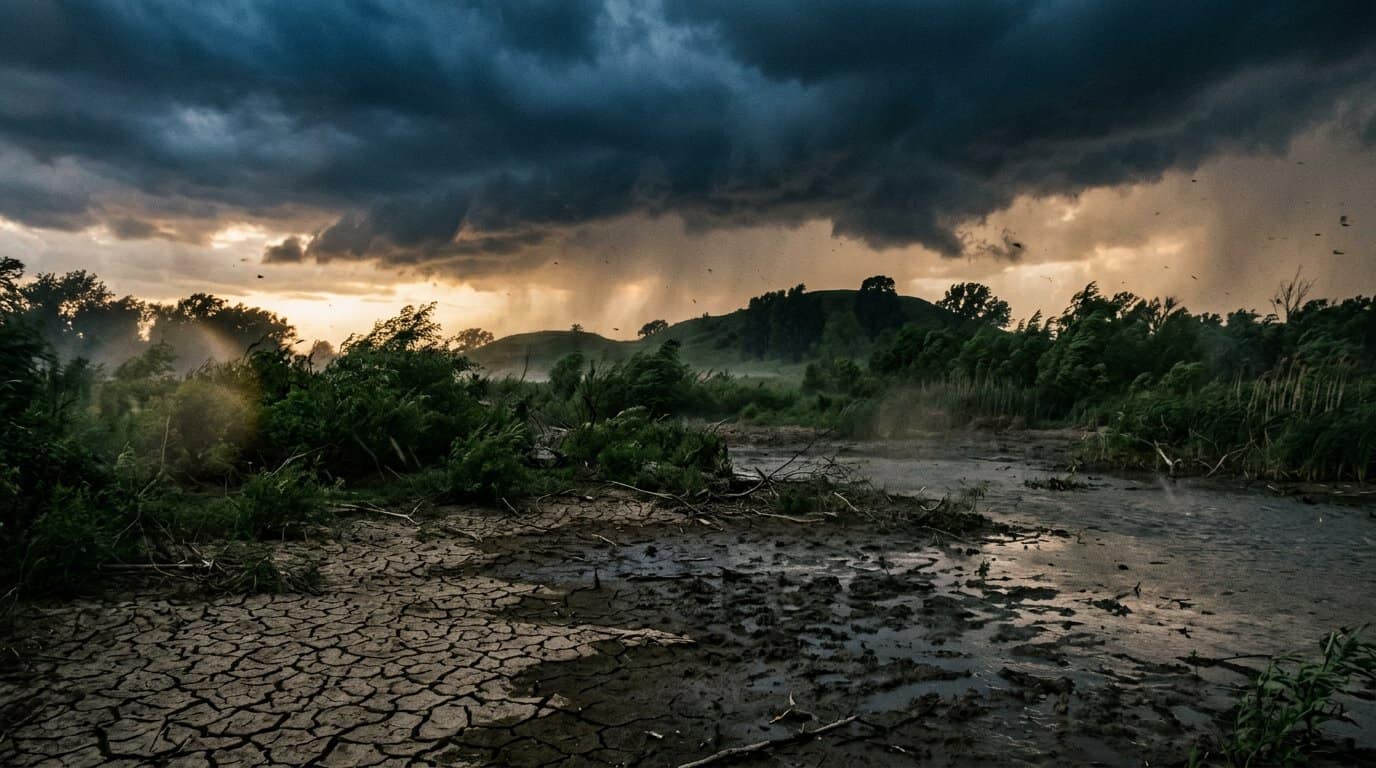
Climate stress may have made life at Cahokia harder, but the evidence does not point to one sudden disaster. Tree-ring records and lake sediments suggest periods of drought and changing rainfall in the Mississippi Valley after about AD 1150, when the city’s population and political tensions were already shifting. Flooding may also have become more disruptive as the Mississippi River and nearby channels changed course. Heavy rain could have washed soil from heavily farmed fields. These environmental pressures threatened harvests, transport, and access to dependable water, yet they varied across seasons and locations rather than creating one clear moment of collapse.
The river environment added another layer to the mystery. Cahokia depended on a landscape that offered rich floodplain soil, fish, forests, and easy movement, but that same landscape was always changing through erosion, sediment buildup, and shifting wetlands. Research on the Horseshoe Lake watershed suggests that environmental change continued after Cahokia’s main decline. This finding shows that people did not simply abandon the region because it became unlivable. Instead, climate stress likely strained food supplies and weakened the city’s ability to support a large population, especially when combined with soil pressure, political conflict, migration, and changes in religious authority.
By roughly AD 1350 to 1400, most residents had dispersed, but the long timeline matters. Cahokia’s decline appears to have begun around AD 1150 to 1200 and unfolded unevenly over generations rather than following a single failed harvest. The work of archaeologists and climate researchers supports a complicated picture: drought and flooding may have pushed the city toward fragmentation, while social decisions determined how communities responded. The enduring question is not simply whether the climate changed, but why Cahokia’s leaders and residents could no longer adapt together.
Political Fragmentation And Social Change
By about AD 1150 to 1200, Cahokia appears to have entered a period of political fragmentation rather than a sudden collapse. Settlements changed as some neighborhoods were abandoned, while the population became more spread across the surrounding region. Palisades and other defensive structures suggest that conflict, or fear of conflict, had become more important. Archaeologists have also found signs of violence at some Mississippian sites. Unequal access to food, land, and trade may have weakened trust between local communities and the leaders who once coordinated life around the city. This pattern resembles other cases explored in the site’s ancient urban collapses, where power fades gradually as cooperation becomes harder to maintain.
Religious and political change may have deepened the divide. Cahokia’s rulers once organized enormous earthen mounds, plazas, ceremonies, and other public works, but the decline of large building projects suggests that central authority could no longer command the same labor or loyalty. Changing religious practices may have challenged older institutions, especially if communities began following local leaders or traditions instead of a shared civic order. Climate stress, including drought and shifting flood patterns, likely added pressure to farms and food stores, but current research does not support a simple story in which drought alone drove everyone away. Instead, environmental strain may have intensified disputes over resources and encouraged some residents to leave.
By roughly AD 1350 to 1400, most of Cahokia’s population had dispersed, although the region was not simply abandoned forever. Migration, new settlements, and the rise of smaller centers point to communities reorganizing rather than vanishing without a trace. Research discussed in American Antiquity and related archaeological studies suggests that Indigenous people later repopulated parts of the Horseshoe Lake watershed. This evidence offers an important connection to the site’s coverage of Indigenous migration. Cahokia’s mystery therefore lies less in one dramatic disaster than in the slow weakening of a powerful network. Which pressure mattered most, political conflict, environmental change, or shifting beliefs, remains an open question for archaeologists and readers alike.
A Gradual Dispersal Not A Sudden Collapse
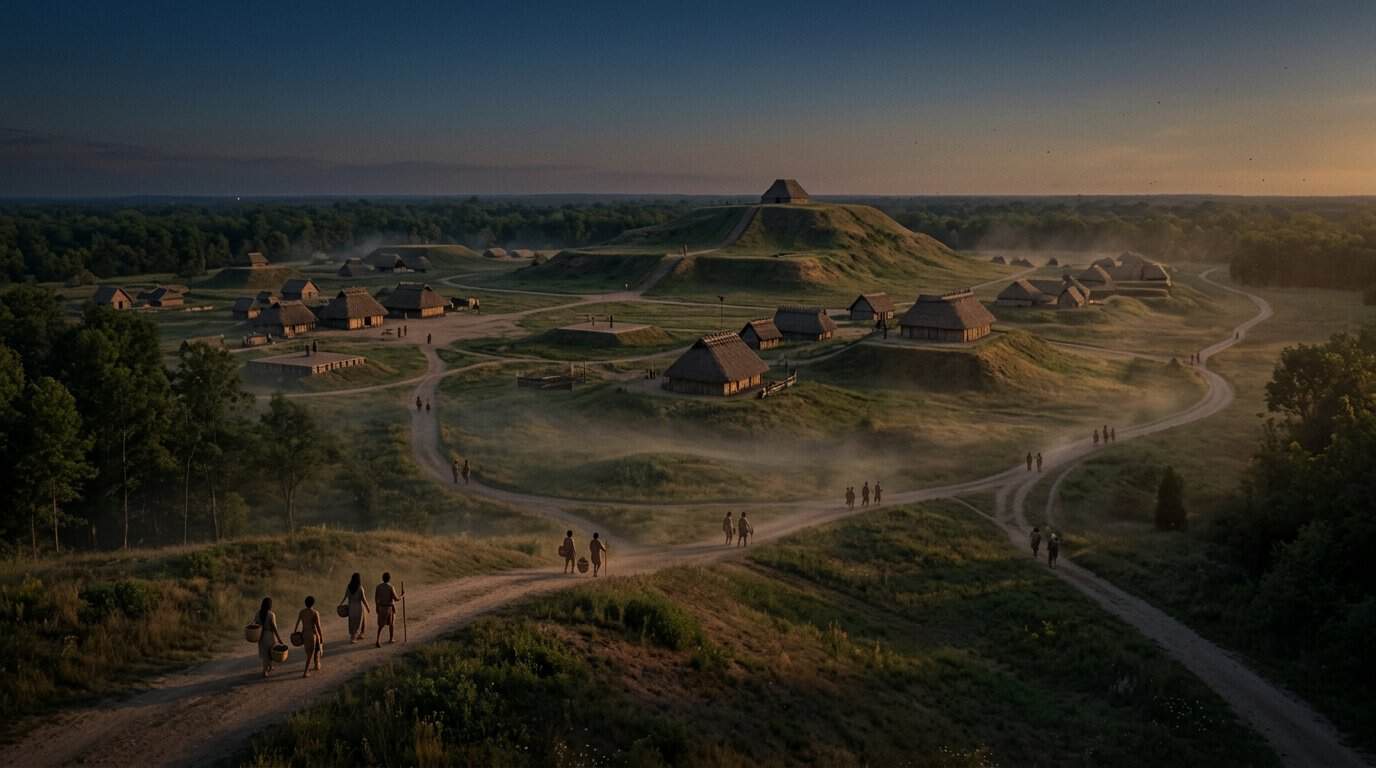
Cahokia’s decline appears to have begun as a gradual change in the city’s structure, not as one dramatic disaster. Around AD 1150 to 1200, some neighborhoods show signs of reduced activity, while central areas and major ceremonial spaces became less closely connected. Archaeologists also find changes in housing, trade goods, food remains, and settlement patterns. These clues suggest that people were making new choices about where and how to live. The city may still have held political and religious power, but its ability to organize thousands of residents was beginning to weaken. In this sense, the first stage of the Cahokia decline mystery was urban fragmentation, with the center slowly losing its pull.
Several explanations could account for that shift, and each has some support. Drought, flooding, soil exhaustion, and changing river conditions may have made farming and daily life more difficult, although evidence does not point to one climate event that forced everyone away. Political conflict or a loss of faith in Cahokia’s leaders and religious institutions could also have reduced cooperation across the city. At the same time, trade networks may have changed, allowing smaller communities to become more independent. Research discussed in American Antiquity increasingly suggests that environmental pressure and social change worked together rather than acting as separate causes.
By approximately AD 1350 to 1400, most residents had dispersed into smaller settlements across the region, even though Cahokia’s mounds and other landmarks remained. Population movement was likely uneven, with some families leaving early, others staying for generations, and nearby communities absorbing newcomers. This slow reorganization helps explain why the site was not simply abandoned overnight. It also leaves room for questions about conflict, migration, and cultural memory. The evidence points to a long unraveling shaped by climate stress, political change, economic reorganization, and the choices made by ordinary people. Cahokia’s mystery may therefore be less about a vanished city than about how a powerful society gradually learned to live beyond its former center.
Why Cahokia Faded Away Over Generations
Cahokia’s decline mystery remains unresolved because the evidence points to several connected pressures rather than one clear cause. Beginning around AD 1150 to 1200, the city appears to have experienced changing climate conditions, shifting flood patterns, environmental strain, political conflict, and social change. Drought may have made life harder, but it does not fully explain why Cahokia’s population dispersed over many generations. The strongest evidence suggests a gradual and uneven transformation that weakened the city’s ability to organize people, resources, and religious life. By roughly AD 1350 to 1400, most residents had moved away, yet Cahokia’s influence and Indigenous communities continued across the region.
That uncertainty makes Cahokia more than a simple story of collapse. New discoveries may clarify how climate, migration, trade, and political choices shaped the city’s final centuries, while the surviving landscape still leaves room for careful debate. Which factor mattered most, environmental pressure, social conflict, or the reshaping of regional power? Readers may also ask whether Cahokia should be understood as a failed city, a changing political center, or part of a wider Indigenous movement across North America.
Frequently Asked Questions
1. What is the Cahokia decline mystery?
The Cahokia decline mystery asks why North America’s largest pre-Columbian city lost much of its population after reaching its peak between about AD 1050 and 1200. Cahokia did not vanish overnight, and no single cause has been proven. The evidence points to a long period of environmental stress, political change, migration, and shifting religious or economic practices.
2. When did Cahokia begin to decline?
Cahokia’s decline appears to have begun around AD 1150 to 1200, centuries before the city was largely emptied by the late 1300s. Archaeological evidence shows that population levels, construction activity, and political influence changed unevenly over time. Some areas may have been abandoned while other settlements remained active.
3. How large was Cahokia at its height?
Between AD 1050 and 1200, Cahokia may have supported 10,000 to 20,000 people in the city and nearby settlements, with higher estimates for the wider region. More than 100 earthen mounds, including enormous Monk’s Mound, surrounded broad plazas used for ceremonies, political gatherings, markets, and public events. Its size made Cahokia a major urban center by any ancient North American standard.
4. Did drought cause Cahokia’s collapse?
Drought is one of the strongest natural explanations because tree-ring studies and other climate evidence point to periods of reduced rainfall during Cahokia’s later centuries. A shortage of rain could have damaged crops, increased food insecurity, and weakened confidence in leaders whose authority depended partly on maintaining order and abundance. Drought alone, however, does not explain every change at the site.
5. Could flooding and environmental damage have driven people away?
Yes, changing flood patterns may have made life on the Mississippi River floodplain less predictable. Floods could destroy crops, damage homes, alter travel routes, and place pressure on forests and other local resources. Cahokia’s large population may have placed additional strain on the environment, making the city more vulnerable when weather patterns shifted.
6. Was warfare or political conflict responsible for Cahokia’s decline?
Conflict may have contributed, although direct evidence for a single war that destroyed Cahokia is lacking. Archaeologists have found signs of defensive structures, including palisades, which suggest that leaders faced threats or serious tension during the city’s later period. Political divisions, disputes over resources, or declining trust in religious authorities could have encouraged groups to leave.
7. Where did the people of Cahokia go?
The people of Cahokia did not simply disappear, and many likely moved to smaller settlements across the Mississippi, Missouri, Illinois, and Ohio River regions. Cultural traditions linked to Cahokia continued among later Indigenous communities, including mound building, trade, ceremony, and artistic styles. The exact destinations of particular families remain difficult to trace because written records from the period do not exist.
8. What evidence could finally solve the Cahokia decline mystery?
Future research may combine soil studies, climate records, animal remains, plant evidence, ancient DNA, and careful mapping of settlements across the region. These clues can reveal what people ate, how the landscape changed, where they moved, and whether disease or conflict played a role. The most convincing explanation will likely be a combination of pressures rather than one dramatic event.