Lake Baikal Ice Circles: The Science Behind Giant Frozen Rings
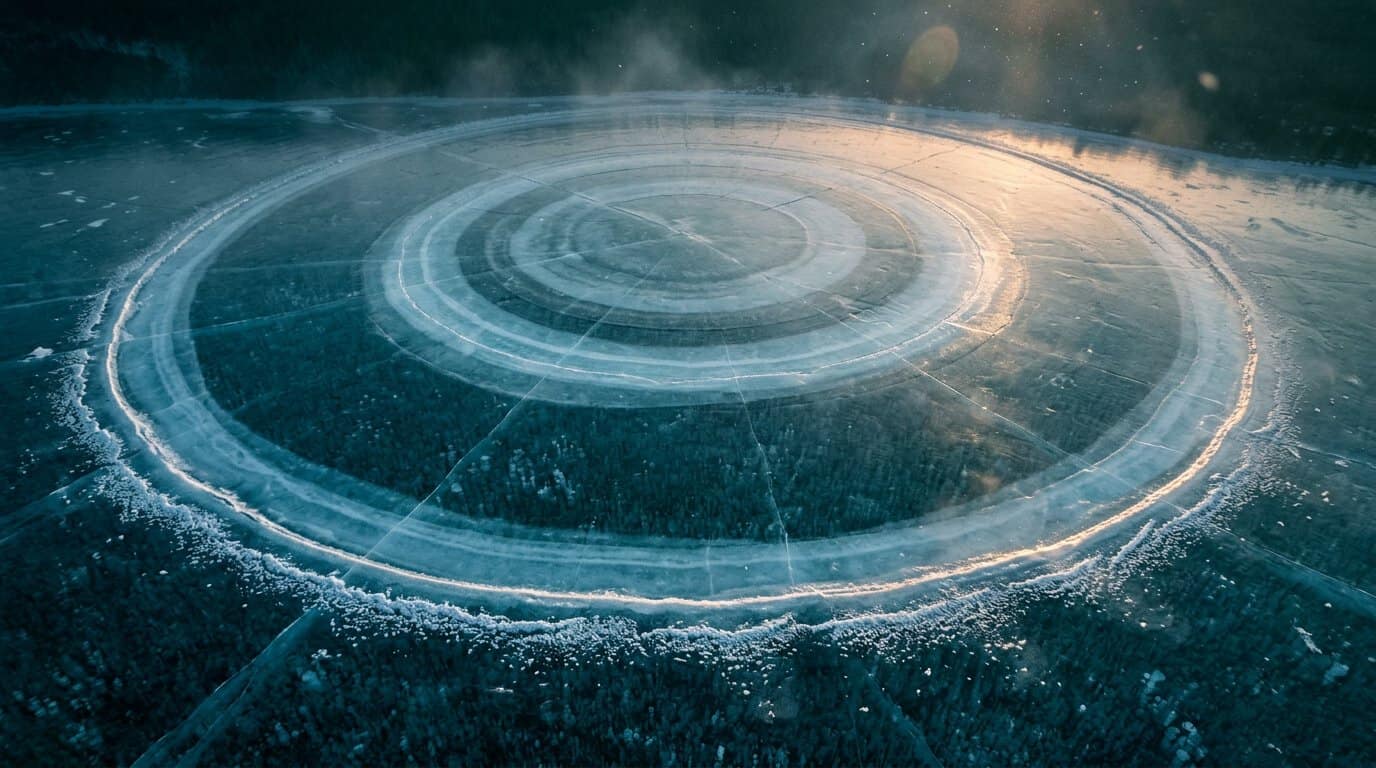
Lake Baikal ice circles appear like enormous marks across Siberia’s frozen Lake Baikal: dark, nearly perfect rings stretching across the ice. They are not holes or shapes cut into the surface, but bands of unusually thin ice that can be seen from above. Their size and eerie precision have sparked questions about methane, hidden forces, and even stranger possibilities.
Scientists now link the rings to warm, clockwise-rotating water currents beneath the ice. These currents thin the outer edge while leaving the center thicker. However, the forces that create each underwater eddy remain under investigation, with wind, river water, the shoreline, and the lake floor all offering possible clues. This mix of strong evidence and unanswered questions keeps these frozen circles among Lake Baikal’s most captivating mysteries.
Key Takeaways
- Lake Baikal ice circles are broad bands of unusually thin, dark ice—not open holes or perfectly cut markings—sometimes spanning several kilometers.
- Warm, clockwise-rotating underwater eddies carry heat toward their outer edges, thinning the ice there while the quieter centers remain thicker.
- Wind, river outflow, shoreline shape, and the lake floor may help create each eddy, but scientists have not yet determined why a specific circle forms in a particular place and time.
- Methane is not the leading explanation; the evidence favors subsurface water movement. Because the rings indicate fragile ice, they should never be treated as safe to walk across.
Introduction To Lake Baikal Ice Circles
Across the frozen surface of Lake Baikal, enormous dark rings can appear as if someone traced circles across the ice overnight. Earth-observing satellites reveal these formations most clearly, sometimes showing rings several kilometers wide. Local residents and travelers have also reported seeing darker ice from the shoreline, roads, and aircraft. The formations are not open holes or perfectly drawn marks, but broad bands of unusually thin ice that contrast with the thicker, paler ice around them. Their scale and near-circular shape naturally raise questions about how such a precise-looking pattern could form.
The leading scientific explanation begins beneath the ice, where a large, warm, clockwise-rotating eddy moves through the lake. Stronger currents around the eddy’s outer edge carry heat upward, thinning the ice and making the ring appear dark. The quieter center generally remains covered by thicker ice. Scientists are still studying what creates each eddy, with wind, river outflow, shoreline shape, and the lake floor all considered possible influences. Earlier speculation focused on methane rising from the lakebed, but current research gives greater weight to water movement and weather.
For people on the ground, the beauty of a Baikal ice circle can hide a serious danger because thinner ice may be difficult to detect from above. Satellite images help researchers track when and where rings appear, while local observations add details that a single image cannot show, including changes in weather, currents, and surface conditions. The phenomenon sits at an intriguing meeting point between mystery and measurement. The broad explanation is becoming clearer, even as the exact origin of each eddy remains uncertain. What other clues might future satellite passes and local observations reveal about these remarkable frozen rings?
First Sightings And Satellite Discoveries
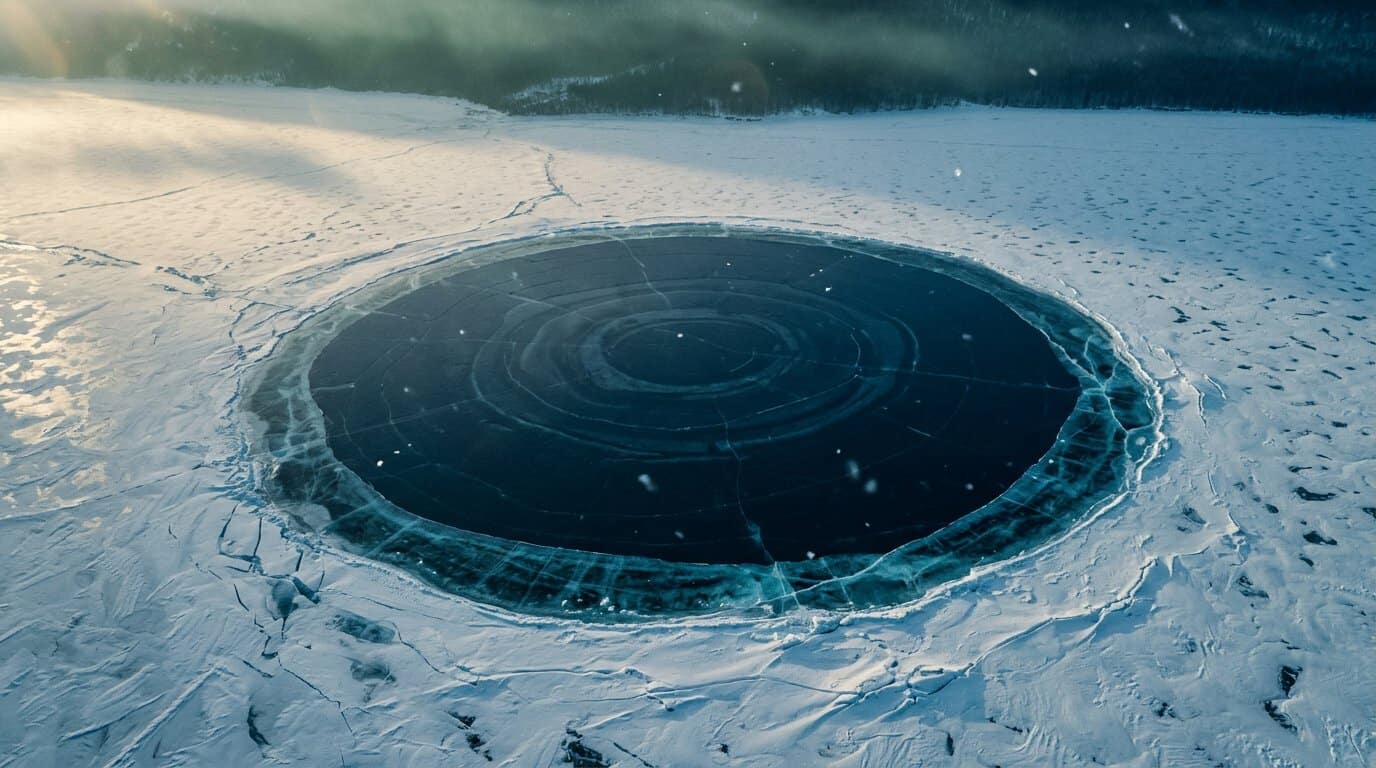
Local residents, fishermen, and researchers had noticed unusual dark rings on Lake Baikal’s winter ice before satellites brought them wider attention. Field photographs and reports described broad circular bands that looked different from ordinary cracks, pressure ridges, and areas of open water. Because many formed far from the shoreline, early observations often captured only part of the pattern or offered little sense of its full scale. Their remote setting helped preserve the mystery while also making careful investigation difficult.
Satellite images changed that picture by showing complete rings against the surrounding white ice. Earth-observing spacecraft revealed formations several kilometers across, including circles in isolated parts of the lake that would be dangerous or impractical to reach on foot. Images from research teams also showed that the rings could return in different years and appear in more than one region. Annotated aerial images are especially useful because they let readers compare the dark, thin outer band with the thicker ice at its center.
Today, researchers generally connect the circles to large, warm, clockwise-moving currents beneath the ice. The current carries heat toward its outer edge, thinning the ice there and creating the visible ring, while weaker movement near the center allows thicker ice to remain. Scientists are still studying how wind, river water, shoreline shape, and the lake floor help create these rotating currents. The evidence has shifted attention away from dramatic methane theories, but each new satellite discovery still leaves an engaging question: why does a particular eddy form in that place and at that time?
Warm Eddies Beneath The Ice
Beneath a broad, dark ring on Lake Baikal, water may be moving in a slow, powerful circle. The leading scientific theory is that a large, warm, clockwise-rotating eddy carries warmer water along its outer edge, sending extra heat upward toward the frozen surface. That heat thins the ice and can make it appear darker in satellite images, while the eddy’s center has weaker currents and remains comparatively thicker. Satellite observations have connected these striking rings with subsurface circulation rather than with holes, cracks, or perfectly melted disks.
Seen from above, the result looks almost too precise to be natural, but the ring is usually a zone of fragile ice, not an open doorway into the lake. Wind, river outflow, shoreline shape, and the lake’s underwater terrain may help create or steer the eddy, although researchers are still studying how each event begins. Local observations and weather records add important clues as the circles appear, change, and fade with the season. Their unusual symmetry keeps the mystery alive, while the evidence points toward a hidden current shaping the ice from below.
Wind Rivers And Baikal Bathymetry
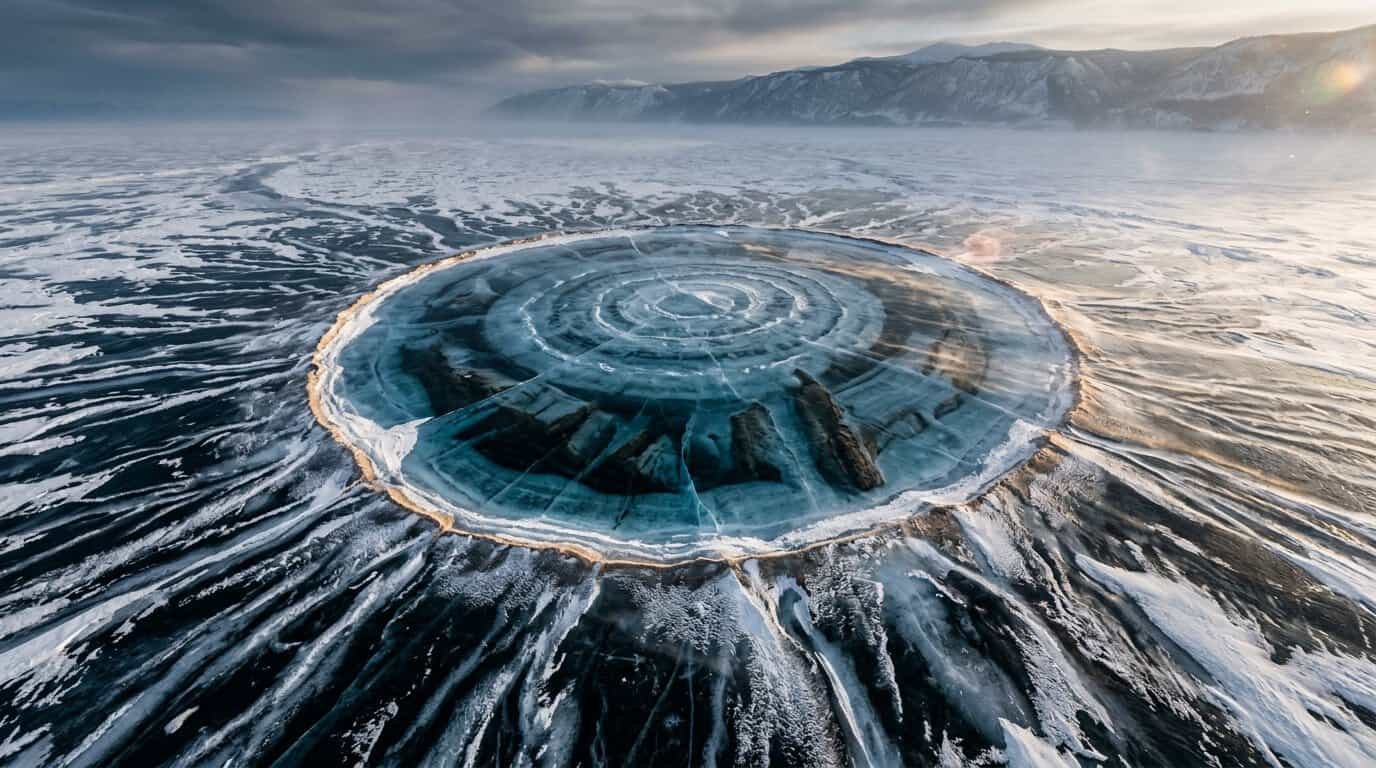
Wind may help set Baikal’s hidden water in motion, while river outflow adds warmer water near the shore. The lake’s irregular coastline and underwater ridges can then guide that flow into a broad, rotating eddy. In the eddy’s outer current, warmer water rises and transfers heat toward the ice, making a dark, thin ring while the quieter center stays thicker. Satellite images, weather records, and observations from the ice support this explanation, although scientists are still studying how each eddy begins.
Methane eruption theories gained attention because Lake Baikal contains deep sediments, trapped gas, and unusual underwater activity. A sudden release of methane seemed to offer a dramatic explanation for holes, melting, or perfectly shaped marks in the frozen surface. Yet the circles are generally thin areas of ice rather than open vents, and their shape and movement fit a rotating water system more closely. Current research favors heat carried by subsurface currents over explosive gas eruptions.
The mystery remains in the details, especially how wind, river water, shoreline contours, and the lake floor combine to produce a powerful clockwise eddy in a particular location. Each winter ring becomes a natural record of forces that cannot be seen beneath the ice, inviting comparison with satellite images and local reports. That does not make the methane idea impossible in every case, but available evidence places it behind water movement and lake geography as the leading explanation. As new images reveal where the circles form and how they change, Baikal still leaves room for a compelling question: what hidden current shaped the next ring?
What The Ice Reveals In Person
Seen from the ice, a Lake Baikal ice circle is far larger than photographs suggest, often stretching five to seven kilometers across. Its dark, transparent surface can look almost black, revealing deep water beneath, while long cracks trace irregular lines through the frozen sheet. The ring itself is usually easier to notice than the center because the outer band is thinner and more fragile. From shore, local observers may see only a faint curve, but changing light and snow cover can make the pattern suddenly stand out.
Walking near an unusual formation carries serious risk, even when the ice appears solid. The ring’s outer edge may have been weakened by warmer water and strong currents, and cracks can widen without warning as temperatures, wind, and pressure change. Researchers link the pattern to a warm, clockwise-rotating underwater current that thins the ice around an eddy while leaving the center relatively thicker. This explanation makes the ice circle less mysterious, but it also shows why visual beauty should never be treated as proof of safe footing.
Local observations remain important because they record where the rings appear, how quickly they change, and what weather came before them. Those details connect naturally with other site stories about natural mysteries, where unusual sights invite both careful investigation and honest uncertainty. Wind, river outflow, shoreline shape, and the lake’s underwater landscape may help create the eddies, although the exact beginning of each one is still being studied. For visitors, the most compelling question is not whether the circles are real, but what new evidence might reveal about the hidden movement beneath Baikal’s ice.
Conclusion: A Mystery Explained Carefully
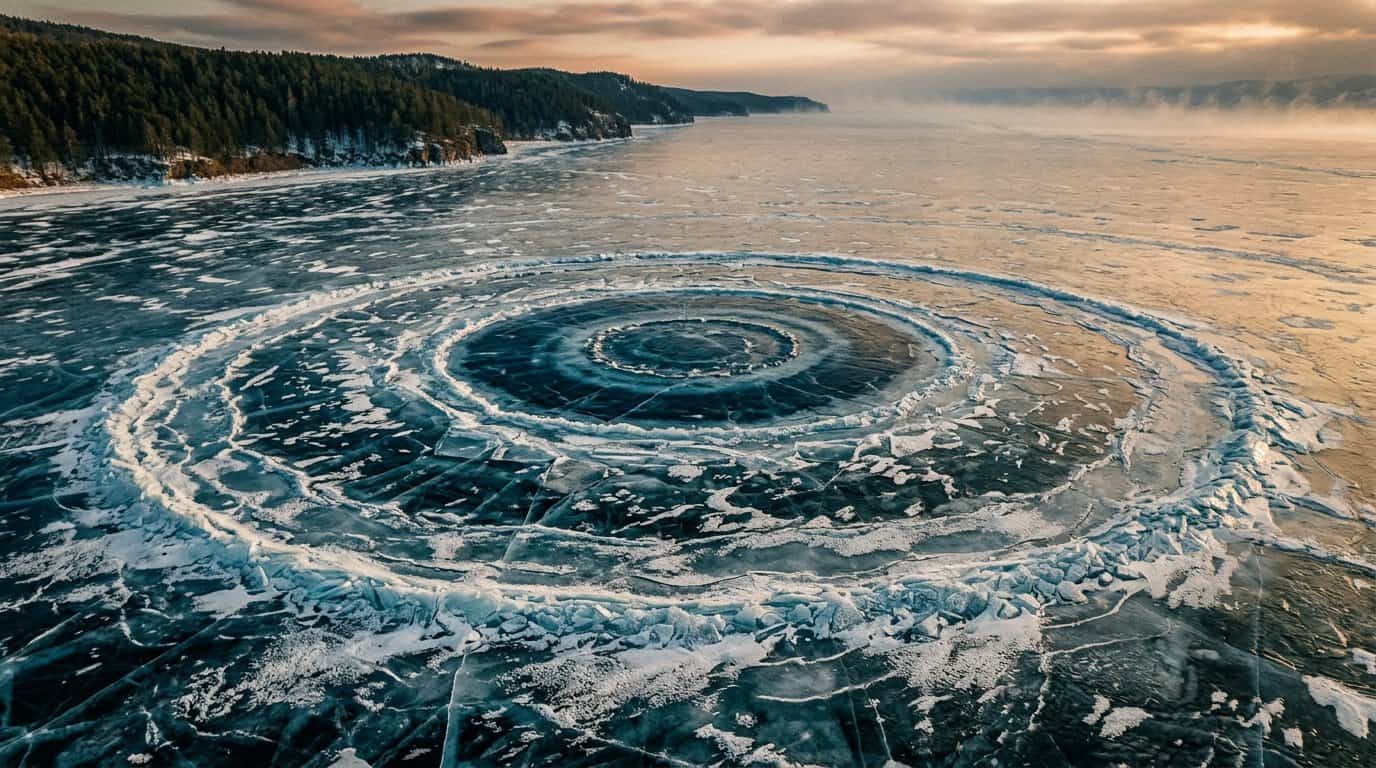
The strongest explanation for Lake Baikal ice circles comes from below the frozen surface. A large, warm, clockwise-moving eddy can push extra heat toward the ice along its outer edge, making that band thinner and darker while the quieter center stays thicker. Satellite images reveal the rings across the lake, while weather records, ice measurements, and local observations help show how they change over time. This evidence makes the formations less like holes or perfect markings and more like visible traces of hidden water moving beneath the ice.
Even so, science has not identified the exact cause of every eddy. Wind, river outflow, shoreline shape, and the lake’s underwater landscape may work together to create these powerful currents, and researchers continue to study how those conditions align. The mystery has shifted rather than disappeared, from asking what makes the circles to asking why a particular eddy forms in a particular place. When satellite science brings these enormous patterns into view, does it make Lake Baikal’s ice circles less mysterious, or does it reveal an even deeper story beneath the ice?
How Warm Currents Shape Baikal’s Ice Circles
Lake Baikal’s ice circles are giant rings of unusually thin, dark ice, not open holes or perfectly cut shapes. The leading scientific explanation is a warm, clockwise-rotating current beneath the frozen surface, known as an eddy. As the eddy moves, it carries heat toward its outer edge, thinning the ice in a broad ring while the quieter center remains thicker. Satellite images, weather records, and observations from the lake have helped researchers connect these striking patterns to changing ice and water conditions.
The exact way each eddy begins is still being studied, with wind, river outflow, shoreline shape, and the lake floor all possible influences. That uncertainty leaves room for curiosity without requiring extraordinary explanations, since the circles show how much can happen beneath an apparently still sheet of ice. They also remind observers that remote sensing and local knowledge can reveal natural events that are difficult to witness directly. What other clues might future satellite images or field research uncover about Lake Baikal’s mysterious frozen rings?
Frequently Asked Questions
1. What are Lake Baikal ice circles?
Lake Baikal ice circles are enormous dark rings that appear across the frozen lake, sometimes stretching several kilometers wide. They are not open holes or markings cut into the ice, but broad bands where the ice becomes thinner than the surrounding surface, making the rings look darker from above.
2. How do the ice circles form?
The leading explanation involves a warm, clockwise-rotating water current, or eddy, moving beneath the ice. Faster water near the eddy’s outer edge carries heat upward and weakens the ice, while the calmer center usually stays thicker and lighter.
3. Are Lake Baikal ice circles caused by methane?
Methane can rise from lake sediments and affect ice in some places, but it is not the main explanation for the large circular bands. The shape, movement, and thin-ice pattern fit better with heat carried by underwater currents, although methane may still influence local ice conditions.
4. How large can the ice circles become?
Some circles can reach several kilometers across, making their full shape difficult to recognize from the shoreline. Their enormous size is one reason satellite images and other Earth-observing programs have been so important for studying them.
5. Why do the circles look so perfectly round?
An underwater eddy can move in a broad, organized rotation, spreading heat in a roughly circular path beneath the ice. The ring may look precise from above, but its edges are usually uneven and change as wind, water movement, temperature, and ice conditions shift.
6. Where are Lake Baikal ice circles usually seen?
The circles have appeared in several parts of Lake Baikal rather than at one permanent location. Researchers examine water depth, shoreline shape, river inflow, wind patterns, and the lake floor to understand why certain areas are more likely to develop the currents linked to these formations.
7. Can people safely walk across a Lake Baikal ice circle?
A dark ring often signals thinner or weaker ice, so it should never be treated as a safe route. Travelers should follow local guidance, avoid unexplored ice, and remember that a surface that looks solid from a distance may conceal dangerous cracks, moving water, or rapidly changing conditions.
8. Is the mystery of the ice circles solved?
The connection between the rings and warm rotating currents is strongly supported by satellite observations and field research. The deeper question remains open because scientists are still determining what triggers each eddy and how wind, rivers, the shoreline, and the lake floor work together.