The Enigmatic Symbols Of Dighton Rock
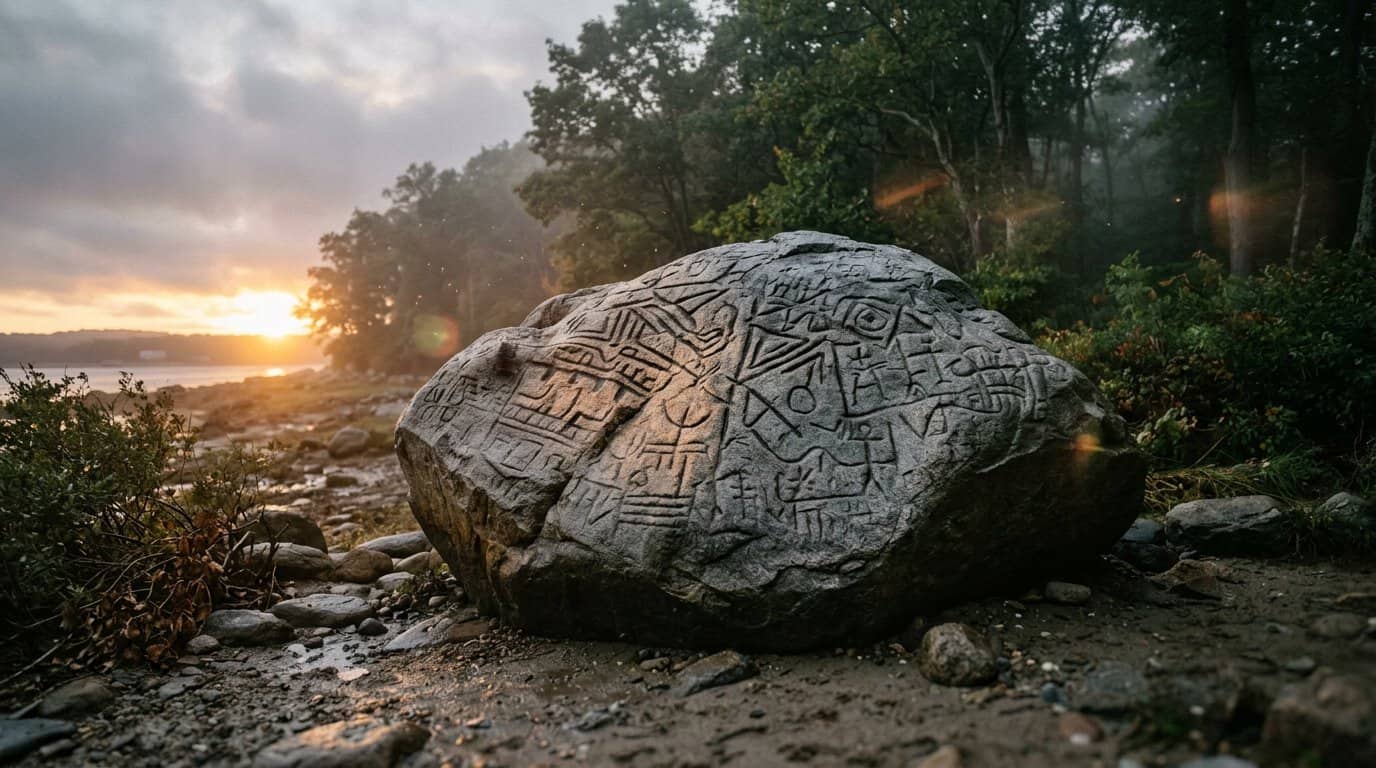
Resting along the quiet banks of the Taunton River in Massachusetts lies a forty-ton mystery that has puzzled observers for over three centuries. The dighton rock inscriptions consist of a chaotic web of lines, shapes, and figures carved deeply into a massive sandstone boulder. Ever since the first drawings of these symbols were made in 1680, scholars and curious travelers alike have wondered who left these marks behind.
While the rock now sits safely inside a museum at Dighton Rock State Park, its secrets remain as weathered and elusive as ever. Some see the work of ancient Native American tribes, while others find evidence of explorers from distant lands arriving long before recorded history. This massive stone serves as a silent witness to a forgotten chapter of the past, inviting anyone who looks upon it to help solve its enduring riddle.
Key Takeaways
- The Dighton Rock is a 40-ton sandstone boulder featuring a complex array of petroglyphs that have remained an archaeological mystery for over 300 years.
- Scholars are divided on the rock’s origins, with theories attributing the carvings to the indigenous Wampanoag tribe, Portuguese explorers like Miguel Corte-Real, or ancient Phoenician and Viking navigators.
- Originally submerged in the Taunton River and visible only at low tide, the rock is now preserved in a climate-controlled museum at Dighton Rock State Park to protect its inscriptions from erosion.
- The inscriptions serve as a critical bridge between documented history and mythology, challenging traditional timelines of European contact with the Americas.
Ancient Petroglyphs Of The Taunton River
Resting as a massive forty ton block of gray-brown sandstone, Dighton Rock once sat directly within the tides of the Taunton River in Berkley, Massachusetts. For centuries, this five foot high boulder remained a hidden treasure that was only visible during low tide, emerging from the water like a rising ghost. This constant cycle of being submerged and then revealed added an air of mystery to the strange markings etched across its surface. The coarse texture of the crystalline sandstone provided a durable canvas for whoever decided to leave their mark on history. Today, the rock is safely housed within a museum at Dighton Rock State Park to protect it from the very river that once kept its secrets.
The dighton rock inscriptions themselves are a chaotic web of lines, geometric shapes, and human-like figures that seem to defy a single explanation. When Reverend John Danforth made the first known drawing of the carvings in 1680, he captured a series of symbols that looked nothing like the colonial writing of the time. Cotton Mather later described the rock in 1690 as being covered in deeply engraved characters that appeared to be ancient and full of meaning. Because the carvings were often obscured by river silt and water, early observers struggled to document every detail accurately. This physical isolation helped fuel the idea that the rock was a message intended for only a select few to find.
While many researchers believe the markings are the work of indigenous people, the complexity of the symbols has led others to look toward distant shores. The rock acts as a bridge between documented archaeology and the whispers of mythology, suggesting that Phoenician sailors or Viking explorers might have navigated these inland waters. Some even point to the possibility of Portuguese explorers leaving behind a record of their arrival long before the Pilgrims landed nearby. By looking at the rock as a physical record of ancient travel, we can begin to imagine a world where the Taunton River was a busy highway for global cultures. These theories remain a central part of the rock’s legacy as it continues to challenge our understanding of early American history.
Native American Art Or Portuguese Exploration
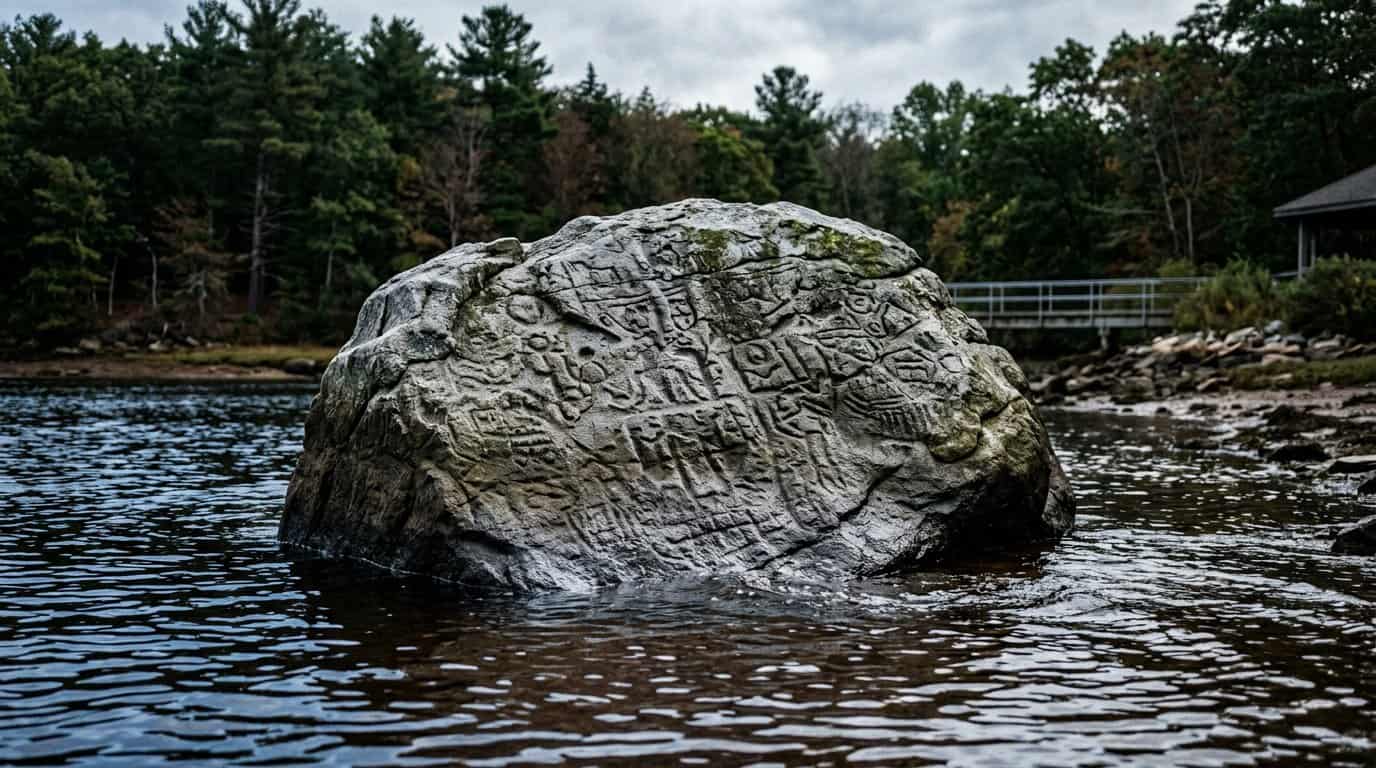
The most widely accepted explanation for the Dighton Rock petroglyphs points to the Indigenous peoples of the Taunton River basin, specifically the Wampanoag tribe. Scholars like Garrick Mallery have noted that many of the carvings, such as the geometric shapes and stylized human figures, bear a striking resemblance to other Algonquian rock art found across the Northeast. These symbols likely served as historical markers, recording significant events or spiritual visions experienced by the local inhabitants long before Europeans arrived. By viewing the rock through this lens, we see a sacred canvas that captures the deep connection between the land and its original stewards.
A more controversial but fascinating theory emerged in the early 20th century when Professor Edmund Delabarre of Brown University suggested a European origin. Delabarre claimed to have deciphered a Latin inscription hidden among the lines that read Miguel Corte-Real, 1511, by the will of God, leader of the Indians. This theory suggests that the Portuguese explorer, who disappeared during a voyage in 1502, may have survived a shipwreck and lived out his days in Massachusetts. While many modern archaeologists remain skeptical of these findings, the idea of a lost explorer leaving his final testament on a New England riverbank continues to ignite the imagination of history buffs.
Deciding between these two origins requires a careful balance of archaeological evidence and a willingness to explore the unknown. If the Wampanoag created these marks, the rock stands as a testament to an ancient cultural heritage that survived the test of time and tide. However, if the Portuguese markings are authentic, it would rewrite the timeline of European contact with the Americas. Which theory do you find more compelling, the enduring legacy of the local tribes or the mysterious survival of a lost maritime explorer?
Deciphering Phoenician And Viking Interpretations
Early scholars were often convinced that the strange markings on Dighton Rock were the work of ancient seafaring civilizations from across the Atlantic. In the 1700s, a prominent French scholar named Antoine Court de Gebelin suggested that the carvings were actually Phoenician characters. He believed these master navigators from the Mediterranean had reached the shores of Massachusetts long before the arrival of Christopher Columbus. This theory gained significant traction at the time, as many people were eager to find evidence of ancient world explorers visiting the Americas. The idea of a Phoenician outpost in the Taunton River added a layer of historical romance to the mysterious sandstone boulder.
The fascination with ancient visitors continued to grow, leading some researchers to look toward the north for answers. During the 1830s, a Danish scholar named Carl Christian Rafn proposed that the inscriptions were actually Norse runes left behind by Viking explorers. Rafn argued that the carvings depicted the arrival of Thorfinn Karlsefni and his crew around the year 1010. He even claimed to identify the name of the explorer and the Roman numerals for the number of his companions within the chaotic lines. This Viking interpretation turned the rock into a potential monument of the legendary Vinland voyages, capturing the imagination of the public and historians alike.
While these theories are highly speculative, they highlight the long history of curiosity surrounding the rock and its potential link to global maritime history. Modern researchers often point out that the markings may have been weathered or altered over time, making it difficult to definitively prove any single origin. Despite the lack of concrete evidence for Phoenicians or Vikings, these early interpretations helped turn Dighton Rock into a symbol of the unknown. They invite us to wonder if the history of the Americas is much more interconnected with ancient seafaring cultures than we once believed. Do you think these carvings are evidence of ancient explorers, or are they the artistic expressions of the local Indigenous people?
Preserving The Mystery At Dighton Rock State Park
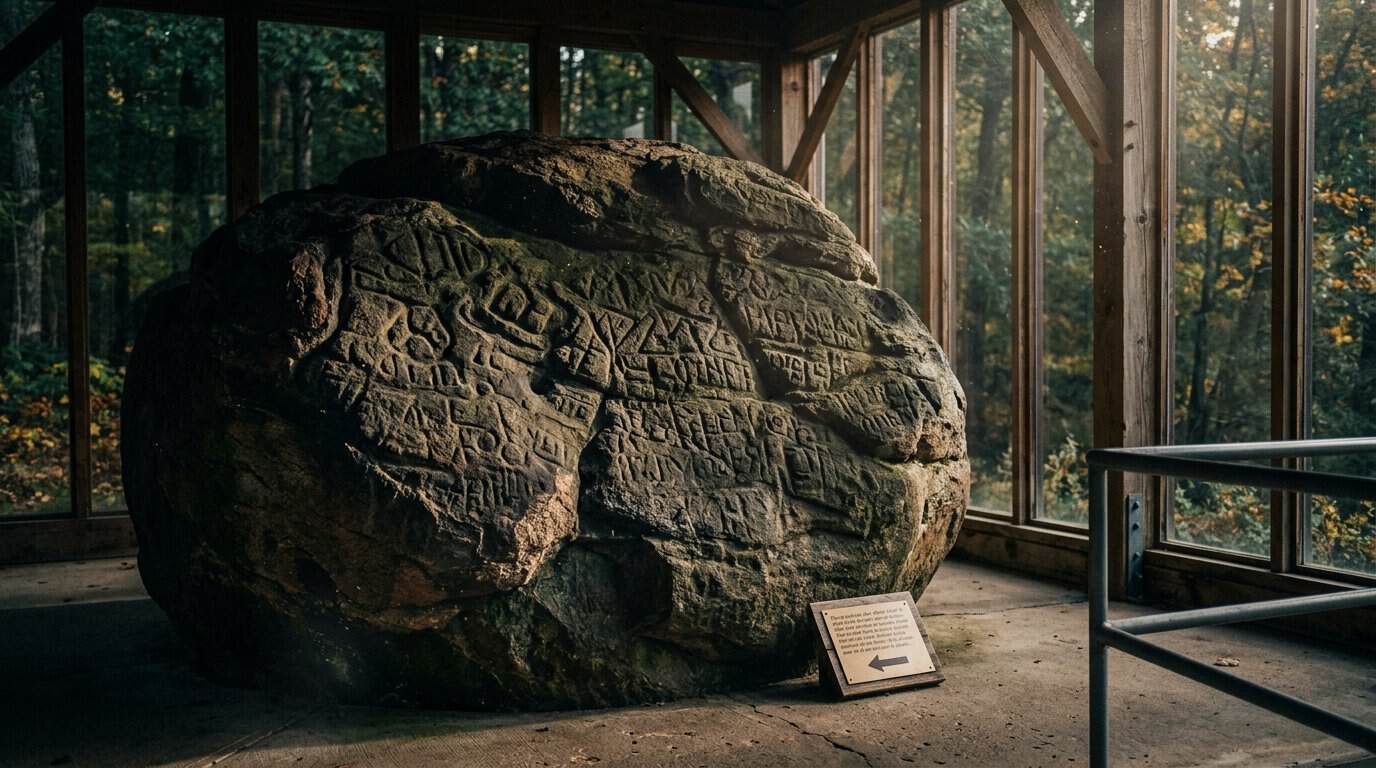
To protect the mysterious carvings from the relentless tides of the Taunton River, officials moved the forty-ton sandstone boulder into a climate-controlled museum in 1963. This relocation to Dighton Rock State Park ensured that the enigmatic petroglyphs, first documented by Reverend John Danforth in 1680, would be shielded from further erosion. Now resting safely behind glass, the rock continues to invite visitors to stare into its weathered face and wonder about the hands that carved it. Its inclusion on the National Register of Historic Places highlights its significance as more than just a stone, but as a silent witness to a forgotten chapter of history.
The inscriptions themselves remain one of the greatest archaeological puzzles in the United States, bridging the gap between documented history and ancient mythology. While many researchers believe the markings are the work of Native American tribes, others point to features that suggest visitors from much further away. Some theories suggest the symbols are ancient Phoenician script or perhaps evidence of a Viking expedition that reached the shores of Massachusetts long before Columbus. There is even a compelling argument regarding Portuguese explorer Miguel Corte-Real, whose name some believe is etched into the stone alongside the date 1511.
Inside the quiet walls of the museum, the air of mystery is thick as guests weigh scientific analysis against the allure of the unexplained. The rock does not give up its secrets easily, as the overlapping lines and symbols seem to change depending on how the light hits them. This enduring puzzle forces us to reconsider what we know about early maritime travel and the paranormal activity that may have happened on these shores centuries ago. Which theory do you find most convincing when looking at these ancient markings, and do you believe we will ever truly decode their meaning?
The Enduring Mystery of the Stone’s Markings
The markings on Dighton Rock remain one of the most captivating puzzles in the world of archaeology. This 40 ton sandstone boulder has served as a silent witness to centuries of speculation, bridging the gap between documented history and local mythology. Whether the inscriptions are the work of Indigenous peoples, wandering Vikings, or lost Portuguese explorers like Miguel Corte Real, each theory adds a new layer to the stone’s legacy. The museum at Dighton Rock State Park now protects these carvings, ensuring that future generations can witness the same symbols that once baffled early colonists.
The beauty of this mystery lies in its ability to spark the imagination while grounding us in the physical past. Some observers see a clear historical record of ancient transatlantic voyages, while others view the lines as sacred art created by the local Wampanoag people. There is a sense of wonder in knowing that after three hundred years of study, the rock refuses to give up all its secrets. Similar to the moon-eyed people of Cherokee legend, it stands as a reminder that history is often a living narrative, shaped by the evidence we find and the stories we choose to believe.
What do you see when you look at the complex patterns etched into this ancient gray stone? Do you believe these carvings are a map left by ancient Phoenician sailors, or perhaps a symbolic message from a culture that has since moved on? The line between scientific fact and unexplained phenomenon is often thin, and your perspective might just be the one that sees a connection others have missed. We invite you to share your thoughts and join the ongoing conversation about whether Dighton Rock is a true historical document or a masterpiece of ancient myth.
Frequently Asked Questions
1. What exactly are the Dighton Rock inscriptions?
The inscriptions are a complex web of lines, geometric shapes, and human-like figures carved into a forty ton sandstone boulder. These mysterious markings were first documented by Reverend John Danforth in 1680 and have puzzled researchers for centuries. They represent a chaotic puzzle of symbols that do not match any known colonial writing from that era.
2. Where can visitors see the rock today?
The rock is currently housed in a dedicated museum within Dighton Rock State Park in Berkley, Massachusetts. It was moved from its original location in the Taunton River to protect the carvings from erosion and tides. This climate controlled environment ensures that the ancient sandstone remains preserved for future generations to study.
3. Who is believed to have created these carvings?
There is no single consensus on the creators, leading to several fascinating theories ranging from local Native American tribes to ancient seafaring explorers. Some researchers point to possible Viking or Portuguese origins, while others believe the symbols are indigenous petroglyphs. The variety of styles within the carvings suggests that multiple groups may have added to the stone over many years.
4. How large is the Dighton Rock?
This massive block of gray brown sandstone weighs approximately forty tons and stands about five feet high. Its broad, slanted face provided a natural canvas for the extensive carvings found across its surface. The sheer size of the boulder made it a prominent landmark along the river even before it became a subject of historical debate.
5. Why was the rock originally difficult to study?
For centuries, the boulder sat directly within the tides of the Taunton River and was only visible during low tide. It would emerge from the water like a ghost, giving scholars only a few hours at a time to sketch or examine the symbols. This constant cycle of submersion added to the rock’s mystique and contributed to the weathering of the inscriptions.
6. What was the first recorded observation of the symbols?
The first known drawing of the inscriptions was created by Reverend John Danforth in 1680. His sketches brought the mystery to the attention of other colonial scholars, including Cotton Mather, who described the strange markings in his own writings. These early records are vital because they show how the carvings looked before centuries of modern weathering and vandalism occurred.