Tsukumogami Folklore: Japan’s Everyday Objects That Came to Life
Tsukumogami folklore describes ordinary household objects, such as teapots, umbrellas, and cooking tools, that gain spirits after nearly one hundred years of use. The idea is tied most closely to the medieval tale Tsukumogami-ki, in which objects discarded during the year-end housecleaning, known as susuharai, grow resentful and turn into restless specters around the Lunar New Year. A two-scroll manuscript from the sixteenth century, kept at Sōfukuji in Gifu Prefecture, preserves one of the tale’s two main versions. The story is not a simple guide to Japanese belief, but its central number has stayed with readers for centuries: a tool that has served its owner for about a century is ready to wake up.
The tale does not end in pure terror. Its abandoned objects repent, enter religious service, and reach Buddhahood through Shingon Buddhist teaching. The tradition’s most striking images come from picture scrolls and the Hyakki Yagyō, or “Night Parade of One Hundred Demons,” where sixteenth-century painted versions show umbrellas and musical instruments marching as if they were alive. Those pictures help explain why a humble teapot could become one of the most memorable characters in Japanese folklore.
Key Takeaways
- Tsukumogami folklore holds that ordinary household objects such as teapots, umbrellas, and cooking tools can gain spirits after nearly one hundred years of use, and many retellings treat that threshold as just short of a full century.
- The medieval tale Tsukumogami-ki follows objects discarded during the year-end housecleaning known as susuharai, which turn into resentful specters around the Lunar New Year before they repent and reach Buddhahood through Shingon Buddhist teaching.
- Scholars such as Michael Dylan Foster and Fabio Gygi show that tsukumogami imagery grew from painted scrolls, parades, and live performance, while Tsukumogami-ki itself should not be treated as proof of a single, unchanging Japanese animism.
- The kasa-obake, a one-eyed paper umbrella spirit that hops on a single leg, became one of the most familiar named yokai of the Edo period, and Toriyama Sekien’s illustrated catalogues helped fix its look for later readers.
- The YOKAI Immersive Experience Exhibition TOKYO ran in Shinagawa from March 27 to June 28, 2026, and its organizer reported more than 30,000 visitors, with advance adult tickets priced at ¥2,400.
What Exactly Is a Tsukumogami?
A tsukumogami is an everyday object, such as a container, a tool, or an instrument, that gains a spirit after a long period of ordinary use. In the medieval tradition, these household items are believed to receive souls once they have served their owners for nearly a century. Noriko T. Reider, writing in the Japanese Journal of Religious Studies, describes them as animate objects that come alive through years of faithful service.
The name itself carries a playful puzzle. Its first part, tsukumo, is pronounced much like the Japanese word for ninety-nine, and the second part, kami, refers to a spirit or divine presence. Readers who see the name written out may notice that the wordplay depends on sound as much as meaning, which is part of why the word stuck in people’s memories.
The age threshold is where the story gets its particular charm. Many retellings place the moment just short of a full century rather than at one hundred. The difference is small, but it is the heart of the pun. A tool that has nearly reached a full century is close enough to feel believable, yet not so old that its awakening seems impossible.
That number matters because it turns a magical event into something readers can picture. Imagine a wooden tub, a cast-iron kettle, or a paper umbrella that has sat in one family’s home for generations. Its years of daily use make the spirit feel earned, as though the object has quietly collected a lifetime of human attention before it finally wakes.
The idea is older than the story that made it famous, but not by much. Animate tools appear now and then in late-Heian literature, yet the practice of calling such objects tsukumogami is largely medieval. Depictions of these objects multiply during the medieval and Edo periods, when artists and storytellers found that a familiar kitchen item could be far more unsettling than a distant demon.
How Does a Household Object Turn Into a Spirit?
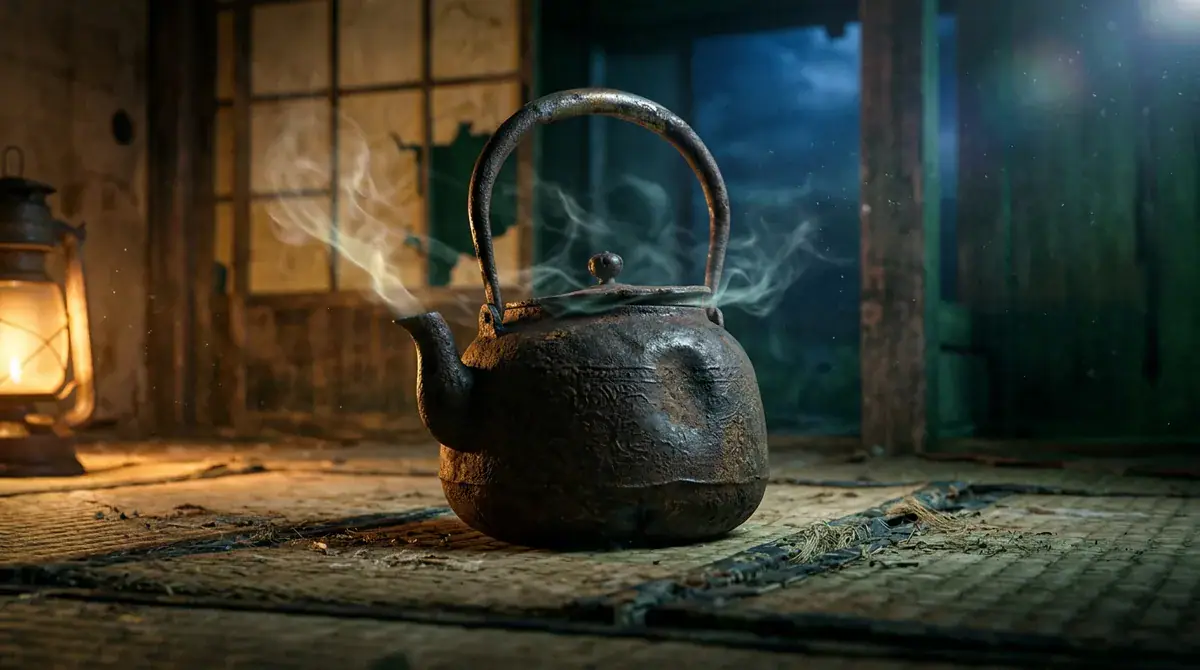
In the medieval tale Tsukumogami-ki, a household object becomes a spirit after nearly a century of use, usually once it has been thrown out during the year-end cleanout. The story belongs to a group of short works called otogizōshi, or companion tales, which were written from the fourteenth through seventeenth centuries to entertain readers and teach moral or religious lessons.
The story begins with susuharai, the housecleaning that families carried out at the end of the year. Worn containers, tools, and instruments were pushed out of the house as junk. Their owners gave them no thought, and that neglect sets the rest of the tale in motion.
Around the Lunar New Year, the discarded objects transform into specters. They are not gentle ghosts. In the story, abandoned tools grow resentful and turn against the people who cast them aside, so the early part of the tale is full of unease and threat.
The turn comes when the objects repent. Instead of staying angry, they enter religious service and, through the teachings of Shingon Esoteric Buddhism, reach Buddhahood. A cleaning day that began with rejection ends with the tools finding a higher purpose.
Scholars have identified two main versions of the tale. Type A is represented by a two-scroll manuscript from the sixteenth century, kept at Sōfukuji in Gifu Prefecture. Type B survives in other manuscripts of one or two scrolls, which shows that the story circulated in more than one form.
An archive record for the tale lists a two-volume copy measuring 26.8 centimeters and dates the composition of the tale to the Muromachi period. The record summarizes the plot in much the same way: discarded old tools seek revenge, then repent, practice Buddhism, and attain Buddhahood.
It is tempting to read Tsukumogami-ki as a clear window into Japanese beliefs about objects, but scholars urge caution. The tale blends object folklore, year-end cleaning customs, and Shingon teaching in a way that suits its own time and audience. It is one story, not a complete definition of Japanese belief, and it should not be treated as proof of a single, unchanging Japanese animism.
Even so, the story gives readers a memorable way to think about things they usually ignore. In this tale, a tool tossed out after decades of faithful use is a being with memory and grievance. Whether the idea reflects old attitudes toward worn-out possessions or simply makes a good story, the question it raises still lingers. When does a thing stop being just an object?
Where Did the First Pictures of Walking Objects Come From?
Medieval Japanese picture scrolls were among the first places where ordinary tools were shown acting on their own. Artists working from earlier periods through the Muromachi era used painted sequences to turn kettles, umbrellas, and other household items into characters that a viewer could follow from one frame to the next.
Picture scrolls, known as emaki, were unrolled slowly from right to left, so a viewer moved through a story one scene at a time. Text and painting worked together, and the artist controlled the pace of the reveal. That format suited tsukumogami well, because a worn-out object could be shown lying discarded in one scene and then stirring in the next.
The Kyoto University Rare Materials Digital Archive preserves a Tsukumogami emaki, which shows that the story was meant to be seen as well as read. The catalog treats the work as a picture scroll and places its composition in the Muromachi period. Its plot summary, in which discarded tools seek revenge and then turn to Buddhism, reads almost like a storyboard for the painted sequence.
The most elaborate visual tradition grew up around the Hyakki Yagyō, or “Night Parade of One Hundred Demons.” In his book Pandemonium and Parade, Michael Dylan Foster describes sixteenth-century Hyakkiyagyō emaki in which musical instruments, umbrellas, and cooking utensils march along as living things. The parade format let painters line up a crowd of objects, each with its own posture and expression, and let viewers take in the whole procession at once.
Foster also notes that playful yokai imagery flourished during the Edo period and into the early Meiji era. Over those centuries, the grim specters of the earliest scrolls gave way to lighter, more comic images. A teapot with a grin or a lantern with a long tongue began to appear as entertainment, and the idea of the animated object took on new humor without losing its roots.
In a 2025 article in the journal Religions, Fabio Gygi suggests that tsukumogami are best studied through “animation” as a practice rather than as a fixed belief about objects. He reads illustrated scrolls and live performance as methods that made objects appear alive to their audiences. The question shifts from whether a broom once truly woke up to how a painter’s brush, a storyteller’s voice, or a performer’s movement could make it seem to.
The images leave a lingering puzzle. When a painted umbrella hops across a scroll, is the artist telling a joke, issuing a warning, or simply showing off a clever trick? The pictures alone do not settle the matter, and the viewer who looks closely is left to decide what the scene was meant to do.
Which Named Yokai Joined the Object Parade?
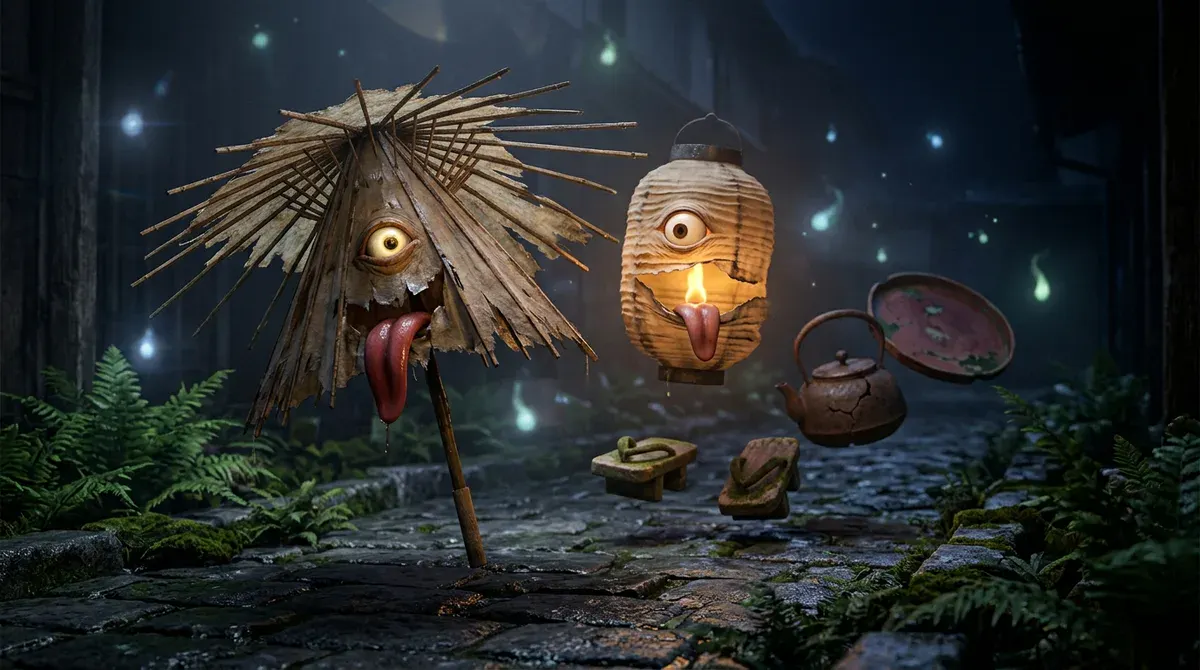
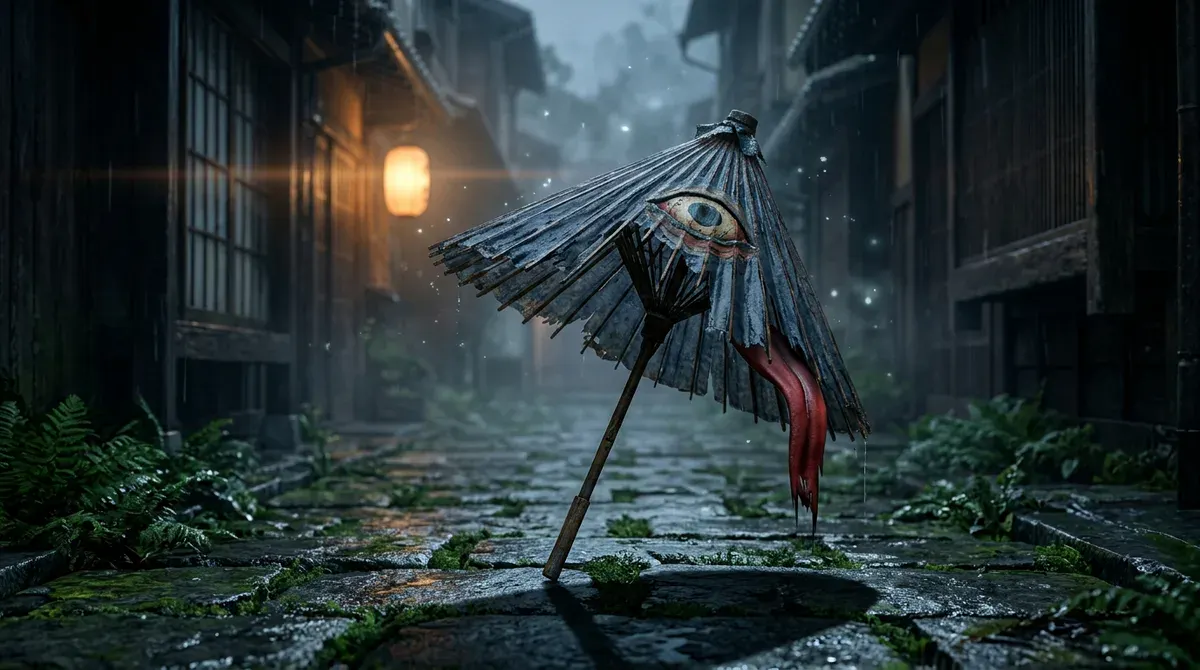
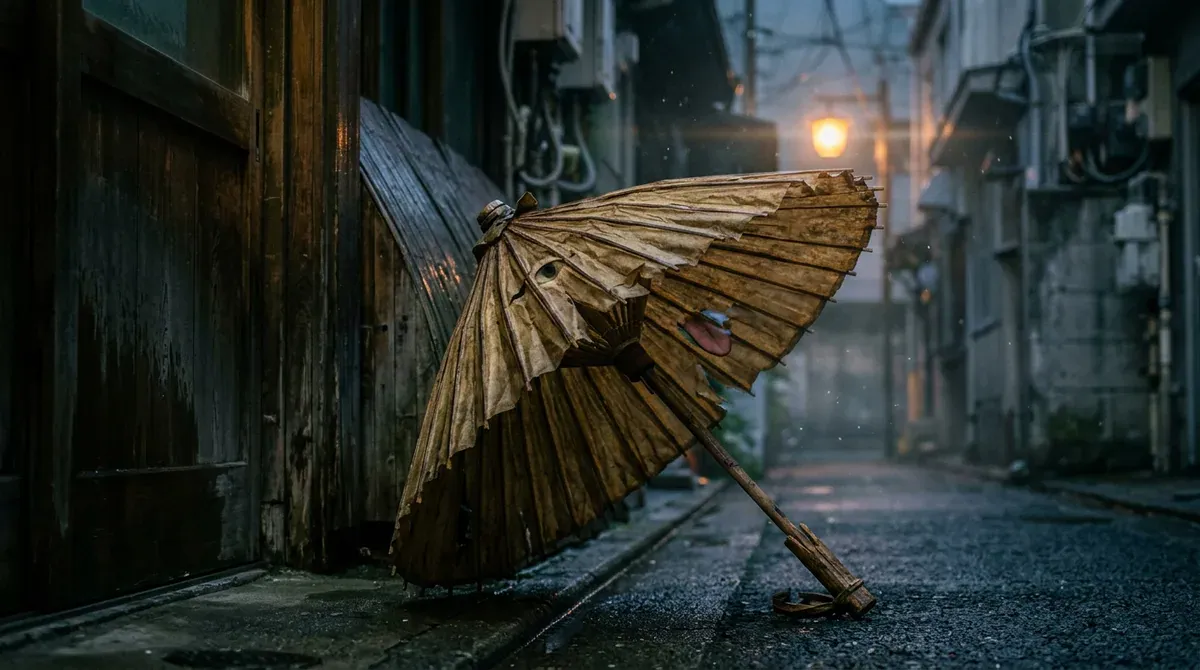
Several named yokai joined the object parade during the Edo period, and the most famous is the kasa-obake, an umbrella spirit usually drawn as a one-eyed paper parasol that hops on a single leg with its tongue hanging out. Its name and look became so familiar that many readers today picture it before they picture any real umbrella.
Other household objects soon received names and faces of their own. Artists and storytellers gave them lively personalities that could be recognized at a glance:
- Chōchin-obake, paper lanterns with a single eye, a long tongue, or a stretched-out body
- Bunbuku chagama, a tea kettle that sprouts legs and a face, linked in some stories to the shape-shifting tanuki
- Bakezōri, straw sandals that wander off the step and walk on their own
- Tsuzumi and other drums, which had already marched in the older parade scrolls and reappeared with eyes and limbs
The change in mood is what makes the Edo images stand out. The medieval Tsukumogami-ki told of objects that turned on the people who discarded them, and the earliest scrolls showed them as frightening. By the Edo period, depictions of tsukumogami had become far more common, and many were playful rather than menacing. A discarded umbrella could still be strange, but it was just as likely to be clumsy, cheeky, or silly, and that shift in tone helped the figures reach a wider audience.
Print made that audience possible. Woodblock prints and illustrated books could be copied and sold across the country, so a single drawing might reach readers far from the city where it was first made. Toriyama Sekien produced illustrated catalogues of yokai that gathered creatures and objects into orderly collections. Each entry paired a picture with a name, and the pages invited readers to browse, compare, and linger over the strange creatures.
Those catalogues did more than entertain. They helped fix the names and appearances that later readers came to expect, so the one-eyed umbrella in a book could be recognized in a theater, a toy shop, or a modern museum. When a later artist draws a kasa-obake, the design often traces back to the patterns that print culture repeated for generations.
The Edo images raise a question that the medieval tale does not answer. Did the laughter make the objects less threatening, or did it simply give them a different kind of power, one that lived in the reader’s imagination and kept coming back? The answer may depend on whether a viewer sees the grinning teapot as a joke or as a quiet reminder that everyday things have been watching all along.
Is the Tsukumogami Tradition Documented or Reconstructed?
The tradition is firmly documented at its core, but much of the wider picture is reconstructed from a small set of texts and paintings. Surviving manuscripts and scrolls, including the medieval tale and its copies, are the strongest evidence that the story, its plot, and its images existed. Many other links, such as the idea that ordinary household items were widely believed to hold spirits, are interpretations built on those sources rather than direct records of everyday belief.
Scholars urge caution about how far the tale can be pushed. Tsukumogami-ki was written for entertainment and moral instruction, so it cannot stand in for the views of every household across several centuries. Treating it as proof of a single, timeless Japanese animism flattens a long and varied history into one neat belief. Readers who hear that “the Japanese have always believed” objects wake up should ask which document, painting, or performance supports that claim.
The story’s background draws on both Shinto and Buddhism. Shinto has long held that kami can dwell in natural places and in made things, which gives the idea a foundation of respect. A long-used object was not simply junk, and the tale’s anger at discarded tools reflects that expectation of care. Buddhism shapes the ending. The idea of salvation means that even a rejected object can be taken into religious service and reach Buddhahood through Shingon teaching, turning a story of resentment into one of redemption.
Belief in yokai itself appears to have shifted over time, moving from fear of the unseen toward enjoyment of stories and images. That change helps explain why the grim specters of the early scrolls later became the playful figures of Edo prints, though it is only one reading of a long and uneven history.
Modern readers meet tsukumogami in very different settings. Horror films and games often turn animated objects into threats that hunt the living, while picture books and character designs present them as clumsy, cheerful companions. The medieval moral was a warning that neglect breeds resentment, and that lesson is easy to see in a haunted-house story. The whimsical versions seem to forget the warning and keep only the wonder.
Which version feels closer to the original? Read the tale’s ending, where the tools repent and find a purpose, beside a modern scary story and a cheerful cartoon. Each one keeps a different part of the old idea, and the question is which part a reader finds most convincing.
Why Are Tsukumogami Showing Up in Modern Culture?
Tsukumogami now appear in modern culture as lively, playful figures in exhibitions, animation, and games. The most visible recent example is the YOKAI Immersive Experience Exhibition TOKYO, which ran from March 27 to June 28, 2026, at the Warehouse TERRADA G1 Building in Shinagawa. It presented tsukumogami alongside other yokai through 3DCG, projection mapping, and holographic screens, so visitors walked through rooms where painted creatures seemed to shift and glow.
Admission was sorted by age and timing, according to HITOHATA, the company behind the show. The published prices were:
- Advance adult ticket: ¥2,400
- Same-day adult ticket: ¥2,600
- Student ticket: ¥1,600 to ¥1,800
- Child ticket: ¥700 to ¥800
The tiers reward planning ahead while keeping the show affordable for families and students. Ticket prices alone do not reveal how the public responded, so the organizer’s figures are useful. The exhibition organizer reported more than 30,000 visitors during the run. The show also won Gold in the Exhibition Experience category within Experiential & Immersive at the 2026 MUSE Creative Awards.
Anime, manga, and video games have also taken the idea and remade it. Creators often give a worn-out teapot or a battered umbrella a face, a voice, and a personal history, then send it on adventures or into danger. Some stories keep the sense that neglect creates resentment, while others turn the objects into loyal companions. These works borrow the tsukumogami concept, but they are modern creations, not medieval sources.
The difference matters for readers. The exhibition, the award, the visitor count, and the anime characters all belong to the present day. The Tsukumogami-ki text and its scrolls belong to the medieval world. A modern display can make a teapot feel alive for an evening, but it cannot tell us exactly what medieval audiences believed about old household goods.
Looking at Your Own Old Teapot Differently
Start with the object closest to hand. If you have a teapot, kettle, or tin tray that has been in your home for decades, write down what you know about it: who first owned it, how often it was used, and whether anyone repaired it. Then count the years. Many families can trace an object back several generations, and that history is often enough to make it worth keeping.
Next, try a small version of the old year-end ritual. Before you throw out a worn kitchen tool during your next cleaning, hold it for a moment and ask whether it still does its job. The Tsukumogami-ki tale turns on tools that were discarded without a second thought, so that pause is the modern echo of its lesson.
For a more playful step, sketch your teapot as if it were a character in an Edo-period print. Give it one eye, a long tongue, or a pair of legs, then notice how your feelings about it shift. Does it seem comical, unsettling, or simply like a quiet companion that has watched your household for years?
Finally, compare your sketch with a modern cartoon and with a haunted-house story. Decide which version your teapot seems to prefer, and then judge for yourself where the line between an ordinary object and a spirit should fall.
Frequently Asked Questions
1. How does the nearly century-long threshold compare with how long objects last in modern homes?
Modern households usually replace kitchen tools and small appliances well before they reach a century of use, so the nearly century-long threshold is rarely reached today. Many items are upgraded within a few years, while a wooden tub or cast-iron kettle in a traditional home might be repaired and handed down for generations. The threshold works more as a symbol of long, careful use than as a practical measure of how long an object lasts.
2. Where can readers see the Tsukumogami emaki or its manuscript copies today?
A university rare-materials archive in Kyoto holds a catalog record for a two-volume Tsukumogami emaki manuscript copy, which readers can browse online. The sixteenth-century Type A two-scroll manuscript is kept at Sōfukuji in Gifu Prefecture. Visitors planning a trip to see either manuscript should contact the holding institution in advance.
3. Which yokai are most often confused with tsukumogami, and how can readers tell them apart?
Readers often mix tsukumogami with other object-based yokai, since both appear in Edo prints and parade scrolls as household items with faces and legs. The key test is origin: a tsukumogami is an everyday container, tool, or instrument that gained a spirit after long use. Yokai such as oni or kappa were never everyday objects, so checking whether a creature began as a household item usually settles the question.
4. Did the 2026 Tokyo exhibition offer group or family pricing, and is it still open?
The published ticket tiers for the YOKAI Immersive Experience Exhibition TOKYO covered advance and same-day adults, students, and children. Anyone interested in group or family packages should check the organizer’s official channels for bundled options. The exhibition ran from March 27 to June 28, 2026, in Shinagawa.