Jiangshi Folklore: The Hopping Corpse From Qing Graves to Hong Kong Screens
Jiangshi folklore describes a stiff, hopping corpse from Chinese tradition. Its name literally means “corpse,” even though it is often translated as “vampire.” Its roots run deep into Qing dynasty tales, where storytellers linked the creature to unburied dead, a problem concentrated in the Jiangnan region of southeastern China.
By the 18th century, families there often practiced delayed burial, known as tingzang, while they searched for a suitable grave site. The Qing government preferred anzang, a timely burial in earth, yet the gap between that ideal and daily life left many bodies waiting. Those old anxieties about the dead later found new life on screen. In Mr. Vampire (1985), a film that runs 96 minutes, the hopping corpse helped launch a popular film cycle.
Key Takeaways
- Jiangshi literally means corpse, yet the creature is often translated as vampire even though the two share surprisingly few traits, such as a Western vampire’s seduction and blood feeding versus a jiangshi’s stiff, hopping body.
- The jiangshi grew out of Qing dynasty fears about unburied dead in the Jiangnan region of southeastern China, where families practicing delayed burial known as tingzang left many bodies waiting for a grave by the 18th century.
- Mr. Vampire, directed by Ricky Lau and released in 1985 with a running time of 96 minutes, helped spark a vampire film craze in Hong Kong and a jiangshi craze in Japan.
- Hong Kong cinema turned the hopping corpse into a fast, funny action figure, and games such as Darkstalkers, which ran from 1994 to 2022, later let players control a jiangshi’s stiff leaps directly.
Where Did the Hopping Corpse First Appear?
The hopping corpse first appeared in older strange tales from China and took a more fixed shape during the Qing dynasty, when storytellers tied it closely to the unburied dead. Its name, jiangshi, literally means “corpse,” a plainer and more revealing clue than the label most English readers meet first.
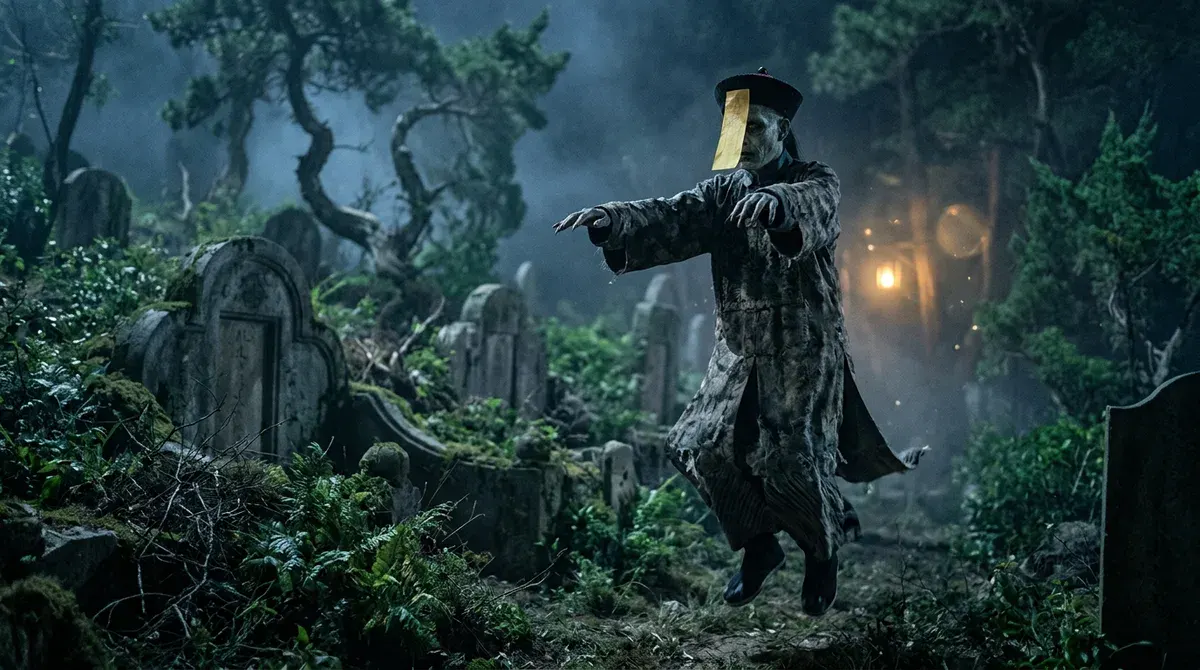
That label is where confusion begins. Jiangshi is often translated as “vampire,” yet the two creatures share surprisingly few traits. A Western vampire typically seduces its victims and feeds on blood. A jiangshi, by contrast, is usually a stiff, rotting body that hops forward with outstretched arms and is said to drain the life energy of the living. Calling it a Chinese vampire can hide a history that grew out of the country’s own burial customs and fears.
The figure did not arrive fully formed. Early tales offered brief, uncanny glimpses of corpses that refused to rest, and over time those glimpses gathered into recognizable patterns. Qing writers gave the creature its clearer outline, so hopping, stiffness, and the threat of a body left above ground became part of its identity.
Scholars therefore read the jiangshi as a shifting set of literary and popular portrayals, not as one belief held the same way by every Chinese community. A storyteller in one region, a magistrate worried about graves in another, and a later audience far from either may each have pictured the creature differently. The stories rarely agree on every detail, and that inconsistency is part of what keeps the hopping dead so unsettling.
Why Did Unburied Corpses Become Monsters?
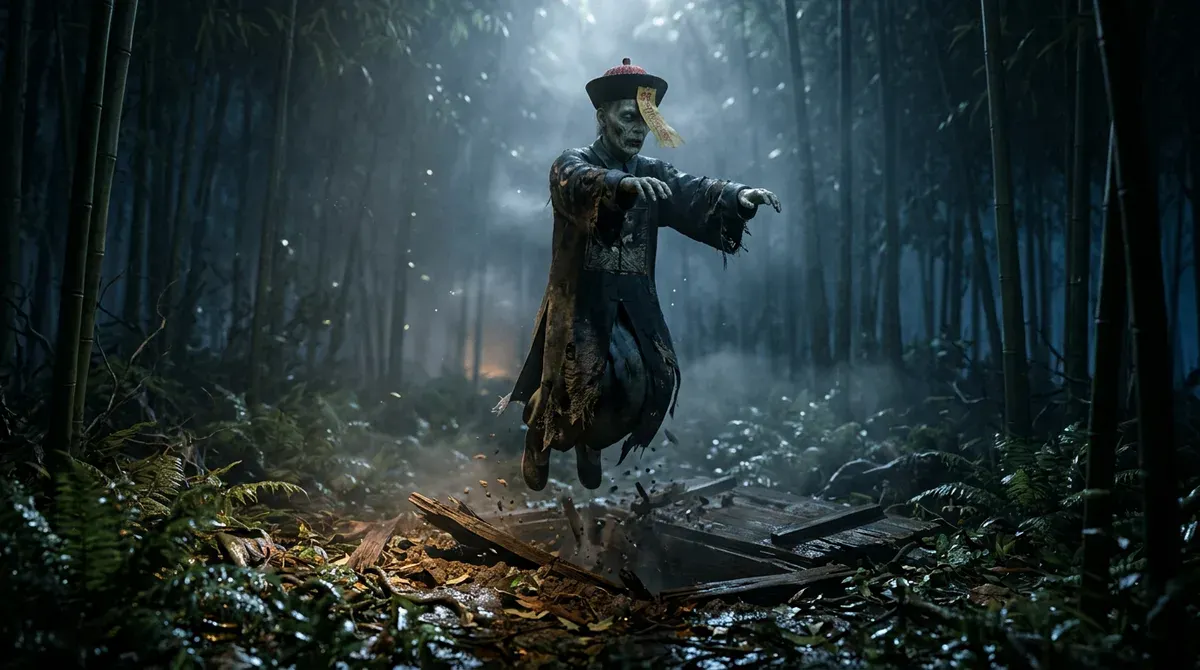
Unburied corpses became monsters in the Qing imagination because a body left above ground seemed to belong neither to the living nor to the dead. Qing popular tales described such corpses as jiangshi, and the problem was concentrated in Jiangnan, the crowded river and lake region of southeastern China. Research on the period reports that these unburied bodies multiplied there in particular.
The roots of the problem lay in ordinary life rather than in any single belief. By the 18th century, delayed burial, known as tingzang, had become common in Jiangnan as families spent long stretches searching for a suitable grave site. Land was limited, and a respectable plot was often hard to secure. A coffin might wait in a temporary place while relatives looked for ground that suited their needs.
The Qing government preferred anzang, a proper burial in which the dead were placed in earth in a timely manner. Between that ideal and the crowded reality of the region, a steady number of bodies lingered outside the ground. For a community already uneasy about whether the dead had found rest, a coffin that waited too long could feel like a warning.
Storytellers took that unease and gave it a shape. A corpse that could not be laid to rest was imagined as a corpse that might rise, and the hopping figure became a way to picture what happened when the proper order of death broke down. Fear of scarce land and failed burials slowly merged with fear of the dead themselves.
It is easy to blame the corpse. The harder question is who the stories were really warning.
What Makes a Jiangshi Hop and Count Rice?
Jiangshi hop because, in the popular telling, a corpse stiffens after death and can no longer bend its knees. It springs forward on rigid legs with its arms stretched out in front. Hopping is the creature’s most recognizable trait, and storytellers kept it because a body that will not bend looks deeply wrong.
Most tales gather a few signature details into one picture of the creature:
- Stiff limbs that force a hopping gait
- Outstretched arms held straight ahead
- Yellow paper talismans that can halt it
- A fondness for counting grains of rice
Taoist priests were usually the people called to deal with a jiangshi. In the stories, a master would press a talisman, often a strip of yellow paper marked with red writing, onto the creature’s forehead to freeze it in place. Some tellers describe priests who guided a wandering corpse home across the countryside, as if it were a traveler who had lost its way.
Another belief holds that a jiangshi cannot resist counting. Rice scattered on the ground, or sticky rice placed before it, was said to hold the creature’s attention until it had counted every grain. Some tellers tie this to the wandering habit, since a mind fixed on counting would have no time to roam. Others see it as a way for the living to buy time until dawn.
Many depictions also dress the creature in the long robes and tall hat of a Qing-era official. That choice gives the corpse rank and authority. It makes the figure look less like a poor soul left unburied and more like a powerful man who refuses to lie down. Why would storytellers choose a dead official as their monster?
How Did Hong Kong Cinema Reshape the Jiangshi?
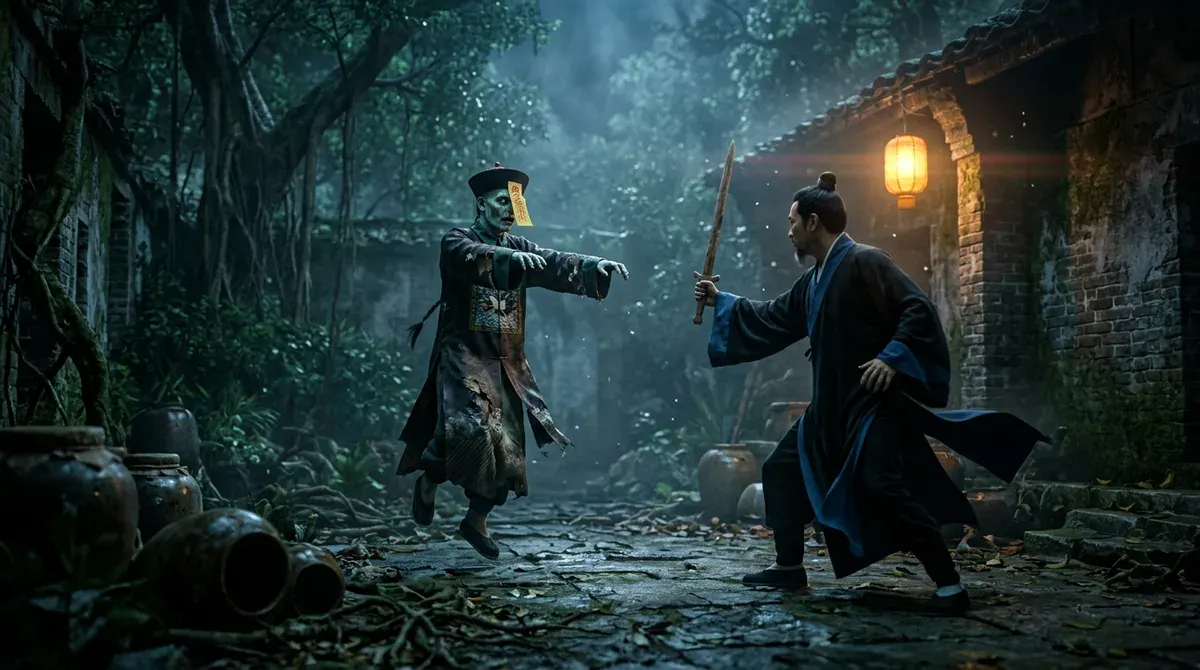
Hong Kong cinema reshaped the jiangshi by carrying an old village fear onto the big screen and turning it into a fast, funny, action-packed spectacle. The dread of corpses that refused to rest became entertainment that audiences could cheer, laugh at, and argue about afterward.
The Xiangxi folk legend of corpse driving, in which bodies were said to be led home across the countryside, became a recurring motif in Hong Kong films. A 2012 Hong Kong government release describes the legend as a story that kept returning to local cinema. It notes how the motif gave filmmakers a ready-made supernatural hook.
The Shadow Boxing, released in 1979, is described as a pioneer that inspired the wave of Hong Kong vampire films that followed in the 1980s. It showed how a tale rooted in rural belief could hold the attention of a crowded city.
Filmmakers then blended those folk tales with comedy and martial arts. The mix proved so appealing that it started a new trend in vampire movies across Asia, and the hopping corpse became a fixture of the genre.
Over time, a set of conventions took hold. Martial arts fights, slapstick jokes, and Taoist magic such as paper talismans and skilled priests became standard on screen. The hop itself turned into the creature’s signature move. Audiences came to expect every element, and the stiff, leaping body grew more playful with each film.
Did the comedy make the corpse less frightening, or did it simply give an old fear a brand-new audience?
Did Mr. Vampire Start a Jiangshi Craze?
Yes. Mr. Vampire (1985), directed by Ricky Lau, inspired a fad of vampire movies. A Hong Kong Film Archive account shown in a National Film Archive of Japan program states that it also helped spark a jiangshi craze in Japan. The hopping corpse, once a village fear, had become an export.
The film did not appear out of nowhere. The Spiritual Boxer II (1979) and Encounters of the Spooky Kind (1980) are considered its cinematic precursors. Both mixed ghostly scares with martial arts and gave filmmakers a template to follow.
Mr. Vampire runs 96 minutes, a lean length that left room for kung fu, slapstick, and eerie night scenes. ACMI reports that four sequels followed, all directed by Lau himself. The series is generally dated from 1985 to 1992, a span that shows how long the craze held its grip on audiences.
Each new entry leaned on the same ingredients: comedy, Taoist priests, paper talismans, and a hopping corpse that was more playful than frightening. The formula kept the jiangshi recognizable even as the stories grew wilder, and it gave later filmmakers a set of props they could reuse.
Was it the monster or the mix that made audiences return? A single comedy turned an old burial worry into a pop-culture icon. It also raises the question of whether the fear faded or simply found a more entertaining way to be remembered.
From Rigor Mortis to Video Game Hero
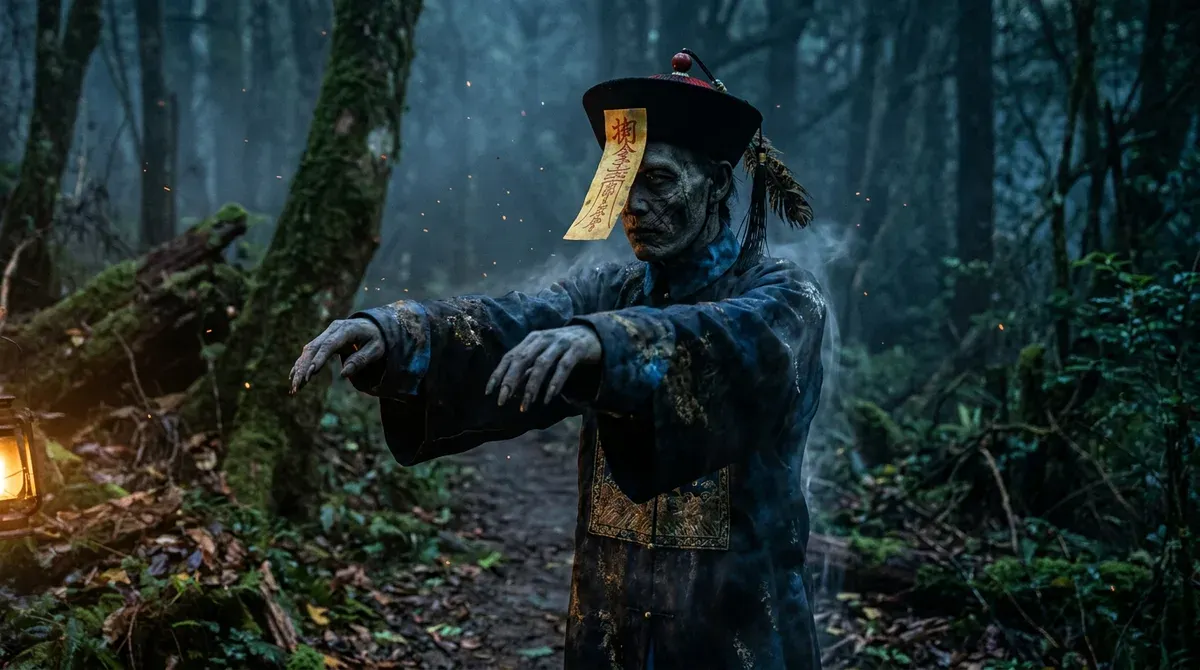
Rigor Mortis, a 2013 film, showed how far the hopping corpse had traveled from village tales. It won Best Supporting Actress and Best Visual Effects at the 33rd Hong Kong Film Awards, and the Smithsonian National Museum of Asian Art notes that the film earned more than HK$10 million.
Games carried the creature even further. Darkstalkers, a fighting game series that ran from 1994 to 2022, gave Western players a jiangshi they could control directly, with its stiff leaps and outstretched arms turned into attacks. Overwatch, which ran from 2016 to 2022, introduced the figure to a new generation of online players.
The tabletop role-playing game Jiangshi: Blood in the Banquet Hall, released in 2022, went a step further. Instead of watching a corpse hop across the screen, players sit around a table and decide how their characters will face it. The creature becomes a story they shape together.
Each step moved the figure away from its origins. In the Qing stories, a jiangshi warned that burial had gone wrong, a message tied to crowded land and anxious families. On screen it became a comic opponent, and in games it became a challenge to beat. The burial worry faded into the background while the spectacle moved to the front.
Does a playable corpse still carry the old warning, or has the hopping dead simply become a new kind of hero?
Is the Jiangshi Really Just a Chinese Vampire?
No, the jiangshi is not simply a Chinese vampire, though the comparison is easy to understand. Scholars caution that the label can hide a separate history, one that grew out of burial practice rather than a hunger for blood. The creature seems to reflect deep anxieties about how the dead were treated, especially when land was scarce and families struggled to secure a grave. A coffin waiting in a temporary spot may have seemed like an unfinished duty to the living, and a stiff body rising from the ground gave that unease a face.
Yet the picture was never uniform. Different regions, storytellers, and generations told the figure in different ways, so no single jiangshi was recognized by every Chinese community. A folklorist may read these tales as social commentary, while a listener in a village after dark may have taken the danger quite literally. Both readings can sit side by side without canceling each other out.
That leaves an open question. How much of the modern image came from what people genuinely believed, and how much came from the films that turned the hopping corpse into a comic hero? The yellow talismans, the rice, and the Qing robes may have come from village tradition, or they may have been polished by filmmakers who needed a reliable set of props. Where would you draw the line?
Where Your Own Jiangshi Story Begins
Start with the screen, then work backward toward the graves. Watch Mr. Vampire (1985) on a quiet evening with a notebook nearby. Note when the hop first appears, when the yellow talisman comes out, and when the comedy takes over. Then watch one of its four sequels and track which details repeat and which change.
Next, test the older story against the newer one. Ask whether a coffin waiting in a temporary spot in Jiangnan would have frightened a Qing family more than a wandering stranger would have. Your answer will show how much of the modern image still rests on the burial worry that shaped the first tales.
For a different angle, try a playable version. Darkstalkers lets you control a jiangshi’s stiff leaps directly, while the tabletop game Jiangshi: Blood in the Banquet Hall asks a group to decide how their characters will face one. Notice which version keeps the old sense of unease and which version trades it for a challenge.
Then compare your findings with other readers. Explore our other posts on Chinese ghost stories and funeral customs to see whether the same anxieties about the dead appear in other traditions. Finally, share your favorite jiangshi scene in the comments. Did the monster scare you, make you laugh, or make you wonder about the dead?
Frequently Asked Questions
1. What is the Japanese word for jiangshi, and how did it spread beyond China?
In Japan the creature is usually called kyonshi, a katakana rendering of the Chinese term. Its spread there came largely through film, and Mr. Vampire (1985) helped spark a jiangshi craze in Japan.
2. What is corpse driving, and how does it connect to the jiangshi?
Corpse driving is a folk legend from the Xiangxi region in which the bodies of people who died far from home were said to be led back to their hometowns. Its image of a wandering body guided across the countryside resembles the jiangshi’s own habit of traveling. This is why filmmakers in Hong Kong later adopted it as a recurring motif.
3. Which Mr. Vampire film should a newcomer watch first?
Start with the 1985 original, which Ricky Lau directed and which runs 96 minutes. It sets up the main ingredients of the series, including the hopping corpse, Taoist priests, paper talismans, and comedy, so the four sequels make more sense after you have seen it.
4. How do Taoist talismans in jiangshi stories differ from real religious practice?
In films and folk tales, a single yellow paper talisman can freeze a corpse in place, which makes the charm work like a weapon. In real Taoist practice, talismans are written and used within ritual ceremonies meant for protection, healing, and honoring the spirit world, rather than as tools for stopping a monster.