The Oera Linda Manuscript: Ancient Chronicle or Nineteenth-Century Hoax?
The Oera Linda manuscript first surfaced in the Netherlands in 1867, presenting itself as a medieval copy of much older records. Its text claims to recount Frisian history from 557 BC to 1256 AD, and it dates its own copy to the thirteenth century.
The first Dutch printed edition followed in 1872, and by 1876 an English version had appeared that openly acknowledged the book’s authenticity was in dispute. Early linguists found that its language did not match Gothic, Anglo-Saxon, or Old Frisian, and later scholarship has argued that its script and paper point to a modern fabrication. Still, the book keeps drawing readers, and the tension between its bold claims and doubtful origins is where this story begins.
Key Takeaways
- The Oera Linda manuscript first surfaced in the Netherlands in 1867, claiming to record Frisian history from 557 BC to 1256 AD, but its origin remains disputed.
- Jan Beckering Vinckers concluded in 1876 that the Oera Linda manuscript could not be Old Frisian, since its language matched neither Gothic, Anglo-Saxon, nor Old Frisian.
- Goffe Jensma’s doctoral thesis, published at the University of Groningen in 2004, found that the Oera Linda manuscript uses pseudo-runes and paper produced after 1850, pointing toward a nineteenth-century origin.
- The Oera Linda Foundation’s revised Codex Oera Linda edition, which runs to 352 pages and includes colour reproductions of all 190 manuscript pages, lets readers compare the original handwriting with the translation.
- Readers who want to judge the evidence should examine the custody of the Oera Linda manuscript before Cornelis Over de Linden IV donated it to the Frisian provincial library in 1938.
A Medieval Chronicle That Claimed to Remember Frisian History
The Oera Linda manuscript does not present itself as a modern invention. It calls itself a chronicle, a record kept and copied by hand across generations. It describes a Frisian people who lived under their own laws, reckoned time by their own calendar, and remembered a past far older than the Middle Ages. Its story runs from 557 BC to 1256 AD, and its pages are arranged as dated entries, the same form used by the annals that monks and town clerks kept throughout medieval Europe.
For early readers, that format mattered as much as the content. A chronicle looks like an archive rather than a storyteller’s tale, and its entries seemed to record events as they happened. The legends it contained, with their sea kings, sacred places, and ancient disasters, were not the sort of material found in the standard histories of the region. For readers who knew Frisian folklore only as scattered oral stories, the book seemed to fill a gap.
Yet the claim rests on a fragile foundation. Historians usually test a chronicle against other documents written in the same period, and the Oera Linda text stands largely alone. Its original sources are never produced, and its older records exist only as the book describes them. Scholars writing in BMGN – Low Countries Historical Review have treated the text as a document to be examined closely, not simply believed. That examination is where the real story begins, because a chronicle is only as trustworthy as the evidence behind it.
Where Did the Oera Linda Manuscript Come From?
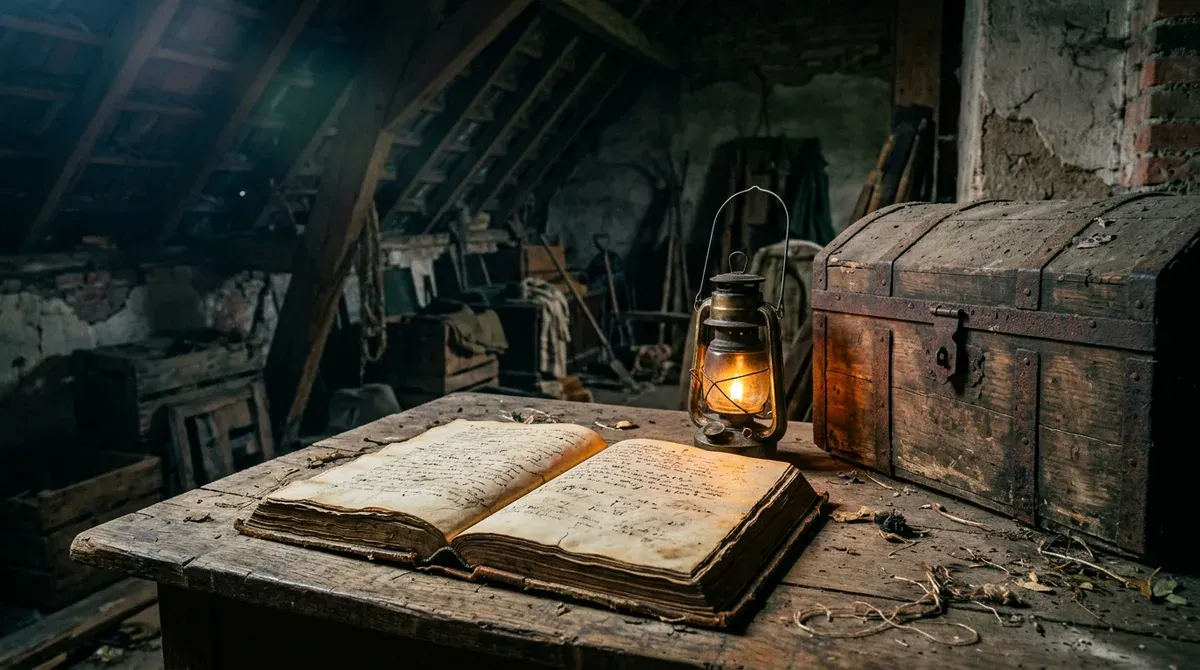
The Oera Linda manuscript is linked to the Over de Linden family. The Oera Linda Foundation says Cornelis Over de Linden IV donated it to the Frisian provincial library in 1938. The foundation was founded on 14 December 2020 to promote research, translations, and publications about the book, and its account treats the 1938 gift as the manuscript’s formal entry into a public collection. In that telling, a private family heirloom became a document scholars could study openly.
Before 1938, the trail becomes much harder to follow. The family’s account describes a book handed down through several generations, but the names, dates, and households of those earlier owners are difficult to confirm through independent records. Readers are asked to accept much of the chain on trust, and that trust is exactly what the debate hinges on.
The family story also raises an uncomfortable question. Goffe Jensma’s account names Cornelis Over de Linden not only as an owner but also as the scribe who copied the text. A family that copied its own book is a different kind of witness than a family that simply kept it safe.
Historians test a document’s custody the way a detective tests an alibi. Each step that cannot be checked leaves a gap, and the Oera Linda book has several. A 1938 donation tells us when the book reached a library. It does not tell us when the words were written, who first wrote them, or what they were meant to record.
How the Text Reached Print and English Readers
The first printed edition, Thet Oera Linda Bok, appeared in the Netherlands in 1872, and its text soon reached readers well beyond the country’s borders. Dr. J. O. Ottema then produced a Dutch translation of the manuscript, and that rendering became the basis for the versions that followed. The original 1872 edition is still available through the Digital Library for Dutch Literature.
William R. Sandbach later turned Ottema’s Dutch version into English, and his 1876 edition can still be read online through Project Gutenberg. Sandbach did not present the chronicle as settled fact. His edition openly acknowledged that the book’s authenticity was disputed, so English readers met the question of origin before they met the Frisian past.
That candor suggests the doubts were not a later invention. The English translator recorded that questions about the text were already in circulation when his edition appeared, which means the controversy was part of the book’s public life from the very beginning.
Critics were quick to respond. In the same year, Jan Beckering Vinckers published a critique that tested the manuscript’s language against the scholarly standards of his day, and a Library of Congress study of nineteenth-century Dutch philology places his work within that debate.
Why would a translator announce doubt about the very book he was introducing to a new audience? Was it an act of honesty, a sign that the editors believed the text deserved a fair hearing, or a warning that the story needed to be read with care?
Why Did Early Scholars Question Its Language?
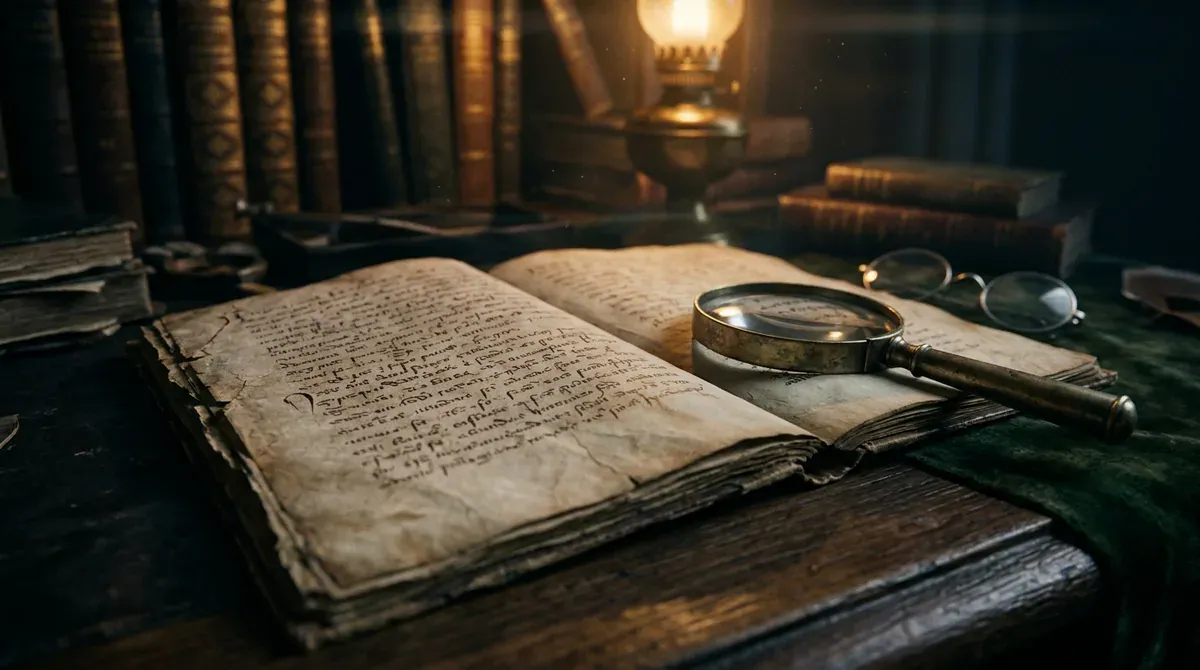
Early scholars questioned the manuscript’s language because its words did not fit the older forms of Frisian that philologists could compare them with. The method was straightforward: place the text beside related languages from the same period and see whether its grammar, vocabulary, and spelling match what survives. In 1876, Jan Beckering Vinckers set the manuscript beside Gothic, Anglo-Saxon, and Old Frisian, the closest relatives of the book’s supposed tongue. Gothic is known mainly from a fourth-century Bible translation, Anglo-Saxon from the Old English written across England, and Old Frisian from a smaller body of medieval legal and other texts. Vinckers concluded that the book could not be Old Frisian.
Such a finding carries weight, but it has limits. Languages change from region to region, and scholars can only compare a new text with the examples that happen to survive, which may be few. A skilled writer who studied those examples could imitate them, so a mismatch suggests the claimed age is wrong without revealing who wrote the book or why.
Even so, language analysis was one of the first serious tools used against the book’s claim to be medieval. It asked a question readers could follow: if this text was really copied in the thirteenth century, why does its speech sound like neither of the languages it should resemble? For many readers in the 1870s, that question made the chronicle’s antiquity look doubtful, and it set the pattern for the arguments that followed.
Was the Oera Linda Book a Nineteenth-Century Literary Hoax?
Goffe Jensma’s research makes the strongest case that the Oera Linda book was a nineteenth-century literary hoax, written by a small group of people rather than copied from a medieval original. His doctoral thesis, published at the University of Groningen in 2004, runs 467 pages and focuses on François HaverSchmidt and the book’s making.
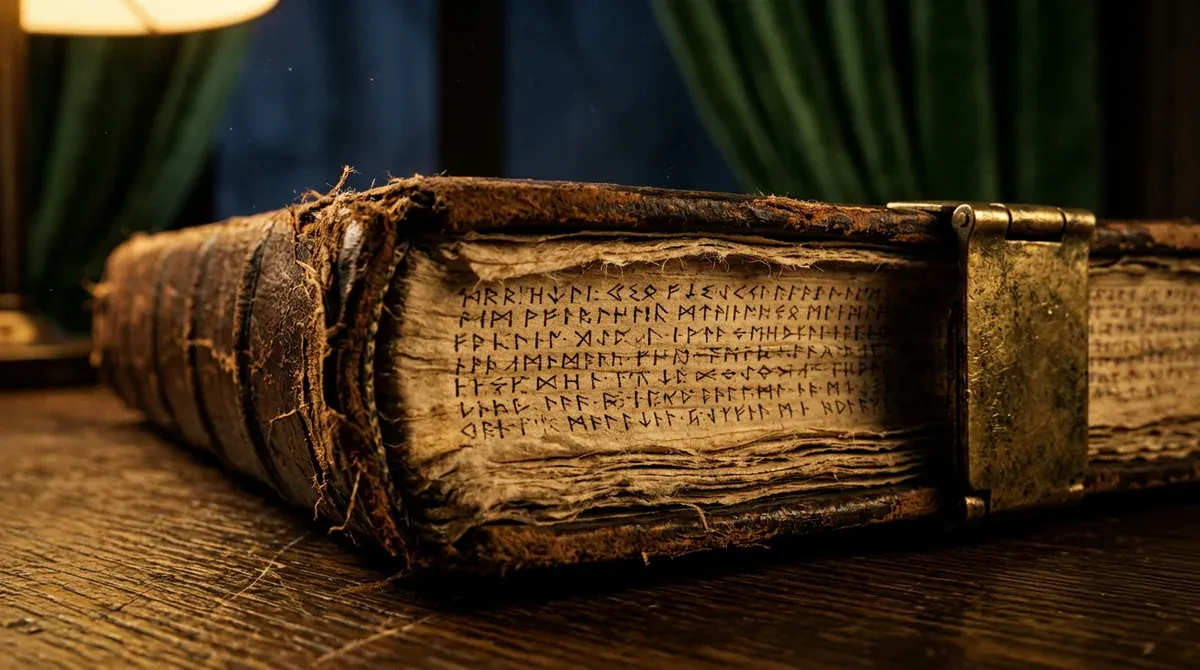
Jensma concluded that the manuscript uses pseudo-runes, invented letter shapes that imitate old runic writing rather than genuine medieval script. He also found that its paper was produced after 1850, decades after the thirteenth-century date the text gives for its own copy. These physical details are why his work is treated as a turning point in the debate.
He identified four contributor roles. François HaverSchmidt, writing under the pen name Piet Paaltjens, supplied the intellectual content as the main writer. Cornelis Over de Linden acted as the scribe who wrote out the pages by hand, while Eelco Verwijs worked as translator and editor, shaping the text for print.
Jensma returned to the material in 2006 with a volume that gave readers a facsimile of the pages, a transcription, and a translation. Its 447 pages, published by Verloren, let readers compare the original handwriting with a modern reading side by side.
The theory still leaves questions open. Jensma’s account explains how a group of writers could have produced the book, but the custody of the manuscript before its 1938 donation remains hard to trace, and the exact share each contributor played is still discussed. Why would a circle of writers invent an entire ancient past, and how far did they expect readers to believe it? Those questions keep the Oera Linda book suspended between deliberate invention and a document that still captures the imagination.
Why the Manuscript Still Draws Readers Today
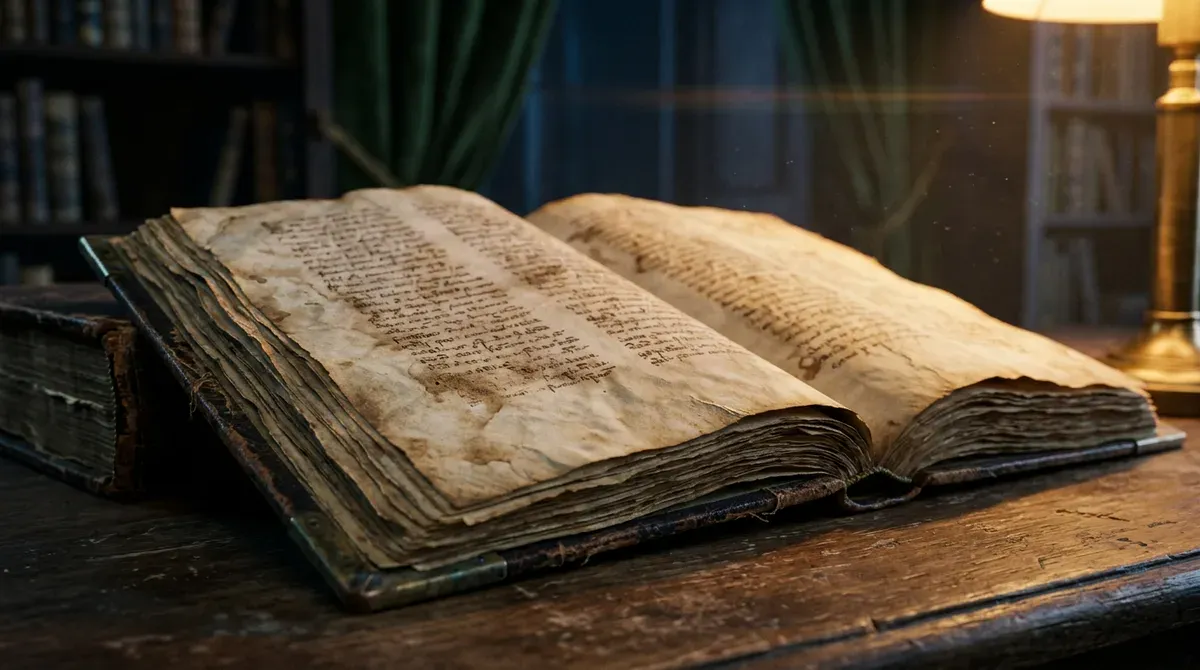
The Oera Linda manuscript has never faded from public view, and part of the reason is that its text is easy to get hold of. The Oera Linda Foundation, founded on 14 December 2020, exists to promote research, translations, and publications about the book. Its revised English Codex Oera Linda edition runs to 352 pages and includes colour reproductions of all 190 manuscript pages, followed by five appendices. For a reader who has never seen the original, that combination offers something rare: the chance to look at the handwriting and the translation on the same page.
The book’s voice adds to its appeal. It speaks like a witness from a distant age, recording sea kings, sacred places, and disasters that struck a coastline the North Sea still reshapes. Stories of drowned lands and vanished peoples have circulated along the Dutch and German coasts for centuries, so a chronicle that seems to come from that buried past feels both familiar and mysterious.
Still, public interest is not the same as scholarly acceptance. The book’s continued circulation keeps readers curious, yet the questions of when the words were written and who wrote them remain open. The English translator of 1876 was already noting dispute, and that dispute has never been resolved in the book’s favour.
Readers can test the question for themselves. Set a reproduced page beside the printed translation and look at the letter shapes that Goffe Jensma described as pseudo-runes. Notice where the translation reads smoothly and where it seems to strain. Which would persuade you more: the age of the handwriting, or the sense of the words?
Reading the Evidence and Forming Your Own View
Start with one dated entry from the early pages of the English translation. Read it slowly and mark every phrase that feels forced, modern, or borrowed from another language. Then ask whether a thirteenth-century scribe would have written it that way, and jot down two reasons for your answer.
Next, find a reproduced page of the manuscript and compare a few letter shapes with the translator’s reading of them. Look for the pseudo-runes that Goffe Jensma described. If your local library holds his 2006 volume with its facsimile, transcription, and translation, check whether the three columns agree. Notice any place where the translation chooses a meaning the letters do not clearly support.
Finally, read one account that defends the manuscript’s age and one that treats it as a nineteenth-century invention. Make two columns in a notebook: what each side shows with evidence, and what it simply assumes. Pay close attention to paper and custody before 1938, since the Frisian provincial library received the book only after its earlier history had passed through several hands.
By the time you finish, you will have a view built on the pages themselves rather than on the legend. Share your findings in the comments, and tell us which evidence you found most persuasive.
Frequently Asked Questions
1. Which English edition of the Oera Linda Book should a new reader start with?
New readers can start with William R. Sandbach’s 1876 English edition, which can be read free online and openly notes that the book’s authenticity is disputed. For a closer look at the original handwriting, the Oera Linda Foundation’s revised Codex Oera Linda edition includes colour reproductions of all 190 manuscript pages across 352 pages, followed by five appendices. Reading the Sandbach text first shows the story in its earliest English form, and the Codex edition lets you check the translation against the pages.
2. What is the difference between the Oera Linda manuscript and Thet Oera Linda Bok?
The Oera Linda manuscript is the handwritten book itself, while Thet Oera Linda Bok is the printed edition that first reached readers in the Netherlands in 1872. The print edition made the chronicle available to a far wider audience than the single handwritten copy could reach. Readers who want to see the original handwriting will need the page reproductions in the Oera Linda Foundation’s Codex edition rather than the 1872 print.
3. Do most historians accept the Oera Linda Book as a medieval source?
No, the Oera Linda Book has not gained scholarly acceptance as a medieval source. Doubts about its language were raised as early as 1876 by Jan Beckering Vinckers, and Goffe Jensma’s later research on pseudo-runes and paper made after 1850 pushed the debate firmly toward a modern origin. Its ongoing popularity with readers does not change that academic position, although questions about who wrote it and why remain open.
4. Can visitors see the original Oera Linda manuscript in person?
The original manuscript is held in the Frisian provincial library collection, which received it as a donation from Cornelis Over de Linden IV in 1938. Anyone hoping to see the handwriting should contact Tresoar, the Frisian heritage institution that holds the collection, before planning a visit, since viewing arrangements can change. The reproduced pages in the Oera Linda Foundation’s Codex edition offer a practical way to study the original script from home.