Night Vision Goggles Compared: Which Type Fits Nighttime Investigations?
A night vision goggles comparison has no universal winner. The U.S. Army’s AN/PVS-14 is a head-mountable monocular that weighs 1.2 pounds with its battery and helmet mount. For an investigator moving through a dark site, hands-free image intensification keeps the view available while walking. A digital day/night scope is designed for viewing through a mounted optic, while a handheld thermal viewer helps reveal heat. These tools detect different signals, so one cannot simply replace another.
That distinction matters more than the word “goggles” on a product label. ATN lists its X-Sight 4K Pro digital day/night scope at $799, with a 5-degree field of view and more than 18 hours of battery life. Those specifications may suit someone observing from a fixed position, but they do not make it equivalent to a hands-free viewer for moving around. The right choice depends on the task: walking and scanning, watching from one spot, recording an observation, or locating warm shapes in darkness. Weight, field of view, battery life, illumination, and recording features can all affect which setup makes sense.
Key Takeaways
- A head-mounted image-intensifier monocular or binocular best supports hands-free movement and scanning, while a digital day/night scope suits fixed observation and recording, and a thermal viewer helps locate warm people or animals.
- The AN/PVS-14 weighs 1.2 pounds with its battery and helmet mount and runs for at least 20 hours on one AA battery, while ATN lists the X-Sight 4K Pro at $799 with 5–20× magnification, a 5-degree field of view, and more than 18 hours of battery life.
- Thermal detection distance describes finding a heat source, not identifying fine details, so the discontinued FLIR Scout TK’s detection distance of over 100 yards should not be compared directly with an image-intensifier’s viewing range.
- Buyers should choose a device based on the planned task, then compare field of view, weight, battery life, illumination, and recording; civilian purchase and international transfer rules depend on the device’s classification and jurisdiction.
Which Night Vision Type Fits Investigations?
There is no universal winner. A head-mounted image-intensifier monocular or binocular suits observation while moving, a digital day/night scope suits viewing and recording through a mounted optic, and a handheld thermal viewer helps detect warm people and animals.
The categories work in different ways. Image intensification amplifies available light to form a visible scene. Digital day/night optics use an electronic sensor and may rely on infrared illumination in darkness. Thermal imaging detects heat differences, so it can reveal a warm figure without showing the same scene details as an image-intensifier device. A fused system combines image intensification and thermal imagery in one view.
| Investigation task | Device that fits | What it helps with |
|---|---|---|
| Moving and scanning a site | Head- or helmet-mounted intensifier monocular or binocular | Hands-free observation while walking |
| Watching from a fixed position and recording | Digital day/night scope | Viewing and capturing video through a mounted optic |
| Finding warm people or animals | Handheld thermal viewer | Spotting heat signatures in darkness |
| Seeing a low-light scene and heat cues together | Fused intensifier-and-thermal system | Combining two kinds of visual information |
A thermal image is not a brighter version of an intensified image. The discontinued Teledyne FLIR Scout TK, for example, used a 160×120 thermal sensor and had a 20°×16° field of view. Its listed detection distance of over 100 yards describes finding people, objects, or animals, not the amount of scene detail it shows. A wide view can help sweep an area, while a narrow view or higher magnification can help examine a smaller portion.
Magnification and detection range do not make devices from different categories directly comparable. A thermal viewer’s ability to reveal a heat source is not the same measure as an intensifier’s view of a dim scene. A scope’s recording ability answers a different need again.
Investigators planning a broader kit can also consult Mysterious Realms’ guide to nighttime investigation equipment. Matching the device to the task first makes comparisons of weight, viewing angle, battery life, and recording features more useful.
Comparing Goggles, Scopes, And Thermal Viewers
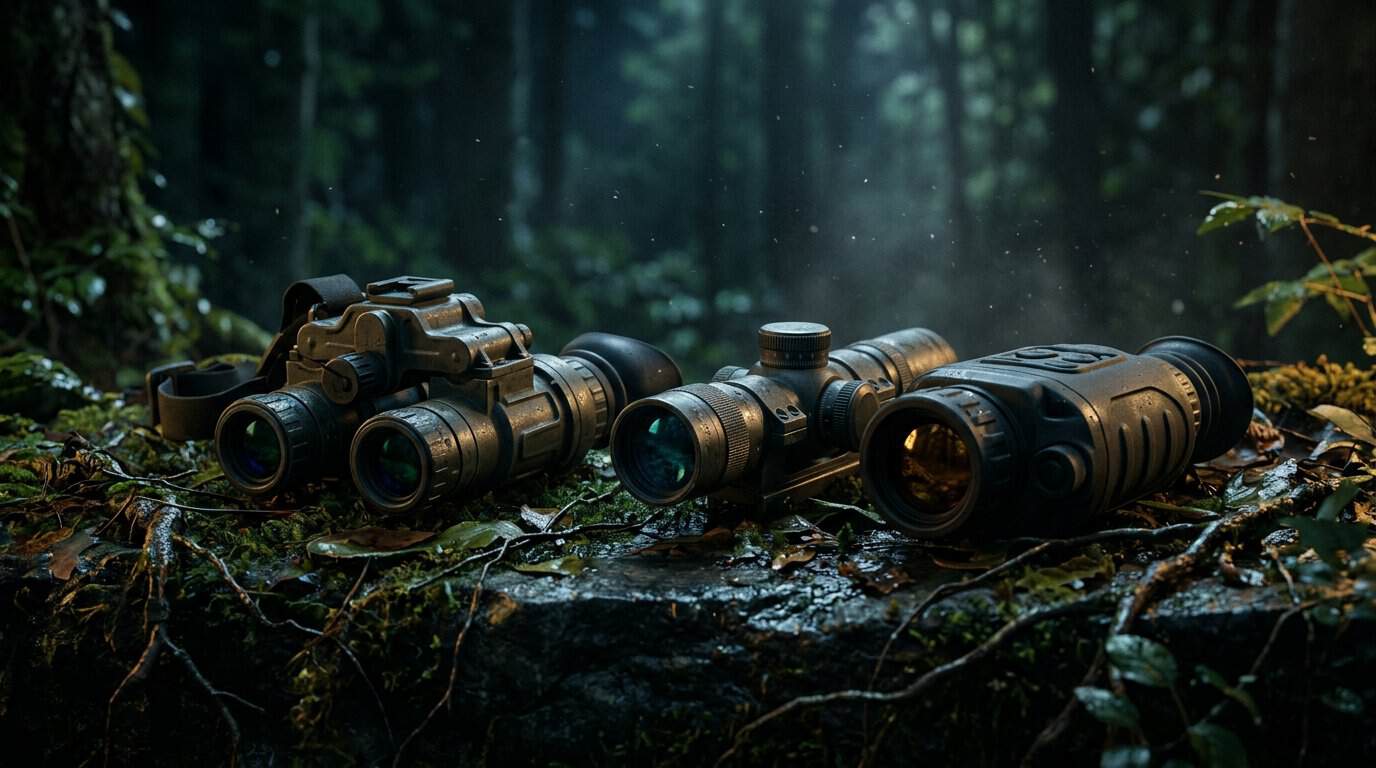
The U.S. Army’s AN/PVS-14 is a head-mountable monocular, not a pair of goggles. Its 1× magnification preserves a natural-scale view rather than bringing distant details closer. The Army lists a 150-meter range, at least 20 hours of operating time, and power from one AA battery. As a head-worn device, it leaves the wearer’s hands free while observing.
ATN’s X-Sight 4K Pro is a digital day/night scope, not a head-mounted viewer. Its variable 5–20× magnification can bring a distant subject closer, but its listed 5-degree field of view is narrow compared with a view designed for broad scanning. The scope records 1080p video and uses a 1280×720 microdisplay. These features support viewing and documentation through the optic, rather than hands-free observation while walking.
An electronic display and video recording may suit an investigator watching from a steady position. The same setup can be awkward when the task requires looking around while moving, because the scope must be held or mounted and viewed through its eyepiece. Magnification also narrows the scene, making it harder to keep a wide area in view.
The Teledyne FLIR Scout TK is a handheld thermal monocular, and the manufacturer lists the model as discontinued. It weighs 6 ounces and runs for more than five hours per charge. Its 20°×16° field of view offers a different way to scan than the ATN scope’s narrow view. Its thermal sensor detects heat rather than producing the same kind of scene image as an image-intensifier device.
The Scout TK’s listed detection of people, objects, and animals at distances over 100 yards (90 meters) describes detecting a target, not necessarily identifying fine details. Its IP-67 submersible rating describes durability in wet conditions, not how much visual information appears on screen. A handheld thermal viewer can help locate a warm shape, but it occupies a hand and does not provide the head-worn view of a monocular.
The numbers answer different questions. The AN/PVS-14’s operating time and AA battery describe endurance and power. The ATN’s recording resolution describes captured video, while the Scout TK’s thermal detection figure describes finding heat signatures. A scope, a handheld viewer, and a head-mounted monocular are not interchangeable goggles. Their form determines whether an investigator can scan while walking, watch through a magnified optic, or point a thermal view toward a suspected heat source.
What Matters Beyond Image Quality?
A useful comparison considers field of view, battery life, weight, illumination, recording, and thermal detection in relation to the task. A wide field of view can help someone walking scan more of the surroundings without continually turning the device. Someone watching from one spot may prefer a narrower view that focuses on a specific area. Battery life matters most when an investigation may run for hours, while weight becomes more noticeable when equipment is worn or carried throughout a search. Illumination and recording serve different purposes. A digital device may need an infrared illuminator to form a view in darkness, so buyers should check whether illumination is included and suits the setting. Recording can document an observation for later review, but it may matter less to someone focused on moving quietly and scanning. Thermal detection can help locate warm people or animals, but it does not provide the same kind of scene detail as image intensification. Numbers only help when the devices are comparable. A handheld thermal viewer’s field of view, a head-mounted intensifier’s weight, and a digital scope’s battery life describe different forms and purposes. The U.S. Department of Homeland Security’s SAVER assessment, revised in January 2024, used 21 weighted criteria and organized its evaluation around capability, deployability, maintainability, and usability.
A person crossing a dark field needs a different setup from someone watching a doorway from a fixed position. A helmet- or head-mounted monocular keeps the image available while leaving both hands free to move branches, use a map, or steady a walking stick. A head-mounted binocular offers the same hands-free arrangement, though its weight and fit still matter during a long search.
The AN/PVS-14 offers one practical reference point: its listed 1.2-pound weight includes the battery and helmet mount, and it runs on one AA battery for at least 20 hours. Those figures help an investigator consider what will be worn on the head and how many spare batteries may be needed, but they do not describe every monocular. Fit and balance matter too. A device that feels manageable while standing may become tiring during a long walk.
A weapon-mounted digital scope suits a different posture. Its magnified view is useful when an observer has a stable position and wants to examine or record a limited area. However, the user must look through the optic rather than maintain a broad, head-directed view while moving. A handheld thermal viewer also occupies a hand. It can sweep for heat signatures, but it does not replace a head-mounted image-intensifier view for navigating the visible scene.
Thermal imaging can add a second kind of clue. An investigator might use image intensification to move carefully and inspect the surroundings, then pause to scan with a thermal viewer if a warm person or animal may be hidden in darkness. The thermal view can help locate a heat source, while the intensified view can help make sense of nearby scene details. Carrying both means planning for the extra device and using it without losing awareness of the surroundings.
Endurance depends on the whole setup, not just a headline battery figure. A head-mounted unit runs while worn, while a handheld viewer may be switched on for targeted checks. Investigators comparing these approaches can read Mysterious Realms’ guide to thermal imaging to learn what a heat-based view can reveal and what it cannot.
Can Civilians Buy Military-Grade Night Vision?
There is no single yes-or-no rule. Whether a civilian may buy or receive a particular night-vision device depends on its classification and the rules in the relevant jurisdiction. The phrase “military-grade” on a product label does not settle the question.
U.S. Munitions List Category XII(c) covers specified binoculars, monoculars, goggles, and head- or helmet-mounted imaging systems with certain advanced features. These include autogated third-generation-or-higher image-intensifier tubes, fused image-intensifier and infrared arrays, or certain military-designed infrared imaging systems. The text of 22 CFR § 121.1 describes the covered equipment. The category does not apply to every device marketed as military-grade. Domestic purchase eligibility is separate from permission to export or transfer equipment internationally.
For international transfers, the Defense Security Cooperation Agency describes two routes: Foreign Military Sales and direct export licensing. Both require case-by-case review under U.S. export policy, as set out in the DSCA policy memorandum. The device’s features and classification matter, as do the countries and parties involved.
Before a transaction, buyers and recipients should check the specific product’s classification and the rules that apply in the relevant jurisdiction. A consumer digital night optic, a head-mounted intensifier, and a thermal or fused imaging system may fall into different regulatory categories. The marketing label alone cannot establish whether a particular sale or transfer is permitted.
The Military’s Shift Toward Fused Views
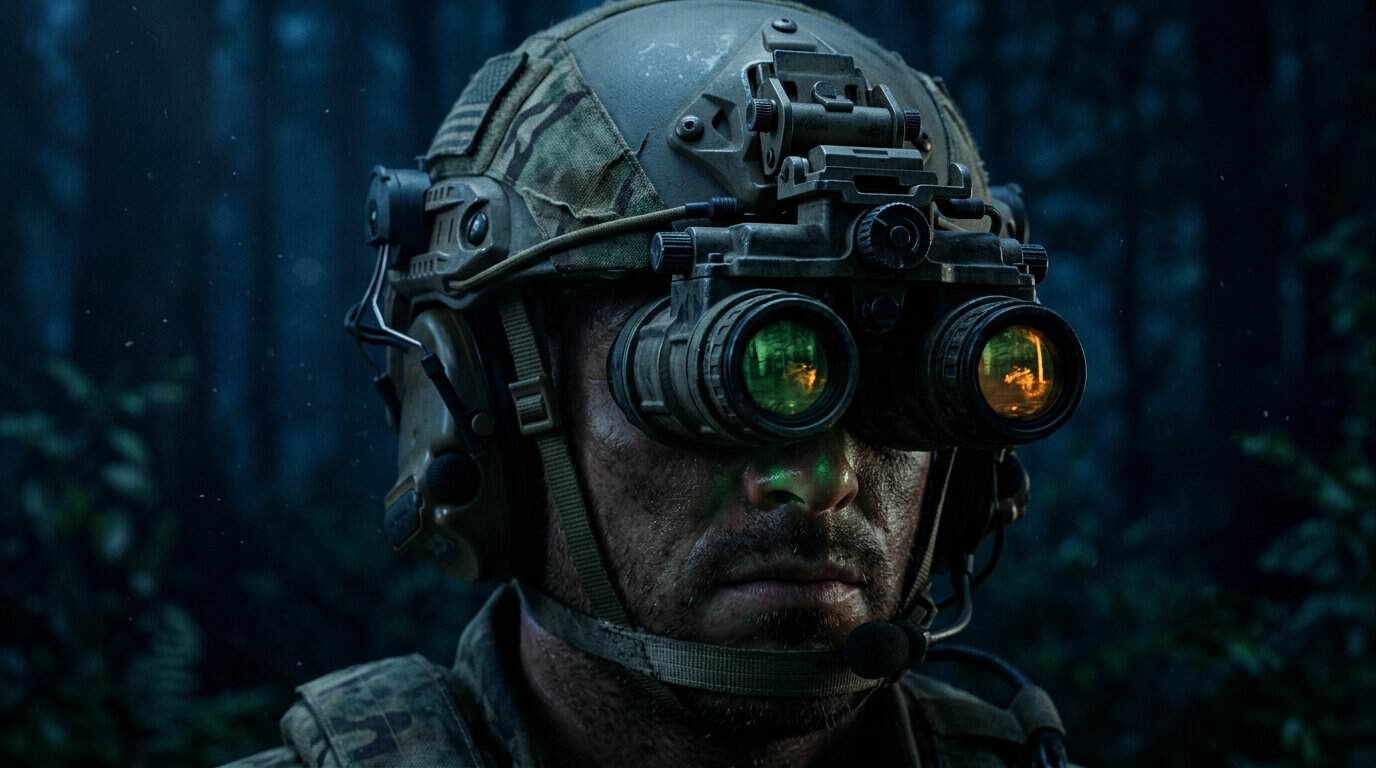
Night-vision systems are moving beyond a single kind of image. The U.S. Army’s 2024 acquisition portfolio lists the Enhanced Night Vision Goggle–Binocular (ENVG-B) as reaching first-unit-equipped and full-rate-production milestones in FY2024. The helmet-mountable ENVG-B can display high-definition images and is designed to operate in low and high light, extreme weather, and battlefield obscurants.
The system reflects a broader move toward combining image intensification, thermal imagery, and connected displays. Image intensification shows a scene using available light, while thermal imagery reveals heat differences. Bringing both into one view can give an observer different clues at once. Connected displays add another layer of information, but may also mean more controls and more to learn.
For a nighttime investigation, added capability is useful only when it solves a real problem. A team searching for a heat source in darkness may value a fused view, while someone documenting a fixed location may not need a helmet-mounted military system. More integrated equipment can also bring higher costs, setup demands, and operating requirements. Readers considering a fused device can ask whether seeing the scene and heat cues together would change how their investigation is carried out. Military equipment such as the ENVG-B shows the direction of the technology, not a default choice for civilian use.
Choose The View That Fits The Search
Before choosing a device, mark the route or observation point for the investigation. A search involving movement between locations points toward a hands-free, head-mounted view. A fixed watch point leaves room to consider a digital scope for observing or recording. A search focused on locating warm shapes points toward thermal imaging. Decide which task matters most before comparing models, rather than expecting one device to cover every need.
Next, shortlist products within that category and check the specifications that affect the planned session: field of view, weight, battery life, illumination needs, and recording features. For a moving search, check how the mount fits and whether the view remains usable as the wearer turns their head. For a fixed station, check whether the scope’s field of view suits the area under observation. For thermal searches, check what the maker means by detection distance, since finding a heat source is not the same as identifying fine detail.
If possible, arrange a demonstration or supervised trial in a safe, familiar setting before committing. Test the controls, fit, and view under conditions similar to the investigation, and confirm that the device’s classification and transfer rules fit the buyer’s location. Which matters most for the next search: moving hands-free, recording a fixed view, or spotting heat?
Frequently Asked Questions
1. Do night vision goggles work in complete darkness?
Image-intensifier goggles need some available light, while a digital night-vision device may use an infrared illuminator to form an image in darkness. Thermal viewers detect heat rather than visible light, so they can reveal warm objects without relying on ambient light.
2. Can night vision goggles be used during the day?
Some digital day/night optics are designed for use during the day and at night, but bright light may damage traditional image-intensifier goggles. Thermal viewers can also be used during the day, though they show heat differences rather than a conventional visible-light scene. Check the device’s instructions before using it in daylight.
3. What is the difference between green and white phosphor night vision?
Green and white phosphor night vision use different display colors to show an image intensified from available light. Green phosphor gives the view a green tint, while white phosphor presents it in shades of black and white. The color changes the display, not the basic image-intensification method.