Greenland Norse Disappearance: Where the Vikings Vanished and Why
The Greenland Norse disappearance is the puzzle of how two farming settlements in southwest Greenland, founded around 985 CE, slowly slipped out of the historical record. The National Museum of Denmark notes that the Eastern and Western Settlements were established at almost the same time, bringing turf-walled homes and grazing animals to a land of ice, fjords, and open sea.
The Western Settlement was largely empty by the mid-14th century, while the Eastern Settlement appears to have lasted into the mid-15th century. The last written mention of Norse life in Greenland is dated 1408, which leaves a long stretch of silence. That silence shows where the paper trail ends, but not how or why the farms emptied. That gap is where the mystery begins.
Key Takeaways
- Lake 578 sediments near Qassiarsuk point to persistent drying beginning around 950 CE, while no sharp cold snap appears in the record.
- Marine foods rose from about 40 percent of Norse diets in the 11th century to more than 80 percent in the final phases.
- The Icelandic Annals record a 1379 attack that killed 18 Greenlanders, yet one account alone cannot explain the colony’s end.
- A 2025 Heritage study interviewed 13 specialists who read the same Norse evidence in different ways.
Who Were the Norse Who Settled Greenland?
The Norse who settled Greenland were Scandinavian farmers who sailed west from Iceland. The name most tied to their arrival is Erik the Red, a restless chief whose story still anchors the colony’s beginnings. Around 985 CE, his people began claiming land along the fjords of the southwest coast, and the Eastern and Western Settlements took root at almost the same time.
The Greenland National Museum & Archives dates the Norse presence from around the end of the 10th century to 1450, with its main farms clustered near Cape Farewell and the Nuuk area. Within that region, Brattahlíð, today’s Qassiarsuk, became a central farm, and the saga tradition places Erik’s own home there.
Life on these farms revolved around turf. Builders stacked sod over stone and timber to make thick walls that held in warmth through long, dark winters. Nearby pastures supported cattle, sheep, and goats, while the fjords offered seals, fish, and other sea harvests that helped families get through lean seasons.
How many people lived in the settlements is still unknown. Estimates vary widely, because the ruins alone cannot show how many people shared each farm at any given time, or how many farms were occupied in the same year. Any single number should be read as a rough guess rather than a count, and that uncertainty shapes every question that follows.
When Did the Norse Settlements Fade Away?
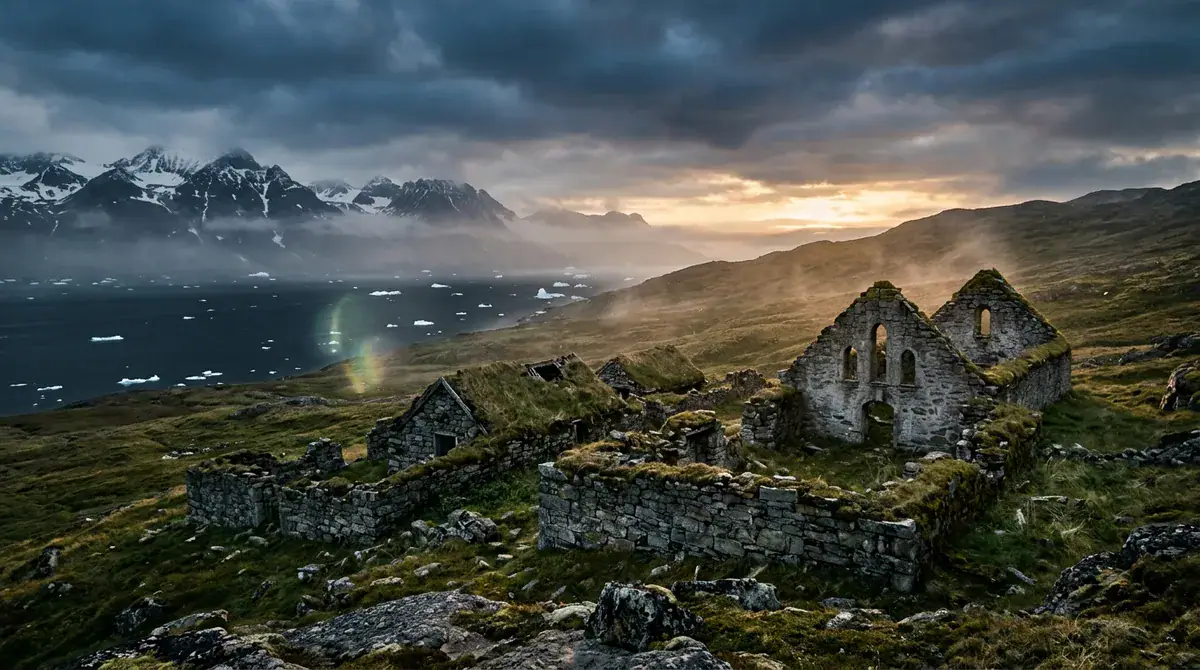
The Norse settlements faded in stages, and the written record went quiet before the ground stopped telling their story. Written sources place the depopulation of the Western Settlement in the mid-14th century. The Eastern Settlement appears in documents a little longer, and its final written trace is dated 1408, after which the records fall silent.
Archaeology tells a different timeline. Evidence from the Eastern Settlement suggests people kept living there until at least the mid-15th century, roughly four decades after the last written mention. That gap is the heart of the puzzle. Greenland’s National Museum & Archives gives the end of the settlement period as 1450 and places its core farms around Cape Farewell and the Nuuk area.
Silence in a written record does not, by itself, show when or how a community ended. A missing entry might reflect distance from the rest of Europe, manuscripts lost over the centuries, or simply a lack of interest in a remote colony. Farms that were abandoned quietly could leave no record at all, while a settlement still in use might also go unmentioned for decades.
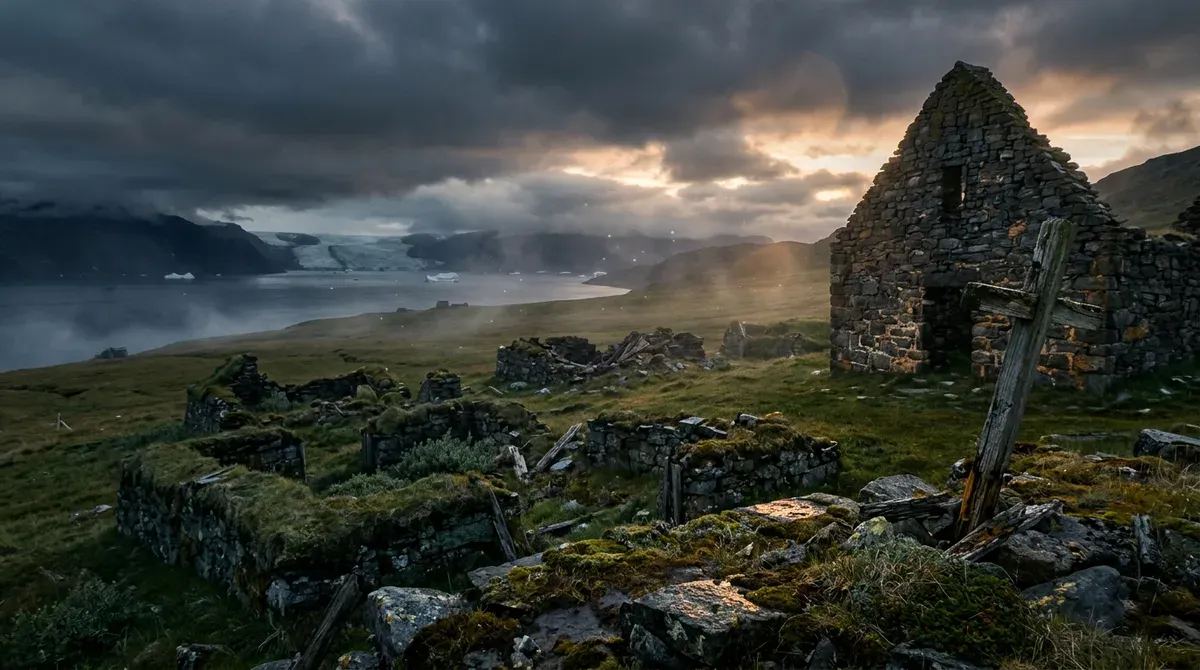
Walking the ruins today, a visitor can see how the record and the land disagree. Turf walls still rise from the grass, and the church and farm sites hold the outlines of daily life. Yet the walls cannot say which year the last family left, or whether they left in a hurry or by slow choice. Reading the gap between the two kinds of evidence is where the investigation starts.
Did Climate Change Drive the Norse Out?
Probably not as a sudden freeze, but a slow drying of the land may have added pressure on farms that depended on grass, water, and hay. A 2022 study in Science Advances examined sediments from Lake 578, collected beside a former Norse farm about 9 km from Qassiarsuk. The sediments record persistent drying beginning around 950 CE, a trend that peaked in the 16th century.
The temperature story looks different. The researchers found no substantial temperature change during the settlement period. Their reconstruction, built from records at roughly 30-year resolution, showed no abrupt temperature decline near the time the farms were abandoned. A sharp cold snap would be expected to leave a clear mark, and this record does not show one.
If climate did play a role, the question becomes how it acted. Rainfall and drying appear to be the main pressures in this lake record. A farm can survive one poor summer, but a run of thinner pastures and drier soil could cut hay yields and strain the animals that families relied on through winter.
Why might such a trend not show up as a break? Records averaged over about 30 years smooth out short bad runs, and a gradual drying would look more like a slow slope than a cliff. A few hard years, or a sequence of failed harvests, could sit inside that averaging and disappear from view.
The lake cannot tell us how farmers responded. Did they move herds, change crops, rely more on the sea, or simply leave? Those choices, rather than the weather alone, may decide whether a dry trend becomes a reason to go.
How Did Diet and Trade Change Over Time?
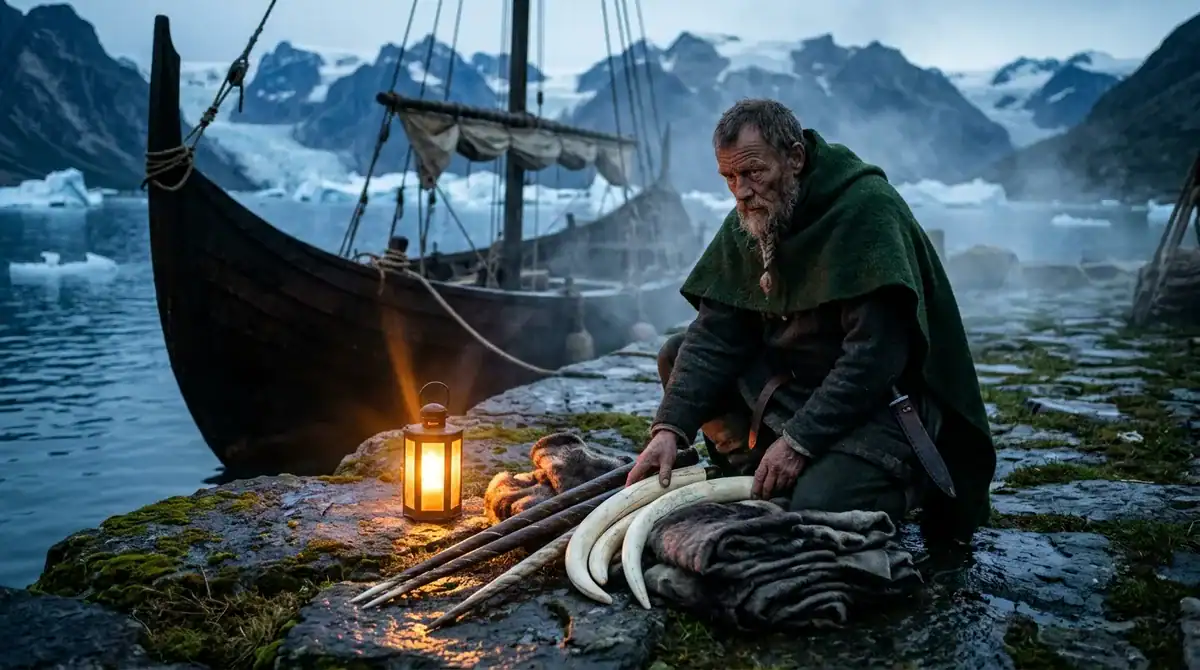
Over time, Norse diets moved away from farm produce and toward the sea, and trade tied the colony to wider networks. A 2018 synthesis in the Proceedings of the National Academy of Sciences reports that marine foods made up about 40 percent of Norse diets in the 11th century, rising to more than 80 percent in the final settlement phases. Researchers traced the change through carbon isotope analysis of settlers’ bones, since what a person eats leaves a chemical signature in the skeleton.
That shift raises a question about the farms. A move to seals, fish, and other sea harvests could mean families were adapting skillfully to a changing land, using the fjords as a dependable larder. It could also mean the pastures were no longer feeding enough animals, and people were turning to the sea out of necessity. The same bones can support either reading.
Walrus ivory was among the goods that linked Greenland to Europe, and a 2024 study in Science Advances examined 31 walrus-ivory artifacts. Its genetic analysis found that late-period harvesting increasingly drew on High Arctic walrus stocks, especially around the North Water Polynya, a rich patch of open water far to the north. Hunters appear to have traveled farther for the same valuable material.
Norse reach was broader still. At L’Anse aux Meadows on the northern tip of Newfoundland, archaeologists have found evidence of a Norse presence in North America, showing that these sailors had pushed well beyond Greenland’s fjords.
Was Conflict With Newcomers Part of the Story?
Conflict with the newcomers may have played a part, but the evidence for it is thin, and it cannot be treated as the main cause. The Thule Inuit, ancestors of many of today’s Inuit, moved into the region from farther north and later became the main Indigenous population of Greenland. Their arrival meant the Norse were no longer the only people shaping life along the coast, so contact between the two groups belongs in the story.
The clearest account of violence comes from the Icelandic Annals, which record a 1379 attack in which 18 Greenlanders were killed and two boys were taken into slavery. It shows that hostile encounters happened, but one attack recorded in one distant written source is a thin foundation for explaining the disappearance of a whole colony.
Meanwhile, the Black Death was spreading through Europe during the same century, killing large numbers of people and disrupting the ships and trade that linked the Norse world together. Its effects on the wider Norse world are well documented, but no record ties it to a specific loss of life in Greenland. Its role there remains a question rather than an answer.
Weighing the conflict theory against the other evidence is the key step. The lake sediments show drying but no sudden cold, and the diet and walrus-ivory evidence points to hunters reaching farther for resources. Those findings suggest a slow squeeze on the farms rather than a single violent break. Whether raids, trade losses, or shifting alliances pushed the last families out remains open, and the written record alone cannot settle it.
Why Do Experts Still Disagree?
Experts disagree because the same clues can support more than one story. A 2025 study in Heritage interviewed 13 specialists and found that researchers read the same evidence about Norse Greenland’s depopulation in different ways. The disagreement centers on how much weight to give climate, ecology, and social, economic, and political processes.
Several theories compete for the same farms:
- Slow economic decline, as demand for walrus ivory and other goods weakened and trade thinned out
- Environmental strain, as grazing land, hay, and soil wore thin under generations of use
- Cultural change, as customs and daily habits shifted away from the European world the settlers came from
- People moving away or joining other groups, through migration or by being absorbed into neighboring communities
Religion and politics add another layer. The settlers depended on church ties and royal oversight from across the sea, and fewer ships or weaker institutions could have loosened those bonds. Later missionary inquiries into the fate of the settlers, sent from Europe long after the last Norse records, form part of the puzzle as well. They raised questions that the written sources never fully answered.
Notice where these theories meet. A dry summer that cut hay could push a family toward the sea, and a shift toward hunting could tie them to a trade that was itself fragile. A weakened trade might then push people to leave, or to join neighbors. Weighing each theory on its own is useful, but the strongest explanations may sit where these threads overlap.
What Evidence Has Been Lost Beneath the Ground?
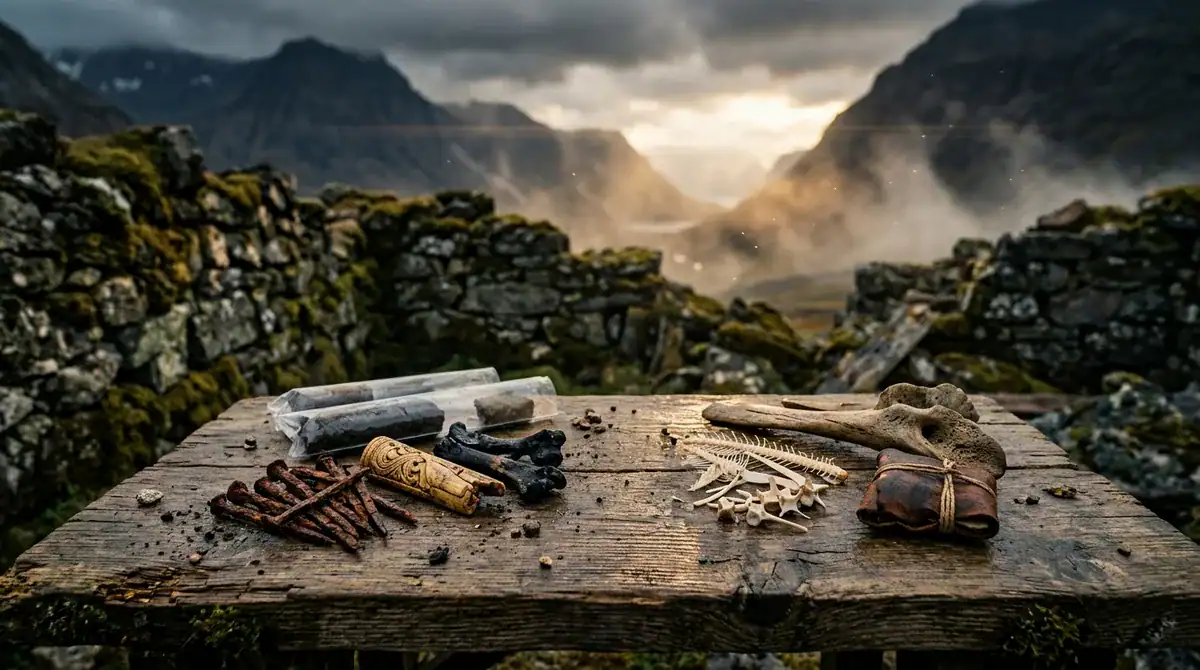
Much of the Norse story has been lost beneath the ground, because the materials that make a home feel lived in, such as wood, leather, and textiles, rarely survive centuries in damp soil. A 2024 study in Scientific Reports sampled four archaeological sites in or near Kujataa between 2021 and 2023. Three of its Norse sites held no preserved organic artifacts, so the everyday objects that once showed how people worked, dressed, and repaired their homes were simply gone.
Recent climate change is not the only possible explanation for that decay. Moisture, soil chemistry, and the long process of burial could each have played a part, and the question remains open. For historians, the result is that one of the richest sources for the final decades is missing.
Sand can preserve, but it can also hide. The Farm Beneath the Sand excavation uncovered a buried Norse farm, showing how drifting sand can seal walls and floors for centuries while keeping them out of sight. What the sand protects, it also conceals, so every dig reveals only the part that was spared.
Archaeologists are still searching for the final farms, church sites, and burial grounds. Those places could show how the end unfolded: whether households left in order or in haste, whether a church stayed in use until the last years, and whether the dead were laid to rest in familiar ground. Until those sites are found, the last chapter of Norse Greenland remains written mostly in soil that has not yet given up its secrets.
Where Your Own Investigation Begins
Start with a timeline on paper. Draw a line from about 950 CE, when the Lake 578 record shows drying began, to 1450, the end date Greenland’s National Museum & Archives gives for the settlement period. Mark the mid-14th-century depopulation of the Western Settlement, the 1379 attack in the Icelandic Annals, and the final written trace in 1408. Seeing the gaps side by side highlights the questions each source raises and where the evidence thins out.
Next, read the interviews behind the 2025 Heritage study. They show where specialists part ways, and that disagreement is a useful map. Pick one theory, such as a slow decline in the walrus-ivory trade, and write two columns: the evidence that supports it and the evidence that pushes against it.
If you want to see the ground for yourself, begin with Kujataa, the UNESCO World Heritage landscape that holds many of the Norse ruins. The Hvalsey church ruin, one of the best-preserved stone buildings from the period, is a good place to picture the final decades. Stand among the walls and ask what a family would have needed to hold on to, and what might have made them leave.
Then share what you found. Which thread do you think explains the most, and what would change your mind?
Frequently Asked Questions
1. Were people living in Greenland before the Norse arrived?
Yes, Greenland was home to earlier peoples long before the Norse sailed in around 985 CE. Groups known as the Paleo-Inuit lived along its coasts for thousands of years, and their cultures came and went before the Norse settlers arrived. The Thule Inuit, who moved in later from farther north, were the people who remained after the Norse farms emptied.
2. How do researchers date a Norse farm or a settler’s bones?
Researchers often use radiocarbon dating, which measures the slow decay of carbon in organic material such as bone, charcoal, or turf to estimate when it stopped living. Dates from several samples taken from the same layer can be compared to narrow down when a building was used. Chemical analysis of bones can reveal diet, but it does not give a calendar date on its own.
3. What Norse objects survive in museum collections?
Objects made from stone, metal, bone, and ivory are the most likely to survive in museum collections from the Norse period in Greenland. Iron tools, nails, and carved walrus ivory have been recovered from farm sites and churches. Wooden tools, leather goods, and cloth rarely last in the damp soil, so many of the everyday items that once filled Norse homes are missing from collections.
4. Where did the last Norse settlers go if they left Greenland?
No written record confirms where the last Norse settlers went after they left Greenland. Historians have considered possibilities such as sailing back to Iceland or Norway, or joining neighboring Inuit communities. Without firm documents or clear physical evidence, each of these ideas remains a possibility rather than a proven answer.
5. What makes Kujataa a UNESCO World Heritage site?
Kujataa is a cultural landscape in southwest Greenland recognized by UNESCO for the way people have farmed and hunted there over many centuries. The site preserves traces of both Norse farming and Inuit hunting traditions in the same region. Its ruins, pastures, and field patterns help visitors see how two very different ways of life adapted to the same harsh land.