The Fatima Sun Miracle: What Witnesses Saw and Why It Still Puzzles Researchers
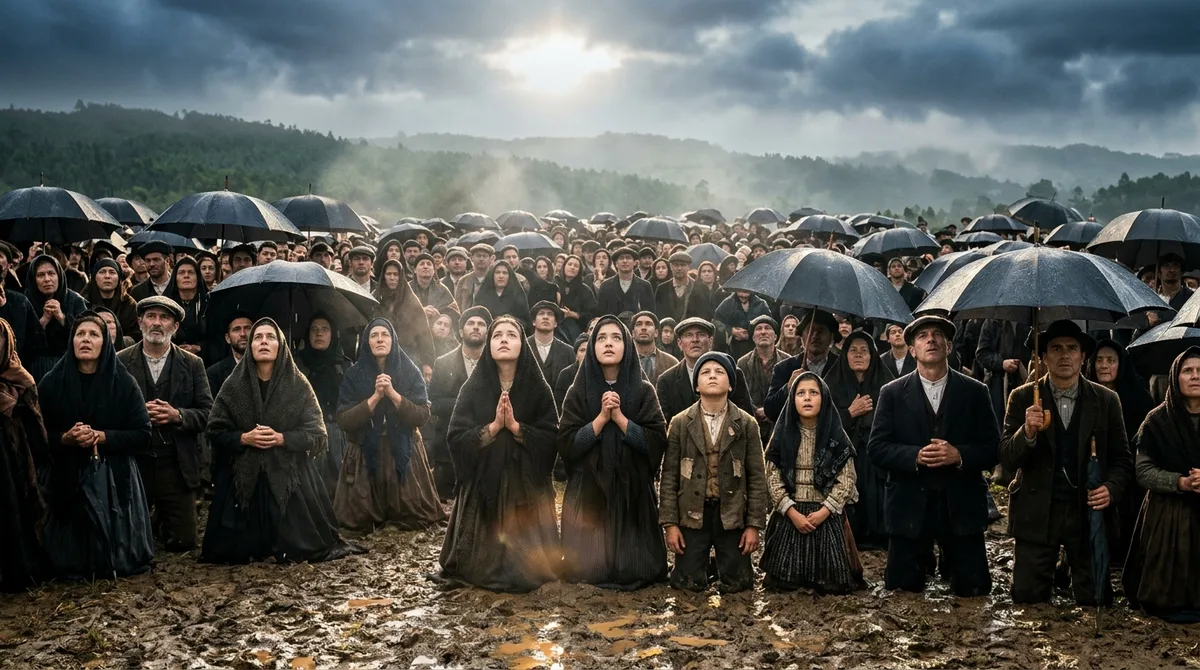
The Fatima sun miracle was a reported solar spectacle witnessed on October 13, 1917, at Cova da Iria near Fátima, Portugal. Crowds said the sun seemed to dance, change color, and draw closer to the earth. The Shrine of Fátima estimates that 50,000 to 70,000 people were present.
One witness put the display at roughly eight to ten minutes, and accounts differ on nearly every detail. More than a century later, the Fatima sun miracle still puzzles researchers.
Key Takeaways
- The 1930 ruling by the Bishop of Leiria judged the children’s visions worthy of belief, not the sun’s behavior.
- Physicist Auguste Meessen’s 2005 paper offers natural explanations for the reported sun display, though none has been proven.
- Witnesses reported damp clothes drying quickly that afternoon, claims recorded as testimony rather than verified fact.
- Readers can compare the children’s testimony with later witness statements to see where wording shifts from seeing to believing.
Who Were the Three Children at Fatima?
The three children were Lucia dos Santos and her cousins, Francisco and Jacinta Marto. They looked after their families’ sheep in the hills near Fátima, Portugal. Picture a dry, stony countryside in 1917, where villages sit far apart and a child’s day is measured by the flock. Between May and October that year, the children said a lady appeared to them above a hollow called Cova da Iria. Each visit brought a new message, and the children said they had been told that a sign would appear for everyone to see on October 13. The sun event was the culmination of those reported visions, the promised sign that drew the crowd to the field.
Lucia’s Account of Saint Joseph, the Child Jesus, and Mary
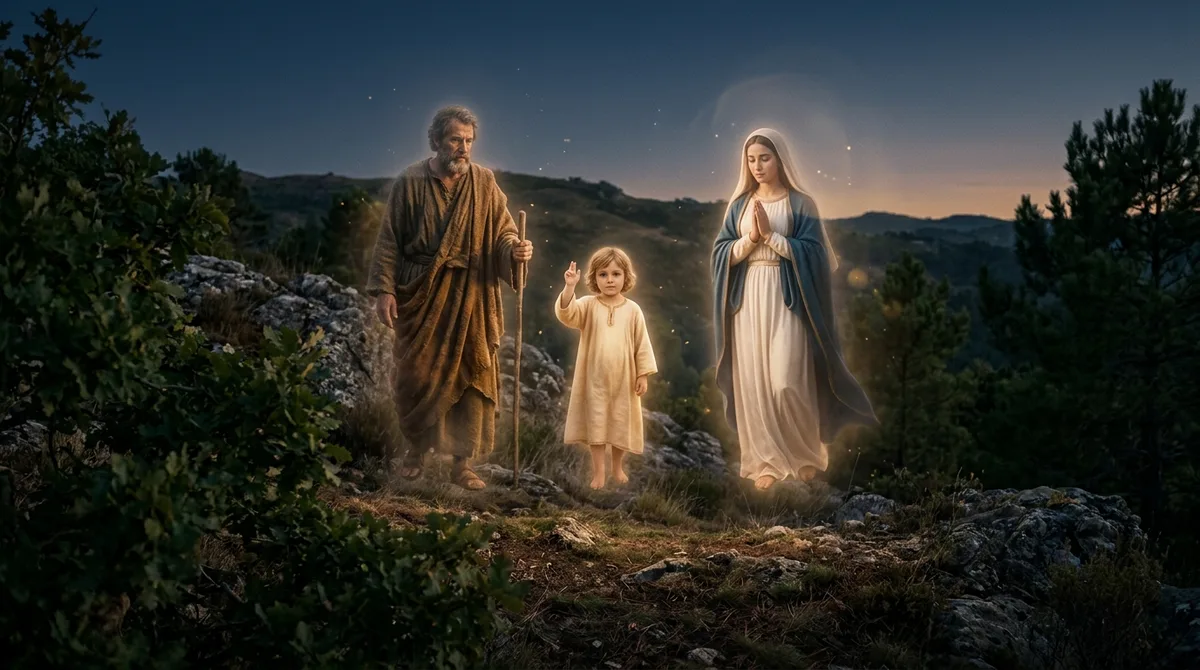
Lucia later wrote down what the children said they had seen, and her memories form the main record of the visions. In those accounts, the lady asked the children to pray the Rosary every day, to offer sacrifices for sinners, and to turn their hearts back toward God. She also spoke of the war raging beyond the hills and of prayer as a way to bring it to an end.
Lucia remembered a quieter scene as well. She said Saint Joseph appeared with the Child Jesus, and the Holy Family blessed the children and the land around them. For the young seers, these figures seemed to reinforce the earlier messages rather than change them.
Then came the promise. The lady told the children she would work a sign so that everyone could believe. Word of that coming sign spread through the villages, and by October the children’s words had drawn a crowd to the stony field of Cova da Iria.
Why Did Tens of Thousands Gather at Cova da Iria?
Tens of thousands came because three children had promised that a sign would appear there. Cova da Iria was a stony hollow near Fátima, and by October 13, 1917, people had arrived from villages across the region, many of them on foot. Estimates put the crowd at 50,000 to 70,000, a wide range that shows how hard it is to count a field full of moving people.
Crowd size matters when weighing eyewitness reports. A gathering that large meant many people, standing at different points, were looking at the same sky at the same time. Yet the same crowd was charged with expectation, and a shared hope can shape what people believe they see. Readers can ask two questions of the accounts: how many people saw something, and how strongly had they been prepared to see it?
What Did Witnesses Say the Sun Did?
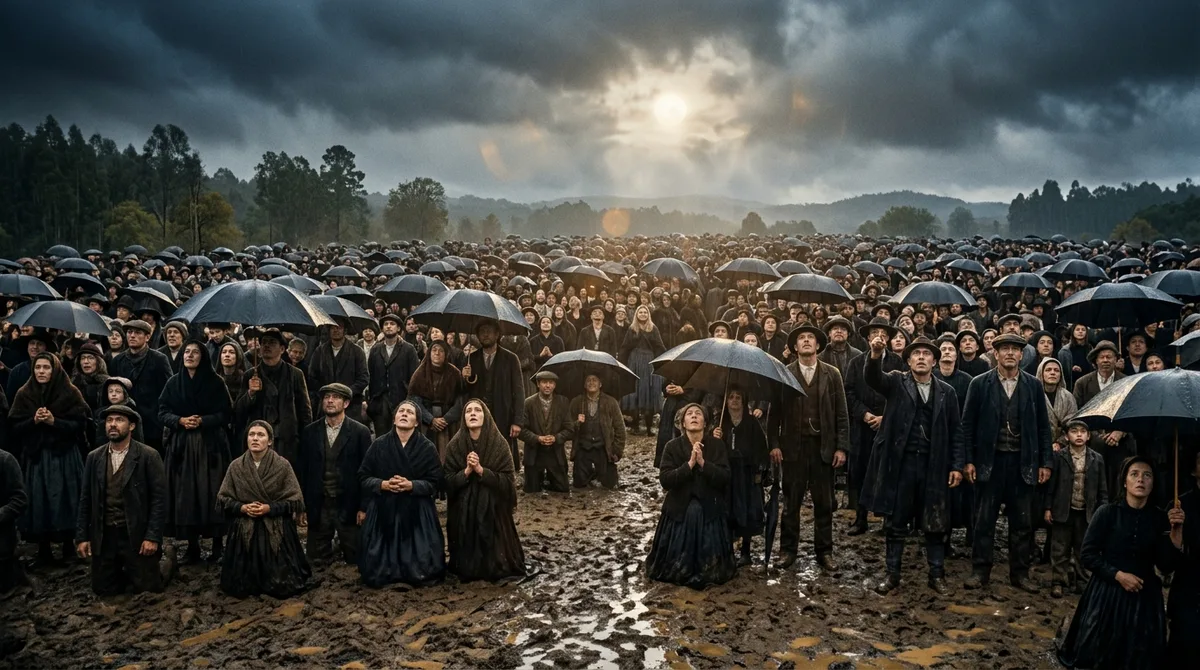
Witnesses said the sun seemed to move, change color, and draw closer to the earth, but no two people described it in exactly the same way. Some saw a sky that looked alive, while others focused on the light falling across the crowd and the land. A few days later, the story took a sharper shape. In the Lisbon newspaper O Século, Avelino de Almeida wrote that the sun had “danced,” a word that quickly became part of how the day was remembered, as the Shrine of Fátima’s chronology records.
As the Shrine of Fátima’s document collection reproduces, José Maria de Proença de Almeida Garrett later estimated that the phenomena lasted about eight to ten minutes, a short window in which thousands of people had to look up and decide what they were seeing. Shrine’s document collection
Other testimony went beyond the sky. People spoke of damp clothes drying quickly that afternoon and of sick visitors who said they had been cured. These claims were recorded as what people said happened, not as verified events, yet they helped turn a field of light into a story of healing and wonder.
Could Natural Causes Explain the Solar Display?
Some researchers believe natural processes explain part of the display, but no single explanation has been proven. Physicist Auguste Meessen’s 2005 paper proposed that unusual visual or physiological processes could account for reported “miracles of the sun.” Staring at a bright sky can produce afterimages and false motion, and a crowd gazing upward for minutes had many chances to experience them.
Mass suggestion may also have played a role. In a field full of people waiting for a sign, one cry of wonder can spread quickly, and nearby observers may begin to see what others describe. That helps explain why accounts differ. Each person stood in a different spot, with different eyesight and expectations.
The children’s testimony is debated from both sides. Supporters point out that the three young seers kept to their accounts under questioning. Skeptics note that they were children who had been told in advance that a sign was coming.
How the Church Judged the Claims
On October 13, 1930, the Bishop of Leiria declared the visions the children had reported from May through October 1917 “worthy of belief.” That judgment concerned the visions themselves, not a scientific finding about the sun. Whether the sun moved or changed color was a separate question, and the bishop’s words did not settle it.
Today the church’s approach is set out in norms issued in 2024 by the Dicastery for the Doctrine of the Faith. Under those norms, the process begins with the diocesan bishop, who works in dialogue with the Dicastery in Rome.
A nihil obstat is one term in that procedure, and it is easy to misread. It permits pastoral use of a phenomenon, such as devotion at the site, but it does not declare the phenomenon supernatural.
Why Do Millions Still Visit Fatima?
Millions still come to Fatima because the story offers something people can take home, whether or not they accept the claims about the sun. The shrine’s 2025 figures show around 6.5 million pilgrims visited that year.
Francisco and Jacinta Marto died young in the years after the visions, so Lucia became the one who carried the story forward. She wrote down her memories and later entered religious life, spending many years encouraging people to pray the Rosary and to change their hearts. Her message also reached ordinary homes. Families who follow it often pray together and offer small sacrifices for sinners, the same practices the lady asked of the children.
Each October 13, the anniversary of the 1917 events draws people back to the field for prayer and a candlelit procession. The crowds who gather there are as varied as the witnesses of a century ago. What would it take for you to believe what they saw?
Weighing the Evidence for Yourself
Start with the two accounts that describe the sun most directly. Read Garrett’s estimate of eight to ten minutes, then ask how long you could hold a clear memory of something moving overhead before your memory began to fill in gaps. Next, compare Avelino de Almeida’s “danced” report with the statements witnesses gave later. Notice where the wording shifts from what people saw to what they believed it meant.
Then read Auguste Meessen’s 2005 paper and list each natural explanation it offers. Check which one matches the timing and details in the testimony you have read. Write your own conclusion in a notebook before you look at anyone else’s, and compare it with your first impression once you have finished.
Frequently Asked Questions
1. Are there any photographs of the sun on October 13, 1917?
No photograph of the sun from that afternoon is widely accepted as showing the reported changes. Pictures taken at Cova da Iria mostly show the crowd, many people looking upward, and the ground still soaked from earlier rain. Because the sky was the focus of the event, the images offer little direct visual evidence of what happened overhead.
2. What would a scientist need to test the physiological explanation for the sun display?
A researcher would need records from many independent observers, including each person’s position, the time they looked up, and what they reported seeing. Weather and light conditions for that afternoon would also need to be reconstructed so the reports can be checked against the sky. Controlled experiments, such as staring at a bright sky for several minutes and recording apparent motion or color shifts, could then show whether those effects match the details in the testimony.