Great Zimbabwe Origins: Who Really Built the Stone City?
Great Zimbabwe was built by the Shona-speaking ancestors of today’s Zimbabweans, who founded the stone city in the 11th century on land that had been only sparsely settled. Its origins lie in the Iron Age, and UNESCO describes a 722-hectare property whose stone structures were built between 1100 and 1450.
The name is usually translated from Shona as “houses of stone,” a title that hints at the pride its builders took in their masonry. Legends later attached foreign origins to the ruins, but the archaeological record points firmly to African builders.
Key Takeaways
- The stone walls most likely began rising in the late 12th or early 13th century, a narrower window than UNESCO’s 1100 to 1450 span.
- Great Zimbabwe’s builders stacked shaped granite blocks by hand without mortar, tapering their walls so they stayed upright.
- Estimates of the population at Great Zimbabwe range from about 1,000 to about 20,000, so the true count remains uncertain.
- Kilwa, a busy East African port, helped Great Zimbabwe trade for distant goods such as Asian porcelain.
Who Built the Stone City?
Iron Age Shona people built the city, and their descendants still speak the Shona language across Zimbabwe today. Archaeology links the stonework to these early communities, so the story belongs to the people who lived on this land rather than to outside visitors. The name Zimbabwe comes from the same language and is commonly understood to mean “houses of stone,” a phrase that points to the ruins’ most striking feature. The modern country shares that word, but the order is reversed. The stone city carried the name first, and the nation later took it as its own.
When Did the Walls Go Up?
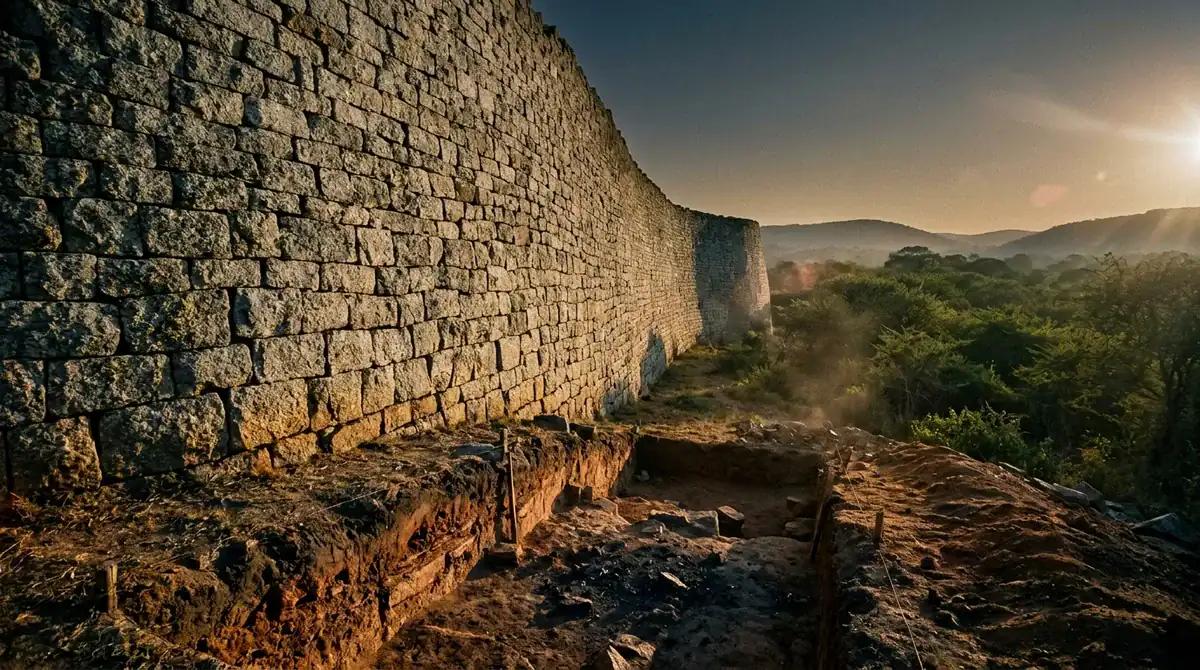
The stone walls most likely began to rise in the late 12th or early 13th century, a narrower window than the 1100 to 1450 span that UNESCO gives for the whole site.
The most detailed attempt to pin down this timeline came in 2015, when a Bayesian chronology published in Antiquity weighed many dates against one another and against the layers they came from. The method produces ranges of likelihood rather than a single day, which is why the answer still feels unsettled.
The same study placed the peak of wall-building in the 14th and 15th centuries, when the city was at its most ambitious. The capital itself was abandoned around 1450.
Yet people kept living among the ruins. Occupation continued at least into the 16th century and probably into the 17th. Looting and earlier digging have scrambled some deposits, and every radiocarbon date carries a margin of error. Each new excavation can shift the picture a little.
How Were the Walls Raised Without Mortar?
Great Zimbabwe’s walls were raised by fitting shaped granite blocks together by hand, stone upon stone, with no mortar to bind them. Masons dressed each block so it sat snugly against the one beneath it.
The finished walls rise with a gentle taper, growing slimmer toward the top. That shape helps a tall wall stay upright without any binding material. Some sections also carry decorative patterns formed by the arrangement of the stones, which suggests the builders planned how the walls would look as well as how they would stand.
Skills like these were not improvised. Stoneworking knowledge was passed from one generation of local craftspeople to the next, and the careful planning behind the designs points to a well-practiced tradition. Researchers are still working out exactly how the courses were laid out and how the patterns were set out in the first place.
Hill Ruins, Great Enclosure, and Valley Ruins
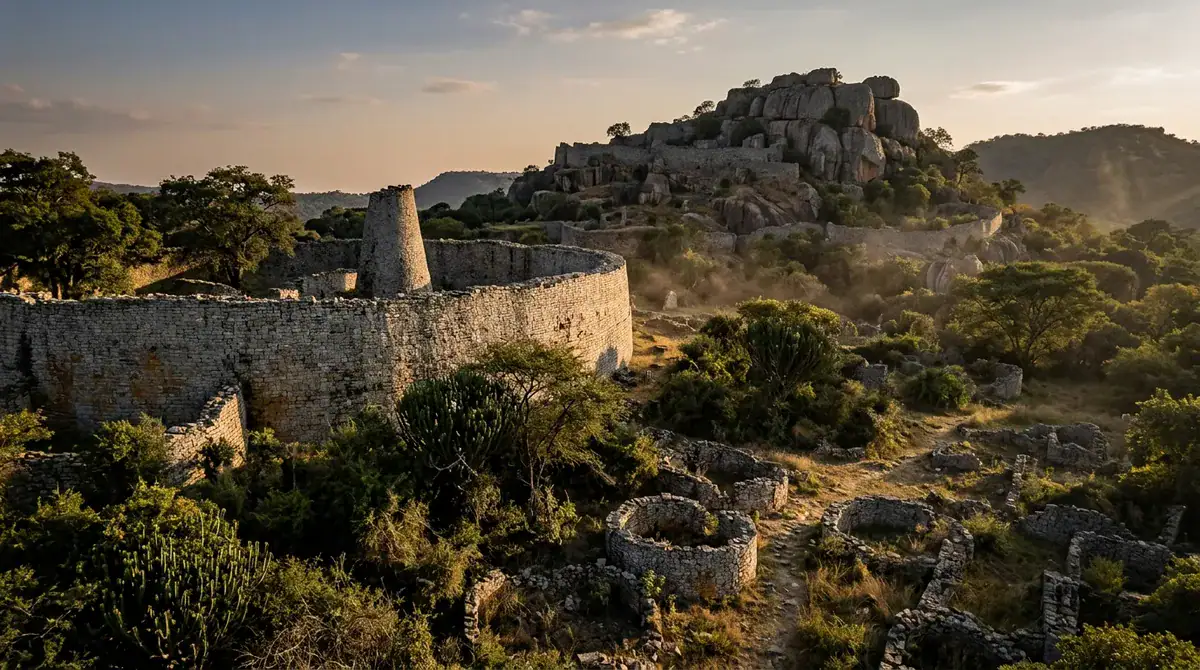
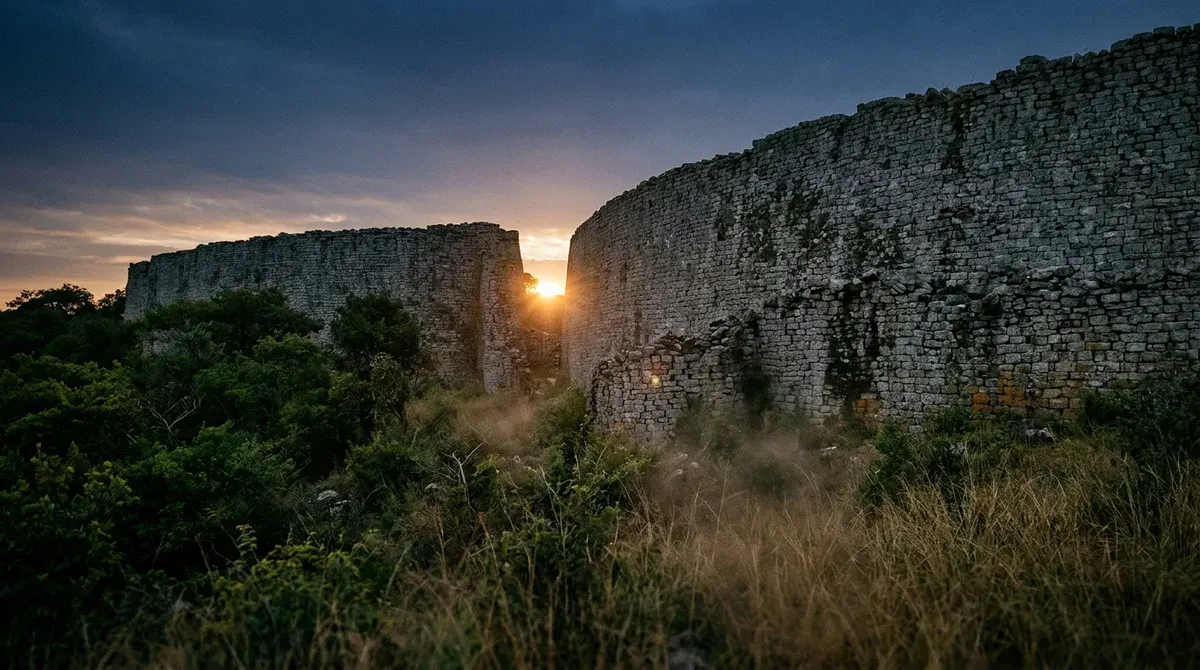
The property stretches across 722 hectares and is organized into three connected parts. The Hill Ruins rise on a granite outcrop above the rest of the site, where walls and terraces cling to rocky slopes. Here archaeologists found carved soapstone birds, figures that scholars still debate. Were they religious symbols, clan totems, or markers of rank held by people who controlled the city’s trade? Each idea has supporters, and the birds may have meant different things to different people. Below the hill lies the Great Enclosure, a massive walled space with a curved stone wall that ranks among the most striking structures on the site. The Valley Ruins spread across the lower ground, where many stone enclosures and homes once stood. Walking between the three areas shows how the city was planned around its hill, its enclosure, and its valley.
How Many People Lived Here?
Estimates of how many people lived at Great Zimbabwe range from about 1,000 to about 20,000, and the question remains open. An older 1985 assessment put the population above 10,000 in the 14th century, when the city was at its height. The Zimbabwe Heritage historical overview reports this same wide span, which shows how much guesswork still surrounds the count.
Archaeologists generally describe a social ladder that the layout seems to reflect. Elite families likely lived close to the hilltop, while commoners built their homes across the valley below. The arrangement of stone enclosures on the hill and in the valley is the main clue to this ranking.
Why do the numbers vary so much? Excavation has been uneven, with some areas dug deeply and others barely touched. Many houses were built of earth and thatch, which decays quickly, so counting homes from what survives is difficult. Every missing house leaves a gap in the count.
What Did Foreign Trade Bring to the City?
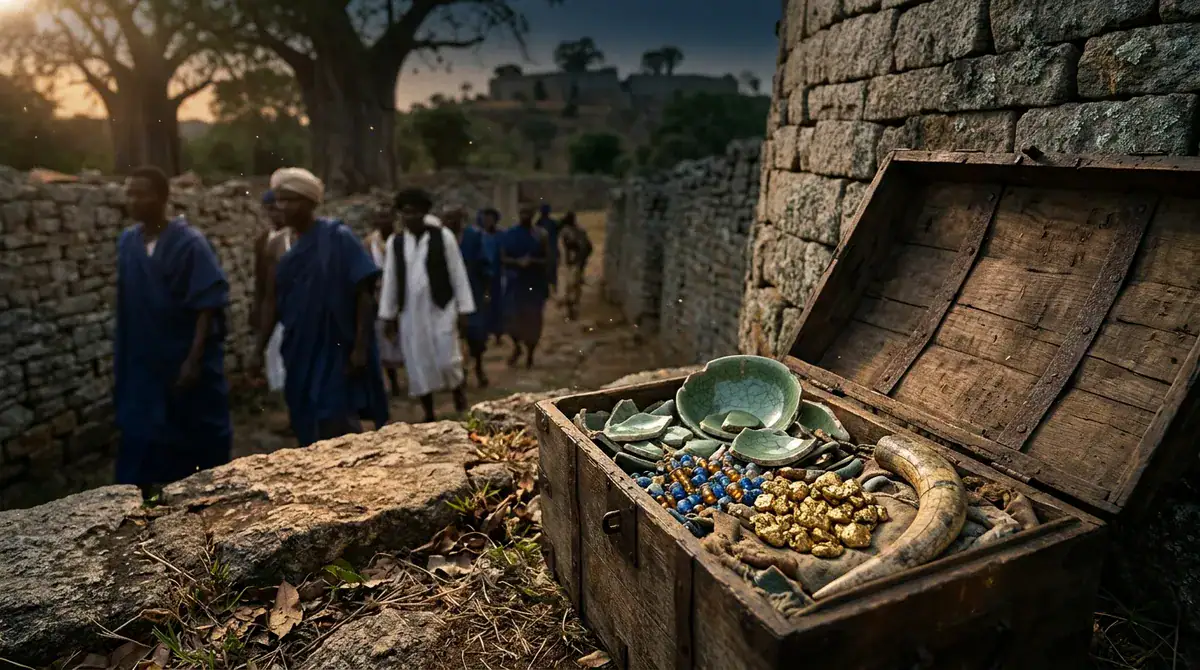
Foreign trade brought porcelain, glass beads, and coins from distant lands, while local craftspeople also turned gold into wealth of their own. Excavations have uncovered Chinese and Persian porcelain, fragments of goods that had crossed the Indian Ocean before reaching the stone city. Glass beads, gold, and Arab coins linked to Kilwa, a busy port on the East African coast, show how far the city’s contacts reached. Kilwa acted as a hub where traders passed goods between Asia, the Middle East, and inland markets. Yet not all the gold was imported. Workshops inside the settlement shaped gold locally, which suggests that Great Zimbabwe grew rich by making its own treasures as well as by trading for others.
Foreign Builders and the Biblical Legends
Long before archaeologists reached the ruins, stories had already linked them to the Bible. Legends tied the stonework to King Solomon, the Queen of Sheba, and Ophir, a distant land associated with gold and rare treasure.
Colonial-era writers embraced these tales. Many found it hard to accept that Africans could have raised such a city, so they credited Phoenicians, Arabs, or other outsiders instead. The myth flattered European assumptions about who was capable of building something so grand.
The physical evidence tells a different story. Carbon-14 dating, along with pottery, tools, and other artifacts recovered from the ground, points to Shona builders and an 11th-century founding. The people who shaped the stone were the ancestors of the communities that still live in the region.
Why do the foreign-builder tales persist? They make a dramatic story, and they survive in old travel books, films, and online forums long after scholars have moved on.
Who Keeps the Ruins Alive Today?
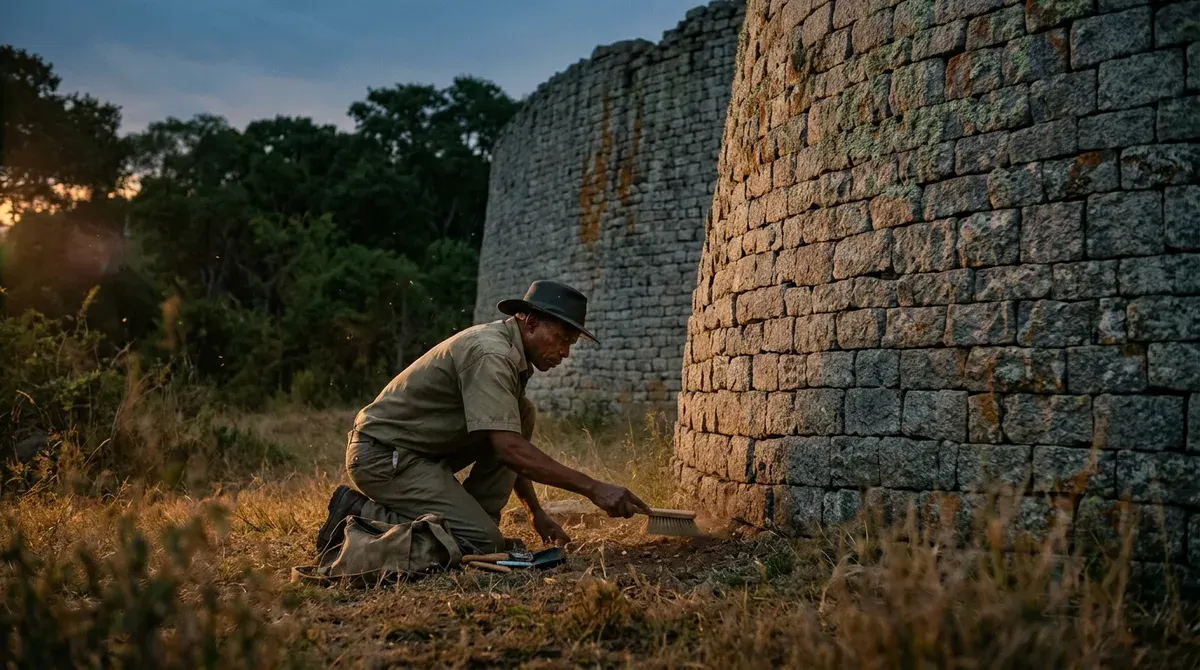
Today the stone city is protected by Zimbabwe’s own laws, its UNESCO World Heritage listing, and a growing team of conservators, trainees, and researchers. Under the National Museums and Monuments Act, anyone who wants to dig at the site needs the consent of the Executive Director, and the same law bars altering, damaging, or removing a protected structure without that consent. The law defines an ancient monument as any ruin believed to have been built or used in Zimbabwe before 1 January 1890, which covers the stone city many times over.
The ruins matter far beyond archaeology. Since independence, Great Zimbabwe has stood as a national symbol, and the Zimbabwe bird that appears on the national flag shares its name with the soapstone birds found on the Hill Ruins. For many visitors, the site is also a place of spiritual pilgrimage, where the walls are approached with reverence.
The Great Zimbabwe Integrated Management Plan for 2024–2028 gives the site its roadmap. In July 2024, UNESCO’s regional office reported that National Museums and Monuments had received the plan along with tourism and interpretation documents.
A rehabilitation effort worth EUR 3 million is also underway. Backed by Agence Française de Développement, the three-year project works with the United Nations Office for Project Services and the national museums body.
Local hands are part of the work too. Young people from nearby communities were chosen for two weeks of on-site wall-restoration training, learning stone masonry and how to assess the condition of heritage structures. Those skills connect the present generation to the craftspeople who first shaped the granite.
New digging continues as well. A 2026 report said Oxford archaeologist Shadreck Chirikure was leading fresh excavations, and it described a Chinese Longquan celadon fragment found at the site, a piece later featured in a PBS documentary. Each new find adds another thread to the story of how this city stayed connected to the wider world.
Weighing the Clues for Yourself
Start with one claim from this article, such as the 11th-century founding or the Kilwa trade links, and ask what evidence supports it. Is it pottery, coins, a carbon date, or an old legend? Then watch PBS’s Secrets of the Dead: Africa’s Golden City and note which scenes show objects recovered from the ground and which rely on storytelling. Finally, follow Shadreck Chirikure’s new excavations at Great Zimbabwe. Do the upcoming finds fit the chronology described here, or do they push the timeline somewhere new? Share what you discover in the comments.
Frequently Asked Questions
1. How do archaeologists date stone walls when no written records survive?
Archaeologists rely mainly on radiocarbon tests of charcoal and other plant material found near the walls. They also compare pottery styles and imported goods, such as porcelain, whose production periods are known from other sites in Asia and the Middle East.
2. Did the builders of Great Zimbabwe have a writing system?
No writing from the people who built Great Zimbabwe has been found, so their history comes from archaeology, oral tradition, and the accounts of later visitors. Researchers piece together daily life from tools, pottery, beads, and the layout of the stone enclosures.
3. Why was the capital abandoned around 1450?
No single cause has been proven. Researchers have proposed shifts in long-distance trade routes, strain on farmland and local resources, and changes in political power as possible reasons for the decline.
4. What was Mapungubwe, and how was it connected to Great Zimbabwe?
Mapungubwe was an Iron Age center on the Limpopo River, close to where South Africa, Zimbabwe, and Botswana meet today. The two places shared trade networks for gold and imported goods, so archaeologists often compare them when studying how wealth moved across southern Africa.
5. How long did it take to build Great Zimbabwe?
There is no single build time for the site, because construction happened in stages over many generations. Walls were added, repaired, and reshaped as the community grew, so the history is better understood as a series of building phases than as one continuous project.