Rongorongo Script: The Undeciphered Writing of Rapa Nui
Rongorongo script is an undeciphered system of signs carved into wooden objects from Rapa Nui, the remote Pacific island better known as Easter Island. Only a small group of pieces survives. A 2022 study in Digital Scholarship in the Humanities counts 26 inscriptions scattered among museums and collections around the world, so the writing today lives far from the place where it was made. Researchers can describe its features in detail, from its unusual line direction to sequences of signs that repeat across different objects. Yet the values of those signs, and whether they record a spoken language at all, remain open questions.
The timeline is just as intriguing. The first outside record of the script dates to 1864, and a 2024 study in Scientific Reports says tablets stopped being produced in the late 1860s. Radiocarbon testing of wood from one tablet held in Rome points to 1493 to 1509 CE, a date that sounds like a dramatic early origin. The same study cautions, however, that wood age only sets an earliest possible date for carving, since old or reused timber could have been worked much later. Meanwhile, Thomas Barthel’s 1958 reference catalogue lists 599 sign shapes, including variants and some compound signs, a number that hints at how complicated the writing may be.
Key Takeaways
- Rongorongo script, carved into wooden tablets and staves from Rapa Nui, remains undeciphered, and researchers still disagree on whether its signs record a spoken language at all.
- Rongorongo is written in reverse boustrophedon, in which the tablet is turned 180 degrees at the end of each line so that alternate lines sit upside down relative to one another.
- Radiocarbon testing of wood from the Échancrée tablet in Rome produced a range of 1493 to 1509 CE, but the 2024 study in Scientific Reports cautioned that wood age only sets the earliest possible date for carving.
- A Bayesian model built from three tablet dates places the Rongorongo phase at 1722 to 1843 CE with 68.3 percent probability, a window that stands apart from the older Échancrée wood date.
Where the Surviving Rongorongo Tablets Are Held
Rongorongo does not sit in one place. The surviving inscribed objects are spread across museums and private collections in Europe and South America, far from Rapa Nui, the volcanic island where the carvers worked. A reader who wants to see the writing up close has to travel to several cities, and each object has its own history of how it left the island and how it was labeled once it arrived.
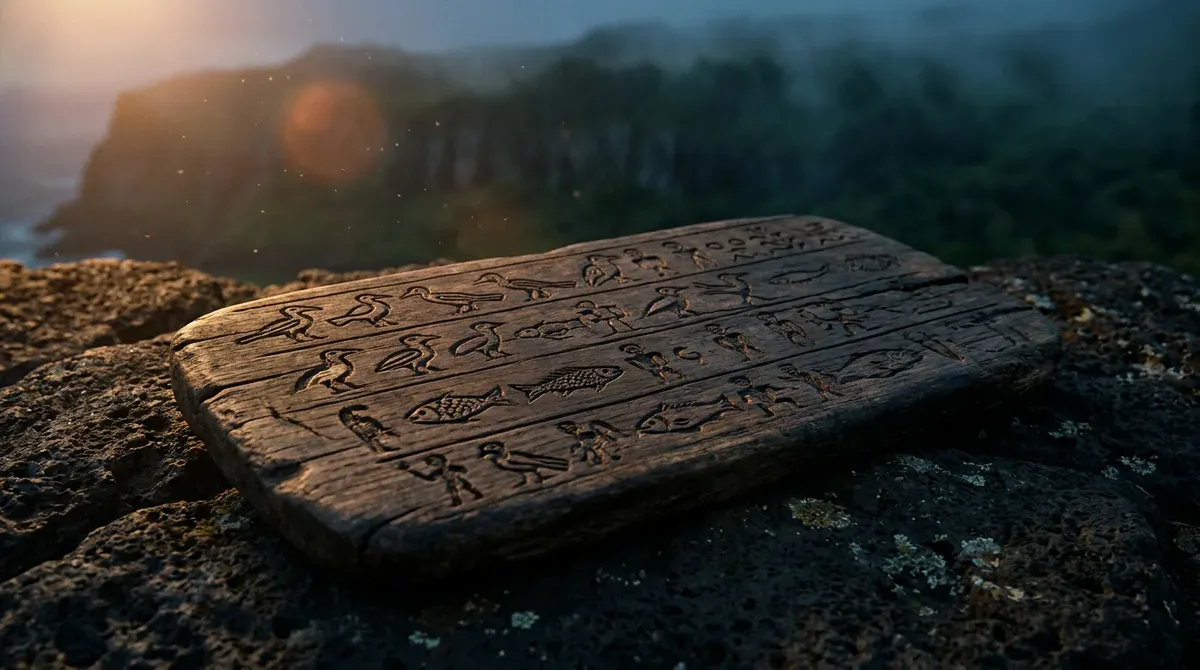
The corpus is small, and it is made up of different kinds of objects. The signs are carved into wood, not painted onto it. Islanders cut each glyph into the surface with sharp tools, so the lines have depth and edges that researchers can measure. Most of the inscribed pieces are wooden tablets, flat boards with writing on both faces, while a smaller number are staves, long rods that were also marked with rows of signs. Because the objects differ in shape and size, scholars must compare them carefully before deciding whether two pieces share the same script or only look alike.
Two names come up again and again. Tablet C, known as the Mamari tablet, is one of the most studied pieces in the corpus. A 2022 study in the University of Rome Sapienza’s research repository produced a three-dimensional model, a revised drawing, and a new transcription of the Mamari tablet. The authors described a calendar-like passage and possible lists of agricultural or other words as proposed contents, not as settled readings. The Mamari tablet is held in St Petersburg, so anyone comparing it with other pieces must work across distant archives.
Tablet D, called the Échancrée tablet, is the other object readers will meet often. It is held in Rome, and its wood became the subject of the 2024 radiocarbon work that shaped so much of the debate about when the script was used. Its notched edge, which gives the tablet its nickname, makes it easy to recognize even in photographs. The Échancrée tablet is also why many readers first hear about Rongorongo, which makes it a useful anchor for the rest of the story.
The corpus is also incomplete, and that gap may matter more than any single object. Many tablets and staves were lost or destroyed during the nineteenth century, a period of disease, forced labor, and upheaval on Rapa Nui. Some pieces were burned, some were broken or left to decay, and others were given away as curiosities to visiting ships. Researchers rarely know how much writing disappeared with them, so every surviving object carries extra weight.
Even the boundaries of the corpus are still shifting. In July 2026, a research article in the journal Cryptologia described a Rongorongo-inscribed wooden pendant said to have been collected during the whaling ship Margaret Rait’s five-day stop at Rapa Nui in late December 1843. The authors note that the pendant is not a typical tablet or staff in the core corpus, which raises a practical question: how much unusual material should count as Rongorongo at all? The answer will shape the next chapters of this story, because every new piece changes the pool of signs that researchers must try to read.
When Was the Script Carved?
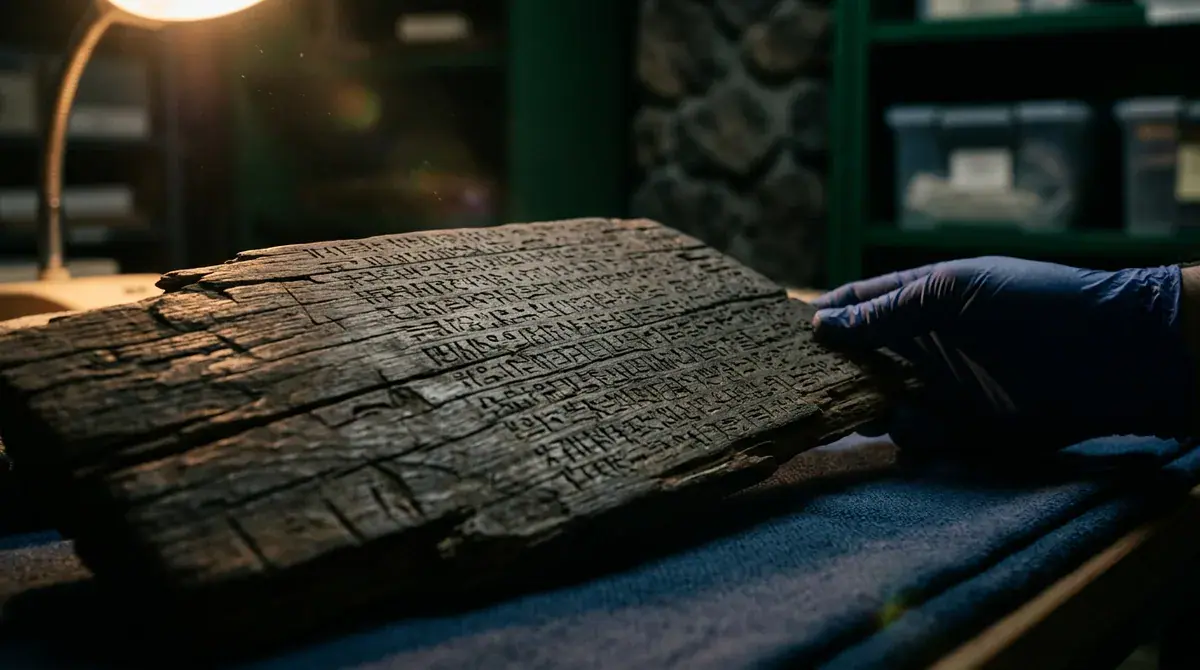
Rongorongo’s age is harder to pin down than its final chapter suggests. The tablets stopped being made in the late 1860s, and the first outsider to write about the script did so in 1864, while islanders were still producing it. Modern dating evidence has since pointed in several directions, and the oldest number, a radiocarbon date from one tablet in Rome, needs the most careful reading.
The earliest written mention of the script is a note made by an outsider in 1864, which shows that the writing was known to visitors by that time. The 2024 study concluded that tablets ceased to be produced in the late 1860s. Together, those two markers form a rough frame, and the question becomes what happened before the frame opened.
The key dates researchers have used so far are shown below:
| Evidence | Date or range |
|---|---|
| First outsider record of Rongorongo | 1864 |
| Tablets stopped being produced | Late 1860s |
| Radiocarbon date for wood from Tablet D (Échancrée) | 1493–1509 CE |
| Bayesian phase from three tablet dates (68.3% probability) | 1722–1843 CE |
Radiocarbon dating drew the most attention. Scientists took a very small sample from the Échancrée tablet, held in Rome, and processed between 40 and 74 milligrams of wood powder. That is a tiny amount, and it was enough for the laboratory to measure the carbon left in the wood. A raw radiocarbon measurement is not yet a calendar year, so the researchers converted it using the SHCal20 calibration curve, which is built for the Southern Hemisphere, where Rapa Nui sits. They ran the calculations in OxCal 4.4, a widely used software program for this kind of work. The result was a range of 1493 to 1509 CE for the wood.
That range is why the number sounds so dramatic. It places the wood in the years around the arrival of Columbus in the Americas, long before the nineteenth-century records. The number still needs a careful reading. Wood age sets an earliest possible date for the carving, because a tablet cannot have been carved before its timber was alive and shaped. It does not say when the signs were cut. A plank can sit in a house, a boat, or a storeroom for centuries before someone decides to write on it. Old or reused timber could have been carved much later, which means the Échancrée date is a starting line, not a finish line.
The other three tablets in Rome gave dates associated with later periods, so the Échancrée result stands apart from them. To make sense of the group, the researchers built a Bayesian model. In plain terms, a Bayesian model combines several dates and known limits, such as the period when tablets stopped being made, to find the range that best fits the evidence. Using three tablet dates, the model estimated a Rongorongo phase of 1722 to 1843 CE at 68.3 percent probability. That means the model places roughly two chances in three that the phase falls inside that window. The researchers treated the older Échancrée result separately from this model, so the two numbers should not be merged into one story.
Readers should notice the gap between those two results. The Échancrée wood points to the 1490s and early 1500s, while the group model points to the eighteenth and early nineteenth centuries. One explanation is that the Échancrée wood was old when it was carved, perhaps salvaged or reused. Another is that the model’s three dates are simply not enough to describe the whole corpus. A third possibility is that the Rongorongo phase we can see is only the last chapter of a longer tradition, and the older wood reflects something that came before it. Each explanation fits some of the facts and leaves others open.
That gap sits at the center of the origin debate. Some scholars argue that Rongorongo was a local invention, shaped by islanders who had their own reasons to record sequences of signs. Others argue that the writing took its form, or at least its purpose, in response to contact with Europeans, perhaps after ships began visiting the island. The 1722–1843 window also overlaps a period of growing contact with outside ships, which gives the second idea real weight. If outsiders shaped the script, the older Échancrée wood would be hard to explain. If the script was local and very old, the tight window of the group model would need its own explanation.
Neither side can yet prove its case from the dates alone. Radiocarbon numbers are powerful, but they answer only part of the question. The tablets themselves, the way their signs are arranged, and the accounts written by early visitors all have to be read together. So which picture seems more convincing to you: a script with deep roots on the island, or one that took shape in the centuries when the outside world came calling?
Why Do the Lines Run Upside Down?
Rongorongo is written in reverse boustrophedon, a pattern in which the tablet is turned 180 degrees at the end of each line, so alternate lines sit upside down relative to one another. A 2009 article in the Journal de la Société des Océanistes describes the method and explains why the layout is so central to reading the script.
The word boustrophedon comes from Greek and means “ox-turning.” It describes the way a plowing ox walks back and forth across a field, turning at the end of each furrow before heading the other way. Some ancient inscriptions were written this way, with the reader’s eyes moving left to right on one line and right to left on the next. Rongorongo takes the same idea and changes the motion. Instead of the reader’s eyes turning, the object itself is rotated, so the carver and the reader must both physically turn the tablet to follow the text.
Imagine a carver sitting cross-legged on the ground with a wooden board across his knees. He cuts one line of signs from left to right, then rotates the board, sets it down again, and cuts the next row in the opposite orientation. Each turn brings the carver back to the edge where the previous line ended, which makes the process practical. The method also means the surface never has to be re-marked from scratch, because the carver can work in a continuous rhythm along the wood.
The objects that carried this writing were mostly wooden tablets and staves. Tablets are flat boards with writing on both faces, while staves are longer rods that were also marked with rows of signs. Wood was the chosen medium, not stone, and that choice mattered. Wood is light, easy to carve, and vulnerable to rot and insects, which is one reason so few objects have survived. Rapa Nui had few large trees by the time outsiders arrived, so timber was valuable. Carvers may have reused old boards or worked with driftwood, which fits the radiocarbon debate about older wood being carved much later.
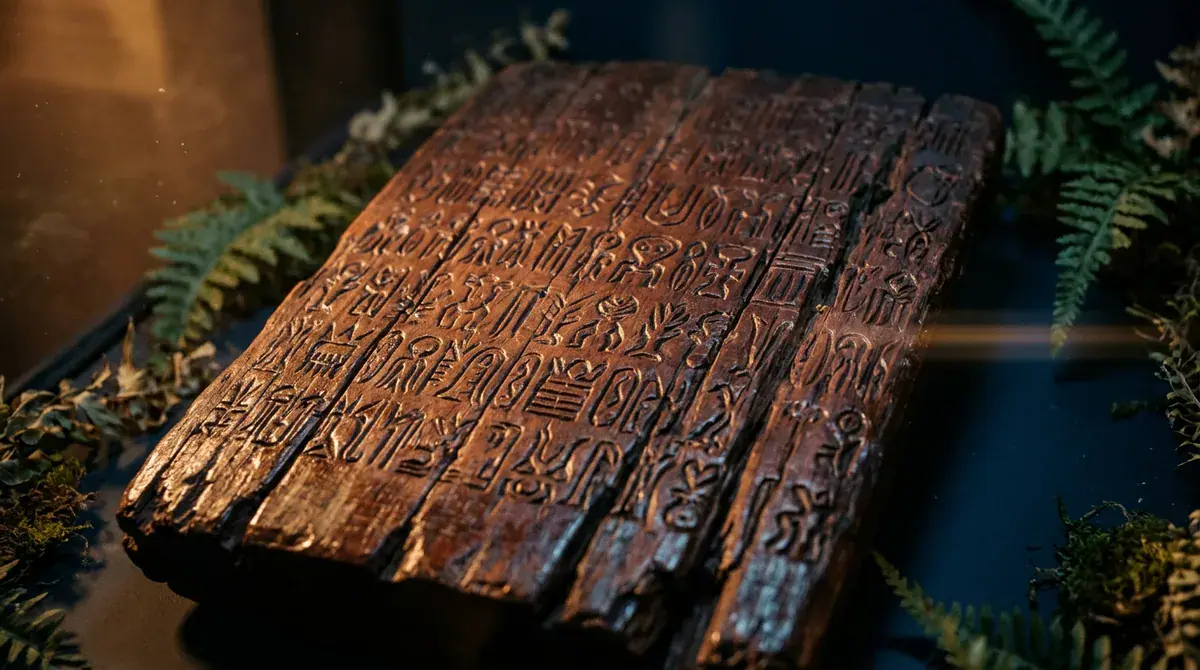
The tools that cut the signs leave their own clues. Islanders cut the glyphs with sharp implements, and the resulting lines have depth and edges that can be measured. In close-up images, the cuts often look like narrow, parallel channels, a pattern that people who study carved wood call fluting. Fluted grooves are the shallow troughs a pointed or narrow-edged tool leaves as it moves through the grain. If the grooves are as regular as they appear in photographs, they would suggest a carver who worked in short, controlled strokes rather than a single deep slice, and who kept a steady hand across a long line.
Regular marks can also reveal how much time a carver spent on each sign. A glyph cut with many small, careful passes would look different from one cut in a quick sweep, and that difference could point to a practiced hand or a beginner. Such observations are useful, but they are still clues about technique rather than proof of who carved a particular tablet.
Line direction matters for a more basic reason. A reader cannot start reading until knowing which way is up for each line, and in reverse boustrophedon that answer changes from one line to the next. Any transcription of a tablet must therefore decide the orientation of every row before it can list a single sign. Scholars can still describe the direction in which signs face, count how often a group of signs appears at the end of a line, and test which orientation produces the most consistent repeats. They can do all of this without knowing what any sign means. The layout is a set of rules that can be studied on its own, and it gives researchers a way to compare objects long before the script can be read.
Glyph Inventory: From Barthel’s 599 Shapes to Pozdniakov’s Revision
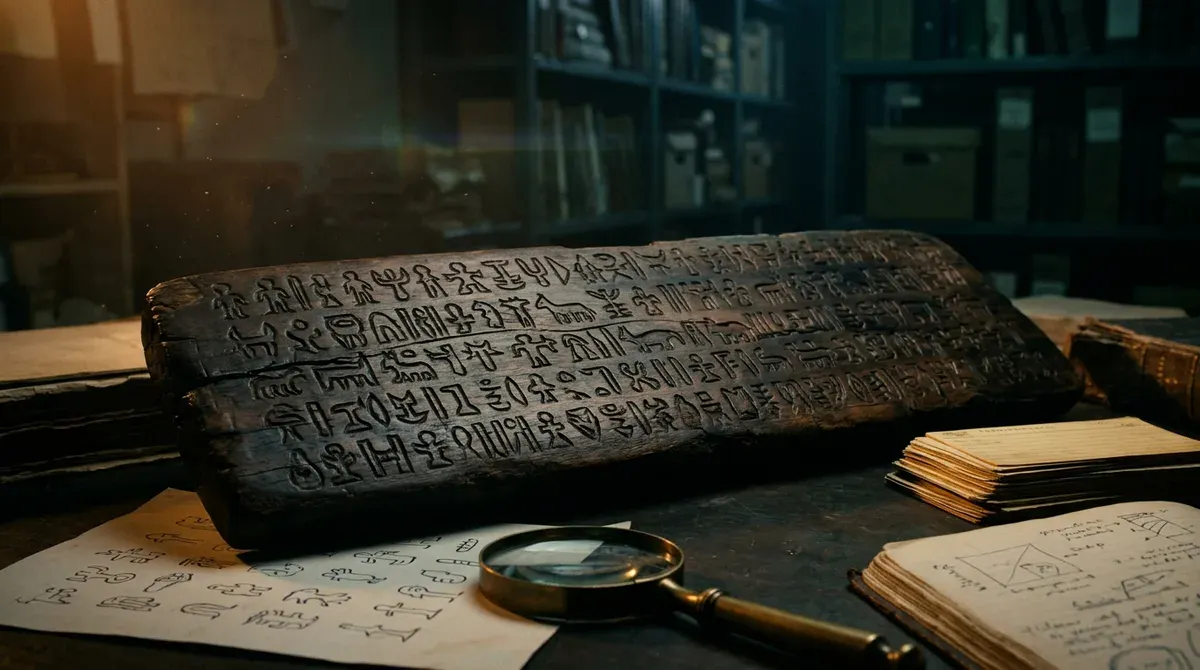
Barthel’s 1958 reference catalogue is the starting point for almost every serious count of Rongorongo signs. It lists 599 sign shapes, a total that includes variants of the same basic form and some compound signs, where two shapes are joined into one unit. A sign shape is simply a drawn form as it appears on the wood, such as a figure with raised arms or a row of tiny strokes. The catalogue shows what the shapes look like, but it does not say what any of them mean.
That distinction matters more than it first appears. A list of 599 shapes is not a list of 599 separate words or sounds. Some entries may be the same sign drawn slightly differently by different carvers, or on different objects, while others may be genuinely distinct. Barthel’s work gave scholars a shared set of reference points, so two people could talk about the same mark without arguing over its outline. How many different signs the script actually contains remains an open question.
Many of the shapes can be described in plain terms. Some show human figures, standing or seated, with arms held out or bent at the elbow. Others show birds, sometimes with a head turned to one side or a long tail that sweeps back across the frame. Fish, plants, and other natural forms appear as well, alongside purely geometric designs such as circles, zigzags, rows of dots, and straight lines that cross or branch. Researchers can sort these shapes into rough groups by appearance, which is useful for comparison even before anyone knows what the groups represent.
- Human figures, often shown in simple poses that change from one sign to the next
- Birds and other animal forms, sometimes with small changes to the beak, head, or tail
- Geometric shapes such as circles, zigzags, dots, and crossed lines
- Compound forms, where two or more smaller shapes are joined into one unit
The harder question is how to tell a variant from a separate sign. A later study of the Échancrée tablet took up this problem directly. It looked at how many of the shapes on that tablet are best understood as variants of one another and how many stand as separate signs. The distinction is not a matter of taste. A researcher has to ask whether a difference in outline reflects a different sign, or simply the uneven hand of the person who carved it, the way the wood has worn over time, or damage that has made a line look longer or shorter than it was.
Those questions become especially tricky on old wood. A gouge that slipped, a splinter that broke away, or a crack running through a line can make two identical signs look unlike each other. A researcher who sees only the photograph may decide that a mark is new, while someone holding the object in person may see that the line is simply damaged. For that reason, careful comparison depends on the object itself, the images, and the notes made during examination, all read together.
Catalogue work also has to deal with the fact that carvers may have varied a sign on purpose. A small change in the angle of a limb or the number of strokes in a group could carry meaning, or it could be an artistic choice that does not change the sign at all. Without knowing what the signs stand for, scholars cannot be fully sure which kind of difference they are looking at. Every decision to merge two shapes or keep them apart is therefore a working hypothesis, and it can shift as more objects come into view.
Konstantin Pozdniakov, a researcher who has studied the corpus in detail, later proposed a revised glyph inventory that reorganized Barthel’s catalogue. His revision reduces or regroups the count by treating some shapes as variants of a single sign and by sorting the rest according to a clearer set of rules. The result is not a final list. What it offers is a different way of looking at the same material, which can make patterns in the sequences easier to see.
Why does the count matter so much? A large inventory can suggest a large writing system, one with many distinct signs that might represent words, syllables, or other units of language. A smaller inventory can point toward a simpler system, or toward a set of signs that repeat in varied forms. The problem is that the total depends heavily on grouping. Two researchers who look at the same tablets can arrive at very different totals, and each total then shapes the questions that follow. A sign count is less like a measurement and more like a decision about what counts as the same thing.
For a reader, the lesson is simple but easy to forget. When a number like 599 appears in a headline, it describes a catalogue, a set of choices, and a set of assumptions about where one sign ends and another begins. Each of those choices can be questioned. If you were looking at the Mamari tablet for the first time, which shapes would you group together, and which would you keep apart?
Did Islanders Read the Signs Aloud?
Some islanders did recite tablet content to outsiders, but no recitation has yet been matched sign by sign to the carved wood. The clues come from a small number of people, most of them recorded by visitors who wrote down what they heard in their own languages and for their own purposes. Each account is valuable because it is so rare, and each one raises as many questions as it answers.
The most discussed name is Metoro, a Rapa Nui man who reportedly recited tablet content to outsiders in the 1860s. His readings survive in a list associated with the missionary Tepano Jaussen, which seems to attach spoken words to particular boards. That promise is what makes the list so tempting. Yet a list written by a foreigner, using a language the listener only partly understood, carries several layers of translation. A sound heard once can be misspelled, a long phrase can be trimmed, and a reading can be assigned to a sign the speaker may never have looked at closely. Researchers have to ask whether Metoro was reading from a tablet in front of him, reciting a memorized chant, or answering a question in the way the questioner hoped to hear.
Ure Vaʻe Iko offers a different kind of evidence. Scholars often value his recitations because they seem to come from a person with a living connection to the tradition, rather than from a visitor’s notes alone. Recitations like his can reveal vocabulary, grammar, and the rhythm of phrases, which gives researchers a sense of how the language may have sounded. The difficulty lies in the match. A recitation flows as a stream of words, while a tablet is a grid of separate signs. Without a clear point where one sign ends and the next begins, it is hard to say which spoken word belongs to which glyph. A recitation may also include words that never appear in the carvings, or it may skip whole sections that the carver chose to write.
Thomson’s observations brought the calendar idea into the public imagination. He described a passage on the Mamari tablet that he read as a lunar calendar, with groups of signs tied to the phases of the moon. His reading gave the Mamari tablet a memorable identity, and it shaped how many later readers approached the object. Later scholars reexamined his claim with more caution. A repeated group of signs can be read as a count of days, but linking that count to the lunar cycle requires assumptions about signs whose values are still unknown. The passage therefore became a test case for the whole problem: it looks like a calendar, yet the proof depends on readings nobody can yet confirm.
A 2022 study in the University of Rome Sapienza’s research repository gave scholars a fresh and more detailed view of the Mamari tablet. Its authors produced a three-dimensional model, a revised drawing, and a new transcription, so researchers could compare the object without relying on older sketches. The study described the calendar-like passage again, and it also proposed that some sequences might be lists of agricultural or other lexical items, such as words for plants, foods, or everyday things. The authors presented these as proposed contents rather than a settled reading. For a reader, the difference is important: a proposed content is a hypothesis to test against the signs, not a sentence that has been decoded.
Why would a spoken account and a carved text fail to match word for word? One reason is that recitation is often a performance, and performances change. A reciter may adjust wording, shorten a passage, or add a phrase to suit the audience, while a carved sign stays fixed on the wood. Another reason is memory. A carved tablet could have served as a cue for someone who already knew the words, the way a written list reminds a speaker of a longer speech. In that case, a single sign might prompt a whole phrase, and the carving would never contain the full sentence. Language also shifts over time, and the upheaval of the nineteenth century meant some knowledge was lost before outsiders thought to ask about it. A reciter in the 1860s may have been working with words that had already changed from the ones used when a tablet was carved.
So the records of Metoro, Ure Vaʻe Iko, and the early observers are less like a dictionary and more like fragments of a conversation. They show that people once connected the carvings with speech, yet they leave open how closely the two were tied. If a reciter can say a phrase that a tablet only hints at, does that make the phrase the meaning of the sign, or just one of many possible ways to bring it to life? Where would you place your trust: in the spoken word an outsider wrote down, or in the carved sign that has survived for centuries without a voice?
Can Rongorongo Be Deciphered?
Not yet. No one has read Rongorongo with confidence, and no proposed reading has won broad agreement. Researchers still disagree about whether the signs record a spoken language at all, and that disagreement is the main reason the script remains a puzzle. The central debate often comes down to two possibilities. In one, the signs are proto-writing, a kind of notation that helps people remember or count things without fully recording speech. Think of a farmer’s tally sticks or a shopping list with a few drawn pictures. Those marks can be useful and meaningful to their makers, yet they cannot say everything a person might want to say. In the other possibility, Rongorongo is true writing, a system in which signs stand for the sounds, words, or syllables of a language, much as letters do in a novel. A true writing system could record any sentence, which is why proving it is so difficult. Early attempts at a solution often came from outside the Pacific. The Soviet scholars Yuri Knorozov and Nikolai Butinov proposed in the mid-twentieth century that many signs could be read as syllables tied to the sounds of the Rapa Nui language. Knorozov was famous for his earlier work on Maya glyphs, and his approach gave the idea real credibility. Critics, however, point out that the proposal depends on assumed sound values for signs whose meanings were never recorded. With a small and scattered corpus, it is hard to test whether those values fit the carvings or only the expectations of the reader. Thomas Barthel’s contribution was different. His 1958 catalogue gave scholars a shared set of sign shapes to discuss, which made careful comparison possible even when no one agreed on meaning. Steven Roger Fischer took a bolder path. In his book Glyphbreaker, he argued that Rongorongo was a genuine writing system and offered readings for a number of signs. His work pushed the debate forward and drew attention to the script, but many specialists found that his readings rested on assumptions that could not be checked against independent evidence. Konstantin Pozdniakov approached the problem from another angle. Beyond the revised glyph inventory already discussed, he has suggested that the signs may work more like memory aids, cues that prompt a reciter to recall a known passage rather than a complete text written out in full. This view takes the carvings seriously while respecting the limits of the evidence. Its weakness is that a memory aid is hard to distinguish from a writing system when the signs cannot be tied to words. Without a clear anchor, both explanations can fit the same tablets. The history of Rongorongo study is also full of fanciful decipherments, and readers should treat them as a warning sign. Some writers have linked the signs to Egyptian hieroglyphs, to ancient Indian scripts, or to Old World alphabets, producing neat translations that looked convincing on the page. Others read the tablets as stories or histories that matched the writer’s expectations. Such readings often attract attention because they promise a quick answer, but they usually cannot be tested against the wood. A useful rule for any new claim is to ask whether it explains the signs in a way that could fail, or whether it explains every sign so smoothly that no contrary evidence could ever count against it. A 2022 study reached a sober conclusion. It reported that Rongorongo remains undeciphered and that its status as a notation of language has not been proved. The same study’s proposed contents for the Mamari tablet, including a calendar-like passage and possible lists of plants, foods, or everyday things, remain interpretations rather than solved sentences. For a reader, that is the most honest place to start: the script is not a mystery that someone has quietly solved, but a question that is still open. Digital tools have added a new layer to the debate. Software can measure the depth of carved lines, compare sign shapes across objects, and count how often a group of signs repeats at the end of a line. Interactive 3D viewers, such as the INSCRIBE 3D Interactive Web Viewer, let researchers examine tablets from many angles without handling fragile wood. Machine learning programs can also search for patterns that a human eye might miss. Yet a pattern is not a meaning. A program can show that two sequences behave alike, but it cannot tell whether they say the same thing unless something anchors the signs to words, such as a bilingual text or a reliable recitation. Rongorongo has no equivalent of the Rosetta Stone, so even the most advanced software can only sort the signs, not translate them. So what would it take to convince you that Rongorongo really records a language? Would a single reliable reading of one sign be enough, or would you need a full passage that makes sense from beginning to end?
Petroglyphs, Lost Tablets, and the Search for More
Rapa Nui is also known for carvings cut into its volcanic rock, and a few writers have asked whether some of those marks could belong to the same tradition as Rongorongo. The best-known rock art on the island includes birdman figures, humans with bird heads, and other shapes that look a great deal like the figures found on the wooden boards. That resemblance is exactly what makes the question hard. A bird on a cliff may be decoration, a clan symbol, or a sign in a longer line, and the rock alone rarely says which.
Rock carvings also resist the tools that help researchers study tablets. A tablet can be turned in the hand, measured, photographed from every angle, and compared with a second object in a different museum. A petroglyph stays where it was cut, often weathered by wind, rain, and salt air. Its lines may be shallow and blurred, and a researcher cannot test whether the rows follow the reverse boustrophedon pattern that the wooden objects show, because a cliff face does not turn over at the end of a line.
Those losses matter just as much as the surviving carvings. Many tablets and staves disappeared during the nineteenth century, and the pieces that remain are only the part of the writing that happened to survive. Researchers cannot count what is missing, so they cannot tell how many sign shapes never reached a museum drawer. A tablet that vanished after a single visitor sketched it may have carried a sign found nowhere else, and that sign would be lost to every later comparison.
Digital copies have made the surviving objects easier to study, even though they cannot replace the wood. The INSCRIBE 3D Interactive Web Viewer allows readers and researchers to rotate and zoom into a tablet on screen, so a person in one country can look closely at a board held far away. The 3D model produced for the Mamari tablet, for example, lets scholars check a sign’s outline without asking for a fragile object to be moved again. A scan cannot show the weight of the wood or the smell of old timber, but it does preserve the grooves in a form that many people can examine.
Encoding has added another layer of help. Unicode, the international standard that lets computers store and display writing systems, now includes entries for Rongorongo signs. Once a sign has a standard code, a researcher can type it into a document, search a database for it, and share it with colleagues without a long description of the shape. Those entries do not tell anyone what a sign means, but they give the corpus a common vocabulary, which makes it far easier to notice when the same sign appears on two different objects.
The corpus is still changing. In July 2026, the journal Cryptologia published a report on a Rongorongo-inscribed wooden pendant said to have been collected during the stopover of the whaling ship Margaret Rait at Rapa Nui. The visit lasted five days in late December 1843. The authors note that the pendant is not a typical tablet or staff in the core corpus, so it may widen the picture of what the script could be carved on, or it may complicate the boundaries researchers have drawn so far.
Where to Look Next in the Rongorongo Puzzle
If you want to move from reading to looking, start with the Mamari tablet. Open its 3D model in the INSCRIBE 3D Interactive Web Viewer and rotate the board until you find the line where the orientation flips. Mark every raised-arm figure you can find, and note whether each one faces left or right.
Next, choose one sign shape from Barthel’s 1958 catalogue, such as a bird with its head turned to one side. Search for that shape on the Échancrée tablet, which is held in Rome. Ask whether the two versions are truly the same sign or only look alike, and write down your reasons. That kind of record is what researchers produce when they decide whether a difference in outline marks a variant or a separate sign.
Finally, check the collection history of any tablet you study. Note where it was collected, when it arrived in a museum, and how it was labeled. A tablet’s history can explain why its wood and its inscription may not have been made at the same time.
Which sign would you test first, and what would convince you that two marks really belong together?
Frequently Asked Questions
1. Why is it called rongorongo?
The name is generally linked to a Rapa Nui word meaning to recite or chant aloud, which points to the spoken performance of the carved texts. Scholars treat this link as a clue about how the boards may have been used, but the exact origin of the word is still discussed.
2. Is the Rapa Nui language still spoken today?
Yes, the Rapa Nui language is still spoken on Easter Island, where it is used alongside Spanish, the national language of Chile, which governs the island. The language is separate from the script, so its survival does not by itself show how the signs were read.
3. Is there a living tradition of reading Rongorongo on Rapa Nui today?
No one is known to read Rongorongo with confidence today, so there is no living reading tradition that can translate the tablets. The closest links to the past are the recitations recorded in the 1860s and the carved wood itself.
4. How do researchers tell a genuine tablet from a later forgery or reused wood?
Researchers examine the carving in person, looking at the depth, edges, and rhythm of the cut lines, and they compare sign forms with those on other objects in the corpus. Radiocarbon dating of the wood can show whether the timber is old, which helps rule out some modern fakes, but it cannot show when the signs were cut.
5. Which museums hold Rongorongo objects, and can visitors see them in person?
The surviving objects are spread across museums and private collections in Europe and South America, with the Mamari tablet held in St Petersburg and the Échancrée tablet held in Rome. Visitors should check each institution’s display and access policies before travelling, since storage and loan arrangements can keep some pieces out of public view.