Nimitz UFO Encounter: What the Records Show and What They Leave Open
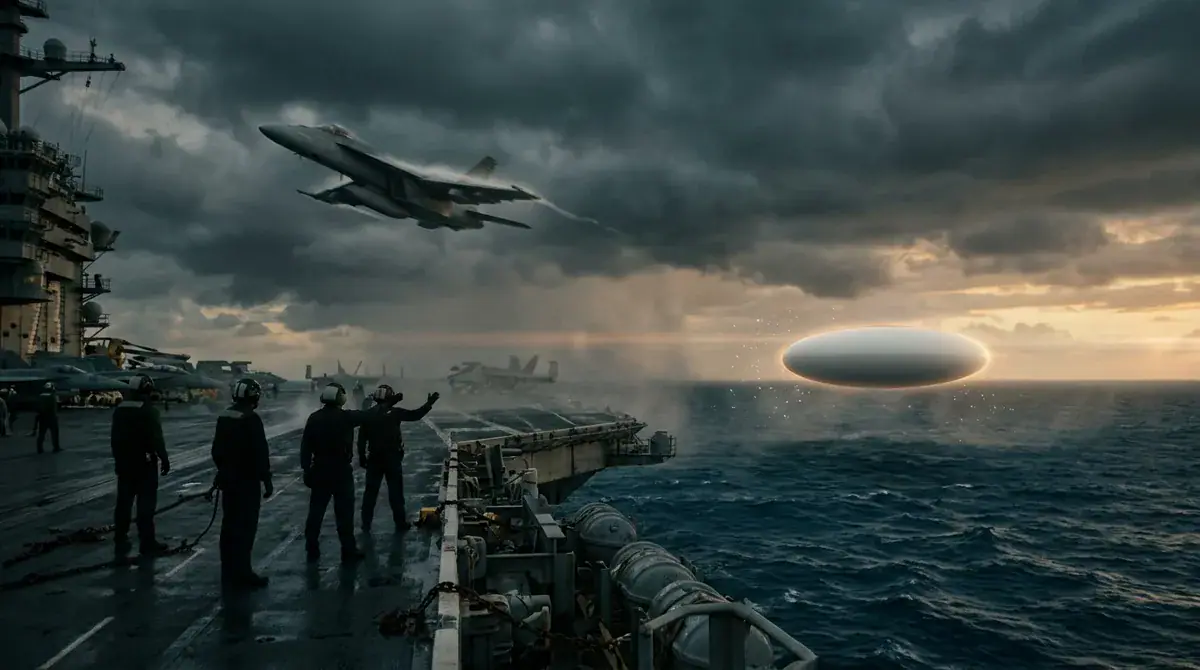
The Nimitz UFO encounter took place on November 14, 2004, when two U.S. Navy F/A-18F jets were pulled from a training exercise to investigate an unknown contact off Southern California. The pilots reported a small, white object shaped like a Tic Tac mint, hovering over a patch of churning water with no visible wings or rotors. The case is one of the most closely examined UFO reports in modern military history, and parts of its official record have only recently come into public view. It began aboard USS Nimitz during a carrier-group deployment, and the chain of orders that sent the jets out moved from the ship’s control room to the cockpit in minutes.
In written statements to a House committee, retired Navy Commander David Fravor, who led Strike Fighter Squadron 41 at the time, described a radar contact that appeared about 60 miles away and was reached in less than a minute. A roughly 90-second targeting-pod video, recorded by a different crew, was released by the U.S. government in 2017. In April 2020, the Department of Defense authorized the release of three Navy videos, including the November 2004 footage, and said the phenomena in them remained unidentified. The full sensor record behind the pilots’ account has not been made public, so readers are left weighing a mix of firsthand memory, a short video, and radar details that are still largely described rather than shown.
Key Takeaways
- The Nimitz UFO encounter took place on November 14, 2004, when two U.S. Navy F/A-18F jets from Strike Fighter Squadron 41 were pulled from a training exercise to investigate an unknown contact off Southern California.
- Retired Navy Commander David Fravor, who led Strike Fighter Squadron 41 at the time, testified to a House committee that the Nimitz radar contact appeared about 60 miles away and was reached in less than a minute.
- The roughly 90-second targeting-pod video of the Nimitz encounter was released by the U.S. government in 2017, and the Department of Defense authorized the release of three Navy videos, including the November 2004 footage, in April 2020 while describing the phenomena as unidentified.
- The full sensor record behind the Nimitz pilots’ account, including the radar data from USS Princeton, has not been made public, so the object’s identity, speed and size remain unverified.
- The House Subcommittee on National Security, the Border, and Foreign Affairs heard Fravor’s testimony at its July 26, 2023 hearing on unidentified anomalous phenomena, giving readers firsthand accounts to weigh against the limited public evidence.
What Happened Over the Pacific on November 14, 2004?
On November 14, 2004, the orders that sent two Navy jets toward an unknown object moved from a warship’s radar room to the cockpit in a matter of minutes. The encounter took place during a routine carrier-group deployment off Southern California, with USS Nimitz (CVN-68) at the center of the group. Carrier Air Wing Eleven flew its aircraft from the carrier, and the pilots involved belonged to Strike Fighter Squadron 41 (VFA-41).
The ship that set the chain in motion was USS Princeton (CG-59), a guided-missile cruiser sailing with the group. Princeton carried the Aegis Combat System, built around the AN/SPY-1 radar, which can track many targets at once. Fravor testified that the Princeton air controller had been watching the same objects on Aegis for about two weeks before the flight. That detail matters because it suggests the contact was not a single fleeting blip on one screen.
Princeton then directed a two-aircraft flight of F/A-18F Super Hornets away from a training exercise. The jets were given a destination but not a clear explanation, and the pilots had to work out what they were facing as they closed in. The controller’s report and the flight’s own orders were two separate links in the same chain, and each one depended on the one before it.
Once the jets reached the area, Fravor said he and the other three aircrew saw the object over a patch of white water. Nothing about it looked like a conventional aircraft to them. Fravor’s account describes a smooth, compact shape with no visible rotors or wings, and it is the visual part of the story that most readers remember. Visual observations made under pressure are hard to measure, but four trained aviators reporting the same thing carries weight in any review.
The Navy’s radar picture is described differently. Fravor testified that Princeton’s radar later placed the object at the flight’s combat air patrol point, a position the jets were heading toward. That implies the object moved in a way that would have been difficult for the aircraft to match. Analysts often focus on this speed claim because it is the detail that would be hardest to explain with an ordinary aircraft, but the figures come from testimony rather than a released radar log.
Fravor later presented his account to lawmakers. The House Subcommittee on National Security, the Border, and Foreign Affairs held a hearing on unidentified anomalous phenomena on July 26, 2023, with Fravor as a witness. His testimony gives the public a firsthand view of how the orders were passed and how the crews responded.
Readers can trace the sequence step by step: a controller watching a contact for weeks, a cruiser directing a flight, four aviators looking at an object over the water, and a radar track that places it at a fixed point. Each step comes from people who were there or from documents that describe their reports, and the official record connects them without fully settling what the object was.
A Small White Object Over Churning Water
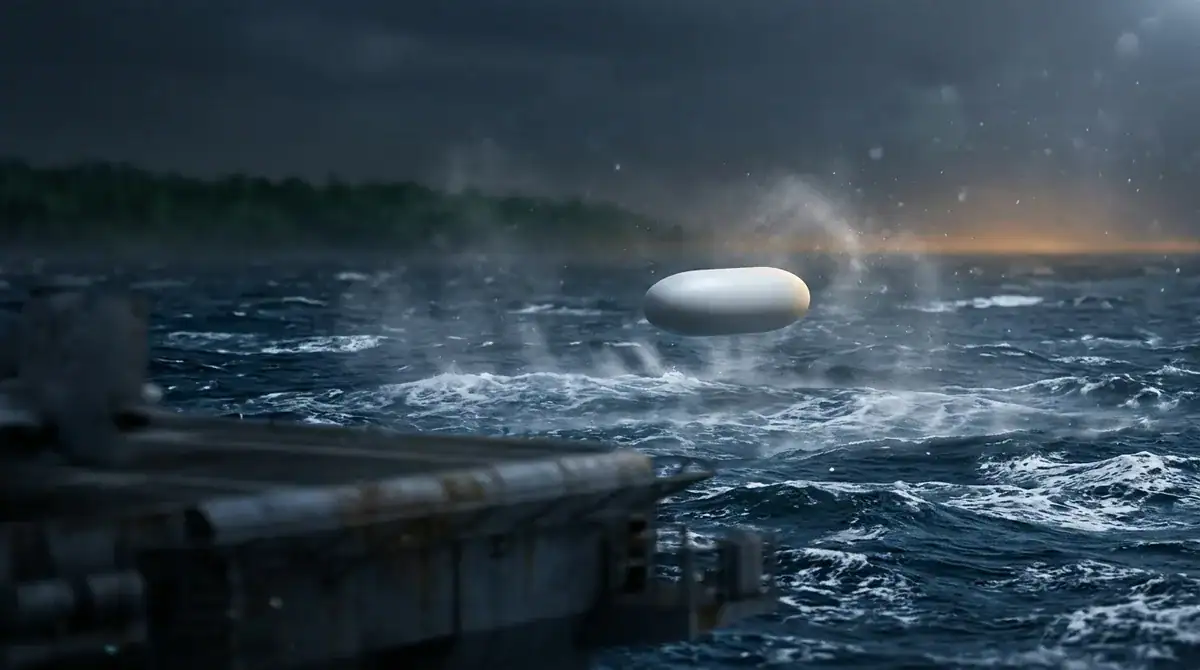
Fravor’s testimony describes the object as small and white, and he compared its shape to a Tic Tac mint. The nickname stuck because the crew reached for a familiar, everyday object to explain something they had never seen before. A shape like that is easy to picture, which is part of why the name spread so quickly beyond the squadron.
The object was reported hanging over a patch of white water, a foamy, churning surface that stood out against the darker sea around it. Fravor testified that neither he nor the other three aircrew could see any rotors or wings. For a pilot, that absence is striking. Nearly every aircraft a Navy aviator would know has some visible way of generating lift or thrust, so an object with none of those features would have looked unfamiliar even at a glance.
The crew’s description of movement is where the account becomes more dramatic. Witnesses said the object behaved in ways they could not match with any aircraft they had flown or seen before. They did not describe it in engineering terms. Instead, they framed it as a contrast with what they knew, pointing to how it sat over the water and how it reacted to the jets approaching it.
It is worth being clear about what kind of evidence this is. The public accounts describe what the crew saw, and the words come from people trained to judge speed, distance and altitude in the air. Still, those judgments were made in the moment, from cockpits, without a published measurement attached to them. No released document gives the object’s size, altitude or exact speed in numbers that could be checked against a standard. The shape and the behavior are reported impressions, not readings.
That gap shapes how readers should weigh the story. A description can be vivid and sincere while still leaving room for other explanations, such as a distant object seen against a difficult sky or a shape that looked different from the angle of the jet. Skeptics point to exactly this kind of uncertainty, while supporters argue that four experienced aviators describing the same thing counts for something. Both views depend on how much weight one gives to trained observation compared with the lack of hard numbers.
Did Radar Also Pick Up the Object?
Yes. Fravor testified that USS Princeton’s radar later placed the object at the flight’s combat air patrol point, roughly 60 miles away, a spot the jets reached in less than a minute. That claim makes radar one of the most important pieces of the case, though the public has only the testimony describing it.
The Aegis Combat System is a network that links a warship’s radars, computers and weapons controls into one picture of the sky and sea. Its main sensor, the AN/SPY-1 radar, sends out pulses of radio energy and listens for the echoes that bounce back. Fravor testified that the Princeton air controller had been watching the reported objects on Aegis for about two weeks before the flight. If that is accurate, the contact was a recurring feature on the ship’s screens rather than a single surprise.
The public has only part of the radar picture. The radar details come from Fravor’s account of the controller’s report. No released radar dataset, track file or timestamped log has been published that would let outside analysts plot the object’s path themselves. Readers are therefore relying on a secondhand description of what a trained operator saw on a screen.
A radar screen rarely shows a picture. It shows a bright mark, a line of travel and a set of numbers for distance, bearing, speed and altitude. A radar can tell an operator that something is there, how fast it is moving and which way it is heading, but it cannot reveal whether that something has wings, rotors or a smooth hull. Think of hearing a bell through fog: you can tell where it is and how it moves, but you cannot see its shape. That is why a radar contact and a visual sighting answer different questions.
The two kinds of report also come from different instruments and different people. The radar operators on Princeton were watching a screen from inside a ship, while the four aviators were looking through the canopies of two jets at the same time. Because they are independent, in principle they can be checked against each other. If the times, bearings and distances line up, the reports support one another. If they drift apart, investigators have to ask why.
Parallax complicates that comparison. Parallax is the apparent shift of an object when it is viewed from different places. Hold a finger up in front of your face, close one eye and then the other, and the finger seems to jump against the background. Radar and cameras suffer from a similar effect. A ship and a moving jet see the same contact from different positions and angles, so the position each one reports may not match exactly, even when both are correct. A camera on a fast aircraft also changes its angle every second, which can make a distant object appear to shift or change size.
Because of parallax, a mismatch between the radar picture and the cockpit view would not automatically mean either account was wrong. The question for readers is narrower: did the radar track and the cockpit sighting describe the same object at the same moment? The answer depends on logs and timing details that the public has not yet seen in full.
How Did the Navy Video Reach the Public?
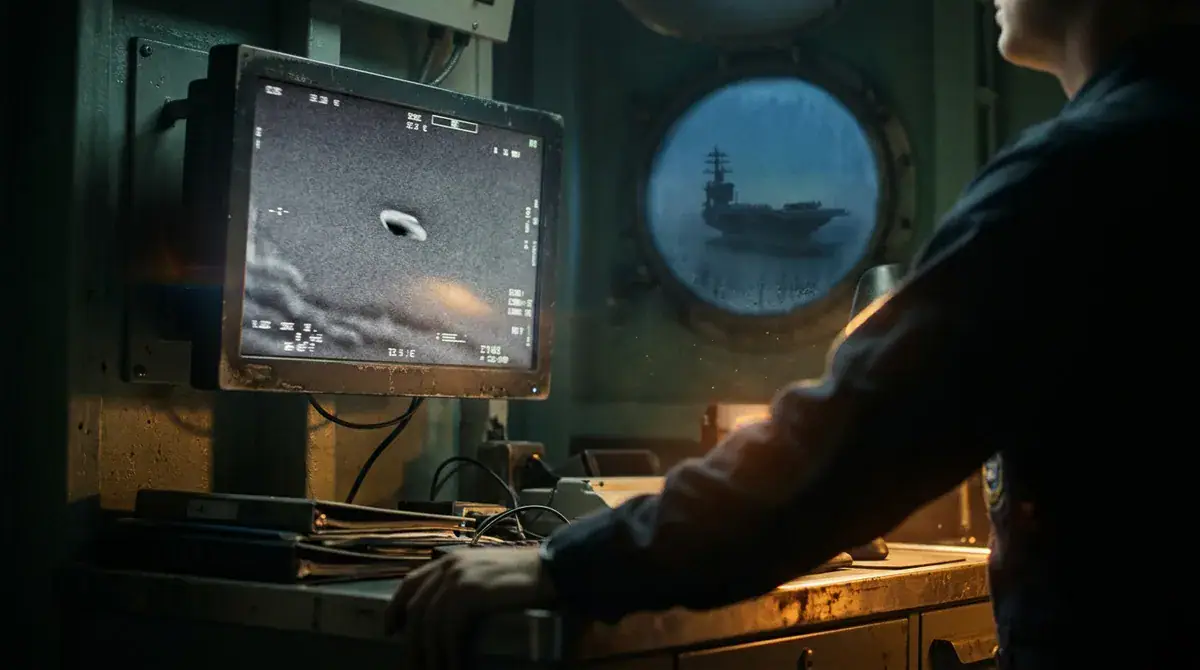
The video reached the public in three steps: a recording made by a different crew in November 2004, a release by the U.S. government in 2017, and a formal authorization by the Department of Defense in April 2020. Fravor’s statement makes clear that the footage was not shot by the pilots who chased the object. Instead, a different crew recorded the roughly 90-second clip through a targeting pod, a sensor unit carried on a fighter jet.
A targeting pod is a pod-shaped housing that attaches to an aircraft and lets its crew find, identify and follow distant objects. Most pods carry an infrared camera, which senses heat rather than visible light. The picture it produces is built from heat contrast. Warmer things appear brighter or darker than the cooler background around them, so a moving object can stand out clearly even when its outline is hard to make out.
Think of a thermal photo of a house on a winter night. The glowing windows and warm roof are easy to spot, but the paint color, the shape of the trim and the small details are gone. An infrared image works in a similar way. It can show that something is there, how bright its heat signature is and how it moves across the frame, but it does not reveal fine edges, surface texture or markings. Viewers who expect a sharp picture often come away disappointed for exactly this reason.
Fravor said the U.S. government released the video in 2017. The Department of Defense took a further step on April 27, 2020, when it authorized the release of three unclassified Navy videos, one of them recorded in November 2004. In its statement, the department said the aerial phenomena in the videos remained “unidentified,” a word that describes an object whose origin and nature have not been established.
Two other clips, known to the public as GIMBAL and GOFAST, are the videos most often discussed alongside the Nimitz footage. Because all of these recordings come from sensors that read heat, they can look strikingly alike even when the objects they show are very different. Readers comparing them should keep in mind that a similar glow on the screen does not mean the objects share a shape, size or speed.
The release history also shows how much of the record has passed through official hands. Each step decided what the public could see, and none of the released clips includes the full set of sensor data that would let outside analysts check the timing, range and motion of the object. Readers can follow the path from the cockpit camera to the public screen, but the route has gaps where the most detailed evidence would sit.
What Did the Navy and Congress Say About the Case?
The official record treats the Nimitz footage as genuine and unexplained, but it has never assigned the object an identity. The Navy uses a broad definition of the term UAP, Congress has heard testimony about the case, and the government has released the video without naming what it shows.
The Navy’s published definition of UAP is deliberately broad. It covers any aerial object or event that has not been identified, so it works as a sorting category rather than a conclusion. Under that wording, a report can be filed as UAP while analysts still consider ordinary explanations such as balloons, drones, sensor errors or unfamiliar aircraft. The term does not imply an extraterrestrial explanation.
Many readers first encounter the Advanced Aerospace Threat Identification Program, usually called AATIP, when they start searching for the Nimitz case. It was a Pentagon effort that is often linked to collecting and studying reports of unusual encounters, including some involving Navy pilots. Public accounts disagree about how large its role was and how its files were handled, so readers should treat its connection to the Nimitz reports as one part of a larger, still-developing story.
Congress brought the case into open discussion when the House Subcommittee on National Security, the Border, and Foreign Affairs held its hearing on July 26, 2023. Fravor appeared as a witness, and the hearing was framed around national security, public safety and government transparency. The setting mattered because it turned a story from pilots’ memories into testimony that lawmakers could question, record and place on the public record.
The Department of Defense went further in its earlier statement, confirming that the November 2004 video was a genuine Navy recording and approving it for release. The statement left the object unnamed.
An “unidentified” label is a statement about the evidence, not a claim about the object. It means that the people who examined the record could not match the object to a known aircraft, balloon, satellite or natural phenomenon using the information available to them. A police report that lists an “unknown suspect” works the same way: the phrase describes the state of the investigation, not the identity of the person. Readers who keep that difference in mind can see the official position for what it is, a record of what remains unsettled.
Has the Tic Tac UFO Been Debunked?
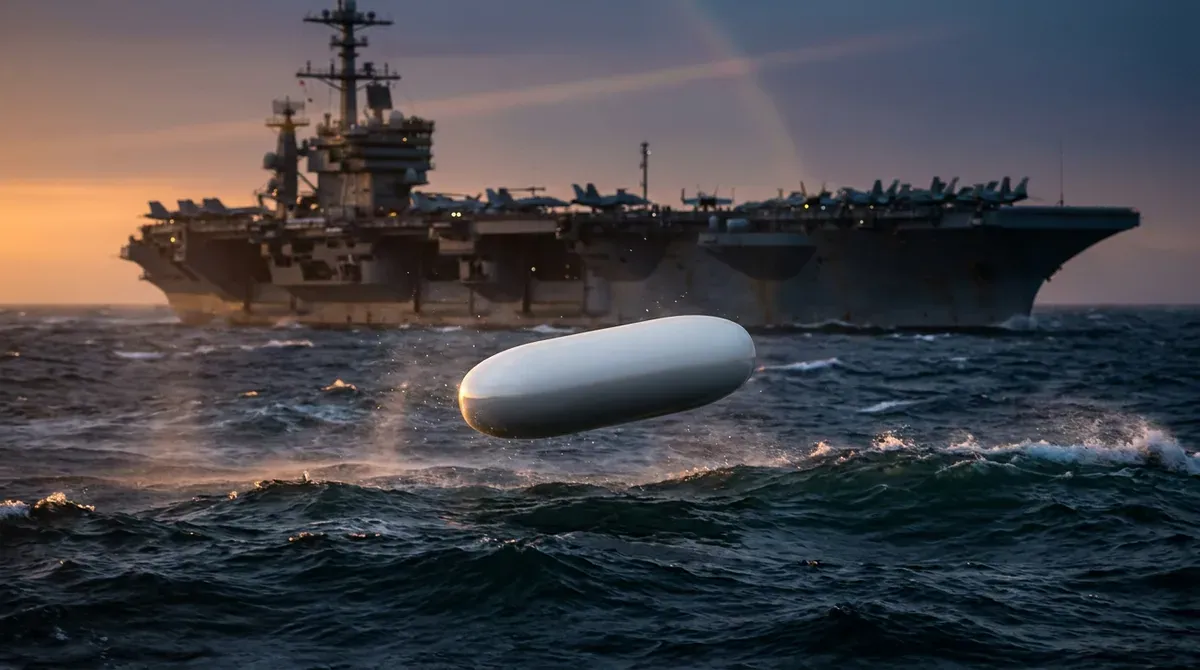
No, the Tic Tac case has not been debunked, because no proposed explanation accounts for every reported detail, and the object has not been identified in the public record. Several ordinary explanations have been offered, and each one fits part of the story better than the rest.
Sensor and optical artifacts come first. An infrared camera can produce bright points from internal electronic noise, lens reflections or glare, and a faint heat source can look like a solid shape once the image is blurred or compressed. Radar can also generate false returns from clutter, stray echoes or the instrument’s own processing. Any of these could explain a blip on a screen, but a single artifact would also have to explain why four aircrew described the same compact shape through their canopies.
Conditions over water add another layer of uncertainty. A churning sea throws up whitecaps and spray, and foam can look like a solid surface or a shape hanging above it. Bright sun on the water can flood a pilot’s view with glare, and uneven light can make a distant object seem closer or farther than it is. Layers of air over the ocean can also bend radio waves, an effect known as radar ducting, which can make a target appear where it is not. Each of these effects is well understood, yet none has been shown to match the full set of reports from that afternoon.
Parallax cuts both ways. A jet turning at speed, a cruiser many miles away and a camera on a moving aircraft each view the object from a different angle, so the positions and motion they record may not match. Parallax could make a steady object seem to jump or speed up. It does not, however, explain why the visual description and the radar picture would both point to the same unusual behavior, unless the timing and bearings are checked against one another.
Media coverage has drawn criticism too. Critics have argued that news stories often led with the most dramatic claims, such as the speed, the Tic Tac shape and the idea of a craft that defies known flight, while giving little room to technical uncertainty. A story built on one short video or one memorable quote can make the case sound settled in either direction. Readers who saw only headlines may have missed that the Department of Defense described the phenomena as unidentified, not explained.
Debunking claims face the same gaps as the dramatic ones. A suggestion that the object was a balloon, a sensor error or a reflection is only as strong as the data behind it, and the public record lacks the full radar logs and timestamps that would let outside analysts test those ideas. A confident debunking built on the released video alone is as incomplete as a confident claim of advanced technology.
Readers can weigh the options with a simple exercise. For each explanation, ask which observations it accounts for easily, such as the white shape over the foam or the radar contact at the patrol point. Then ask which details it can only handle by adding an extra assumption, like a second object, a miscalibrated sensor or a crew misremembering the time. The explanation that needs the fewest unproven assumptions is not automatically the correct one, but it is a sensible place to begin.
Why Do Witness Accounts Still Divide Opinion?
Witness accounts divide opinion because trained pilots describe what they saw with clear conviction, while the public record that could confirm those details is still incomplete. The people involved were experienced Navy aviators, and many readers give their observations real weight for that reason. Fravor and the other three aircrew spent their working lives judging speed, distance and altitude from a cockpit, so a shared description from four of them is harder to dismiss than a single sighting from a casual observer.
Still, testimony is not the same as a measurement. Fravor’s statements to Congress came in 2023, nearly two decades after the flight over the Pacific. In the years between, the crew had likely discussed the encounter, read press coverage and heard the video described many times. Memory does not store events like a recording. It rebuilds them each time they are recalled, and details such as the order of events, the distance to the object or the length of the chase can shift without the witness noticing.
The official record supports part of the story. The Department of Defense confirmed that the November 2004 video was a genuine Navy recording, and its statements say the phenomena remained unidentified. What is missing is the full radar and sensor data behind the picture the pilots and controllers described. Without complete logs, outside analysts cannot check the timing, bearings and speeds that the testimony lays out.
The Nimitz case also does not stand alone. Other Navy reports from the USS Theodore Roosevelt group are often discussed alongside it, and some readers see them as part of a wider pattern of encounters reported by trained crews. Others point out that repeated reports could also reflect how sensors, expectations and reporting habits interact. Placing the cases side by side raises the same question each time: are the repeated reports evidence of something real, or evidence of how people look for what they expect to see?
Trained observers and incomplete instruments are two different kinds of evidence, and each can mislead in its own way. A skilled pilot can still misjudge a distant object over glaring water, and a radar contact can be hard to interpret without its full data. Readers who weigh one against the other will reach different conclusions, and that tension is a large part of why the case still draws attention.
When experienced aviators agree on what they saw, but the instrument records that could test their account remain out of view, how much weight would you give the witnesses?
What Evidence Is Still Missing?
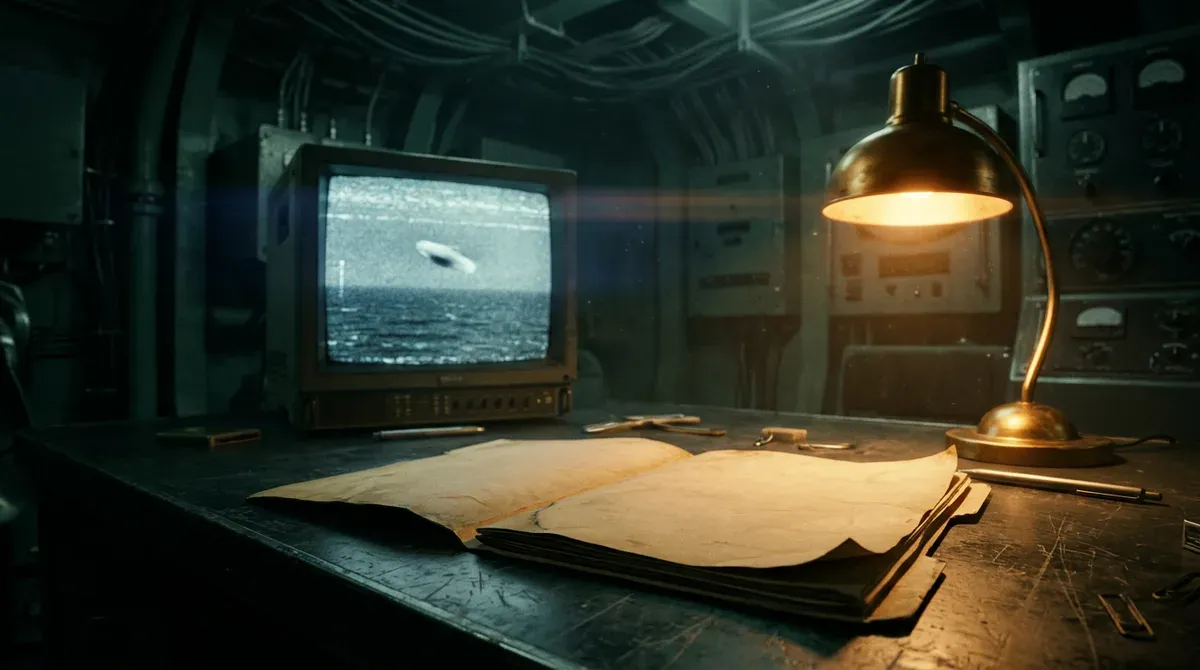
The public record is missing the full sensor data that would test the Nimitz account, and that gap leaves the object’s identity, speed and size unsettled. The complete radar dataset from USS Princeton has not been released, so no outside analyst can plot the object’s track, check its timestamps or compare its bearings with the cockpit reports. What the public has instead is a description of what the controller saw, delivered as testimony rather than shown in a log.
The object’s speed, size and identity have not been independently verified from public sources. The speed figure comes from Fravor’s account of a radar track, and no published file lets anyone recalculate it. No measurement of the object’s size has been released either. Without a confirmed distance, a small shape and a larger one can look nearly identical in a sensor image. Nothing public links the object to a known aircraft, balloon, satellite or natural phenomenon.
The Department of Defense’s use of the word “unidentified” deserves a careful reading. It answers a narrow question: the object could not be matched to anything known using the information the department reviewed. The label leaves the question open, and that is a fact about the record, not a verdict.
Testimony and video are both real public records. The pilots’ accounts were given in writing to a House committee, and the department confirmed that the November 2004 footage was a genuine Navy recording. Together they form the core of what is available. The video is short and built from heat readings, and the testimony describes moments the camera never captured.
Readers who want to form their own view can start with the primary material. Read the written statements and note which details come from direct observation, which come from the controller’s report, and which come from memories recalled years later. Then watch the released videos and ask what a heat image can and cannot show. Set the description of the object’s movement beside the radar account, line by line, and mark every point where the record simply stops.
Where Would You Draw the Line on the Tic Tac Case?
You should draw the line where the public record can no longer be checked. Claims that a reader can test, such as the roughly 90-second targeting-pod clip and the written statements, deserve close attention. Claims that depend on a missing log should stay open.
Start with the video. Watch the clip once at full screen, then again with a stopwatch, and note how long the object stays in the frame before it disappears. Heat images can show a bright shape moving, but they rarely show edges or markings, so write down what the clip can and cannot tell you.
Next, set that clip against the testimony. Fravor described a radar contact about 60 miles away that the jets reached in less than a minute. For each number, ask whether anything visible in the video could confirm it. Mark each claim as “yes,” “no,” or “only partly.”
Then list the details that depend on memory, such as the order of events or how long the chase lasted. Give each one a question mark. Years passed between the flight and the 2023 statements, so those details deserve the most caution.
Finally, decide your own line. Would you accept the object as unexplained but not alien? Would you need the complete radar track before you believed anything about its speed? Name the one document you would most want released, and share your answer in the comments so other readers can compare their lines with yours.
Frequently Asked Questions
1. Why was the November 2004 Nimitz video not made public until years after the flight?
Public sources do not explain why the footage stayed out of view for more than a decade, so the reason for the delay is not known. The record shows that the U.S. government released the clip in 2017, and on April 27, 2020, the Department of Defense authorized the release of three unclassified Navy videos, including the one recorded in November 2004. The department described the phenomena in those videos as unidentified.
2. Has the Navy or the Nimitz crew given an official explanation of the object since 2004?
No official explanation that identifies the object has been published in the public record. The Department of Defense’s 2020 statement kept the word unidentified for the phenomena in the videos, and the Navy’s broad definition of UAP is a sorting term rather than a conclusion. The most detailed public account from the crew comes from David Fravor’s written testimony to a House committee in 2023, which describes what he and his fellow aircrew saw but does not name the object.
3. Can you tour the USS Nimitz?
Mysterious Realms does not run, sell or arrange tours of USS Nimitz. The ship is a working Navy aircraft carrier, so it is not set up as a visitor attraction like a museum ship, and any access would be decided by the Navy rather than offered as a paid experience.