The Great Sky Battle Of 1561 Nuremberg
On the morning of April 14, 1561, the citizens of a bustling German city woke to a sky that seemed to be at war. This event remains the cornerstone of ufo sightings at nuremberg, where hundreds of witnesses watched spheres, crosses, and massive tubes dance around the rising sun. While modern skeptics often look for natural explanations, the sheer scale of the spectacle left a permanent mark on history.
Today, the mystery feels more relevant than ever as unidentified aerial phenomena reports continue to climb across Europe. From that ancient celestial battle to the high-tech sensors of the present day, these accounts challenge our understanding of the skies. Exploring these sightings requires a balance of historical documentation and an open mind toward the truly unknown.
Key Takeaways
- The 1561 Nuremberg event stands as one of history’s most significant UAP records, documenting a massive aerial engagement involving spheres, cylinders, and a dominant spear-shaped craft.
- Hans Glaser’s woodcut broadsheet provides a vital primary source that used Renaissance-era vocabulary to describe what modern observers would interpret as advanced mechanical technology.
- While meteorologists suggest natural phenomena like sun dogs, these scientific theories struggle to explain the reported intentional movements, hour-long duration, and physical crashes described by hundreds of witnesses.
- The historical accounts from Nuremberg bridge the gap between ancient observations and modern UAP reports, suggesting that unidentified aerial phenomena are a long-standing presence rather than a recent trend.
Hans Glaser And The Famous Woodcut
Hans Glaser, a local letter-presser and woodcut artist, became the primary chronicler of the chaos that unfolded in the morning sky. His famous broadsheet, published just days after the event, provided a vivid visual and written record for a public that was both terrified and fascinated. Hans Glaser’s woodcut meticulously carved an image of the horizon filled with blood-red crosses, blue and black globes, and massive flickering pipes that seemed to launch smaller objects into the fray. This document remains one of the most significant pieces of historical evidence because it suggests that the witnesses were seeing something entirely outside their existing vocabulary. By using the technology of the Renaissance printing press, Glaser ensured that this frightful spectacle would be preserved for centuries rather than fading away as a local legend.
The woodcut describes a scene that modern eyes might easily interpret as a high-tech aerial engagement between advanced crafts. Glaser reported that these shapes began to fight one another, moving with purpose and speed until several of them crashed to the earth in a cloud of smoke. He even detailed the appearance of a massive, black, spear-like object that seemed to signal the end of the conflict. While some historians suggest these sights were caused by natural weather phenomena like sun dogs, Glaser’s insistence on the mechanical and aggressive nature of the objects keeps the mystery alive. His work invites us to wonder if the people of 1561 were actually witnessing a display of technology that was hundreds of years ahead of its time.
What do you think was really happening over the rooftops of Nuremberg that morning? Was Hans Glaser recording a rare atmospheric trick of light, or did he leave us a rare, firsthand account of a struggle involving unidentified aerial phenomena? We would love to hear your thoughts on whether these Renaissance-era descriptions match modern-day reports of UAPs. Share your theories in the comments below and let us know if you think history is hiding more secrets like this one.
Aerial Combat Above The City Spires
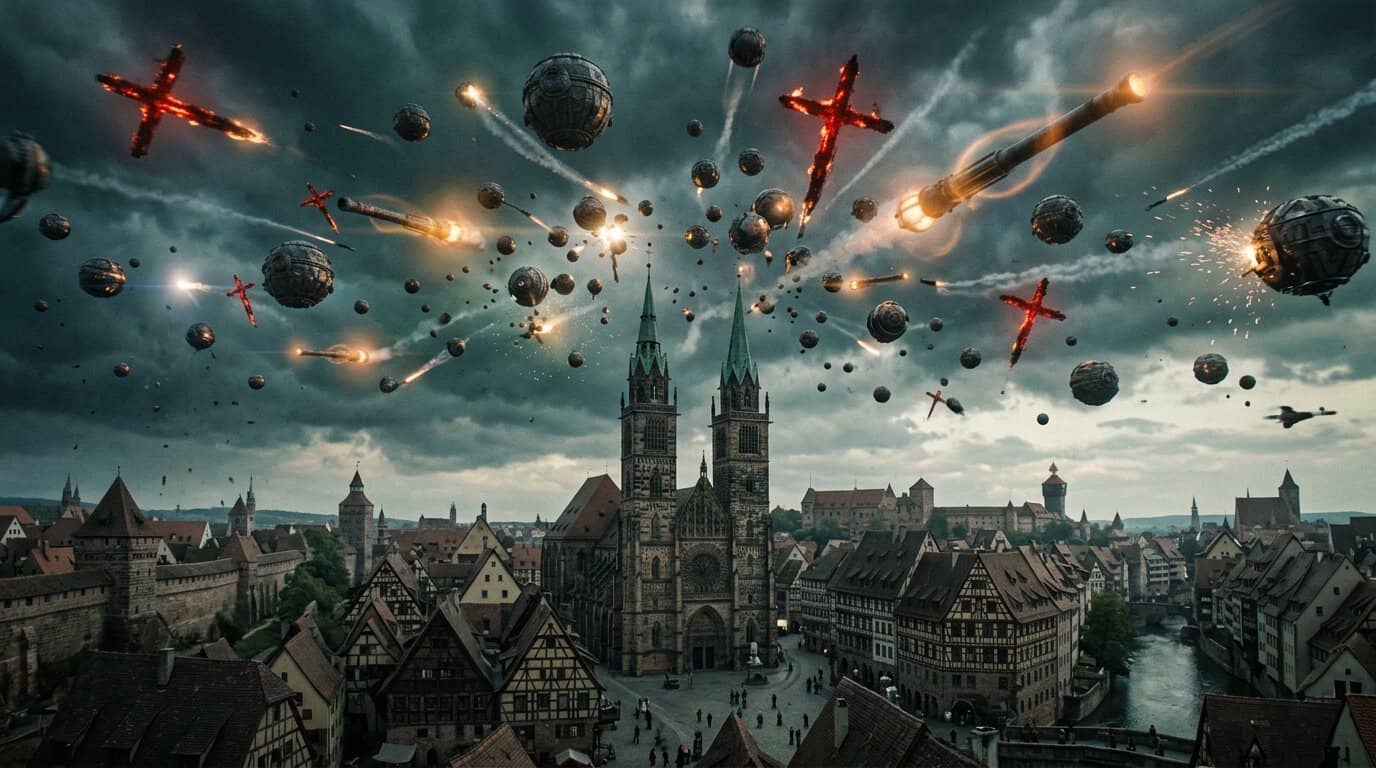
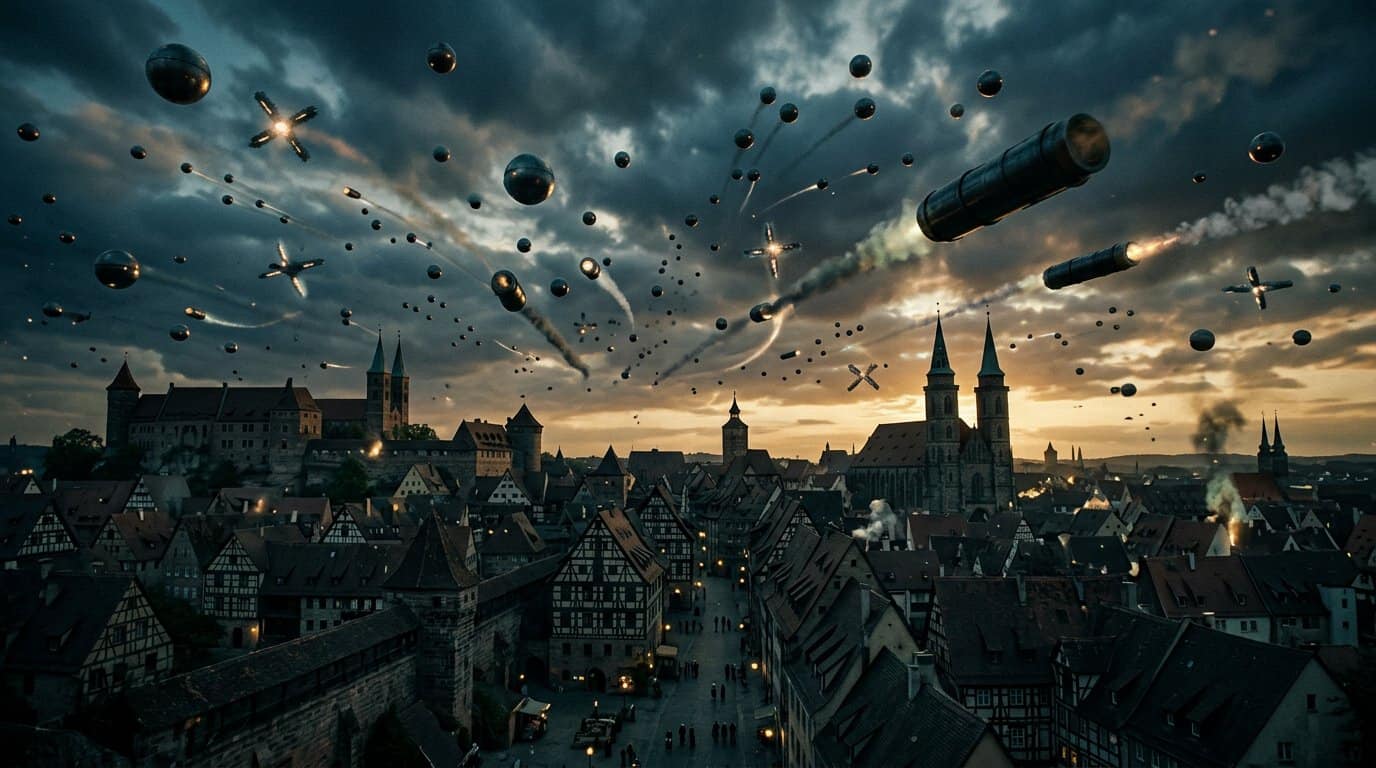
As the sun began to rise over the spiked rooftops of Nuremberg, the morning sky transformed into a chaotic theater of light and motion. According to the broadsheet published by Hans Glaser, hundreds of red, blue, and black spheres emerged from large cylindrical tubes that hovered near the horizon. These tubes acted like massive mother ships, launching smaller objects that darted across the sky in a frantic, organized dance. Witnesses described the scene as a fierce struggle, where the various shapes collided and maneuvered around one another as if locked in a high stakes aerial duel. The sheer scale of the movement suggested a level of technology that was completely foreign to the people of the sixteenth century.
The peak of the encounter occurred when a massive, black, spear shaped object appeared and seemed to assert its dominance over the entire sky. This triangular craft was described as being incredibly long and thick, pointed at one end and wide at the base, stretching across the celestial battlefield like a Great Sword. Its arrival signaled a shift in the energy of the event, casting a shadow over the smaller spheres and crosses that had been clashing just moments before. Many observers felt a sense of awe and dread as this dark titan loomed above the city spires, seemingly putting an end to the frantic movements of the smaller crafts.
As the battle reached its conclusion, several of the glowing objects were seen falling toward the earth in a trail of smoke and flame. Hans Glaser reported that these crafts appeared to burn up as they descended, vanishing before they could be recovered by the startled citizens below. This sudden disappearance left the residents of Nuremberg with more questions than answers, as the sky eventually returned to its natural state. While some modern researchers suggest these were natural reflections or parhelia, the specific descriptions of mechanical tubes and a giant black spear continue to fuel the theory that Nuremberg was the site of a genuine prehistoric encounter.
Scientific Sun Dogs Versus Ancient Aliens
Modern meteorologists often point to parhelia, more commonly known as sun dogs, to explain the chaotic scene over Nuremberg in 1561. These optical illusions occur when sunlight refracts through hexagonal ice crystals in high altitude clouds, creating bright spots and halos that can look like glowing spheres. According to researchers at the National Center for Atmospheric Research, these atmospheric conditions can produce complex patterns that might confuse an observer unfamiliar with the science of light. While this provides a grounded explanation for the colorful globes, it struggles to account for the specific descriptions of dark, spear like shapes or the organized movement reported by the townspeople.
Proponents of the ancient astronaut theory suggest that the woodcut by Hans Glaser documents a genuine encounter with advanced technology rather than a trick of the light. They argue that the detailed descriptions of cylindrical tubes releasing smaller spheres sound remarkably like modern accounts of mother ships deploying scout craft. This perspective treats the 16th century witnesses as reliable observers who simply used the vocabulary of their time, such as crosses and spears, to describe mechanical objects they could not understand. If these were truly physical crafts engaged in an aerial battle, it would represent one of the most significant pieces of evidence for extraterrestrial visitors in human history.
The debate between a natural phenomena like sun dogs and a prehistoric dogfight remains one of the most intriguing mysteries in the study of unidentified aerial phenomena. While ice crystals can explain some of the visual distortions, they rarely account for the hour long duration or the smoky aftermath described in the historical broadsheet. By looking at the event through both a scientific and a speculative lens, we can appreciate how a single morning in Germany continues to challenge our understanding of the sky. What do you think the residents of Nuremberg actually saw that morning, and could a natural phenomenon truly be responsible for such a detailed and violent description?
The 1561 Celestial Battle Over Nuremberg
The 1561 celestial phenomenon over Nuremberg remains a cornerstone of modern ufology because it represents one of the most detailed historical records of a potential aerial battle. Hans Glaser’s vivid woodcut broadsheet captured a moment that defied the scientific understanding of the Renaissance, documenting spheres and cylinders in a complex dance across the morning sky. This event continues to challenge researchers to look beyond simple weather patterns or optical illusions like sun dogs. By examining these ancient accounts through a modern lens, we can see how the human experience of the unknown has remained remarkably consistent over the centuries. The black spear-shaped object that ended the spectacle still serves as a haunting reminder that some mysteries may never be fully solved by history alone.
Today, the rise in global UAP reports has brought renewed interest to this sixteenth-century mystery as we look for patterns in our skies. While skeptics often point to natural atmospheric conditions or religious metaphors, the sheer scale and duration of the Nuremberg sighting suggest something far more physical and intentional. This case bridge the gap between ancient mythology and advanced technology, proving that the fascination with visitors from beyond is not just a modern trend. It forces us to consider if we are truly the first generation to witness such wonders or if we are simply the latest to document a long-standing presence. Much like the dancing plague of 1518, these mass events in European history highlight how entire populations can be swept up in phenomena that defy easy explanation. The legacy of Nuremberg persists because it invites us to wonder about our place in a much larger and more active universe.
As we look back at the woodcuts and testimonies from that spring morning in Germany, the debate between natural wonder and extraterrestrial visitor remains as lively as ever. Was the celestial battle a rare meteorological event that the people of Nuremberg interpreted through their own cultural fears, or did they witness a true technological marvel from another world? Much like Germany’s unsolved massacre at Hinterkaifeck, the vivid descriptions of metallic rods and crashing spheres continue to spark the imagination of every curious soul who looks at the stars. We invite you to weigh in on this centuries-old mystery and share your perspective on what really happened over the city. Do you believe this was a natural phenomenon of the sun, or do you think the 1561 broadsheet is proof of early visitors from beyond our world? Some researchers even compare these Renaissance accounts to the ancient UFOs described in Egyptian texts, suggesting a global history of unexplained aerial activity. Much like the Ariel School Encounter, these mass sightings provide compelling evidence that unidentified objects have been interacting with humanity across different eras and cultures.
Frequently Asked Questions
1. What exactly happened during the 1561 Nuremberg event?
On the morning of April 14, 1561, hundreds of citizens witnessed a chaotic aerial display involving spheres, crosses, and large tubes moving around the sun. This spectacle lasted for some time and reportedly ended with several objects crashing to the earth in clouds of smoke.
2. Who was Hans Glaser and why is his work important?
Hans Glaser was a local woodcut artist and letter-presser who documented the event through a detailed broadsheet. His vivid visual record and written descriptions preserved the encounter for history, providing a unique look at how Renaissance witnesses interpreted these strange objects.
3. What did the objects in the sky look like?
Witnesses described seeing blood-red crosses, blue and black globes, and massive flickering pipes that appeared to launch smaller shapes into the air. These shapes moved with purpose and speed, creating a scene that many today compare to a modern aerial battle.
4. Are there any natural explanations for this event?
Some skeptics suggest the event could have been a sun dog or a similar atmospheric light phenomenon. However, the descriptions of complex movements and objects crashing to the ground make it difficult to dismiss the event as a simple trick of the light.
5. How does this historical sighting relate to modern UFO reports?
The Nuremberg event serves as a foundational mystery that mirrors modern reports of unidentified aerial phenomena across Europe. By looking back at these ancient accounts, researchers can find patterns that challenge our current understanding of the skies and what might be visiting them.
6. Why did the witnesses believe they were seeing a battle?
The objects appeared to fight one another in an organized fashion, moving back and forth with high velocity until some were consumed by fire. This purposeful behavior led the people of Nuremberg to believe they were watching a celestial conflict unfold right above their city.
7. Is the original woodcut still available to view today?
The famous broadsheet created by Hans Glaser is preserved in historical archives and remains a primary piece of evidence for the sighting. It continues to be studied by historians and researchers who are interested in the intersection of art, history, and the unexplained.