The Man Who Brought Skulls To Life: Mikhail Gerasimov And The Art Of Reconstruction
Imagine standing face-to-face with a powerful ruler who died centuries before the camera was ever invented. For decades, the world of archaeology relied on artistic imagination until Mikhail Gerasimov transformed the field with his unique anatomical approach. By treating the human skull as a detailed map of muscle and flesh, Gerasimov allowed us to look into the eyes of legends like Ivan the Terrible and Timur. This method bridges the gap between cold bone and living history, turning ancient remains into recognizable human beings.
Gerasimov’s technique was far more than just an artistic hobby; it was a rigorous scientific pursuit that changed how we view the past. Instead of simply guessing the thickness of skin, he meticulously layered clay over the skull to mimic the way muscles naturally attach to bone. This breakthrough did not just solve historical puzzles, it gave a voice to the silent dead and proved that our skeletons hold the secrets of our true identity. Today, his work remains a fascinating blend of forensic science and haunting artistry that continues to captivate anyone curious about our ancestors.
Key Takeaways
- Mikhail Gerasimov’s anatomical method revolutionized facial reconstruction by treating the human skull as a precise blueprint where bone ridges and grooves dictate the placement of muscle and flesh.
- The scientific validity of this technique was proven through successful forensic applications in the Soviet justice system and historical recreations of figures like Ivan the Terrible and Timur.
- Gerasimov’s work bridged the gap between archaeology and biology, demonstrating that a person’s true physical identity remains etched into their skeletal architecture long after death.
- While primarily used for historical and forensic purposes, the anatomical layering method offers a rigorous framework for investigating mysterious or non-human remains that defy standard classification.
Mikhail Gerasimov And The Anatomical Method Of Reconstruction
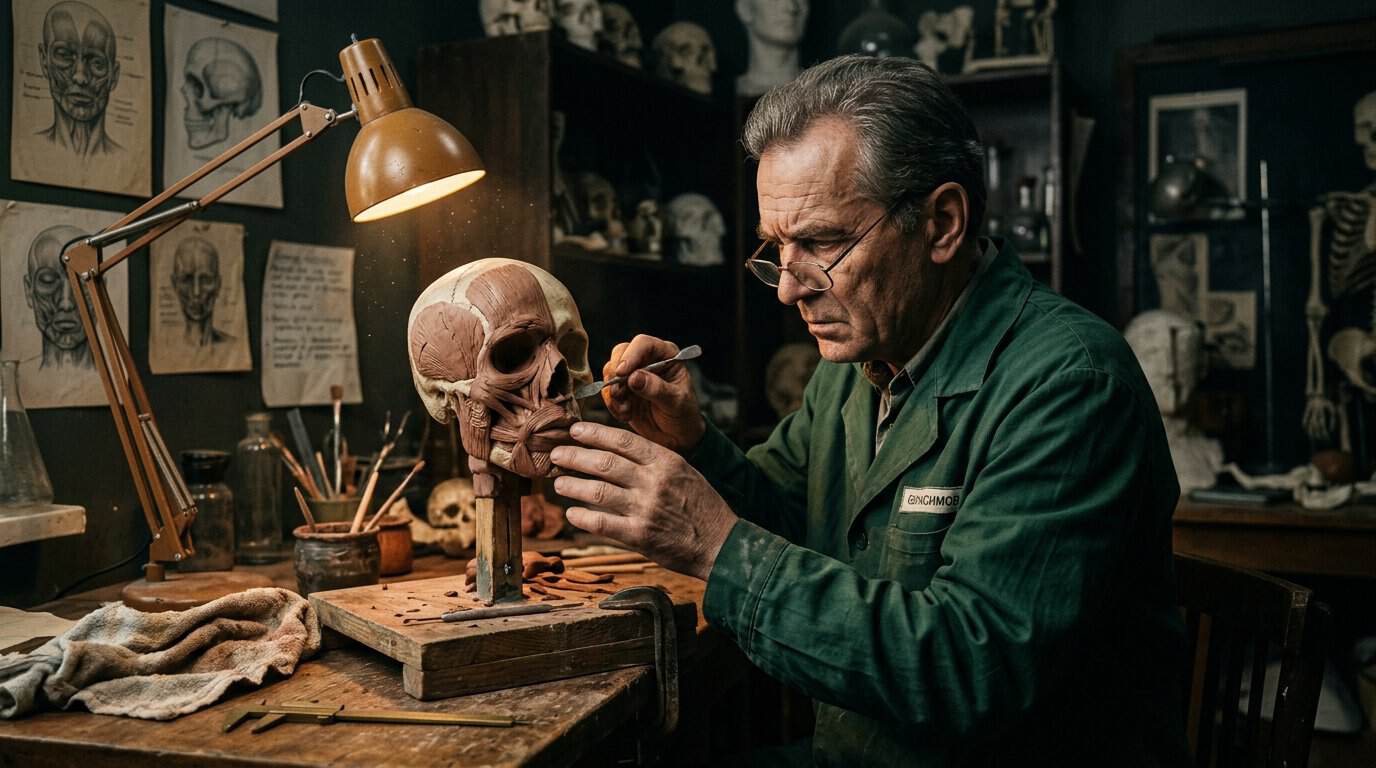
Mikhail Gerasimov transformed the study of the past by treating the human skull as a detailed blueprint for the living face. Instead of relying on simple averages or soft tissue markers, he pioneered an anatomical method that involved sculpting individual muscles directly onto the bone. He believed that every ridge and groove on a skull provided specific instructions on how a person’s features once looked. This approach allowed him to move beyond guesswork, creating lifelike clay portraits that seemed to breathe with personality. His work suggested that the dead still carried their true identity in their remains, waiting for a skilled hand to peel back the layers of time.
The success of Gerasimov’s technique was put to the test when he reconstructed the face of the brutal Tsar, Ivan the Terrible. By analyzing the muscle attachment points on the Tsar’s skull, Gerasimov captured a stern and weary expression that historical records later supported. He also applied his talents to the legendary conqueror Timur, exhuming the body just days before the German invasion of the Soviet Union. These reconstructions were so vivid that they bridged the gap between dry archaeology and the living world. His ability to pull a recognizable human image from ancient bone gave him a reputation as a scientific expert who could summon the ghosts of history.
While Gerasimov is best known for his work with famous world leaders, his methods have also touched the fringes of the unexplained. Some researchers wonder if his anatomical layering could be applied to more mysterious remains, such as those that do not fit standard human descriptions. By following the bone’s natural architecture, Gerasimov proved that the truth of an organism’s appearance is etched into its very skeleton. This leaves us to wonder what other faces might be hidden in the world’s most controversial fossil finds. If we apply his rigorous muscle-by-muscle technique to these anomalies, what kind of creatures might finally look back at us?
Rebuilding History Through The Faces Of Ivan The Terrible And Timur
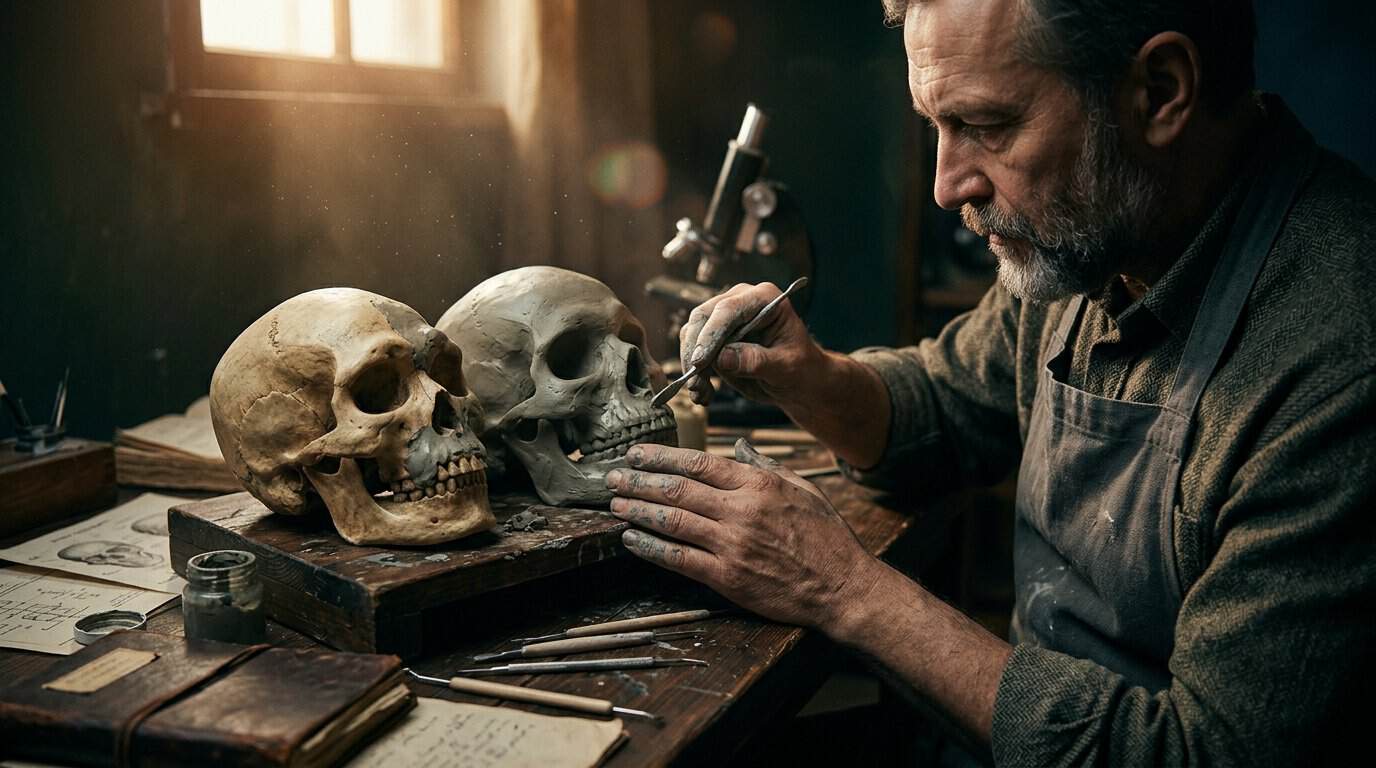
Mikhail Gerasimov approached the skulls of history’s most formidable rulers not just as an archaeologist, but as a sculptor of the dead. In 1941, he exhumed the remains of the Turco-Mongol conqueror Timur, also known as Tamerlane, from his tomb in Samarkand. Legend warned that disturbing the conqueror would unleash a spirit of war, and coincidentally, the Nazi invasion of the Soviet Union began just days later. Despite the superstitions, Gerasimov meticulously applied his anatomical method, building facial muscles directly onto the bone to reveal a stern, powerful face that matched historical accounts of Timur’s fierce personality. This project proved that his technique could bridge the gap between ancient skeletal remains and a living, breathing human likeness.
Decades later, Gerasimov turned his attention to the remains of Ivan the Terrible, the first Tsar of Russia. By analyzing the attachment points of muscles on Ivan’s skull, he was able to recreate a face that appeared bloated and weary, reflecting the Tsar’s notoriously difficult final years. Interestingly, Gerasimov’s reconstruction revealed physical details that traditional portraits had missed, such as the heavy set of the jaw and the specific wear on the bones. Later scientific studies and chemical analyses of the remains confirmed many of Gerasimov’s findings regarding the Tsar’s health and the high levels of mercury in his system. These results provided a hauntingly accurate window into the past, suggesting that the Russian Method could capture the true essence of a person long after their flesh had withered away.
The success of these historical recreations has led many to wonder just how far Gerasimov’s anatomical insights could reach. While he focused primarily on human history, his ability to read the hidden stories written in bone has sparked debate about his work on more mysterious or controversial remains. His method relies on the idea that the skull is a perfect blueprint for the face, leaving little room for artistic guesswork. This intersection of forensic science and historical mystery invites us to reconsider what we think we know about the figures who shaped our world. If Gerasimov could bring a Tsar back to life through his bones, what other secrets of this ancient find might be waiting to be uncovered in the world’s most enigmatic burial sites?
Forensic Success And The Mystery Of Non-Human Reconstruction
Mikhail Gerasimov earned a legendary reputation within the Soviet justice system due to his ability to identify human remains through his anatomical method. While many forensic experts relied on simple tissue depth charts, Gerasimov meticulously sculpted clay muscles directly onto the bone based on the unique texture of the skull. This technique was put to the test in numerous criminal investigations where the identity is solved through careful analysis of physical evidence. In one famous instance, Soviet authorities provided him with a skull from a cold case, and his finished sculpture was so accurate that the victim’s family recognized the likeness immediately. His success rate in these forensic puzzles transformed his work from a niche scientific experiment into a vital tool for the state.
Beyond solving modern crimes, Gerasimov pushed the boundaries of his craft by attempting to recreate the faces of ancient hominids and prehistoric ancestors. This transition into the deep past sparked a wave of curiosity and debate, as he applied his muscle-by-muscle technique to skulls that were not entirely human. He sought to bridge the gap between primitive species and modern man, providing a startlingly lifelike look at faces that had been extinct for millennia. These reconstructions often possessed an expressive, soulful quality that challenged the cold, ape-like depictions common in textbooks at the time. By treating these ancient remains with the same forensic rigor as a modern crime victim, he invited the world to see these mysterious beings as individuals with distinct personalities.
The mystery deepens when considering how Gerasimov’s work touched upon remains that defied easy classification or belonged to the fringes of known history. His dedication to the truth of the bone meant he was willing to reconstruct any specimen placed before him, regardless of how strange or ancient it appeared. Some observers have wondered if his techniques could be applied to even more controversial finds, such as ancient mysteries that do not fit neatly into the standard evolutionary timeline. This blend of rigid scientific discipline and a willingness to explore the unknown is what makes his legacy so enduring for those interested in the hidden corners of anthropology. If a skull can truly dictate the shape of a face, what other secrets might be hiding in the world’s most unusual skeletal remains?
Bringing Ancient Faces Back to Life
Mikhail Gerasimov left behind a legacy that continues to bridge the gap between the cold reality of skeletal remains and the living breathing faces of history. His anatomical method transformed forensic science by proving that a skull is not just a relic, but a detailed blueprint of a human life. By meticulously layering clay over bone to recreate the likenesses of Ivan the Terrible and Tamerlane, he gave the world a way to look into the eyes of the past. Today, his techniques serve as the foundation for modern facial reconstruction used by investigators and historians alike. This unique blend of archaeology and biology remains a cornerstone of how we identify the nameless and the long forgotten.
Despite his scientific contributions, a lingering question remains about where the data ends and the imagination begins. Gerasimov possessed an incredible eye for detail, yet some critics wonder if his personal intuition played a larger role than he admitted. While his reconstructions often matched later historical discoveries, the process of sculpting a personality from a jawbone feels like a feat of artistic magic. This intersection of rigorous forensic evidence and haunting artistry is what makes his work so captivating for those who study the fringe side of history. It forces us to consider if a true likeness can ever be captured through measurements alone.
The debate over Gerasimov’s work invites us to look closer at the thin line between hard science and human artistry. Was he a pioneer who unlocked a secret language hidden in our bones, or was he a master sculptor who used the skull as a mere suggestion for his art? Some believe his ability to recreate historical figures was almost supernatural in its accuracy, while others see it as a brilliant interpretation of limited data. We want to hear your thoughts on this fascinating blend of forensics and mystery. Do you believe a face can truly be reconstructed with such precision, or is there always a touch of the artist’s hand involved? If you are interested in how modern investigators handle unidentified remains, you might also be intrigued by the haunting mystery of the Salish Sea feet.
Frequently Asked Questions
1. Who was Mikhail Gerasimov and why is his work important?
Mikhail Gerasimov was a pioneering Soviet archaeologist and sculptor who developed a scientific method for recreating human faces from skeletal remains. His work changed history by proving that a skull contains enough anatomical data to reconstruct a person’s true likeness with incredible accuracy.
2. How does the anatomical method of face reconstruction work?
This method involves treating the skull as a detailed blueprint and layering clay over the bone to mimic the way muscles and soft tissues naturally attach. Instead of guessing, the process follows the specific ridges and grooves of the bone to build a face that is unique to that individual.
3. Which famous historical figures did Gerasimov reconstruct?
Gerasimov successfully brought many legendary figures back to life, including the powerful conqueror Timur and the formidable Tsar Ivan the Terrible. These reconstructions allowed people to look into the eyes of leaders who had been dead for centuries, bridging the gap between ancient history and the modern world.
4. Is Gerasimov’s method considered a science or an art?
His approach is a fascinating blend of both rigorous forensic science and haunting artistry. While it relies on strict anatomical rules and biological evidence, it also requires a sculptor’s touch to capture the personality and life that once inhabited the remains.
5. How accurate are these facial reconstructions?
The accuracy of this technique was famously tested and proven through several double blind experiments where Gerasimov reconstructed the faces of recently deceased individuals. In these tests, his clay models were consistently recognized by the families of the deceased, confirming that the skull holds the secrets of our identity.
6. Why do we still use Gerasimov’s techniques today?
Modern forensic scientists and archaeologists still use the foundations of Gerasimov’s anatomical method to solve cold cases and identify unknown remains. His perspective turned cold bone into a living story, ensuring that the silent dead can still have a voice in the present day.