Baba Yaga Folklore: The Witch Who Tests, Threatens, and Guides
Baba Yaga folklore paints a witch who can be a deadly threat to a traveler or a sharp guide who helps a hero win through. In a 2013 University Press of Mississippi anthology, she appears in traditional Russian folktales as either a hungry, monstrous cannibal or a shrewd examiner who puts a young hero or heroine to the test. Scholars who have traced her through these stories describe her presence in hundreds, and possibly thousands, of tales told across Russia, Ukraine, and Belarus since the eighteenth century, if not earlier. That scale suggests she was never a minor character in the village imagination, and the tales rarely settle on a single role for her.
Much of what readers picture today comes from the nineteenth-century collection gathered by Alexander Afanasyev. A 2019 University of Eastern Finland dissertation notes that his work first appeared in eight parts between 1855 and 1863 and contained as many as 640 tale specimens. In these stories she is a wooden-legged witch who lives in an izba that rests on chicken legs, deep in an enchanted wood, and every visitor must decide whether to fear her or trust her. Yet the tales were spoken aloud long before they were printed, and that gap between the storyteller’s voice and the printed page is where the mystery begins. Was she always a monster, a mentor, or something the tellers themselves could never quite name?
Key Takeaways
- Baba Yaga appears in traditional Russian folktales as both a hungry, monstrous cannibal and a shrewd examiner who tests young heroes, and the two roles often appear side by side in the same stories.
- Scholars who have traced Baba Yaga across Russia, Ukraine, and Belarus estimate that she appears in hundreds, and possibly thousands, of tales told since the eighteenth century, if not earlier.
- Alexander Afanasyev’s nineteenth-century collection, first published in eight parts between 1855 and 1863 and containing as many as 640 tale specimens, shaped much of the modern picture of the witch.
- A 2025 research article in the UDEKAD journal argues that Baba Yaga can be read as a tester tied to initiation, the ritual passage from one stage of life to another, rather than as a simple villain.
- Translators and illustrators in English-speaking countries often softened or sharpened Baba Yaga’s roles, so readers who want to judge her for themselves should compare the printed versions with the spoken tradition.
Is Baba Yaga a Monster or a Mentor?
Baba Yaga is an ambivalent figure in Russian and wider East Slavic folktales. She may threaten a traveler, test a young hero, or offer the help that carries him home, and she is rarely just one of these things for long. She is neither a plain villain nor a fairy godmother, and that refusal to stay in one box is what makes her so hard to pin down.
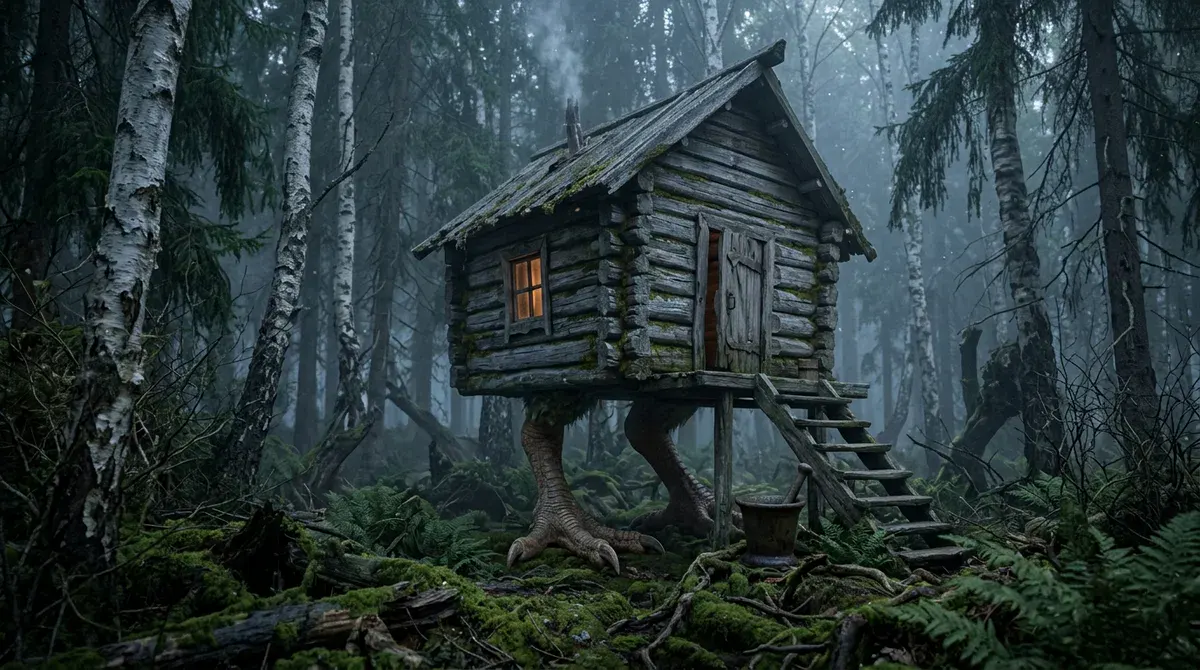
Picture a young hero who has walked since morning along a path that narrows with every hour. The sun sinks behind the birches, the light turns the color of weak tea, and the trees press closer until the path seems to stop. Ahead lies a clearing, and in its center stands a hut that is not quite still. It rests on chicken legs, and it may slowly turn to face the newcomer as if it has been waiting. The folktale asks the hero to decide something quickly: whether to run, to bargain, or to step inside.
That moment holds the two faces of the witch that the tales keep returning to. In one version she is a hungry, monstrous cannibal, a figure who would fit easily into a nightmare about lost children and dark woods. In the other she is a shrewd examiner who sets riddles, chores, and dangerous errands. She watches closely to see whether the young person is clever, patient, and brave enough to deserve what comes next. The two images look like opposites, yet the stories often place them side by side. The same hut that smells of danger may also hold the answer to a riddle, and the same hungry old woman may send the hero away with a gift.
The tale of Vasilisa the Beautiful shows how quickly the roles can shift. Sent into the forest by a cruel stepmother to fetch a light, Vasilisa arrives at the hut and is put to work. Baba Yaga demands chores, asks questions, and at one point sets the girl a task that could easily have ended in her death. Yet the same witch sends Vasilisa home with a skull that burns with fire and gives her the means to survive. Readers who expect a simple lesson about good and evil are left to wonder what the witch actually wanted from the girl.
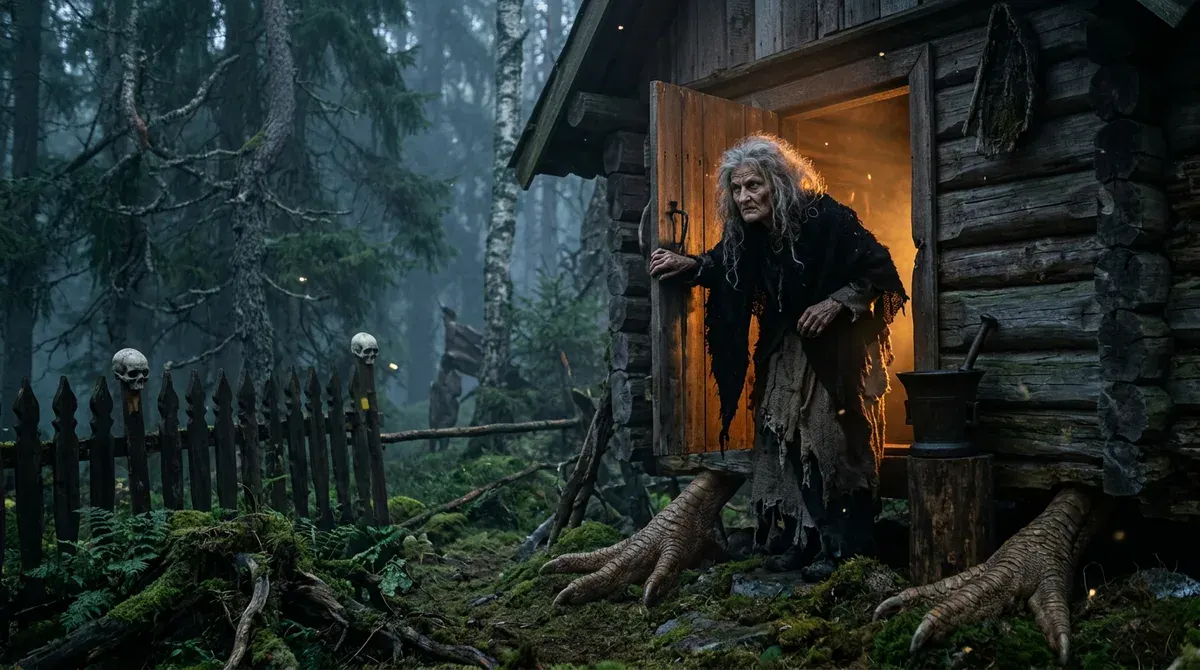
Her memorable motifs help listeners recognize her at once. The hut on chicken legs gives her a home that moves, a sign that she does not belong to the ordinary world of fences, fields, and roads. Her wooden leg is a quieter detail, but it sets her apart as strange and a little unsettling, a body that is not fully human. Together these images make her easy to spot in a story and hard to forget once the tale is over. They also give a storyteller something to play with, since a hut that turns or a leg that knocks against the floorboards can make a listening child hold their breath.
The sheer size of her presence in the tradition adds to the puzzle. A 2014 review of a Sibelan Forrester anthology in the Journal of Folklore Research Reviews notes that the book gathers 29 Russian folktales drawn from the nineteenth-century collections of Alexander Afanasyev and Ivan Khudiakov. The same anthology carries more than 70 images, ranging from older illustrations to photographs of objects that show her likeness. Few characters in the tradition have been drawn, carved, painted, and retold so often, and each new picture seems to pull her a little closer to one role or the other.
So which is she? The stories do not offer a tidy answer, and that may be the point. A monster would be easy to fear and easy to forget, while a mentor would be easy to trust and easy to thank. Baba Yaga sits between the two, asking the hero to prove something before she reveals whether she is a danger or a door. Readers who meet her in a folktale are invited to judge for themselves, and the tellers who passed her along seem to have liked it that way.
The question of motive is where the mystery deepens. What did the first listeners believe the witch was testing for, and why did they keep sending their children to her clearing in story after story? To begin answering that, it helps to follow her path back to the moment when the tales were first spoken, long before they had a printed page to settle them.
Where Did the Stories Come From?
Baba Yaga began as a spoken story, passed from teller to listener in village houses, fields, and market squares long before anyone thought to write her down. No single original text exists, because every teller reshaped her to suit a listener, a season, or a local fear. Scholars can trace the motifs that repeat from tale to tale, but they cannot point to a first storyteller or a first sentence.
Winter was the time when many of these stories were told. Families gathered in warm rooms to spin thread and mend clothes by lamplight, and a single tale could fill a whole evening. A grandmother who wanted a child to stay away from the woods might make the witch fierce and hungry, while a teller who wanted to comfort a frightened boy might give her a patient voice and a useful gift. The same hut on chicken legs could be a place of terror in one kitchen and a place of riddles in another.
Jack Zipes, who wrote the foreword to the 2013 anthology, describes how Andreas Johns followed the witch through a tradition that reached back to the eighteenth century and perhaps earlier. Johns did not find one master version. He found a crowd of voices in Russia, Ukraine, and Belarus, each adding a detail, dropping another, and passing the figure on. That spread of versions helps explain why she is so hard to pin down. A figure carried by so many mouths was bound to change shape at every stop.
Printing changed the picture in a different way. Alexander Afanasyev’s work did not appear overnight, and its beginnings were more practical than dramatic. An archival study reports that the transfer of materials for his collection started in April 1854, and that preparing the first volume took just over six months. During those months, collectors and editors had to decide which versions were worth keeping, which words to trust, and how much of the teller’s manner to preserve. Each decision was a kind of quiet editing, and each one left its mark on the witch who would later appear on the printed page.
Ivan Khudiakov’s nineteenth-century collection adds another layer to the story. Sibelan Forrester drew on his work, along with Afanasyev’s, when she assembled her anthology, so the modern Baba Yaga that many readers meet rests on at least two separate gatherings of tales. Khudiakov and Afanasyev listened to different tellers, in different places, and wrote down what they heard in their own way. When their material meets in a single book, the witch seems more unified than she ever was in a village kitchen.
The move from voice to page carries a cost that is easy to overlook. A teller’s pauses, the lowering of the voice before the witch appears, the sudden laugh, and the hands that mimic a creaking door all disappear when the words are set in type. What remains is a sequence of sentences that can be read silently and quickly. The fear that once made a child hold their breath becomes a line on a page, and readers must supply the sounds and the flickering lamp themselves.
This is one reason the earliest tellers remain so elusive. Their names, their ages, and the exact wording of their stories were rarely recorded, and the witch they described was never meant to be fixed. She was passed along because she was useful to whoever was speaking, whether that meant scaring a child into obedience or teaching a young listener how to think under pressure. Who first decided that she should test a traveler before she helped him, and why that idea held so firmly across generations, is a question the surviving texts can only partly answer.
What Does the Hut on Chicken Legs Hide?
The hut on chicken legs, the enchanted wood, the bone fence, and the skull lanterns together form a border. They mark the place where the ordinary village world ends and another world begins, and where a traveler must prove something before crossing. Folklorists have offered this reading as an argument, not a settled answer, but it explains why the same images turn up again and again.
A 2021 study of Afanasyev’s tales describes Baba Jaga as a wooden-legged witch who lives in an izba that rests on chicken legs in an enchanted wood. Each part of that description does some work. The izba is a house, but it is not planted in soil like a farmhouse. It stands on legs, and in many tellings it can turn to face whoever approaches.
That movement matters. A house that turns is a house that has not decided where it belongs. It seems to sit at the edge of the village and at the edge of something else, facing the traveler as if it has been waiting for a visitor who has already walked too far. Readers who notice the turning hut often sense that the building is more of a gate than a home.
The enchanted wood around the clearing works like a second threshold. In the tales, the path narrows, the light fails, and the familiar landmarks of fields and roads disappear. Folk belief treated forests as places where ordinary rules loosened, where a wrong turn could carry a person somewhere they could not easily return from. A listener who had heard that the witch lived deep in such a wood would already understand that the hero was leaving his own world behind.
Then comes the fence. In the Vasilisa tale, the yard around the hut is ringed with posts, and on each post sits a human skull. The image works as a warning in plain terms. Anyone who sees those skulls knows that others have come this way and not returned, and the fence tells the newcomer what the witch does to those who approach carelessly. It is hard to imagine a clearer sign that the hero has reached the edge of danger.
The skull lanterns add a stranger layer. Some skulls on the fence glow, and one of them, with fire in its eyes, becomes the light that Vasilisa carries home. So the same object that warns of death also lights the way out of the forest. Readers may see this as a riddle the tale poses: the thing that frightens you may also be the thing that guides you through the dark.
Folklorists who study these details often read them as markers of crossing. In this view, the fence and lanterns are signs that a character has entered a liminal space, a threshold where the old identity is set aside and the traveler must be tested before passing through. Arnold van Gennep’s ideas about rites of passage are often invoked here, though scholars continue to argue about how well those ideas fit the Slavic material. The reading is persuasive, but it remains one argument among several.
Artists and curators have also picked up the threshold theme. The Erarta Museum of Contemporary Art presented Baba Yaga in its 2025 exhibition as a possible mediator between worlds, one who can assist a protagonist and guide them into the dark forest. That interpretation shows how the old imagery still speaks to modern audiences, even when the exhibition reads the witch through a contemporary lens rather than an ancient one.
Not every reader is convinced that the setting carries hidden meaning. Some listeners may have heard the hut and fence as nothing more than good storytelling, a grim picture designed to make a child shiver before bed. Skulls on posts were a vivid way to say “stay away,” and a turning house was an easy way to make a witch feel unsettling. That explanation is simple, and it may be partly true.
Yet simple explanations struggle to account for the persistence of these images. Why would a tradition keep a glowing skull, a fence of warning, and a house that moves across so many tellings, unless those details were doing something more than frightening? Perhaps the tellers understood that every threshold asks a question, and the hut on chicken legs was their way of asking it.
Trials, Helpers, and Magic Objects in the Tales
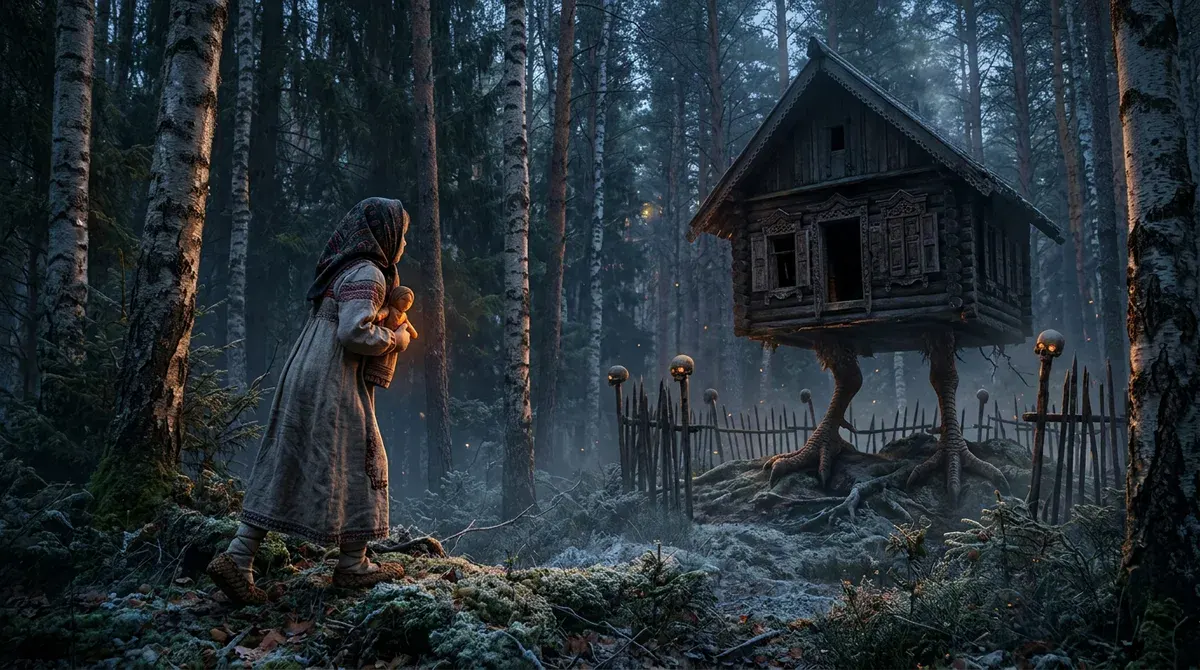
The most famous of these tales follows a girl named Vasilisa the Beautiful. Before her mother dies, she gives Vasilisa a small wooden doll and tells her to feed it and ask it for help whenever trouble comes. After the girl’s stepmother and stepsisters send her into the forest to fetch a light, Vasilisa reaches the hut and finds that the doll has been her quiet companion all along. The doll answers her questions, eats the food she offers, and helps her finish the tasks that Baba Yaga sets. Those tasks are the heart of the story. The witch asks the girl to sort grain, sweep the yard, and cook a meal, and each job tests whether the young person can work carefully and well. Vasilisa succeeds because her helper steps in at the right moments, and the witch’s approval is the reward that follows.
Tasks like these repeat across many folktales. A hero is given a chore that looks simple but cannot be finished by ordinary means, such as separating a mixed pile of seeds before dawn or fetching water from a place no one should reach. Success tends to depend on patience, kindness, or the right animal or object at the right time. Failure usually means the witch will eat the traveler or send them away with nothing. The tales treat these trials as a sort of contract. The hero is not punished for being young or foolish, but he or she must show that they are worthy of the help the witch might offer.
The talking skull is one of the most striking objects in the Vasilisa story. When the girl is finally sent home, Baba Yaga gives her a skull with fire in its eyes to light the road. The skull is not a passive lamp. In many tellings it can see what is hidden in the dark, and it guards the traveler as they walk. Readers who notice that the same skull once sat on a post as a warning may find the detail unsettling, since the object that marked the edge of death is now the one that carries Vasilisa out of the forest. Listeners who heard the story in the village may have sensed that a gift from the witch always came with a cost, even when it looked like a rescue.
Animal helpers appear in a similar way. In many variants of these tales, birds, geese, and talking animals carry the hero across rivers or show the way through the wood. A horse may be the only companion who knows how to cross a dangerous land, and a loyal animal may save the hero’s life at the very moment he is about to fail. Such helpers often remember what the hero forgot, and they tend to appear only after the hero has shown respect or kindness. The witch herself does not always make the animals friendly, but she does seem to recognize when a traveler has earned their help.
Maria Morevna offers a different path through the same world. In this story, a princess is taken by the immortal villain Koschei, and her husband sets out to rescue her with the help of a loyal horse. Along the way, the hero meets several figures tied to the witch’s world, and in some tellings Baba Yaga’s relatives or helpers appear to offer advice, warnings, or directions. Their role is not always clear, and the tales do not explain every relationship. What the story shows is that the witch’s family and network stretch across the forest, so a hero who crosses one threshold may find himself among others who know the old rules.
The conflict between a mother-in-law and daughter-in-law frames many of these journeys. In some versions the young wife is mistreated by her husband’s mother, who finds reasons to send her out of the house. In others, a stepmother takes the same role and gives the girl an impossible errand. Either way, the family tension is the reason the young character walks into the forest in the first place. The witch then becomes the one who sees through the cruelty, and her tests often reveal what the household could not. A listener who had lived with a harsh mother-in-law would have understood the sense of being sent away from safety into danger.
The pattern that emerges is not a simple lesson about obedience or reward. The witch sits at the center of a series of tests in which family pressure, magical objects, animal companions, and hard labor all play a part. Each element asks the young hero to notice something, whether it is the doll’s quiet advice, the skull’s light, or the horse’s patience. The stories seem to invite listeners to ask what the witch is really checking for, and whether the trials reveal the hero’s character or simply the world the hero was born into.
How Did Translators and Illustrators Reshape Her?
English-language readers first met Baba Yaga through translators and illustrators who reshaped her for a new audience, often softening her teeth and sharpening her charm. The tales that crossed into English had already traveled far from the village kitchen, and each stage of translation asked someone to decide what a young reader could handle and what an adult would enjoy.
Among the earliest English gateways were the Russian tales gathered by William Ralston, whose translations placed Russian folk stories beside the familiar fairy tales that English families already knew. Ralston’s versions read like a careful bridge. They kept the outline of the journey, the forest, and the household trials, but they did not always preserve the rough edges of the teller’s voice. For a reader who had grown up with stories about kings and princesses, a witch who tests a girl with sacks of seeds could feel strange, and the translation had to make her understandable without making her ordinary.
Andrew Lang’s colorful fairy books carried the tales further into the nursery. Lang gathered stories from many countries into bound volumes meant for children, and his adaptations leaned toward clear plots, quick pacing, and happy endings. In that setting, the witch’s cruelty was easier to shrink and her gifts easier to highlight. A child reading at bedtime was more likely to remember the skull that lights the road home than the threat of a hero being eaten, and that shift quietly changed the balance between monster and helper.
Caterina Neri’s 2021 article in the Yerevan State University journal names the problems a translator of Slavic folktales must face. The first is the shift from oral tale to written text, which strips away the teller’s pauses, sound effects, and sense of an audience leaning in. The second is the set of conventions that govern children’s literature, which tends to favor clear morals, gentle endings, and characters who are either good or bad. When a translator follows those conventions, the witch’s ambiguity can become a lesson in obedience or a warning about strangers, and the scene that once asked a question now delivers an answer.
Those choices matter because Baba Yaga’s power has always depended on uncertainty. A witch who might eat the hero and might also send him home with a miracle keeps the listener alert. Remove the danger and she becomes a grumpy old helper who grants favors. Keep too much of the danger and she becomes a bogeyman, useful for frightening children into staying near the house. Both versions have obvious appeal, but neither fully matches the tradition, in which the test and the threat are often the same act.
Ivan Bilibin’s illustrations gave many readers a face and a setting before they had read a single line of the story. His pictures drew on Russian folk decoration, carved wooden architecture, and the bold outlines of popular prints, which made the forest and the hut feel rooted in a real world rather than a vague fairy-tale land. The hut on chicken legs, in particular, became easier to picture as an ornate, slightly crooked house with a life of its own. For many readers, that image became the default, and it still shapes how people sketch her today.
Illustration can also settle questions that the text leaves open. A drawing has to show the witch’s posture, her expression, and the way she sits in her home, and each choice tilts the reader toward one role or the other. A stern figure with narrowed eyes reads as a test. A stooped figure with a kindly look reads as a helper. Because the picture arrives first, it often colors how the words are understood, so the same tale can feel menacing in one edition and comforting in another.
The anthology edited by Sibelan Forrester shows how far this visual layer reaches. Its pictures range from older illustrations to photographs of objects that carry her likeness, which means readers see the witch as a drawing, a print, and a carved or painted thing rather than as a single fixed character. That mix reminds readers that Baba Yaga has always lived partly in images, and that every artist who drew her was also deciding what she meant.
So translation changes more than wording. It changes which moments are kept, which are cut, and which are presented as the center of the story. A softened witch makes the hero’s journey feel like a lesson in patience, while a sharpened one makes it feel like a close escape. Readers who first met her in English may have gained a helpful guide, a frightening stranger, or both at once, depending on which book sat on the nursery shelf.
Why Are Scholars Calling Her a Wise Woman?
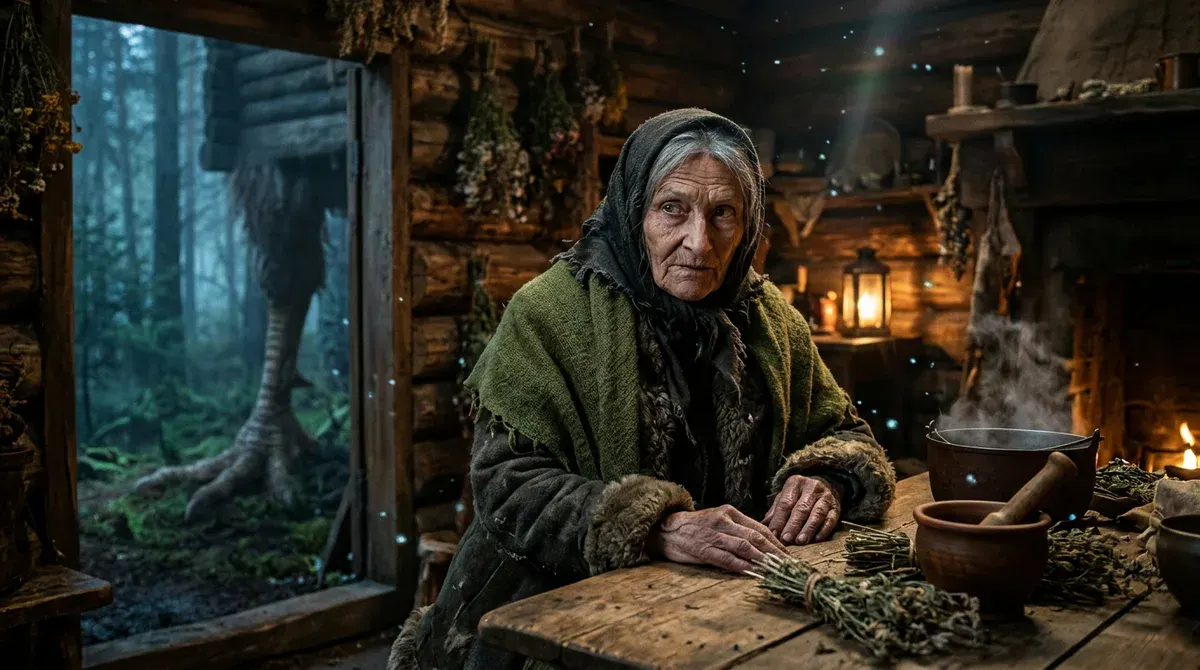
Scholars call Baba Yaga a wise woman because a 2025 research article argues that she can be read as a tester tied to initiation, the ritual passage from one stage of life to another, rather than as a simple villain. The article appeared in the UDEKAD journal on September 30, 2025, in volume 8, issue 3, pages 1225 to 1240. Its authors use anthropological, textual, and comparative methods, which means they study the tales as social customs, compare different versions of the same story, and set Baba Yaga beside figures from other traditions.
The initiation reading starts with the chores. When Vasilisa sorts grain, sweeps the yard, and cooks a meal, the work looks ordinary, but it is also the kind of work that marks a young person as ready to run a household. Seen this way, the witch is less a monster waiting to devour the girl and more an elder who checks whether the child can handle responsibility before sending her back into the world changed. The skull that lights the road home fits the same pattern, since the girl does not leave the forest with the same protection she carried in.
Still, the cannibal image refuses to disappear. The 2013 anthology describes the witch in traditional Russian tales as a hungry, monstrous cannibal and as a shrewd examiner, and both roles appear in the same body of stories. A traveler who fails a test is not sent home with a gift. He or she may simply be eaten, and that outcome is not softened by any talk of initiation. A grandmother warning a child away from the woods would have had little reason to mention the riddles and the rewards.
This is where the two readings pull against each other. The wise woman view explains why the tales keep a test at the center of the encounter, and why the witch so often rewards patience and care. The threat view explains why the fence of skulls and the hungry old woman are so vivid, and why a child would have felt the danger in the story even when the ending was happy. Neither reading needs the other to be false, but each one asks the listener to decide which part of the story matters most.
The reading also has a modern life outside the study. In 2025, the Erarta Museum of Contemporary Art in Saint Petersburg presented Masha Bogoraz’s exhibition “Go and Don’t Look Back,” which ran from September 27 through December 24, 2025. The show placed Baba Yaga among representations of dual femininity, the idea that a woman can be both nurturing and dangerous at once. The exhibition text goes further and presents her as a possible mediator between worlds, one who can assist a protagonist and guide them into the dark forest.
That curatorial choice is worth noticing. An art exhibition is not a scholarly argument, and it does not claim to recover what the first tellers meant. Yet the exhibition and the 2025 research article arrived in the same year, and both moved away from the idea that she is only a warning. Readers who see the witch in a gallery may come away with a softer picture, while readers who grew up with the bone fence may hold on to the older fear.
So how should a reader weigh these claims? A useful start is to go back to a single tale and mark each moment where the witch seems to test, threaten, or help. A test that ends with a reward supports the initiation reading, while a threat that ends in a meal supports the cannibal image. Many moments will not fit neatly into either box, and those are often the most revealing, because they show how quickly the tellers could shift the witch from one role to another.
Scholars may never agree on whether initiation was the original purpose of these tales, or whether it is simply the most satisfying lens for modern readers. The 2025 article makes a strong case, but its argument is still one reading among several, and the older villain image has centuries of storytelling behind it. For readers, the most interesting question may be whether the witch was ever meant to be understood in one way at all. When a child walked out of the forest with a burning skull in hand, did the child feel tested, rescued, or both?
Reading the Forest Path Yourself
Start with one tale from Afanasyev’s collection, preferably the story of Vasilisa the Beautiful, since it holds nearly every motif this article has followed. Read it slowly, ideally aloud, the way a grandmother might have told it on a winter evening. Then find a modern retelling of the same plot, whether a picture book, a short story, or a stage adaptation, and read it straight after the old version.
Keep a pencil nearby and divide a page into two columns. In the left column, write every moment where Baba Yaga threatens: the fence of skulls, her hunger, the chores that could end in death. In the right column, write every moment where she helps: the doll’s advice, the skull that lights the road, the gift sent home with the girl. Some moments will land in both columns, and those are often the ones worth lingering on.
As you read, compare the two versions closely. Ask whether the modern retelling keeps the fence of skulls, whether the witch still wants to eat anyone, and whether Vasilisa succeeds through her own patience or through her helper. Notice which details vanish, which are softened, and which are moved to a different scene. A small change in one detail can turn a tester into a rescuer, or a rescuer into a bogeyman.
Once both columns are full, decide where you stand. Is Baba Yaga a danger that a traveler must survive, a guide who only seems frightening, or a figure who is both at once? Your answer may differ from one tale to the next, and that uncertainty is part of the puzzle the first tellers left behind.
If the border between village and forest in these stories reminds you of other folk figures glimpsed at the edge of everyday life, Mysterious Realms covers the folklore behind unexplained sightings and legendary creatures, where many of the same questions about threat, warning, and guidance come up again.
When you finished your reading, which image stuck with you more: the skull on the fence or the skull that lit the road home? Share in the comments whether that memory makes you think she was a threat, a guide, or both.
Testing the Witch Yourself
Start with the Vasilisa tale, and read it in two versions: one from Afanasyev’s nineteenth-century collection and one retold for children. Read the old version aloud, slowly, the way a family might have shared it on a winter evening, so that the witch’s words carry the weight the printed page cannot fully give them.
As you go, stop at each chore Baba Yaga assigns Vasilisa. Ask whether the task could end in the girl’s death or whether patience could finish it. Mark each one with a T for test or a D for danger, then count how often the witch moves from one to the other. That pattern will show you more about her role than any single label.
To see how the printed version came together, read the archival study on Afanasyev’s sources, a 2026 study of how his collection was assembled. Pay attention to which tellers are named and which remain anonymous. Those gaps shaped what the witch could become on the page, and they may explain why the tale still feels unsettled today.
Last, tell the story to someone who has not heard it. Watch where your listener leans forward, where they pause, and what they expect the witch to do next. Their reaction may reveal whether the tale feels like a warning, a lesson, or a little of both.
Frequently Asked Questions
1. How do you pronounce Baba Yaga, and does the spelling change between translations?
Baba Yaga is usually pronounced BAH-bah YAH-gah, with stress on the first syllable of each word. The spelling varies because Russian letters have no exact English match, so translators and scholars also write Baba Jaga or other variants. All of these spellings refer to the same witch of the folktales.
2. Is Baba Yaga the witch in Hansel and Gretel?
No, Baba Yaga and the witch in Hansel and Gretel come from separate folk traditions. Hansel and Gretel is a German fairy tale in which the witch lives in a house made of bread and sweets, and she has no link to the hut on chicken legs. Witches appear across European folklore, which is why the two are often confused.
3. Why did the John Wick films lead people to search for Baba Yaga’s meaning?
In the John Wick films, the title character is given the nickname Baba Yaga by the criminals who fear him. The films use the witch’s reputation as a dangerous figure who punishes anyone who crosses her path. That pop culture use sent many viewers looking for the original folklore behind the name.
4. Are there tale type classifications that group Baba Yaga stories together?
Yes, folklorists use the Aarne-Thompson-Uther index, which sorts folktales by plot type. The Vasilisa the Beautiful story is usually filed under the index’s entry for the kind and unkind girls. Many other Baba Yaga tales appear in different types, since the witch appears in stories with different plots.
5. Is Baba Yaga a myth or a fairy tale?
Baba Yaga is best described as a figure of folklore who appears mainly in folktales, rather than as a god from a religious myth. Scholars use the words myth and fairy tale loosely, but her stories were told as entertainment and as lessons for listeners. That places her closer to the folktale tradition than to a sacred story.
6. Did people in Slavic villages actually believe in Baba Yaga, or was she only a story?
Scholars still debate how literally village listeners took her. Her tales were told on winter evenings, and a grandmother might use the witch to keep a child away from the woods. That practical use suggests she mattered to villagers as a warning and a teaching figure, even if the question of literal belief remains open.