
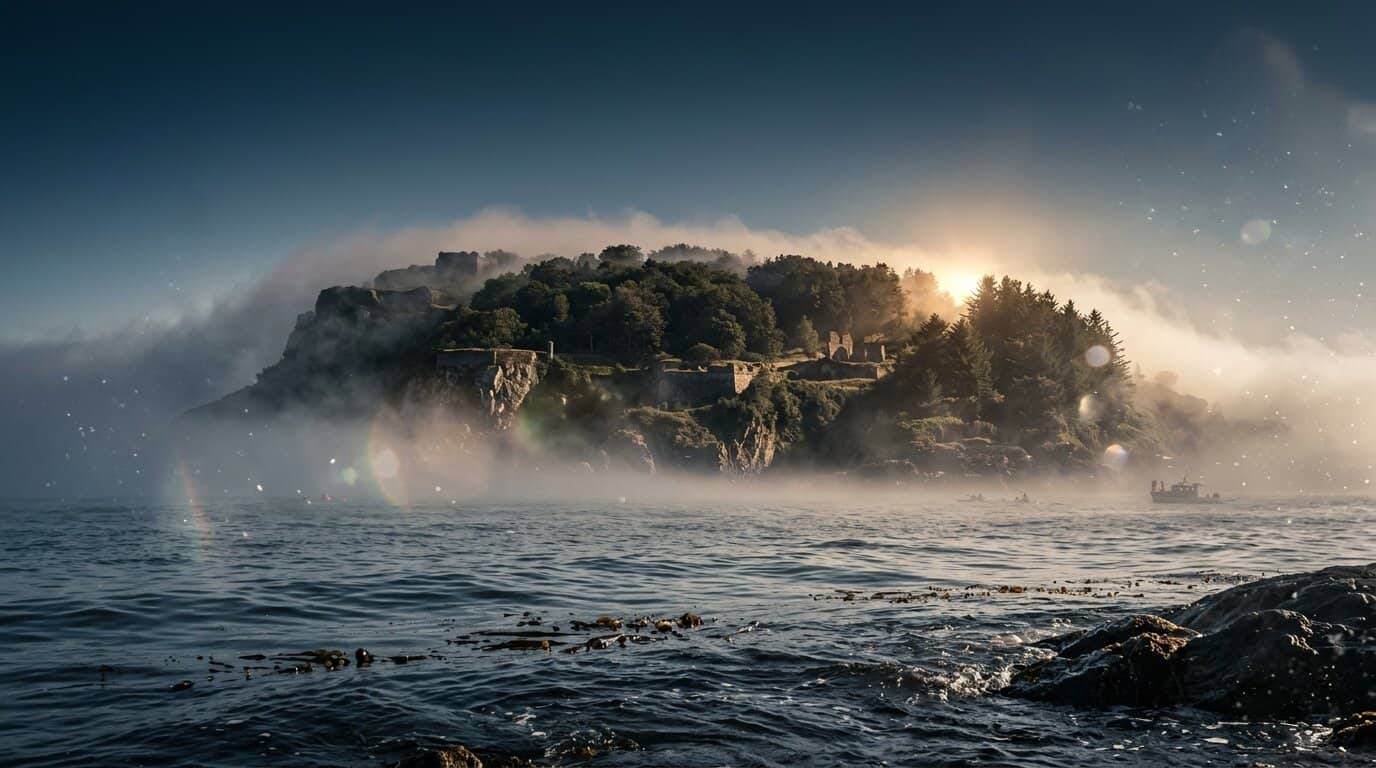
The Vanishing Mist Of Hy-Brasil Island Sightings
For centuries, sailors crossing the Atlantic spoke of a circular paradise hidden behind a thick, supernatural veil of fog. These legendary sightings of a hidden land describe a place that reveals itself only once every seven years, appearing just long enough to tempt explorers before vanishing back into the waves. While modern satellites show nothing but open water west of Ireland, the island’s presence on official nautical charts for over five hundred years suggests that early mariners were chasing something much more tangible than a mere ghost.
The mystery of Hy-Brasil blends ancient Celtic folklore with the high-stakes era of maritime exploration. From the precise maps of the 14th century to the documented expeditions of famous explorers, the consistency of these reports challenges the boundaries of geographical reality. Whether it was a trick of the light, a sunken landmass, or a doorway to another world, the stories of this phantom island continue to haunt the history of the North Atlantic.
Key Takeaways
- Hy-Brasil remained a fixture on official nautical charts for over five hundred years, depicted as a perfect circular island divided by a central river and located 200 miles west of Ireland.
- The legend of the island transitioned from folklore to documented maritime history through high-stakes expeditions by explorers like John Cabot and detailed accounts from Captain John Nisbet.
- The phenomenon of Fata Morgana, a complex atmospheric mirage caused by thermal inversions, likely created the illusion of land and structures for sailors navigating the misty North Atlantic.
- Geological evidence suggests the island may have been the Porcupine Bank, a shallow area that was likely exposed during the last Ice Age before being submerged by rising sea levels.
Ancient Maps And The Circular Phantom
The mystery of Hy-Brasil first gained formal recognition in 1325 when the cartographer Angelino Dulcert placed it on a portolan chart. Unlike the jagged coastlines of known territories, this island was depicted as a perfect circle divided by a singular, straight river running through its center. This striking visual consistency appeared on official nautical maps for centuries, convincing generations of sailors that a terrestrial paradise sat just two hundred miles west of Ireland. Because it was included on professional charts used for navigation, the island was treated not as a fairy tale, but as a legitimate destination for trade and discovery.
The presence of this circular phantom on maps sparked a series of high-stakes maritime expeditions, most notably from the busy port of Bristol. In the late 1400s, explorers like John Cabot were influenced by these charts, with some historical records suggesting that earlier voyagers may have even claimed to find the land. A letter from the Spanish envoy Pedro de Ayala mentioned that the people of Bristol had been sending out ships specifically to hunt for the island of Brasil for years. These sailors were not chasing ghosts, they were following the documented evidence provided by the most respected mapmakers of their era.
While modern satellites show only open water in those coordinates, the persistence of these sightings suggests something more complex than a simple mistake. Some researchers believe the circular shape might have been a clever way for early cartographers to mark a place that was only visible under specific atmospheric conditions. Whether it was a trick of the light known as a mirage or a piece of land that has since sunk beneath the waves, the maps created a bridge between folklore and reality. These early visual records ensured that Hy-Brasil remained a fixed point in the human imagination, inviting us to wonder what else might be hiding just beyond the mist.
Famous Encounters From Cabot To Nisbet

The quest for Hy-Brasil transitioned from ancient folklore to documented maritime history during the late 15th century. In 1497, the Spanish diplomat Pedro de Ayala reported that John Cabot had potentially encountered the island while searching for new lands in the North Atlantic. These early voyages were driven by the consistent appearance of the island on portolan charts, where it was often depicted as a perfect circle divided by a central river. While Cabot’s primary legacy is his arrival in North America, his expeditions highlight how firmly the belief in this phantom land gripped the minds of seasoned explorers. Navigators of the era truly believed they were chasing a tangible landmass that simply refused to remain visible.
The most vivid and mysterious account of the island emerged in 1674 through the reports of Captain John Nisbet. According to these historical narratives, Nisbet and his crew were sailing near the coast of Ireland when a thick fog suddenly lifted to reveal the elusive shores of Hy-Brasil. The crew allegedly stepped onto the island and encountered a large, stone castle inhabited by an elderly man and several servants. This story, documented by contemporary writers like Richard Head, added a layer of high fantasy to the maritime legend. While modern skeptics suggest the tale might have been a clever literary invention, it remains one of the most detailed descriptions of life on the hidden island.
Despite the fantastical nature of these reports, many researchers wonder if there is a grain of truth hidden behind the mist. Some suggest that the sightings were actually optical illusions known as Fata Morgana, where temperature inversions create the appearance of complex structures or land on the horizon. Others speculate that the explorers may have found a sandbank or a volcanic island that has since slipped beneath the waves. The blend of historical documentation and maritime mystery keeps the legend alive for those who love a good puzzle. Do you think these captains truly walked on a hidden island, or were they simply lost in a world of coastal mirages?
Scientific Explanations For Maritime Illusions
While the legend of the mist-shrouded island feels like pure fantasy, many researchers believe that sailors were actually witnessing a complex optical phenomenon known as a Fata Morgana. This type of superior mirage occurs when a layer of cold air sits near the surface of the water while a warmer layer of air rests above it, creating a thermal inversion. This atmospheric quirk acts like a lens, bending light rays and projecting images of distant objects or even the surface of the water itself high into the sky. To a tired sailor on the Atlantic, these distorted reflections could easily take the shape of towering cliffs or lush forests that seem to hover just above the horizon. Because these mirages are highly unstable and change with the temperature, they would appear to vanish or hide themselves as soon as a ship drew near.
Beyond the tricks of light, some historians and geologists point toward actual physical structures hidden just beneath the waves. The Porcupine Bank, a shallow area of the Atlantic shelf located west of Ireland, sits in the exact general vicinity where many ancient maps placed Hy-Brasil. Scientific evidence suggests that during the last Ice Age, when sea levels were significantly lower, this bank would have been a prominent island exposed to the open air. As the glaciers melted and the oceans rose, the land was slowly swallowed by the sea, leaving behind a submerged memory that may have been passed down through oral traditions. Much like the evidence of Atlantis, it is possible that during rare low tides or specific weather patterns, the churning surf over these shallow banks created the illusion of land breaking the surface once again.
These scientific explanations offer a grounded perspective on why so many seasoned explorers claimed to have seen the circular island throughout the centuries. Whether it was a trick of the atmosphere or a lingering cultural memory of a lost landmass, the persistence of the sightings suggests that there was always something real triggering the imagination. Much like the enigma of the Bermuda Triangle, we are left to wonder if these ancient mariners were simply victims of their own tired eyes or if they were catching a glimpse of a world that the ocean had long since reclaimed. What do you think is more likely, a trick of the light or a piece of history hidden beneath the waves? Join the conversation below and share your thoughts on whether Hy-Brasil could still be out there waiting to be found.
Five Centuries of Vanishing Atlantic Sightings
The enduring legacy of Hy-Brasil remains a fascinating bridge between documented history and unexplained maritime mystery. For over five centuries, this circular landmass held a firm place on official nautical charts, guiding explorers like John Cabot into the unknown reaches of the Atlantic. While modern satellites see only empty water, the sheer volume of historical reports suggests that early sailors were chasing more than just a ghost. Whether it was a receding volcanic peak or a persistent optical illusion, the island continues to haunt the edges of Irish folklore.
The story of this phantom island invites us to reconsider the boundaries between geographical reality and collective imagination. It is possible that ancient mariners witnessed a rare atmospheric phenomenon, such as a Fata Morgana, which projected distant coastlines onto the misty horizon. Others wonder if a hidden landmass truly exists, appearing only when the conditions of the sea and sky align perfectly every seven years. This blend of cartographic evidence and speculative theory keeps the legend alive for a new generation of explorers.
Do you believe Hy-Brasil was a physical place that has since vanished beneath the waves, or was it simply a trick of the light shared by centuries of sailors? The ocean is full of secrets, and this shrouded paradise is just one of many islands that seem to defy the laws of science. We would love to hear your thoughts on this maritime enigma, much like an ancient navigator’s secret, or any other lost civilization theories you find compelling. Join the conversation in the comments below and share your favorite stories of the lands that the maps forgot.
Frequently Asked Questions
1. Where exactly was Hy-Brasil located on ancient maps?
Early cartographers like Angelino Dulcert placed the island approximately two hundred miles west of the Irish coast. It was famously depicted as a perfect circle with a straight river flowing directly through its center, a shape that remained consistent on nautical charts for centuries.
2. Why did sailors believe the island only appeared every seven years?
Celtic folklore and maritime tradition claimed the island was shrouded in a thick, supernatural fog that only lifted once every seven years. This legend suggested that the land was enchanted or existed in a different frequency, revealing its beauty to humans only during specific lunar or temporal cycles.
3. Did any famous explorers actually go looking for Hy-Brasil?
John Cabot and many other brave mariners from the port of Bristol launched several expeditions in the late 1400s specifically to find this circular paradise. These explorers were so convinced by the official nautical charts of the time that they risked their lives and fortunes to locate the phantom land.
4. Is there any scientific explanation for these sightings?
Some researchers suggest that the sightings could have been caused by a Fata Morgana, which is a complex optical illusion where light bends to create the appearance of land. Other theories propose that Hy-Brasil was a real landmass or shoal that has since been submerged by rising sea levels or geological shifts.
5. Why did the island eventually disappear from modern maps?
As navigation technology improved and more ships crossed the Atlantic without spotting the circular landmass, cartographers began to doubt its existence. By the mid 19th century, the island was officially removed from charts after being labeled as a persistent but unverified geographical myth.
6. Could Hy-Brasil have been a different landmass altogether?
It is possible that early sailors were actually seeing Porcupine Bank, a shallow area of the Atlantic that may have been above water during periods of lower sea levels. This would explain why the reports were so consistent and why modern satellites only see open ocean where a lush island once stood.