Wild Hunt Origins: Tracing the Phantom Riders of Europe
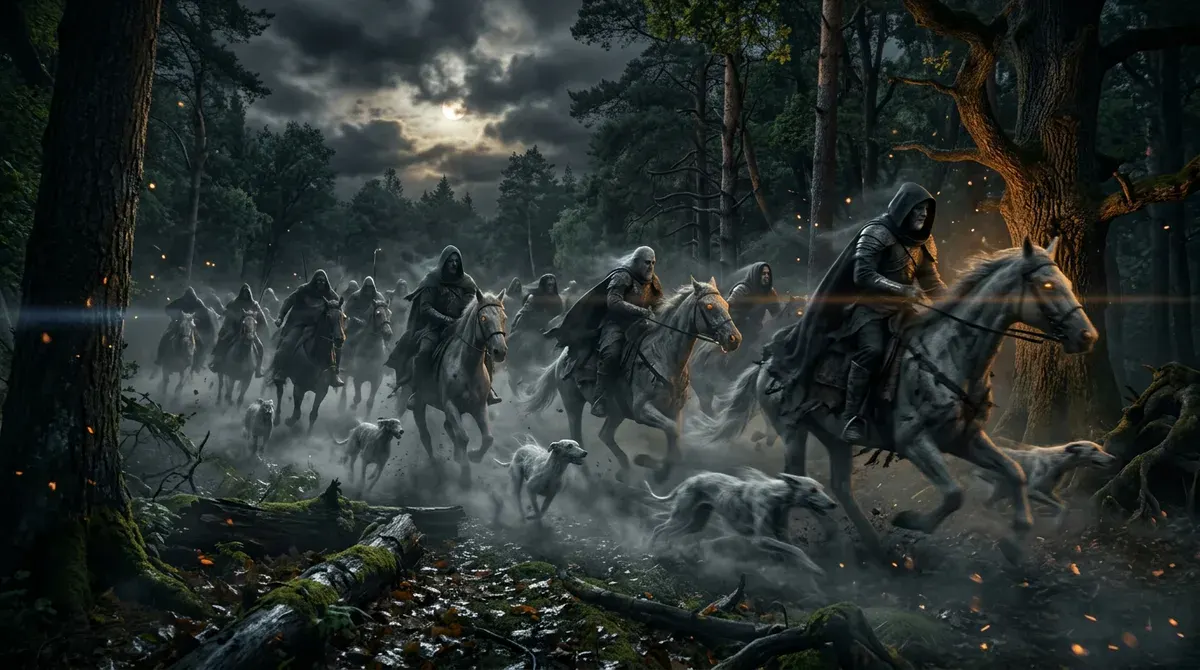
The Wild Hunt is harder to trace than its name suggests, because it is not one securely traceable ancient myth. It is a modern umbrella term laid over many European stories of noisy riders and processions of the dead. The earliest detailed report comes from the Norman chronicler Orderic Vitalis, who wrote in the 1130s about a procession that a Norman priest said he saw on New Year’s Night in 1091 or 1092. The famous name is much younger. Jacob Grimm popularized “Wilde Jagd” in his German Mythology of 1835, when he gathered scattered medieval reports and folk tales into a single picture.
Historians still argue about what that picture hid. In his study The Wild Hunt and the Witches’ Sabbath, Ronald Hutton suggests that Grimm’s synthesis merged traditions that were once quite distinct, and that surviving records do not show where the image began. Medieval writers described penitent dead whose suffering could be eased by prayers and alms. Later storytellers in Britain, Germany, Wales, Scandinavia and Lithuania gave the procession their own leaders, hounds and meanings. So the real question is not only who rides, but whether a single belief ever existed, or whether many local stories were gathered under one name.
Key Takeaways
- The Wild Hunt is not one securely traceable ancient myth but a modern umbrella term that Jacob Grimm popularized as “Wilde Jagd” in his German Mythology of 1835.
- The earliest detailed account of the Wild Hunt comes from Orderic Vitalis, who wrote in the 1130s about a procession a Norman priest said he saw on New Year’s Night in 1091 or 1092.
- Medieval chroniclers such as Ekkehard von Aura portrayed the Wild Hunt’s riders as penitent dead whose suffering could be eased by prayers and alms.
- No medieval writer explained who Herlechin was, so later storytellers filled the gap with many different identities for the leader of the procession.
- Regional legends gave the Wild Hunt different leaders, including Herne the Hunter in the woods around Windsor and Gwyn ap Nudd, who led the Hounds of Annwn in Wales.
Where Did the Wild Hunt Come From?
The Wild Hunt is a phantom procession of riders, hounds and sometimes the dead, reported in many parts of Europe. It is not one securely traceable ancient myth. Instead, the name gathers together a family of stories that share a few striking images: a noisy host moving through the night, a leader riding at its head, and a sense that those in the procession are restless, unlucky or being punished.
Because the stories vary so much, the Wild Hunt is best understood as a modern umbrella concept laid over many local traditions. A German farmer, a Welsh storyteller and a Scandinavian listener may each have pictured something different when they heard about a ghostly chase through the sky. The umbrella word makes those separate tales easier to discuss together, but it can also hide the differences between them.
The earliest clear descriptions come from the eleventh and twelfth centuries. In these medieval accounts, a noisy procession of the dead passes through the world of the living, and the dead within it are suffering for their sins. Writers presented prayers and alms as a way to ease that suffering. The procession was not just a spooky sight but a moral warning with a possible remedy.
Historians still disagree about where this image came from. Ronald Hutton argues that the evidence for a single ancient origin is uncertain, and that surviving records do not show how the image began. He also separates medieval accounts of female spirit processions from accounts made up mostly or wholly of dead people. In his view, the modern Wild Hunt concept joins these traditions into one picture, even though they may have started apart.
Regional storytelling adds another layer. In the nineteenth century, folklore collector Vilius Kalvaitis recorded five Wild Hunt narratives in Lithuania Minor, the historic Lithuanian-speaking region of East Prussia. Folklorist Jūratė Šlekonytė has argued that the aerial hunt imagery in these legends shows German influence, while other features have parallels in Lithuanian tradition and may come from older Baltic culture. The Lithuanian example shows that a single motif can borrow from neighbours and still keep its own local roots.
More recent scholarship pushes the question back even further. A 2026 article by Igor Manzura proposes reading the Wild Hunt as a multilayered motif tied to social organization, warrior ideology and beliefs about the dead. In that reading, the folk versions are fragments of something deeper. This is an interpretation rather than settled fact, and readers will want to weigh it against the medieval records and regional tales.
The hunt has also found new life in the present day. In a 2021 study published in Ritual Year, Athanasios Barmpalexis described a three-day Wild Hunt ritual held near Lumphanan in Aberdeenshire in 2016. Practitioner Andrew Steed, based in Fife, organized it, and it was the eighteenth such celebration he had led. Modern ritual shows that the old procession still stirs people, even if its meaning has changed.
The sections that follow trace the story in time order, starting with the medieval chroniclers, then moving through the leaders, regional legends and changing meanings that shaped the hunt into the form readers know today.
What Did Medieval Chroniclers Actually Record?
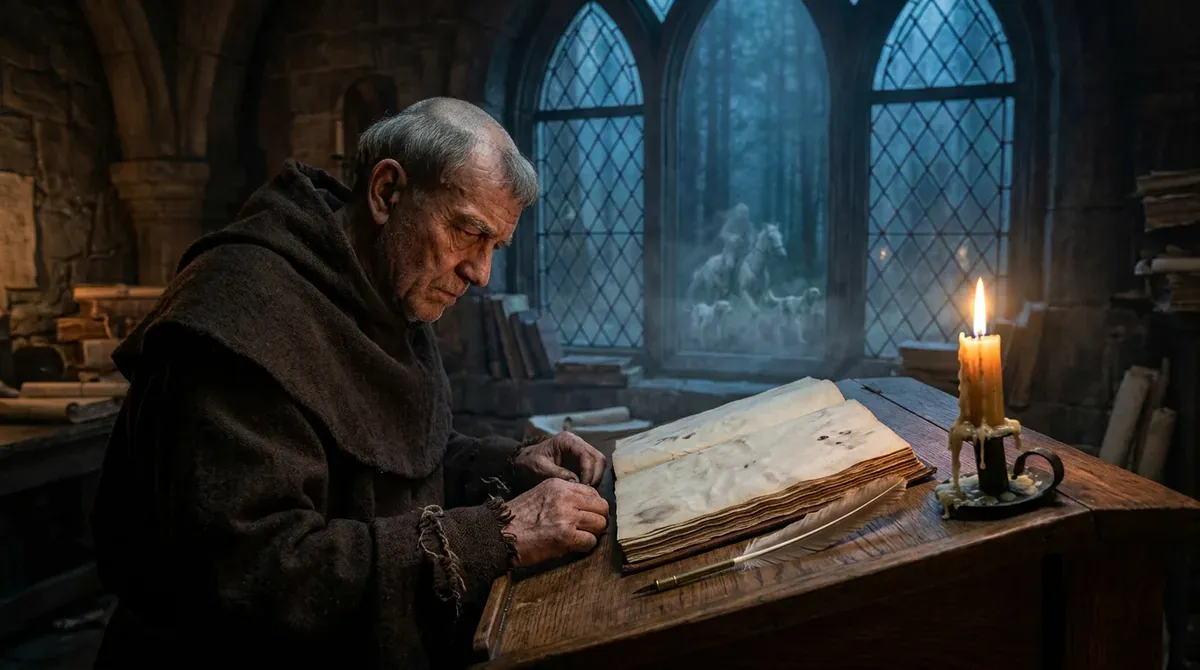
The oldest detailed sightings come from Latin chronicles, where monks and clerics wrote down what they had heard about processions of the dead passing through the night. Orderic Vitalis is the most vivid of these early writers. He wrote in the 1130s, and Ronald Hutton dates the event he describes to New Year’s Night in 1091 or 1092, so the account reached paper decades after the night it recalls.
Orderic reports that a Norman priest saw a noisy crowd moving through the darkness. The priest gave the crowd a name, calling it the familia Herlechini, or the household of Herlechin. Neither the priest nor Orderic stopped to explain who Herlechin was. Readers are handed a title and a procession, but no face, no backstory and no reason for the leader to be riding at all.
A few decades later, the chronicler Ekkehard von Aura made a similar record. Under the year 1123, he wrote about a host of dead knights seen near Worms, the old city on the Rhine. These were not cheerful revellers. Ekkehard said they were suffering for their sins, and that the living could help them. Prayers and alms, he recorded, were the means by which the dead might be delivered from their torment.
That idea of the dead as people in need is the thread that runs through the early accounts. The procession was not simply a spectacle. It was a sign that someone’s soul was in trouble, and the people who witnessed it were expected to respond with devotion and generosity.
By 1175, the image had moved into the language of church authority. An archbishop of Canterbury referred to worldly clerics who, after death, joined the milites Herlewini, the soldiers of Herlewin. The phrase suggests that the archbishop expected his audience to recognize the riders at once. He did not need to describe them, because the procession was already familiar enough to serve as a warning about a life spent serving worldly interests instead of God.
The Latin names are worth pausing over. Herlechini, Herlewini and, later, Mesnié Hellequin in the French poet Chrétien de Troyes’ work, all sound close to one another. Scholars have seen a family resemblance in these names, yet the sources never explain the connection. A reader who wants a clear answer will not find one in the chronicles. What they offer instead is a set of echoes that point toward a shared figure without ever pinning it down.
Across the twelfth century, the penitent dead became a fixed part of storytelling. Writers used the procession as a literary device, and it seems to have been known to ordinary listeners as well. Hutton argues that this popularity is documented, but the evidence does not reveal where the image first took shape or how it spread from one place to another. A reader may notice the gap at once. The sources show a tradition in full swing, yet they stop short of the beginning.
It is also worth noticing what the medieval writers did not do. They did not describe the riders as demons or as cheerful spirits of the forest. Their dead were human, tormented and waiting for help from the living. Whether the chroniclers were recording a real nighttime experience, passing along a sermon’s lesson or repeating a rumor that had grown in the telling is a question the texts leave open.
So the medieval record gives us a Norman priest’s story, a German chronicler’s warning, an English archbishop’s rebuke and a literary motif that gained ground through the twelfth century. Each writer saw something different in the same restless procession. Read in order, the chronicles show a picture taking shape, one source at a time, long before anyone gave it the name the world now uses.
Who Was Herlechin, the Leader Nobody Named?
No medieval writer ever explained who Herlechin was, and the sources leave the leader of the procession as a name without a face. The priest in Orderic Vitalis’s account gave the crowd a lord’s title, but the text offers no biography, no motive and no reason for him to ride at the front. The silence is part of what makes the figure so tantalizing.
The word familia suggests a household, a lord with followers who belong to him. Yet the household has a master whose name is only a sound, and the sound itself is hard to pin down. Scholars have noticed that Herlechini, Herlewini and the later French forms resemble one another, but the chroniclers never explain how the names connect or what the leader did in life.
Chrétien de Troyes, the French poet who wrote in the later twelfth century, used the phrase Mesnié Hellequin in his work. He used it as if his audience already knew what it meant. He gave no definition, no story and no explanation, which suggests the figure was familiar enough in his day that he could assume recognition. For a modern reader, that assumption is the real puzzle. Something was known, but it was not written down in a form that survives.
That gap gave later readers room to fill it. When a medieval listener heard of a restless host led by a shadowy figure, the question of who that figure was could be answered in many ways, depending on the storyteller and the place. The silence of the sources did not leave the leader empty for long.
Christian moralists were among the most active fillers. They tended to present the procession as dead sinners doing penance, souls who could be helped by the prayers and alms of the living. In that reading, the leader was simply one more sinner at the head of a line of sinners, a figure whose punishment was the same as everyone else’s, and whose release could come through devotion.
Other retellings went further and gave the leader a sharper identity. Some storytellers cast him as the Devil, herding lost souls through the night toward damnation. Others imagined him as a cursed sinner, a proud or cruel figure condemned to ride forever as a warning to the living. Both versions turn a blank name into a clear moral character, something the medieval chronicles never did.
A very different leader appears in the story Walter Map told in the 1190s. Map wrote of King Herla, a mounted king whose retinue was doomed to roam for centuries after a visit to another realm. Here the leader is named, and his fate is tied to a particular king rather than to an anonymous host of penitent dead. The historian Ronald Hutton describes the story as anomalous beside the accounts of processions made up of sinful dead, because it does not follow the same pattern of penance and prayer.
That contrast is revealing. Herlechin remains a title that later readers had to complete, while Herla arrives with a name, a court and a story of his own. Map’s king seems to belong to a different family of tales, one that centers on a royal figure and a strange journey rather than on the moral suffering of the dead. Placing the two side by side shows how varied the riders could be, even when they share a sky and a night.
So who was Herlechin? The honest answer is that the sources do not say, and every later answer is an addition made by someone who wanted the figure to mean something. The most interesting question may be which of those answers the listeners of the twelfth century would have accepted, and which ones they would have dismissed as a story told too loudly in the dark.
How Did Jacob Grimm Give the Hunt Its Name?
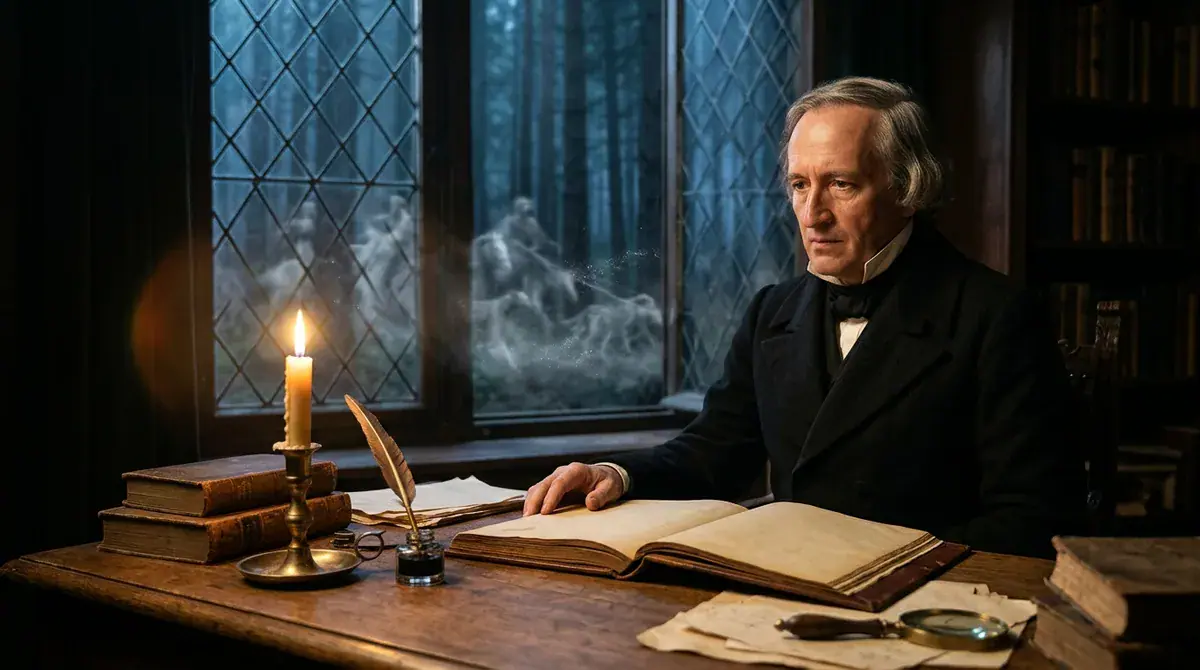
Jacob Grimm gave the Wild Hunt its modern name in German Mythology, published in 1835. He gathered scattered medieval reports and folk materials into one connected picture and popularized the term Wilde Jagd. Before his book, a Norman priest’s crowd, a German chronicler’s dead knights and a storyteller’s riders in the sky had no shared title that linked them.
Grimm was a collector of language and legend, and he treated these stories as fragments of an older belief system. He read the procession as a remnant of the gods of the north and connected its leader to Odin, the chief god of Norse myth, who was often imagined riding through the storm. Scholars still debate whether that link is sound. Odin is a plausible match for a sky-riding leader, but the medieval sources never name him, so the connection has to be built from other material.
Ronald Hutton has argued that the synthesis did more than name the stories. It merged them. Medieval and early modern accounts of female spirit processions, in which women rode with the night, are different from accounts of processions made mostly or wholly of dead people. Hutton’s point is that the modern concept places these traditions under one roof, so that they look like one event even though they may have started apart.
A name works a little like a label on a box. Once the box is marked, people tend to assume everything inside belongs together. Hutton’s 2019 study of the Wild Hunt in British imagination shows how far the label travelled. He notes that Grimm coined the term in the early nineteenth century, and that the motif later became prominent in late twentieth-century British fiction, especially in children’s and young-adult novels.
Consider what a reader would picture after meeting the name in 1835. The phrase suggests a single creature of the night, with a leader, a pack of hounds and a route across the sky. Yet the earlier sources describe a Norman household, a host of penitent knights near Worms and a king doomed to roam. Each of those stories has its own cast and its own reason for riding. Put them under one heading, and a reader may begin to imagine one phenomenon where the sources describe several.
The Lithuanian legends add an interesting twist. Vilius Kalvaitis wrote down his narratives in Lithuania Minor at the end of the nineteenth century, in the same decades when Grimm’s book was shaping European scholarship. Jūratė Šlekonytė’s reading of those legends suggests German influence in the aerial hunt, but also older Baltic roots. Did local storytellers borrow the German imagery, or did scholars and collectors hear the tales through the framework that Grimm had made fashionable? The sources do not settle that question.
So the name did two things at once. It made scattered stories easy to discuss, and it may have made them seem more unified than they were. The next question is whether the riders always belonged to one belief, or whether the name only hung a common label on very different voices.
Which Regional Legends Shaped the Hunt Across Europe?
Across Europe, the Wild Hunt took on a different leader in almost every region, from a ghostly huntsman in English forests to a Welsh lord of the otherworld and a host of restless dead riding the Scandinavian winter sky. Each storyteller kept the noisy chase but changed who rode at its head and what the ride meant.
English forest folklore offers one of the most recognizable figures in Herne the Hunter, a spectral huntsman tied to the woods around Windsor. Storytellers often pictured him with antlers on his head, a sign that he belonged to the forest as much as to the chase. In this version, the hunt is rooted in a particular landscape, and the rider seems to guard the trees he haunts rather than simply pass through them.
Germany offers a different kind of hunter. Hans von Hackelberg appears in German tradition as a hunter who is bound to the riding dead, and in some tellings his sin is that he hunted when he should have kept the holy days. His fate turns the chase into a punishment. The living who hear his horn are reminded that pleasure and piety do not always sit comfortably together.
Wales brings a more otherworldly figure. Gwyn ap Nudd is the lord of Annwn, the Welsh otherworld, and in local tradition he leads the Hounds of Annwn across the night. These hounds are linked to the realm beyond the living world, so the hunt in Welsh storytelling is less about a sinner’s penance and more about a passage between worlds. A listener on a dark hillside might wonder whether the hounds were chasing game or something far more human.
Scandinavian tradition takes the image in a quieter, colder direction. Oskoreia describes a riding host of restless dead, often seen in winter, whose presence is felt in the wind and the sound of hooves overhead. The dead are not cheerful companions but unsettled souls who cannot find rest. Their winter appearances suggest that the cold season itself belonged to the dead, when the boundary between the living and the departed grew thin.
England also has a sound-based version in the Gabriel Hounds. Folklore describes them as voices heard in the sky, a baying pack that passes above the listener without ever being seen. Many people have linked these calls to migrating geese, whose cries carry through the night as the flocks move across the land. The explanation is tempting, yet it does not account for every story, and some tellers insisted the hounds were something older and stranger than birds.
The Lithuanian legends show how a motif can travel and still keep its own roots. The aerial hunt imagery in the tales carries German influence, while other features have parallels in older Baltic traditions. In practice, a listener in Lithuania Minor could hear a sky chase that sounded familiar from German tales, but the people, places and customs around it felt rooted in the local land. The legends show a meeting of influences rather than a simple copy.
Many of these regional figures share a seasonal home. The Wild Hunt was often connected to Yule and the stormy nights of midwinter, when the year was ending and the days were at their shortest. The Twelve Days that followed the midwinter feast were a time of uncertainty, when households kept fires lit, doors barred and stories told by the hearth. Wind howling through the trees on those nights made it easy to believe that the dead were out, riding with the storm.
That winter setting may explain why so many stories cluster around the same season. Whether the riders were penitent sinners, cursed huntsmen or restless dead, they were most often heard when the world seemed to be turning over. A reader who walks a windy road in December can feel how the old tales might have grown from the weather alone. Which of these riders would you most expect to meet on a midwinter night, and which one would you hope to avoid?
Why Did the Meaning of the Hunt Change Over Time?
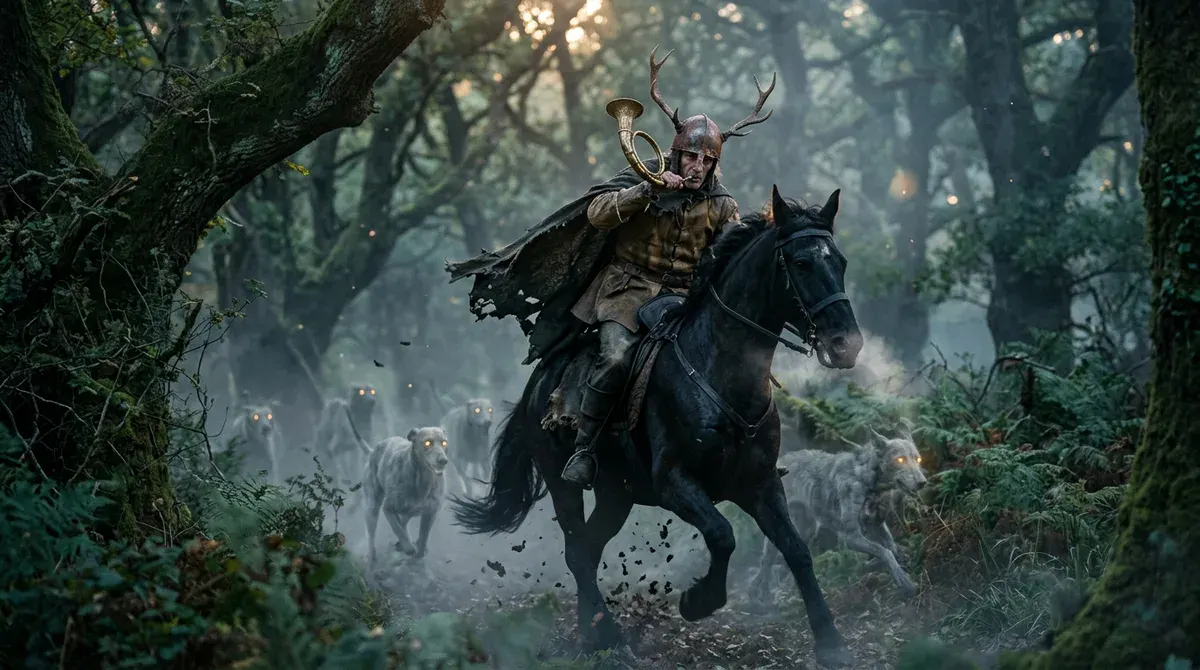
The Wild Hunt changed meaning because each era and each community asked the procession a different question, and the riders were reshaped to answer it. Medieval writers wanted to know what the dead needed. Later village listeners wanted to know what the procession meant for their own households.
In the twelfth century, the chroniclers treated the riders as souls in trouble. Ekkehard von Aura’s dead knights near Worms were suffering for their sins, and his account made clear that prayers and alms could bring them relief. The sightings were a call to devotion. A passerby who heard the host pass could help by praying, giving to the poor or having masses said, so the procession invited the living to act.
As the stories traveled beyond the monastery, the emphasis shifted from helping the dead to reading the sky as a message. In many later folk beliefs, hearing the hunt overhead on a winter night was an omen, a warning that misfortune was on its way. Households might be expecting a bad harvest, sickness among the animals or the death of someone close. The same noise that had once prompted prayer now made people bar their doors and wait for the storm to pass.
Local tellers did not simply pass these ideas along unchanged. They altered who rode, where the riders went and what a listener should do when they appeared. In English forest tales, Herne the Hunter belonged to the woods around Windsor, so his chase kept to a particular landscape. In Germany, Hans von Hackelberg was punished for hunting on holy days, which turned the rule of the Church into the reason the chase existed at all. In Wales, Gwyn ap Nudd led the Hounds of Annwn, so the hunt became a crossing between the living world and the otherworld.
Rules of conduct changed too. In several regional tellings, the safest response was silence and stillness, while others warned against standing in the riders’ path. These customs suggest that communities were not only retelling a story. They were building practical guidance around it, adapting the old image to the dangers and fears of their own valleys and coasts.
A 2026 article by Igor Manzura offers a way to fit these changes together. Manzura proposes reading the Wild Hunt as a multilayered motif connected to social organization, warrior ideology and beliefs about the dead. In that view, the penitent dead of the chronicles, the cursed huntsmen of the regions and the winter omens of the villages could be different layers of one deeper pattern. Manzura also describes the folkloric versions as fragmentary reflections of an underlying phenomenon. That is a scholarly interpretation rather than a settled conclusion, and it asks readers to weigh the idea against the records they can examine for themselves.
Seen this way, the shifting meanings look less like confusion and more like a conversation carried on across centuries. Monks wrote about sin, local storytellers spoke about landscape and luck, and collectors such as Vilius Kalvaitis preserved the voices of ordinary people. Each group heard the same sound of hooves in the dark and answered it in its own language.
So which meaning would you have given the hunt if you had heard it crossing a winter field? A prayer for the dead, a warning about the year ahead or a sign that a boundary between worlds had grown thin?
Is the Wild Hunt Still Riding Through Modern Stories?
Yes, the Wild Hunt still rides, though today it travels mostly through books, games and a few living rituals rather than through village lanes on winter nights. Ronald Hutton observed that the motif became especially prominent in late twentieth-century British fiction, where children’s and young-adult novels used the noisy chase to bring old fear into modern towns and woods.
Authors found the image useful because it arrived with its own atmosphere. A storm, a lost traveler and a host of riders that should not be out at all were enough to build a scene. Young readers could feel the chill of an older story without ever opening a medieval chronicle.
Fantasy games and role-playing settings have carried the procession further. Game worlds often place spectral riders, phantom hounds and a cursed leader across a storm-bound landscape, where a party must decide whether to hide, flee or stand its ground. Players inherit rules that folklore once passed by word of mouth, from keeping clear of the path to the hope that prayer might free the dead.
In north-east Scotland, the procession has a living audience. A three-day Wild Hunt ritual took place near Lumphanan, in Aberdeenshire, in 2016. Andrew Steed, a practitioner based in Fife, organized it, and it was the eighteenth such celebration he had led. Participants treat the hunt as a seasonal rite rather than a haunting, so a warning that once sent people indoors has become a ceremony that brings them outdoors.
Those who doubt the ghostly explanation have their own candidates, and the first is weather. Storm winds funneling through narrow valleys can produce long, rising moans. Gusts may rattle loose gates and snap branches, and they can seem to carry hoofbeats across an open moor.
Migrating birds offer a second answer. Flocks of geese travel at night in autumn and winter, calling to one another as they pass overhead. Their cries are loud, rhythmic and hard to place in the dark, and a listener who cannot see the birds may hear a pack moving across the sky.
Sound itself can mislead. On cold, still nights, a dog barking across a valley, a cart on a distant road or a shout from a village two fields away can arrive from the wrong direction. Hills and woods bounce it around, so a faraway noise may seem to pass directly overhead.
Psychology adds a further layer. Someone who has heard the tale since childhood arrives at a winter night with ears already primed for it. In a group gathered around a hearth, one person’s description of a rushing host can shape what the others claim to hear. Suggestion works quietly, and it rarely feels like imagination from the inside.
Winter darkness does its own work. With few landmarks to guide the eye, the mind fills in gaps, turning shifting shadows into shapes and unseen sounds into moving figures. A rider in the sky may be nothing more than a cloud crossing a patch of moonlight, yet at midnight the mind is in no hurry to correct itself.
Folk beliefs often reflected these same fears, and they gave people practical rules. Many communities advised staying indoors, barring the door and keeping the fire going while the noise passed. Some warned against looking up at the riders, as if a glance might draw their attention or bring misfortune. If the hunt came close, the common advice was to pray, whether for the dead, for the household or for oneself.
Those rules still make sense on a stormy night. They keep people warm, calm and away from danger on a dark road. Whether the sound overhead is wind, geese, an echo or something older, the old advice shows how a frightening noise could be handled with patience and faith. If a gust rose over your roof tonight, would you look up, stay put or say a prayer, and what would you trust to explain the sound?
Listening for Hoofbeats: Weighing the Evidence Yourself
Start with one account and read it closely before you decide what you believe. Orderic Vitalis’s brief description of the familia Herlechini is short enough to finish in one sitting, and it is strange enough to make you stop and wonder. Ask what the Norman priest actually heard, and what he left out.
Then test the ordinary explanations for yourself. On a windy night in late autumn or winter, step outside with a notebook and write down the time, the wind direction and any calls or hoof-like sounds. Note whether the noise seems to move overhead or stays in one place, and whether a flock, a loose gate or a snapping branch could explain it.
Next, compare your notes with the regional tales. Does the sound resemble Gwyn ap Nudd’s Hounds of Annwn in Wales, the cold-season riding dead of Scandinavia, or the baying voices called the Gabriel Hounds in England? Or does it sound like nothing any of those storytellers described?
Keep the notes after the night ends. If you return to the Wild Hunt later, you will be weighing your own evidence alongside the chronicles, not just someone else’s account. Then tell us in the comments which explanation fits your notes best, and what you think is still unexplained.
Frequently Asked Questions
1. What does the name Wild Hunt mean, and where does it come from?
The name Wild Hunt is the English form of the German phrase Wilde Jagd, where wilde means wild and Jagd means hunt. Jacob Grimm popularized that phrase in German Mythology in 1835 while gathering scattered reports and folk tales into one picture. Before his book, the medieval accounts had no shared title linking them.
2. Which regional version of the Wild Hunt is closest to the earliest medieval descriptions?
The Scandinavian tales of a restless host of dead riders in winter come closest in spirit to the earliest medieval accounts. Like the Norman priest’s household and Ekkehard von Aura’s dead knights near Worms, they show unsettled souls who cannot find rest. The likeness is one of theme, and the surviving sources do not show a direct line of descent between them.
3. How have modern games and novels changed the figures people link with the Wild Hunt?
Modern fiction has kept the noisy chase but turned the riders into characters with clear personalities and motives. Ronald Hutton notes that late twentieth-century British children’s and young-adult novels used the motif to bring old fear into modern towns and woods. Game worlds often give the host a cursed leader and spectral hounds, turning the vague medieval figure into an enemy a party must hide from, flee or fight.