Ulfberht Swords: What the Evidence Reveals About Early Medieval Blades
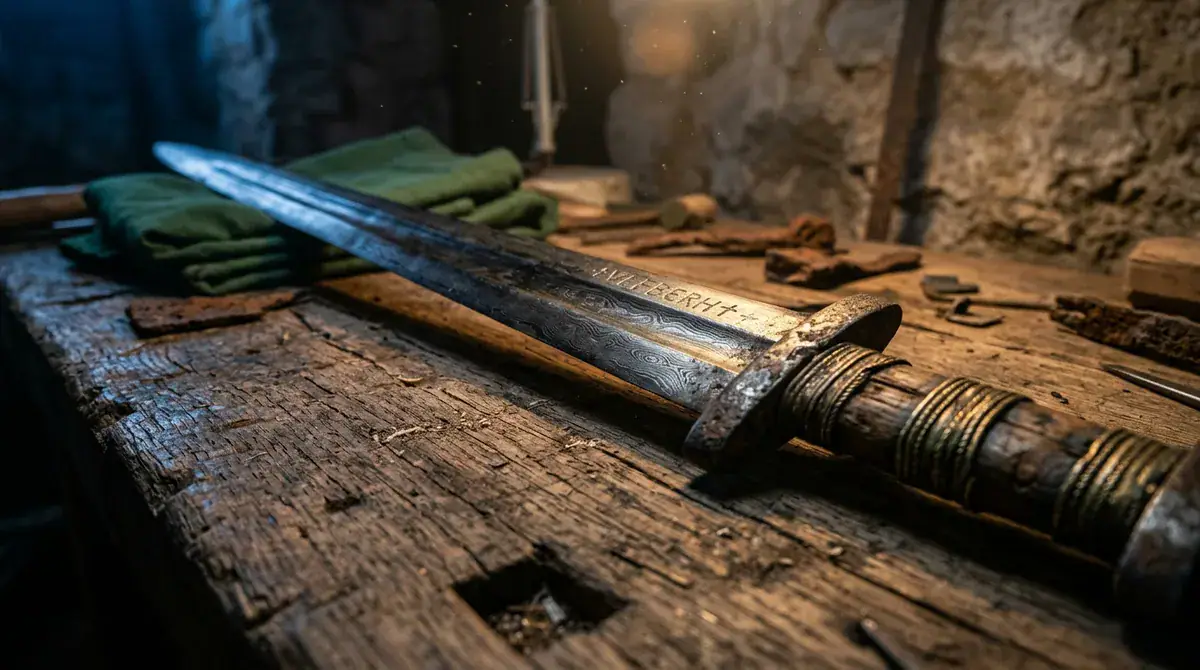
Ulfberht swords are early medieval blades marked with the name Ulfberht inlaid into their steel. The name points to a family of blades rather than a single sword or one maker. Researchers have tracked more than 200 examples scattered across Europe, with the earliest made in the late 8th century and the latest in the early 12th century.
The count varies, however. An older study in Fornvännen from 2010 listed 166 identified blades, including 16 certain examples within the former Frankish realm. That gap shows how hard it is for experts to agree on which blades truly belong to the group.
Key Takeaways
- Ulfberht swords are a family of early medieval blades identified by the name Ulfberht inlaid into their steel, and researchers have tracked more than 200 examples scattered across Europe.
- The total number of Ulfberht swords depends on which blades researchers accept as members, so a 2010 study in Fornvännen listed 166 identified blades while later totals have grown as new finds came to light.
- Most Ulfberht swords have been found in Scandinavia, and Ingo Petri suggests that burial customs may explain that pattern more than the workshops where the blades were made, which he believes was probably the Frankish Empire.
- The claim that Ulfberht swords were far stronger than other blades of their time is not supported by the evidence, because a 2014 study found hypereutectoid steel in only some examples rather than across the whole group.
- A verified record such as the Metropolitan Museum of Art’s sword, dated circa 850 to 900 and measuring 96 cm and weighing 1,497 g, gives readers a reliable yardstick for checking claims about Ulfberht blades.
How Many Ulfberht Swords Have Been Found?
No single number settles how many Ulfberht swords exist. Ulfberht names a family of blades rather than one sword or one maker, and each member is recognized by its inlaid inscription. Any count therefore depends on which blades researchers accept as true members of the group.
The 2010 figure of 166 identified blades included at least 144 examples found outside the former Frankish realm. That split shows how far these swords traveled from their presumed homeland and why the group is spread so widely across the continent.
Later totals have grown as new finds came to light and older blades were recounted. Some totals also shift because researchers sort the inscriptions differently. Anne Stalsberg’s classification divides the name’s variants into seven groups, and the most common form, +VLFBERH+T, accounts for roughly 46 to 51 examples.
A badly corroded or partly hidden inscription can fit one group in one catalogue and drop out of another. Whether a damaged blade counts as an Ulfberht often depends on who is reading the inscription and which list they are using.
Where Were Ulfberht Swords Found Across Europe?
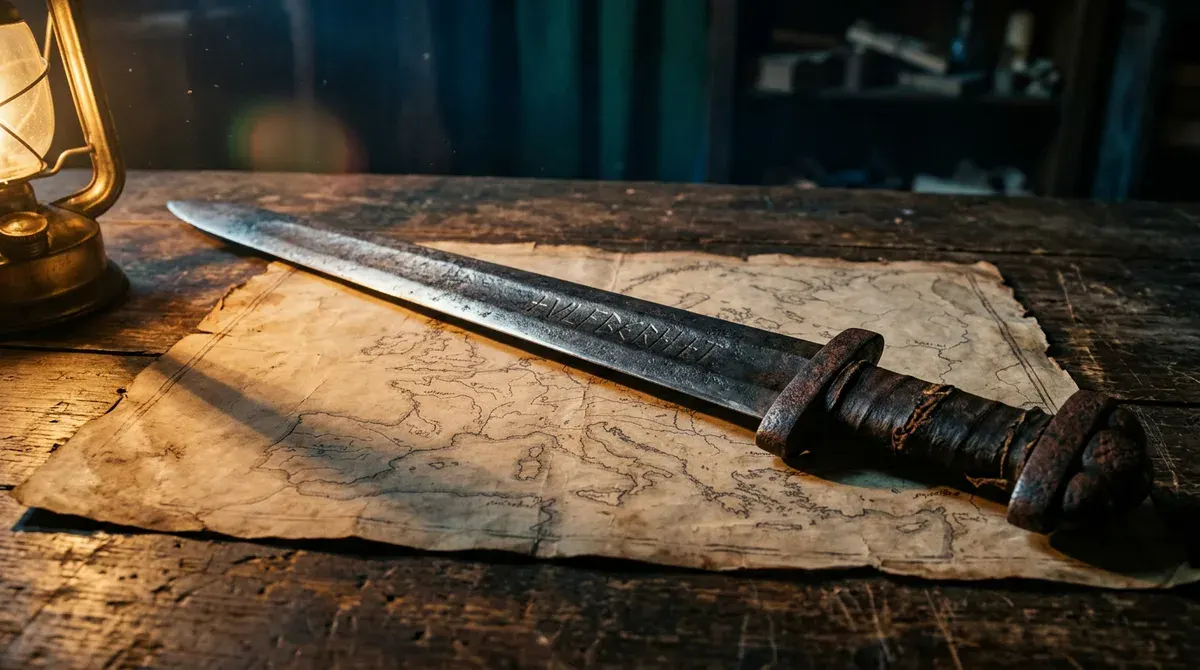
Ulfberht swords have been found from Scandinavia to Romania, but their distribution is far from even. In his 2019 review in History Compass, Ingo Petri noted that most of these blades have turned up in Scandinavia. He proposes that this pattern may reflect burial customs, the habit of placing weapons in graves, rather than the places where the swords were made. He suggests the blades were probably produced in the Frankish Empire.
Graves may have preserved swords that were made elsewhere and carried far from home. A blade in a Scandinavian grave tells us as much about the person who chose that burial as about the workshop that forged it.
Romania offers a sharp contrast. The Analele Banatului article identifies the Albești sword as the only known early medieval sword from Romania with an Ulfberht inscription. Was the region rarely supplied, or have few such blades survived to be recognized?
A sword from a grave at Hedeby, found in 1906, has a hilt dated to approximately AD 900 to 950. That date anchors the object in time, though the blade’s own story may reach back much further.
Museum collections add another layer. The Metropolitan Museum of Art lists a sword inscribed +VLFBERHT+ as circa 850 to 900, measuring 96 cm and weighing 1,497 g. Did these blades travel with their owners, or along trade routes that graves alone cannot reveal?
What Does the Ulfberht Inscription Actually Say?
The inscription is the name Ulfberht, set into the steel of the blade in inlaid letters. It is the one feature that ties these swords together, yet the spelling shifts from blade to blade. Researchers use those differences to sort the marks, and that sorting shapes who counts as a true member of the group.
The inscriptions are not the only thing that varies. Archaeological and metallurgical studies show that blade construction also differs from one example to another, so no single recipe describes every sword.
What the name means is far less settled. A 2008 reappraisal by Stalsberg, reported in a 2010 study, suggested that Ulfberht might name a bishop or abbot who oversaw an arms workshop rather than the smith who forged the blade. In that reading, a churchman supervising the work would have put his name on the product, much as a workshop owner might today. Others still treat the word as a maker’s signature. Whether the name marks a hand at the forge or a figure standing over it remains an open question, and the answer may depend on which blades you are examining.
Were Ulfberht Swords Made From Crucible Steel?
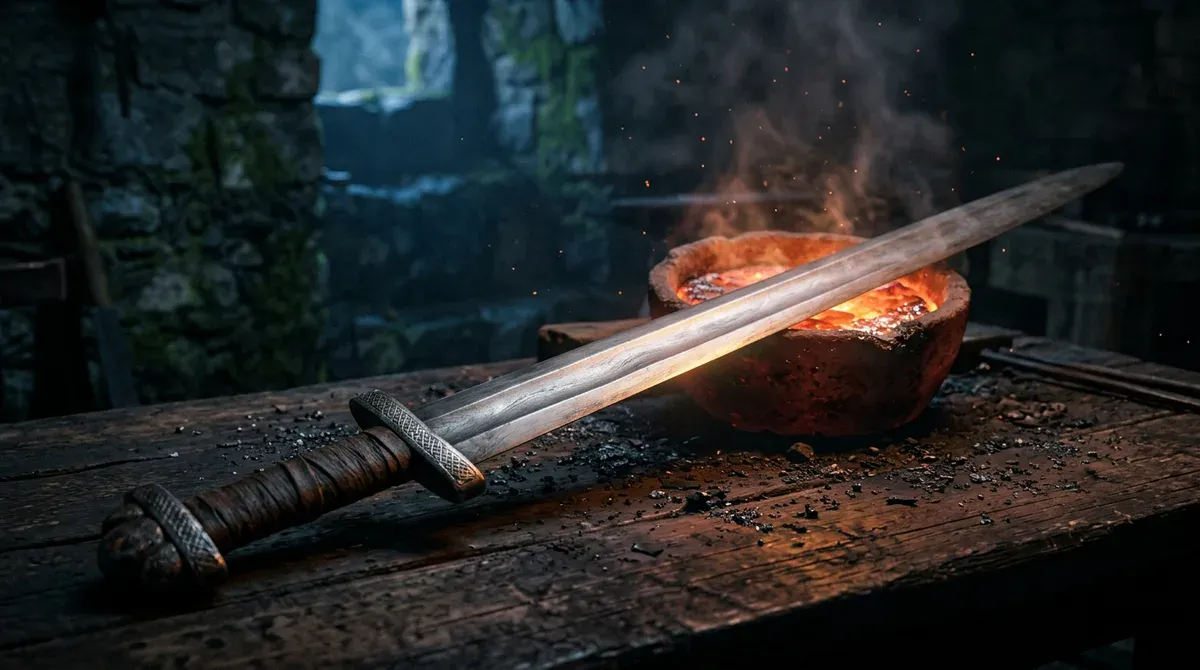
Some Ulfberht swords appear to have been made from crucible steel, a high-carbon material that may have come from far outside Europe. The idea does not cover every blade, though. A 2014 archaeometallurgical study in Fasciculi Archaeologiae Historicae found that some Ulfberht-family swords were made from hypereutectoid steel, a term for steel with more carbon than the usual range. Carbon makes iron harder, but too much of it makes the metal difficult to control at the forge.
Crucible steel was produced by melting iron with carbon in sealed vessels, which gave smiths a more consistent and controlled material. The study suggests that some of these specimens may have been made from crucible steel produced in Central Asia and India. Early medieval Europe had its own ironworking skills, yet reproducing such steel reliably was difficult, which is why the imported explanation draws so much attention.
This remains a hypothesis about some examples, not a settled account of all Ulfberht swords. Many blades have not been tested in this way, and their steel may tell a different story.
The steel question also helps explain the legend of supreme strength. A blade that held a sharp edge under heavy blows would have seemed extraordinary to a warrior, and stories tend to grow around such objects. Careful testing, rather than reputation, will show which claims hold up.
Who Made Ulfberht Swords, and How Did They Travel?
The Frankish Empire is the place most often proposed as the home of Ulfberht swords, and Ingo Petri believes the blades were probably produced there. Historical sources also link Frankish production with the Rhineland, the river region in the empire’s west. Yet a blade made there could travel far, and the routes that carried it remain debated.
Trade is one possibility. Merchants may have carried swords across borders and sold them in distant markets. A law from the Carolingian realm hints at how sensitive that trade was. The Capitulary of Thionville, issued in 805, prohibited merchants arriving from Slavic and Avar regions from bringing arms or breastplates to sell. Such a rule suggests that weapons were moving through markets and that rulers worried about who was buying them.
Looting and gift exchange offer other explanations. A sword taken in a raid could pass from one owner to another, while a blade given between leaders could seal an alliance. Researchers weigh these possibilities against the graves where swords were found. Which story fits best may depend on the individual blade and on whether its owner ever set foot near the Rhine.
Are Ulfberht Swords Really Better Than Other Blades?
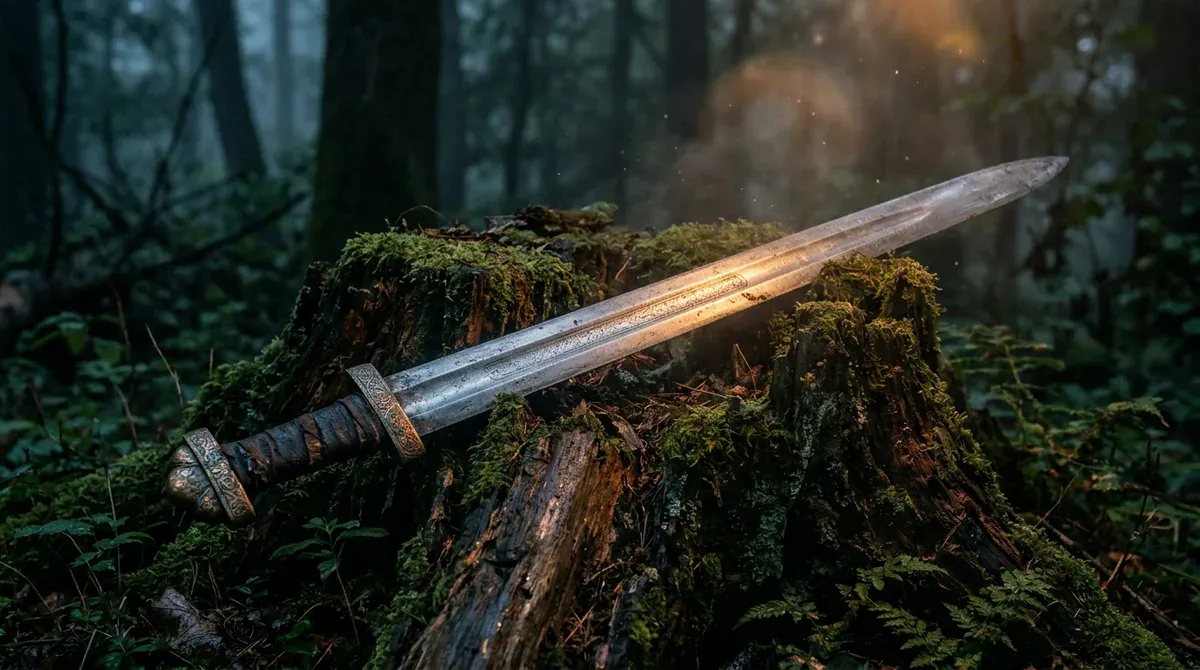
No, the evidence does not show that Ulfberht swords were far stronger than other blades of their time. The strength legend rests mainly on the steel hypothesis, the idea that some blades were made from imported crucible steel, and on popular retellings that repeat the claim without testing it. The 2014 metallurgical findings apply to some examples, not the whole group, so a blanket claim of superiority goes beyond the data.
Modern replicas and sale listings circulate widely, and they often borrow the Ulfberht name. Any price quoted for a blade bearing this name deserves a closer look, since the value of a historical artifact depends on its documented history and provenance rather than on the name alone.
A simple habit helps when weighing a claim. Ask what it is based on: a named study, a museum record, or a general impression. A claim tied to a specific study or catalogue entry can be checked against its source. A claim that sounds impressive but cites nothing may simply be a story passed from one retelling to the next. Which of these claims would you trust, and why?
Following the Trail of the Ulfberht Inscription
Your next step is to take one Ulfberht claim you have read online and test it against the evidence. Start with the inscription. Compare the lettering in any photo or catalogue entry with the variants that researchers group together, and note whether the blade carries the common +VLFBERH+T form or a rarer one.
Then look for a dated source. A claim that names a century, a museum record, or a study can be followed up. One that offers only a dramatic adjective cannot.
Use a verified record as your yardstick. One museum sword, dated circa 850 to 900, measures 96 cm and weighs 1,497 g. If a seller or writer describes a blade with very different dimensions or a much earlier date, ask what supports those figures.
Finally, write down the question the claim leaves open. Is the steel imported crucible steel, or an assumption? Which graves, workshops, or trade routes would need proof before the story holds? Share what you find in the comments, and tell us which kind of evidence changed your mind.
Frequently Asked Questions
1. Can a modern replica be called an authentic Ulfberht sword?
A modern replica cannot be called an authentic Ulfberht sword, because authentic refers to blades made in the early medieval period. Replicas copy the name and style of the inscription, but they lack the history of a blade recovered from a grave or held in a museum collection. Buyers should ask whether a listing describes a historical artifact or a new reproduction, and what dates or records support its claims.
2. Did only Vikings use Ulfberht swords?
The swords cannot be tied to Vikings alone, and no single group of owners has been proven for the whole family. Most known finds come from Scandinavia, where many blades were placed in graves, but examples have also turned up in places such as Romania. Researchers still debate whether the original buyers were traders, raiders, or people who received the swords as gifts.
3. Why do Ulfberht swords stop appearing in the record after the early 12th century?
The latest known Ulfberht-inscribed swords date to the early 12th century, and researchers have not settled why the record ends there. Possible explanations include changes in trade, shifts in how weapons were buried, or simply blades that have not yet been found or recognized. Each explanation remains a question for future study.