
Sea Peoples Mystery Explained: Evidence, Theories, And The Bronze Age Collapse
The Sea Peoples mystery begins with a trail of burning cities, fallen kingdoms, and Egyptian inscriptions describing unfamiliar groups arriving by land and sea. Between about 1250 and 1150 BCE, the Hittite Empire collapsed, Mycenaean palaces declined, and communities across the eastern Mediterranean faced upheaval. Were these strangers raiders, desperate migrants, mercenaries, or survivors of a much larger crisis?
The evidence points not to one nation or invading army, but to several peoples caught in a storm of war, climate stress, trade disruption, and political collapse. Ancient records and archaeology reveal real movement and violence, yet they leave key questions unanswered: who were these groups, where did they come from, and how much did they contribute to the Bronze Age collapse?
Key Takeaways
- The Sea Peoples were likely not a single nation or invading army, but several groups—including raiders, mercenaries, migrants, and displaced families—recorded under a modern umbrella term.
- Egyptian inscriptions from Merneptah and Ramesses III provide key evidence, but their victory-focused propaganda must be balanced with archaeology and records from other regions.
- The Sea Peoples were probably one factor in the wider Bronze Age collapse, which also involved climate stress, famine, warfare, disrupted trade, earthquakes, and political instability.
- Their exact origins, identities, and level of coordination remain uncertain; they may have been both attackers who intensified the crisis and victims displaced by it.
Introduction To The Sea Peoples Mystery
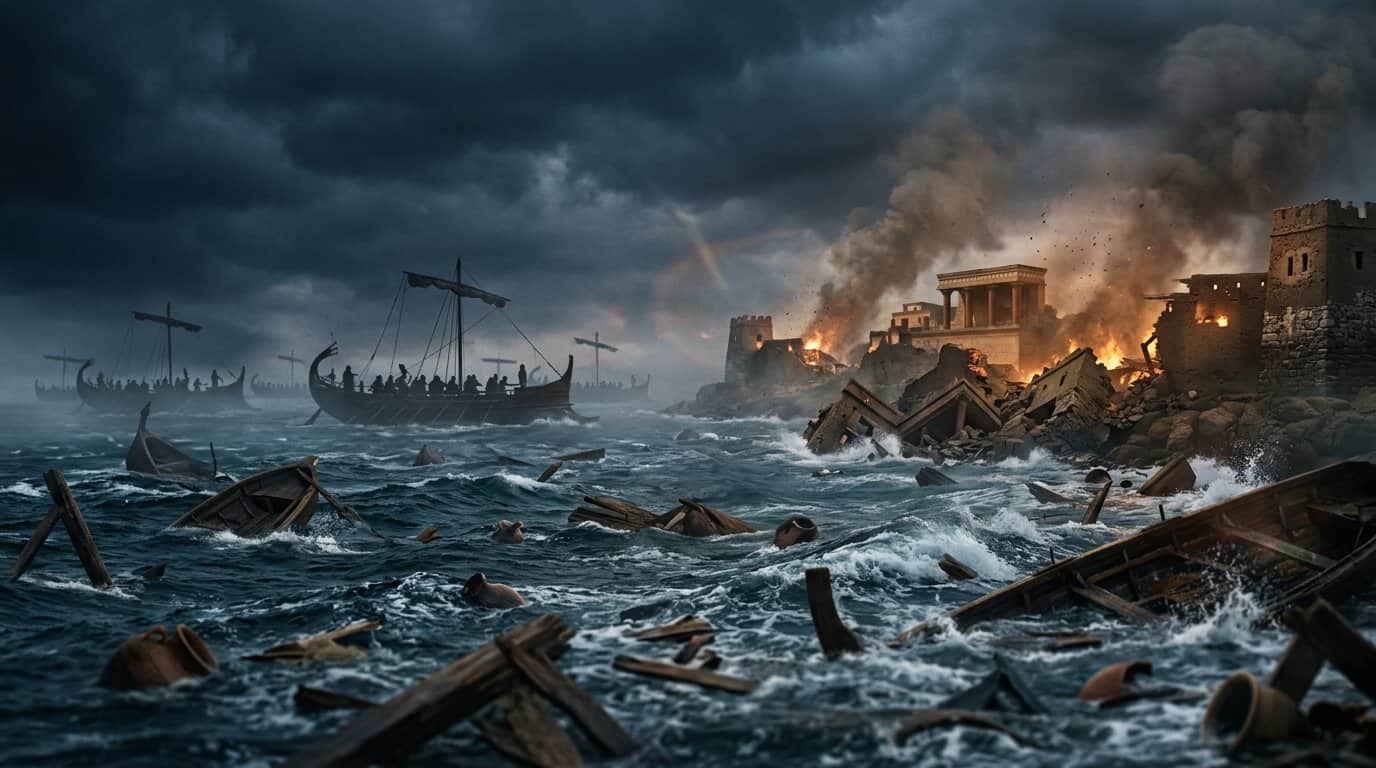
Around 1250 to 1150 BCE, the eastern Mediterranean became a region of upheaval. Ships approached coastal cities, families fled with carts and animals, and Egyptian armies prepared for battle. Palaces, trade networks, and kingdoms that had connected the region for centuries began to weaken or disappear. Egyptian inscriptions later described mysterious groups arriving by land and sea, giving rise to the modern name “Sea Peoples.” Yet the central question remains: were they one organized invading force, or several communities swept into a much larger crisis?
The main evidence comes from Egyptian records, especially the inscriptions and reliefs created under Pharaoh Ramesses III at Medinet Habu. These scenes show naval combat, captured fighters, and families traveling with wagons, while the texts name groups such as the Peleset, Sherden, and Tjekker. The records present Egypt as a defender facing a dangerous enemy, but royal inscriptions were also designed to celebrate the pharaoh’s victory. Archaeology adds a more complicated picture, with destroyed settlements, changing pottery styles, abandoned palaces, and signs of migration across Anatolia, Cyprus, Greece, and the Levant.
Most historians now see the Sea Peoples as a modern umbrella term rather than the name of a single nation. The groups may have included raiders, mercenaries, displaced families, migrants, and local communities responding to famine, warfare, political collapse, or disrupted trade. This view does not make the story less dramatic. Instead, it suggests that the upheaval had many causes and involved people trying to survive a rapidly changing world. The mystery lies in discovering how these scattered movements connected to the vanished kingdoms around them, and whether the Egyptian accounts preserved the full story or only the part Egypt was prepared to tell.
Egyptian Records Name The Invaders
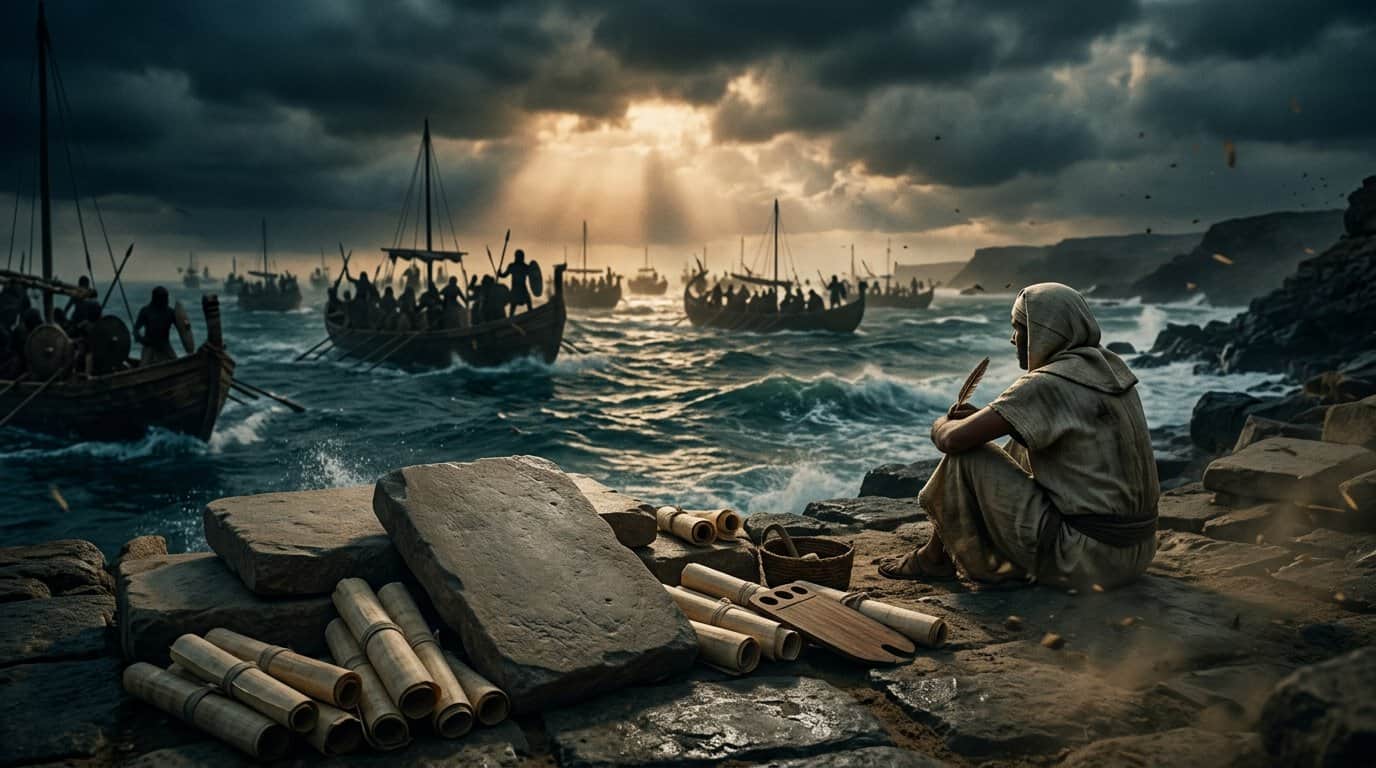
Merneptah’s inscriptions provide one of the earliest Egyptian glimpses of the groups later called the Sea Peoples. Around 1208 BCE, his victory stela describes a campaign in Canaan and names groups such as the Sherden, Shekelesh, Lukka, and Ekwesh, alongside the striking claim that “Israel” had been laid waste. The record suggests that armed groups were moving through a region already under pressure, but it does not describe one united nation or a single invasion force. Instead, it hints at shifting coalitions of raiders, soldiers, and displaced communities during a wider Mediterranean crisis.
Several decades later, Ramesses III recorded a far larger confrontation, shown in the famous Medinet Habu reliefs. The inscriptions name the Peleset, Tjekker, Sherden, Shekelesh, and other groups, while the carvings depict ships locked in battle and families traveling with carts, animals, and belongings. This combination has led scholars to consider both violent raids and organized migrations, perhaps involving people driven from their homes or drawn into military alliances along the way. The Peleset are often connected with the later Philistines, but that identification remains an informed theory rather than a settled fact.
Egyptian records are powerful evidence, yet they must be read with care because they were created to celebrate royal victories. Ramesses III presents Egypt as the defender of civilization and portrays the defeated groups as a sweeping threat. This may simplify a much more tangled chain of local conflicts, climate pressures, political collapse, and population movement. The inscriptions therefore reveal real encounters, but not necessarily the full story behind them. Read alongside archaeology and evidence for the collapse of kingdoms such as the Hittite Empire, they support the view that the Sea Peoples were part of a mixed phenomenon, not the sole cause of the Bronze Age upheaval.
Archaeology Maps A Broken Mediterranean
Across Anatolia, Cyprus, the Levant, and the Aegean, archaeology records a Mediterranean world coming apart between about 1250 and 1150 BCE. Hattusa, the capital of the Hittite Empire, was abandoned as royal power failed, while Mycenaean palace centers such as Pylos and Mycenae suffered destruction, decline, or long-term disruption. At coastal sites, burned buildings and broken storage jars suggest violence, economic stress, or both, but the layers do not always belong to the same moment. The result looks less like one sudden invasion and more like a chain reaction moving through fragile political and trade networks. A regional map could show these damaged centers alongside the main sea routes, turning scattered ruins into a clearer picture of a broken Mediterranean.
Egyptian inscriptions add a human voice to the mystery, although they do not provide a complete explanation. At Medinet Habu, the records of Ramesses III describe groups called the Peleset, Tjekker, Sherden, and others arriving by land and sea during the turmoil. The modern label “Sea Peoples” brings these groups together, but the evidence does not show that they formed one nation or a single invading army. Some may have been raiders, migrants, mercenaries, or displaced communities caught in a wider collapse that also affected harvests, rulers, and trade. The destruction of ports such as Ugarit, along with disruptions to Cyprus’s copper exchange, suggests that the crisis damaged the systems connecting palaces, merchants, and armies.
Yet the ruins also show that many people endured, adapted, and rebuilt. Communities in Cyprus and the Levant reorganized around new settlements, while parts of Greece continued without the palace administrations that had once controlled them. New cultural patterns appeared, including settlements associated with the Peleset in the southern Levant, but these changes do not prove that newcomers erased everyone who came before. An archaeological timeline could place Egyptian campaigns, the fall of Hattusa, palace destruction, trade disruption, and later rebuilding side by side. A related article on the wider Bronze Age collapse could explore the competing theories. If the Sea Peoples were part of a larger breakdown rather than its single cause, which pressure seems most important when the evidence is viewed across the whole region?
Who Were The Sea Peoples
The Sea Peoples were probably not one nation or a single invading army, but a modern name for several groups recorded in Egyptian texts between about 1250 and 1150 BCE. Inscriptions from Pharaoh Merneptah and the temple of Ramesses III mention names such as the Sherden, Shekelesh, Peleset, Tjekker, Denyen, and Weshesh. Some may have been maritime raiders, while others could have served as mercenaries, migrated with their families, or joined larger movements of displaced communities. The Egyptian records describe dangerous encounters, but they do not prove that every group shared one language, culture, or political leader.
Several clues have led researchers toward the Aegean, Cyprus, Anatolia, and the southern Levant. Pottery styles, weapons, settlement changes, and destruction layers suggest that people and goods moved across the eastern Mediterranean during the same period, while the collapse of the Hittite Empire and the Mycenaean palace system created new pressures. Some scholars connect the Peleset with the Philistines of the southern Levant, and others see possible Aegean influences among coastal communities, but these links remain debated. Cyprus also appears important, both as a trading crossroads and as a place affected by wider disruption, yet no single archaeological fingerprint identifies all the Sea Peoples.
A more cautious picture places these groups inside a much larger Bronze Age crisis involving drought, famine, political conflict, trade breakdown, and weakening states. Ramesses III’s account at Medinet Habu presents a dramatic battle by land and sea, but Egyptian royal inscriptions were designed to celebrate victory, so they must be compared with archaeology and records from other regions. The names may describe enemies encountered at one moment rather than permanent ethnic identities or a shared homeland. As with the wider Bronze Age collapse, the mystery lies less in finding one hidden people than in understanding how migrants, mercenaries, raiders, displaced families, and local populations became entangled in a rapidly changing Mediterranean world.
Competing Theories Beyond A Single Invasion
The Sea Peoples mystery becomes clearer when viewed as part of a wider breakdown rather than a single invasion. From about 1250 to 1150 BCE, drought and famine may have strained food supplies, while earthquakes damaged cities across the eastern Mediterranean. Archaeological evidence also points to abandoned settlements, burned buildings, and disrupted trade routes, although these clues do not always reveal who caused the destruction. Political instability weakened kingdoms such as the Hittite Empire and the Mycenaean palace states, leaving them less able to respond to crisis. As explained in this overview of the wider Bronze Age collapse, several pressures appear to have arrived at nearly the same time.
Egyptian records add another important piece to the puzzle. Inscriptions from the reigns of Ramesses III and his predecessors describe groups identified as the Peleset, Tjekker, Sherden, and others in accounts of conflict and population movement, including attacks by land and sea. These records present the groups as dangerous enemies, but they were written to celebrate royal victories and may not describe the full story. Some may have been raiders, mercenaries, refugees, or migrants searching for new homes after their own communities were disrupted. Archaeology in places such as Cyprus, the Levant, and coastal Anatolia suggests movement and destruction, yet it does not prove that one organized force caused every collapse.
The strongest modern explanation is therefore a chain reaction, not a single dramatic invasion. Climate stress could have contributed to famine, famine could have encouraged migration, and migration or warfare could then have deepened political and economic instability. Once major kingdoms faltered, the loss of safe trade and centralized administration may have spread the damage far beyond the first affected regions. The Sea Peoples may have intensified this crisis, perhaps as raiders or displaced groups, but most scholars do not regard them as its sole cause. That conclusion still leaves a compelling question: were they mainly attackers, victims of a failing world, or both?
Conclusion Of The Sea Peoples Mystery
Egyptian records preserve the clearest written clues, but they do not tell a simple invasion story. Inscriptions from Merneptah, around 1208 BCE, and Ramesses III, around 1177 BCE, describe groups such as the Peleset, Tjekker, Sherden, and Denyen during periods of conflict and migration. The reliefs at Medinet Habu show ships, battles, and families traveling with carts, suggesting that some people may have been raiders while others were displaced communities seeking new homes. These records are valuable, yet they were created to celebrate royal victories, so they reveal Egypt’s viewpoint rather than the full experience of every group involved.
Archaeology adds both evidence and uncertainty to the Sea Peoples mystery. Destruction layers, abandoned palaces, new pottery styles, and changing settlement patterns show that many eastern Mediterranean societies faced serious disruption between about 1250 and 1150 BCE, including the Hittite Empire and the Mycenaean palace system. At the same time, these changes do not prove that one foreign army caused the collapse, since drought, famine, trade breakdown, internal unrest, and regional warfare may have worked together. Modern researchers therefore often describe the Sea Peoples as a broad label for raiders, migrants, mercenaries, and local populations caught in a much larger crisis.
The surviving evidence leaves room for genuine mystery without requiring a sensational explanation. Egyptian inscriptions, archaeological remains, and scientific studies of climate, food systems, and population movement point toward a complicated chain of events rather than a single enemy appearing from the sea. The term “Sea Peoples” remains useful because it connects scattered records from a turbulent age, but it may also hide important differences between the groups involved. Which evidence seems most convincing, and does the label help explain the crisis or make its diverse causes harder to see?
What the Evidence Reveals About the Sea Peoples
The Sea Peoples mystery remains compelling because the evidence offers fragments rather than a complete story. Egyptian inscriptions describe several groups arriving by land and sea during the turmoil of roughly 1250 to 1150 BCE, but they do not identify a single nation or unified army. Archaeology adds signs of burned settlements, abandoned palaces, changing pottery, and new communities across the eastern Mediterranean. Together, these clues suggest a world under severe pressure, not a simple tale of one enemy bringing down every kingdom.
The strongest scholarly view is that the Sea Peoples were part of a much wider Bronze Age collapse. Drought, famine, trade disruptions, internal unrest, shifting alliances, and population movement may all have played a role in the fall of powers such as the Hittite Empire and the Mycenaean palace system. Some groups remembered as Sea Peoples may have been raiders, mercenaries, refugees, or migrants whose identities changed as they moved through a troubled region. That interpretation does not solve every mystery, but it explains why the evidence appears so varied and why modern theories continue to develop.
The Sea Peoples were likely real people caught in a complicated historical crisis, rather than a vanished superpower or a single conquering force. Egyptian records preserve the fear of the period, while archaeology reveals disruption and adaptation that written accounts leave unexplained. The unanswered questions still invite careful comparison with other ancient mysteries, especially those involving vanished kingdoms and lost cities. Which explanation best fits the evidence, and what new discovery might finally change the story?
Frequently Asked Questions
1. What was the Sea Peoples mystery?
The Sea Peoples mystery concerns several groups who appeared in eastern Mediterranean records during the upheaval of about 1250 to 1150 BCE. Egyptian inscriptions describe them arriving by land and sea, but they do not clearly identify a single nation, homeland, or shared leader. The mystery grows from the contrast between vivid battle scenes and the limited evidence behind them.
2. Who were the Sea Peoples?
The Sea Peoples were probably several communities rather than one united army. Egyptian records name groups such as the Peleset, Sherden, Tjekker, Denyen, and Shekelesh, but their exact identities remain debated. They may have included raiders, migrants, mercenaries, displaced families, or a mixture of all four.
3. What evidence proves that the Sea Peoples existed?
The strongest evidence comes from the inscriptions and reliefs at Medinet Habu, built during the reign of Pharaoh Ramesses III. These scenes show naval battles, captured fighters, and families traveling with carts and animals. Archaeology also records destroyed settlements, abandoned palaces, and new pottery styles across the eastern Mediterranean, although these signs do not always reveal who caused the damage.
4. When did the Sea Peoples appear?
The main period of Sea Peoples activity falls between about 1250 and 1150 BCE, during the wider Bronze Age collapse. Earlier references may appear in records connected with the reigns of Merneptah and Ramesses III, while the Hittite Empire and Mycenaean palace system weakened during the same broad era. This timeline suggests a long period of instability rather than one sudden invasion.
5. Did the Sea Peoples cause the Bronze Age collapse?
They likely contributed to the collapse, but they were not its only cause. War, drought, food shortages, earthquakes, disrupted trade, internal rebellions, and political breakdown may have worked together to weaken major kingdoms. The Sea Peoples could have been both attackers and refugees created by the same crisis that they helped spread.
6. Where did the Sea Peoples come from?
Their origins remain uncertain, and different groups may have come from different parts of the Mediterranean. Some researchers connect the Peleset with the Philistines of the southern Levant, while others have proposed links between groups named in Egyptian records and islands or coastal regions farther west. Similar names and pottery can suggest movement, but they cannot prove a precise homeland on their own.
7. How reliable are the Egyptian accounts of the Sea Peoples?
The accounts are valuable evidence from the period, but they were also royal propaganda designed to celebrate Ramesses III as Egypt’s protector. Medinet Habu presents Egypt’s victory in dramatic terms, which may simplify a much more complicated conflict. Comparing the inscriptions with Hittite documents, settlement patterns, ship imagery, and archaeological destruction gives a more balanced picture.
8. Is there still a real mystery about the Sea Peoples?
Yes. The evidence confirms that violence, migration, and political collapse affected the eastern Mediterranean, but it does not reveal a complete story of who moved, why they moved, or how coordinated their actions were. The most convincing explanation sees the Sea Peoples as several groups swept into a regional crisis, while leaving room for discoveries that could change the picture.