
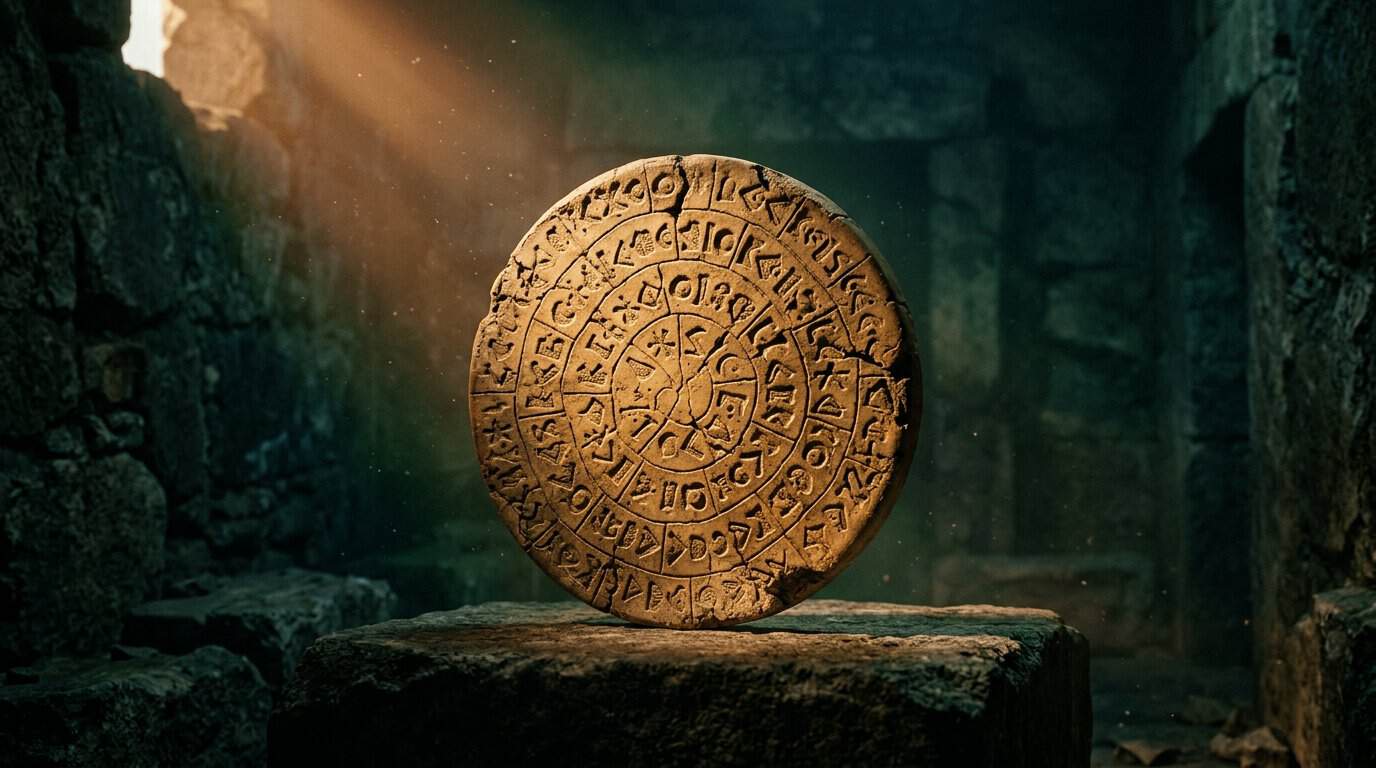
Phaistos Disc Meaning: What The Minoan Mystery Really Tells Us
A small clay disc from Crete has kept its secret for more than 3,500 years. The meaning of the Phaistos Disc remains unknown despite its spiral of stamped symbols, careful design, and countless attempts to read it. Found in 1908 at the Palace of Phaistos, the disc may preserve a prayer, record, message, or something no modern theory has yet imagined.
What makes the mystery difficult also makes it compelling: the inscription is short, unique, and unlike any securely understood writing system. Scholars generally accept the disc as a genuine Minoan-period object, but no translation or language identification has gained broad support. Its symbols invite bold ideas, yet the evidence calls for equal measures of curiosity and caution.
Key Takeaways
- The Phaistos Disc is a genuine Minoan-period fired-clay artifact discovered at the Palace of Phaistos in Crete in 1908, generally dated to around 1700–1650 BCE.
- Its spiral inscription contains about 241 stamped signs across 61 groups, but the symbols and language have not been securely identified or translated.
- The disc remains undeciphered because it is short, unique, and lacks a longer related text or bilingual inscription for comparison.
- Proposed interpretations—including a prayer, ritual text, calendar, administrative record, or teaching object—remain speculative, so visual similarities and intriguing theories should not be treated as verified meaning.
Introduction To Phaistos Disc Meaning
The Phaistos Disc is a small fired-clay artifact that has become one of the ancient world’s most famous mysteries. Italian archaeologist Luigi Pernier found it at the Palace of Phaistos on Crete in 1908. The disc measures about 16 centimeters across and carries symbols arranged in a spiral on both sides. Most researchers place it in the Minoan Protopalatial period, around 1700 to 1650 BCE, although its exact date remains debated. Its stamped figures include people, animals, plants, and tools, giving the object a striking visual character while offering few reliable clues to its purpose.
The question of the Phaistos Disc’s meaning must therefore be approached with care. The symbols have not been translated, and no proposed language, reading, or interpretation has gained broad scholarly acceptance. Some ideas describe a prayer, calendar, ritual text, or message from another culture. Other researchers question whether the disc records writing in the usual sense at all. Until the symbols can be compared with a longer, securely understood text, the most responsible view is that the disc is a genuine Minoan-period inscribed object whose meaning remains unknown. That uncertainty keeps the mystery compelling without turning speculation into fact.
Discovery And Dating Of The Phaistos Disc
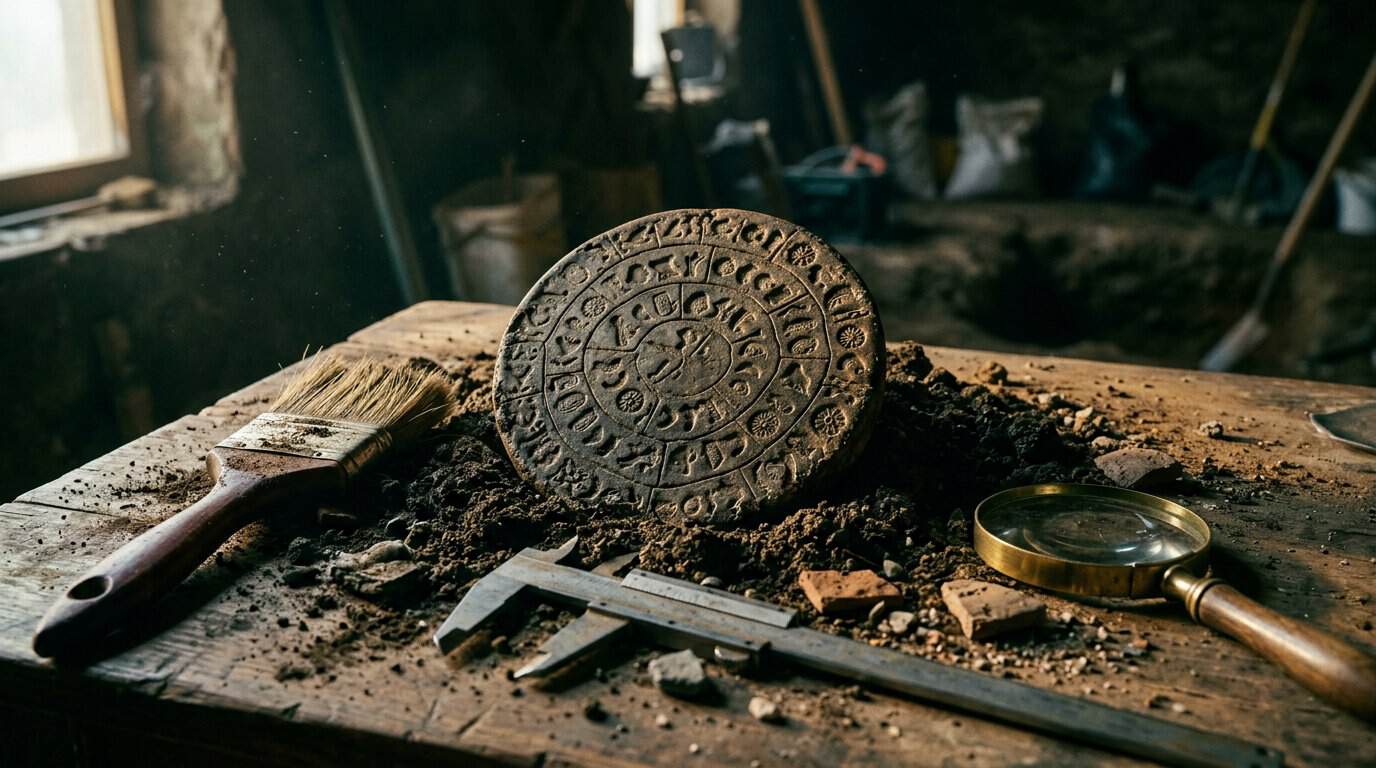
On July 3, 1908, Italian archaeologist Luigi Pernier uncovered the Phaistos Disc at the Palace of Phaistos on Crete. The small object emerged from a room linked to the palace complex, turning a routine excavation into one of archaeology’s most enduring mysteries. Its surface carries rows of unfamiliar signs arranged along a spiral, raising questions about who made it and what message it was meant to preserve. Today, the disc is displayed at the Heraklion Archaeological Museum, where it remains one of the museum’s best-known Minoan artifacts.
The disc is made from fired clay and measures about 16 centimeters across, roughly the width of a small plate. Its symbols appear to have been stamped into soft clay before the object was fired rather than carved afterward. The spiral design runs across both faces, with groups of repeated signs placed inside separate compartments. This unusual layout has inspired theories that the disc may record a ritual text, hymn, calendar, or administrative message, although none of these ideas has gained broad scholarly acceptance.
Most researchers place the Phaistos Disc in the Minoan Protopalatial period, around 1700 to 1650 BCE, although its exact date remains debated. That timeframe fits the wider development of palaces, writing systems, and complex religious practices on Bronze Age Crete, but the disc’s signs do not match any securely deciphered Minoan script. The Heraklion Archaeological Museum emphasizes that the Phaistos Disc has not been translated and that its language and purpose remain unknown. For now, its most defensible meaning is also its greatest mystery: it is a genuine Minoan inscribed object whose short, isolated text has not yet revealed what it says.
Symbols And Structure Of The Phaistos Inscription
The meaning of the Phaistos Disc remains unknown, but its structure offers important clues about how the inscription was made. On both faces, stamped symbols follow a spiral path from the outer edge toward the center, forming 61 groups that may represent words, phrases, or other units of text. Researchers commonly count about 241 signs in total, drawn from 45 recurring sign types. These repeated images include people, animals, plants, tools, and geometric shapes, although their intended sounds or meanings cannot be confirmed. Unlike a handwritten text, the signs were pressed into soft clay with prepared stamps, suggesting a deliberate and carefully planned inscription.
A useful diagram could trace the spiral reading path while marking each sign group and showing where the two faces differ. It should also distinguish the stamped symbols from the later incised dividing lines, which appear to separate groups but are not part of the original sign designs. This detail matters because the groups may shape any future attempt to understand the disc, even though the short text has no securely identified language or matching document. Comparisons with Linear A and Linear B can provide context about writing in the Minoan and Mycenaean worlds, but neither script supplies a proven translation for the disc. For now, the arrangement supports several possibilities, from a ritual text to a record or symbolic message, without confirming any single meaning.
Why The Phaistos Disc Remains Undeciphered

The Phaistos Disc offers too little text for researchers to test a translation with confidence. Found by Luigi Pernier at the Palace of Phaistos in Crete in 1908, the fired-clay disc carries about 241 stamped signs arranged in a spiral, but many signs appear only once or a few times. Its usual date, around 1700 to 1650 BCE, places it in the Minoan world, yet its symbols do not match any securely readable writing system. The Heraklion Archaeological Museum presents it as an important Minoan artifact while acknowledging that its meaning remains unknown.
The disc is also isolated, which removes the comparisons that often help researchers unlock ancient writing. No other inscription uses the same complete set of signs, and no bilingual text pairs its symbols with a known language, as the Rosetta Stone does for Egyptian. Researchers can compare it with Linear A and other scripts from Bronze Age Crete, but those comparisons have not identified the disc’s language or proved that it records ordinary speech. Without a second text, a longer document, or a clear historical context, even repeated symbols can support several readings rather than one verified answer.
That uncertainty has encouraged theories that the disc contains a prayer, calendar, poem, ritual text, or even a message from another civilization. Some proposals focus on the spiral layout and repeated groups of signs, while others search for links to Minoan religion, astronomy, or distant cultures. These ideas keep the mystery alive, but they remain interpretations because none has produced a translation that independent specialists can consistently test against the entire inscription. Until new evidence appears, the most responsible account is that the Phaistos Disc is a genuine Minoan-period inscribed object carrying a message that has not yet been recovered.
Leading Theories About Phaistos Disc Meaning
The Phaistos Disc has not been deciphered, so its meaning remains an open question rather than a confirmed translation. One leading theory sees the spiral text as a ritual hymn or religious prayer, an idea supported by its repeated symbols, careful layout, and discovery at the Minoan palace of Phaistos. This explanation could account for a ceremonial object made to be viewed or recited, but the disc offers no clear names of gods, familiar religious signs, or repeated passages that can be checked against known Minoan texts. The Heraklion Archaeological Museum places the artifact broadly in the Minoan Protopalatial period, around 1700 to 1650 BCE, although its exact date remains debated.
Other proposals treat the disc as an administrative record, a calendar, or a teaching tool. An inventory or official message might explain the repeated groups of symbols, while a calendrical object could fit the disc’s circular form and organized spiral. Neither theory, however, identifies a reliable system of numbers, dates, or measurements. Some researchers have also suggested that it was used to teach writing, mark a game, or preserve a puzzle-like inscription. These possibilities could explain its unusual stamped symbols and compact design, but they remain difficult to test because the disc is a single, short example and no securely readable inscription uses the same sign system for comparison.
Similarities to Linear A, Egyptian writing, or other ancient scripts can make a proposed reading seem convincing, but visual resemblance alone cannot prove a connection or translation. The disc’s symbols were stamped into fired clay, unlike most handwritten texts, and its spiral arrangement may reflect the writing process rather than the message’s meaning. Until another inscription appears or a bilingual text provides a clear key, every theory accounts for some features while leaving major questions unanswered. For now, the most careful view is that the Phaistos Disc is a genuine Minoan-period inscribed object with a purpose that may have been religious, practical, educational, or symbolic, but no interpretation has broad scholarly acceptance.
Conclusion On Phaistos Disc Meaning
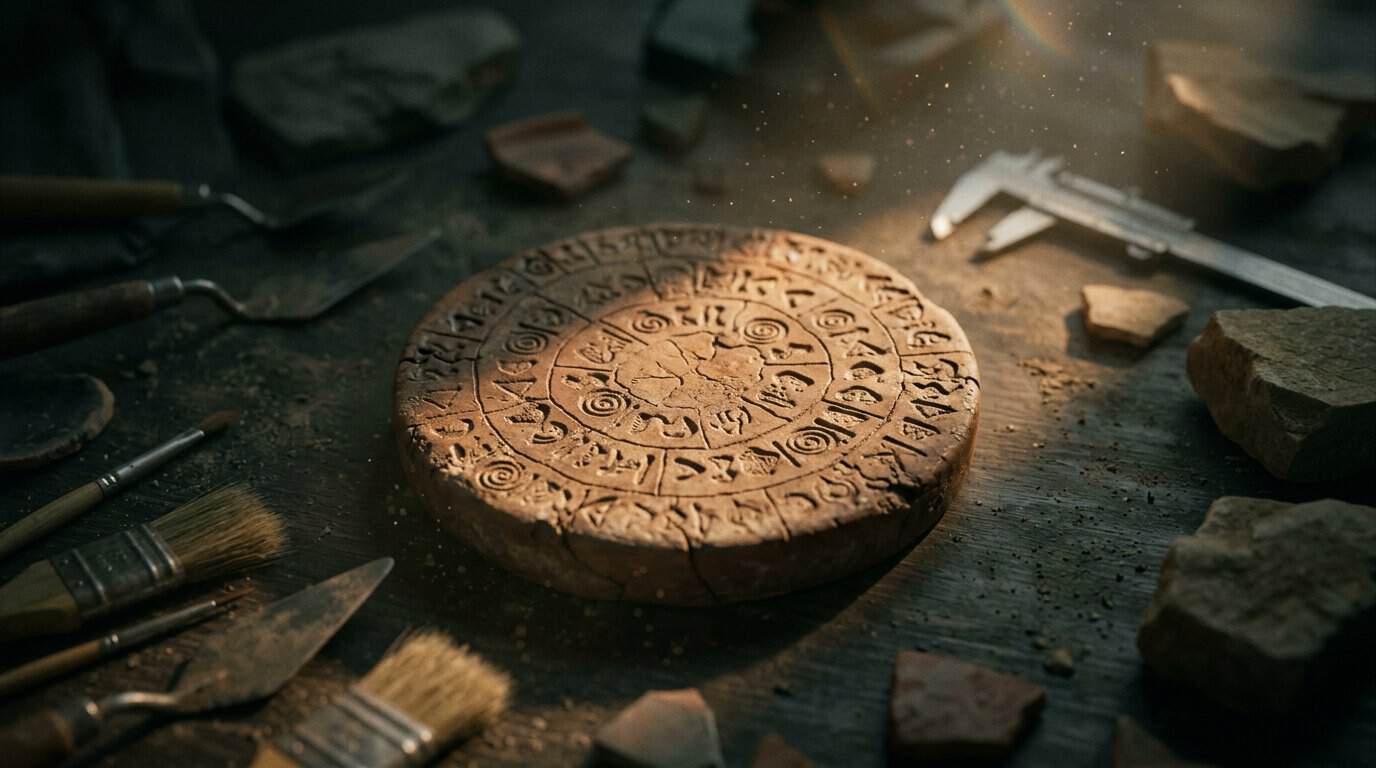
The meaning of the Phaistos Disc remains one of archaeology’s most tempting unanswered questions. Found by Luigi Pernier at the Palace of Phaistos in Crete on July 3, 1908, the fired-clay disc is generally dated to the Minoan Protopalatial period, around 1700 to 1650 BCE, although its exact date is still debated. Its symbols were pressed into the clay and arranged in a spiral, creating an object that is clearly important even though its purpose is uncertain. The disc is therefore valuable as a Minoan-period artifact, whether it records a ritual, message, hymn, or something no modern theory has yet imagined.
At present, no translation, language identification, or proposed reading has gained broad scholarly acceptance. The short inscription appears only on this isolated object, and there is not enough confirmed evidence to compare it with a known writing system or test a complete translation. That leaves room for thoughtful ideas, but each proposed meaning must be weighed against the disc’s limited evidence and the risk of fitting modern expectations onto ancient symbols. Which interpretation seems most plausible, and how can that theory be separated from an intriguing possibility rather than a true scholarly decipherment?
Why the Phaistos Disc Still Resists Translation
The meaning of the Phaistos Disc remains unknown despite more than a century of study. Discovered at the Palace of Phaistos in Crete in 1908, the fired-clay disc carries symbols stamped into a spiral pattern on both sides. Most scholars place it in the Minoan period, around 1700 to 1650 BCE, although its exact date is still debated. Its short text, unusual symbols, and lack of a matching inscription have made a verified translation impossible so far.
Proposed explanations range from a prayer or hymn to a calendar, ceremonial text, or unique form of writing, but none has gained broad scholarly support. That uncertainty makes the disc valuable not because it offers a confirmed message, but because it preserves a rare glimpse of a writing tradition that remains almost out of reach. As research into Minoan Crete and other ancient mysteries continues, the meaning of the Phaistos Disc may become clearer, or its silence may remain part of its lasting power. Which interpretation best fits the evidence remains an open question for historians, archaeologists, and curious readers.
Frequently Asked Questions
1. What is the Phaistos Disc meaning?
The meaning of the Phaistos Disc remains unknown. The disc may contain a prayer, ritual text, calendar, record, or message, but no interpretation has gained broad scholarly support. Its short inscription and unique symbols leave several possibilities open.
2. What is the Phaistos Disc?
The Phaistos Disc is a small fired-clay disc found at the Palace of Phaistos on Crete in 1908 by Italian archaeologist Luigi Pernier. It measures about 16 centimeters across and carries stamped symbols arranged in a spiral on both sides. Most researchers connect it with the Minoan period, around 1700 to 1650 BCE, although its exact date remains debated.
3. Has the Phaistos Disc been translated?
No reliable translation of the Phaistos Disc has been accepted by the wider scholarly community. Many proposed readings identify it as a prayer, hymn, calendar, or administrative message, but they usually depend on unproven assumptions about the symbols or language. A longer related text would be needed to test these ideas more securely.
4. What do the symbols on the Phaistos Disc represent?
The symbols show recognizable figures such as people, animals, plants, buildings, and tools. Their images may represent sounds, words, objects, or ideas, but their exact role is unknown. The disc appears carefully organized, yet its spiral layout does not reveal how each symbol should be read.
5. Which language is written on the Phaistos Disc?
The language of the Phaistos Disc has not been identified. Some researchers have compared its symbols with Minoan scripts such as Linear A, while others have suggested links to languages from nearby regions. None of these comparisons has produced a confirmed reading, so the disc cannot yet be assigned to a known language with confidence.
6. Why is the Phaistos Disc so difficult to understand?
The inscription is extremely short, contains a unique set of symbols, and has no securely understood bilingual text to guide translation. Only one widely accepted example of the disc exists, which makes it difficult to recognize repeated words or test grammar. Its unusual stamped design also leaves open the question of whether it records ordinary writing at all.
7. Could the Phaistos Disc be a fake?
The disc’s authenticity has been questioned because it is unique and was discovered soon after major interest in Minoan writing began. However, many scholars accept it as a genuine Minoan-period object based on its archaeological context, clay, firing, and design. Doubt remains part of the discussion, but no widely accepted evidence has proved it to be a modern forgery.
8. What are the leading theories about the purpose of the Phaistos Disc?
The main theories describe the disc as a religious prayer, ceremonial text, calendar, record, teaching object, or message connected with another culture. Some interpretations focus on the human and animal figures, while others focus on the spiral structure and repeated signs. The evidence supports curiosity rather than certainty, and the disc may represent a form of communication that modern researchers do not yet recognize.