
Sea Peoples Identity: What Ancient Evidence Reveals
The mystery of the Sea Peoples identity begins with a striking question: who were the seaborne groups that appeared in Egyptian records during the upheavals of 1200 to 1150 BCE? They are often described as one invading nation, but the evidence points to a shifting mix of raiders, mercenaries, migrants, and displaced communities from across the eastern Mediterranean. Their arrival helped reshape the ancient world and may show how migration and conflict can transform entire civilizations.
Egyptian inscriptions name groups such as the Peleset, Sherden, and Shekelesh, yet their origins remain debated. The Peleset are strongly linked to the Philistines, whose early communities show ties to the Aegean and southern Europe. Other proposed identifications remain uncertain. Between firm evidence and enduring mystery, the Sea Peoples identity offers a rare chance to examine what history can prove and what it can only cautiously suggest.
Key Takeaways
- The “Sea Peoples” were not one unified nation or empire, but a shifting coalition of raiders, mercenaries, migrants, and displaced communities active in the eastern Mediterranean around 1200–1150 BCE.
- Egyptian records name groups such as the Peleset, Sherden, Shekelesh, Tjekker, Denyen, and Weshesh, but the inscriptions reflect Egyptian political viewpoints and do not establish each group’s homeland or identity.
- The Peleset are most strongly associated with the early Philistines, whose settlements show Aegean and southern European connections; proposed links between the Sherden and Sardinia or the Shekelesh and Sicily remain unproven.
- Drought, famine, warfare, trade disruption, and political collapse likely combined to drive migration and conflict during the wider Late Bronze Age collapse, making climate alone an insufficient explanation.
Introduction To Sea Peoples Identity
Egyptian inscriptions open the mystery of the Sea Peoples with scenes of a world under pressure. Around 1200 to 1150 BCE, records from the reigns of Merneptah and Ramesses III describe groups such as the Peleset, Tjekker, Sherden, Shekelesh, Denyen, and Weshesh moving through the eastern Mediterranean. At Medinet Habu, Ramesses III’s temple shows ships, wagons, families, and fighters arriving during a conflict that threatened Egypt’s coastline. These accounts offer a rare glimpse of the crisis, but they do not provide one clear explanation for who these people were.
“Sea Peoples” is a modern umbrella term, not the name of one known ancient nation. Egyptian scribes listed several groups separately, and their members may have included raiders, mercenaries, displaced families, and migrants whose alliances changed over time. Some may have traveled by sea, while others moved overland with carts and livestock. This pattern suggests a broader movement of communities rather than one organized invasion. The label remains useful, but it can also hide the variety of identities behind the Egyptian records.
Archaeology and climate research add clues without solving the puzzle completely. Evidence of destruction appears at several eastern Mediterranean sites during the same broad period, while studies of drought, food shortages, and political upheaval suggest that environmental stress may have intensified existing conflicts and migrations. The Peleset are often linked to the early Philistines, and some archaeological and genetic findings point to Aegean or southern European connections, although other proposed identifications remain uncertain. Together, the evidence suggests that the Sea Peoples identity was fluid, shaped by movement and crisis, and still open to careful debate.
Egyptian Records Name The Groups
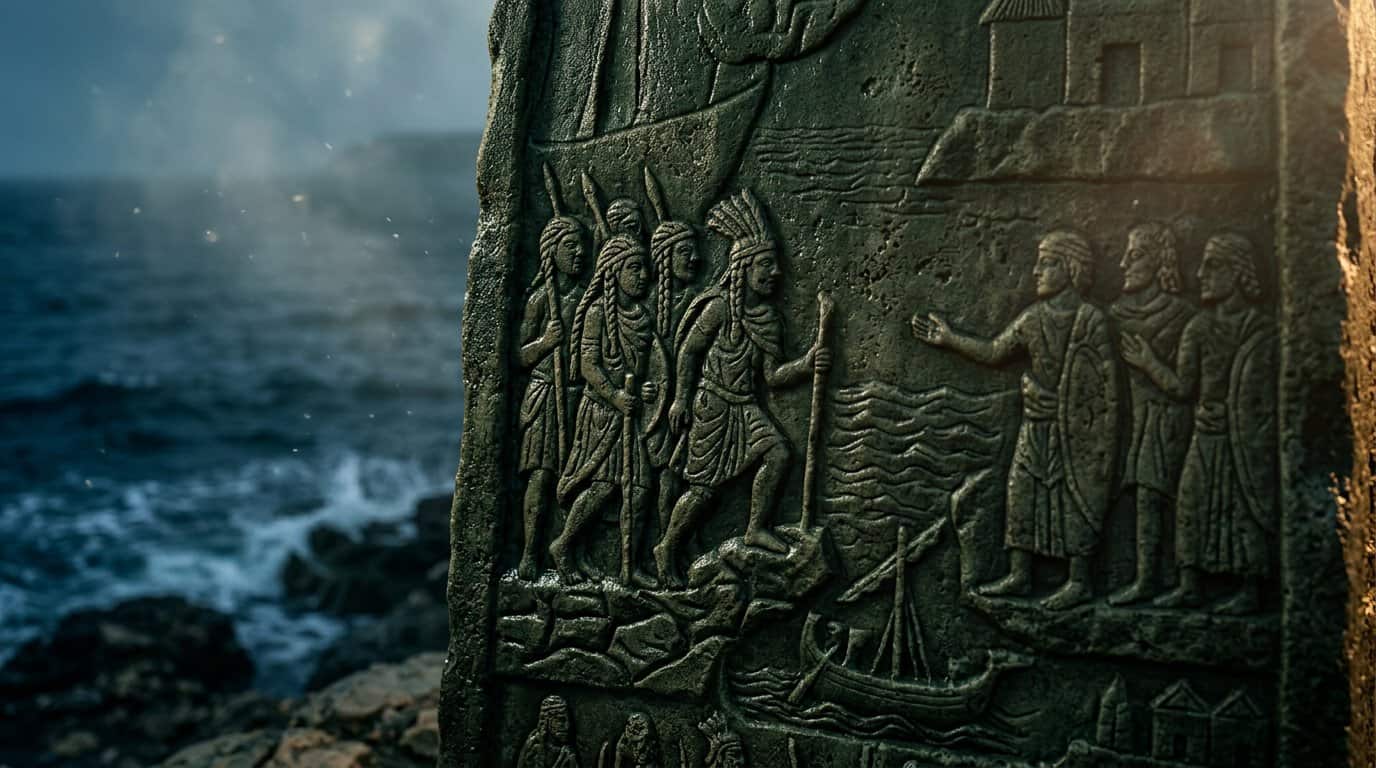
Egyptian records do not name a single “Sea Peoples” nation. Instead, the inscription of Merneptah, dated to around 1208 BCE, lists groups including the Sherden, Shekelesh, Lukka, and Ekwesh among forces connected with conflict in the eastern Mediterranean and Libya. Decades later, Ramesses III’s inscriptions at Medinet Habu describe attacks by the Peleset, Tjekker, Denyen, and Weshesh, presenting them as a dangerous coalition defeated by Egypt. These names suggest shifting alliances of raiders, mercenaries, migrants, and displaced communities rather than one unified ethnicity.
The artwork adds a vivid but carefully controlled layer to the story. Reliefs from Ramesses III’s reign show naval battles, captured ships, distinctive helmets, ox carts, women, and children. These details may point to both warfare and migration. The Peleset are especially important because many scholars connect them with the later Philistines, whose early settlements show some Aegean or southern European connections alongside local traditions. Proposed links between the Sherden and Sardinia, or the Shekelesh and Sicily, remain possible but unproven. A resemblance between names is not the same as proof.
Egyptian accounts also reflect the viewpoint of rulers who wanted to portray order triumphing over chaos. Their inscriptions celebrate the pharaoh’s victory and may simplify complicated movements of people. The images, however, reveal communities traveling with families and possessions, not only armies bent on destruction. Archaeological evidence and climate research suggest that drought, political collapse, trade disruption, and competition for land may all have shaped the wider crisis around 1200 to 1150 BCE. The identity of the Sea Peoples therefore remains a genuine historical puzzle, best approached as a changing human movement whose members came from several places and left different traces.
Proposed Homelands And Evidence
The strongest proposed homeland link connects the Egyptian name Peleset with the Philistines who settled along the southern Levantine coast. At sites such as Ashkelon, archaeologists found early Philistine pottery with Aegean-style shapes and designs, along with food practices and burial customs that differed from older local traditions. Ancient DNA from early Iron Age burials at Ashkelon also identified a southern European or Aegean-related ancestry signal. That signal became less visible in later generations as newcomers mixed with local communities. The evidence suggests that at least part of the Peleset population arrived from across the sea, while not proving that every person called Peleset shared the same origin.
Other names invite intriguing comparisons, but the evidence is less secure. The Sherden have often been linked with Sardinia because the names sound similar and some Egyptian images show warriors wearing distinctive horned helmets. However, no single archaeological marker confirms that they were Sardinian. In the same way, the Shekelesh are sometimes connected with Sicily, but the proposed link rests mainly on name similarities and limited cultural parallels rather than clear settlement evidence. Pottery styles, weapons, and burial practices can reveal contact and movement, but they do not always identify a people with certainty.
Climate research adds another layer to the mystery by pointing to drought, crop failures, and political disruption around the eastern Mediterranean crisis of roughly 1200 to 1150 BCE. Egyptian records from the reigns of Merneptah and Ramesses III describe several groups arriving by land and sea, supporting the view that the Sea Peoples were shifting coalitions of raiders, mercenaries, migrants, and displaced families rather than one united nation. Their changing identities may explain why Aegean connections appear strongest among early Philistine communities, while proposed Sardinian and Sicilian links remain unproven. The evidence invites further study, but it also warns against turning suggestive names into settled history.
Climate Migration And Regional Collapse
The “Sea Peoples” were probably not one nation, ethnicity, or empire, but a changing mix of raiders, mercenaries, migrants, and displaced communities. Egyptian scribes recorded several names, including the Peleset, Sherden, and Shekelesh, during the eastern Mediterranean crisis from about 1200 to 1150 BCE. Inscriptions at Medinet Habu describe battles under Ramesses III, while earlier records from Merneptah mention some of these groups in connection with conflict in the region. Archaeology offers the clearest link between the Peleset and the early Philistines, whose communities included people with Aegean or southern European ancestry, but other proposed identities remain uncertain.
| Approximate date | Key development |
|---|---|
| c. 1250 BCE | Trade networks and palace states still connect much of the eastern Mediterranean. |
| c. 1200 BCE | Major centers, including Hattusa and several Mycenaean sites, face destruction or abandonment. |
| c. 1175 BCE | Ramesses III records a major clash with groups identified as the Sea Peoples. |
| After 1150 BCE | New settlements and political powers emerge, including early Philistine communities along the southern Levantine coast. |
Climate stress may have helped set these movements in motion. Lake sediments, pollen records, and other climate evidence suggest that parts of the eastern Mediterranean experienced periods of drought. These conditions could have reduced harvests, intensified food shortages, and weakened already fragile governments. As famine and political instability spread, communities may have moved toward safer coastlines, fertile valleys, or wealthy trade centers. Warfare and disrupted shipping may also have created new opportunities for armed groups. Climate alone cannot explain every migration or collapse, since local rivalries, rebellions, economic breakdown, and military choices also shaped the outcome. The mystery lies not in finding one simple origin for the Sea Peoples, but in understanding how many communities were drawn into the same age of upheaval.
Why One Sea Peoples Identity Fails
The Sea Peoples were probably not one nation, ethnicity, or empire, but a changing mix of groups moving through the eastern Mediterranean around 1200 to 1150 BCE. Egyptian inscriptions from the reign of Ramesses III name groups such as the Peleset, Sherden, and Shekelesh, yet they do not describe a single leader or homeland shared by all of them. Some may have been raiders or mercenaries, while others could have been displaced families and migrants searching for safety or new land. This shifting pattern makes the Sea Peoples identity less like a forgotten kingdom and more like a loose coalition formed during a time of upheaval.
Archaeology adds clues, but it does not provide a final answer. The Peleset are often linked with the early Philistines, whose settlements show Aegean-related cultural features and evidence that some newcomers had southern European ancestry. Proposed links between the Sherden and Sardinians or the Shekelesh and Sicilians remain possible but unproven. Climate research suggests that drought, food shortages, and pressure on fragile economies may have pushed people across the region, although environmental stress alone cannot explain every conflict or migration. These findings connect the mystery to the wider story of the Late Bronze Age collapse, when several powerful societies weakened or disappeared within a few generations.
What remains uncertain is just as important as what scholars can establish. Egyptian records were written from a royal viewpoint and often presented newcomers as enemies, while archaeology reveals movement and cultural change without always identifying the people involved. The groups called the Sea Peoples may therefore have changed in size, purpose, and membership as they traveled, leaving behind a story that overlaps with the disappearance of ancient civilizations. Rather than seeking one dramatic answer, researchers continue to ask how war, migration, climate, and opportunity combined to reshape the ancient world.
Conclusion Rethinking Sea Peoples Identity
The evidence suggests that the Sea Peoples were not one unified nation, but a modern label for several groups named in Egyptian records between about 1200 and 1150 BCE. Inscriptions from the reigns of Ramesses III and Merneptah describe groups such as the Peleset, Sherden, and Shekelesh, yet they do not establish one shared homeland or leader. Some may have been raiders or mercenaries, while others appear to have traveled with families and settled in new communities. Their identities and roles may have changed as the wider eastern Mediterranean world faced war, political collapse, and migration.
Archaeology adds both clues and complications to the story. The Peleset are often linked with the early Philistines, whose settlements show Aegean-related features and evidence of outside migration. Proposed links between the Sherden and Sardinia or the Shekelesh and Sicily remain possible but unproven. Climate research points to drought and food stress in parts of the region, conditions that could have pushed communities toward movement, conflict, or alliance. At the same time, these pressures do not prove that climate change alone caused the upheaval, and the surviving records were written by Egyptian officials with their own political aims.
The Sea Peoples identity may be best understood as a shifting coalition rather than a forgotten empire waiting to be named. Some members could have arrived from the Aegean, Anatolia, the central Mediterranean, or nearby coastal regions, joining and separating as circumstances changed. The unanswered questions remain compelling: which groups were migrants, which were local rebels, and how much did climate, trade, and warfare shape their movements? Which explanation best fits the inscriptions, archaeological record, climate evidence, and the mysteries that still remain?
Unraveling the Sea Peoples’ Shifting Identities
Sea Peoples identity remains less a solved label than an ancient historical puzzle. Egyptian inscriptions from the late 13th and early 12th centuries BCE name groups such as the Peleset, Sherden, and Shekelesh, but they do not describe one united nation or shared homeland. Most scholars now view these groups as shifting coalitions that may have included raiders, mercenaries, migrants, and displaced families from several parts of the eastern Mediterranean. Their alliances and identities could have changed as wars, famine, and political collapse reshaped the region.
Archaeology adds detail, but it does not provide a single answer. The Peleset are the strongest proposed identification, often linked with the early Philistines, whose settlements show connections to the Aegean and southern Europe during the period after 1200 BCE. Other suggestions, including links between the Sherden and Sardinia or the Shekelesh and Sicily, remain possible but unproven. Climate research also points to drought and food shortages that may have pushed communities to move, although environmental stress alone cannot explain every raid or migration.
The Sea Peoples were likely real groups remembered through an Egyptian viewpoint, not a mysterious superpower with one clear origin. Their story emerged from the wider Bronze Age collapse, when trade networks weakened, kingdoms fell, and people moved across the Mediterranean in search of safety or opportunity. The evidence leaves room for discovery while warning against forcing every name into a modern ethnic category. Readers may still wonder which combination of migration, warfare, and climate change best explains their arrival, making Sea Peoples identity an enduring mystery rather than a closed case.
Frequently Asked Questions
1. What does “Sea Peoples identity” mean?
“Sea Peoples identity” refers to the ongoing effort to determine who the seaborne groups were that appeared in Egyptian records during the crisis of about 1200 to 1150 BCE. The term does not describe one united nation, but a modern label for several groups that may have included raiders, mercenaries, migrants, and displaced families.
2. Which groups were identified as the Sea Peoples?
Egyptian inscriptions name groups including the Peleset, Tjekker, Sherden, Shekelesh, Denyen, and Weshesh. The records treat them as separate communities, and their alliances, origins, and goals may not have been the same. Their names appear most clearly in the records of Merneptah and Ramesses III.
3. What evidence reveals the identity of the Sea Peoples?
The strongest evidence comes from Egyptian inscriptions and reliefs, especially the records of Merneptah and the scenes at Ramesses III’s temple at Medinet Habu. These sources show ships, weapons, wagons, families, and battles, but they reflect Egypt’s viewpoint and were created to celebrate royal victories. Archaeology, pottery, weapons, settlement patterns, and language comparisons help fill the gaps, although none provides a complete answer.
4. Were the Sea Peoples one invading nation?
Probably not. Egyptian records list several groups separately, while the Medinet Habu reliefs show a movement that included fighters and families traveling by both sea and land. This evidence supports the idea of a shifting coalition or larger migration crisis rather than a single empire acting under one ruler.
5. Where did the Sea Peoples come from?
Their origins remain disputed, but many researchers see links to the Aegean, western Anatolia, Cyprus, and other parts of the eastern Mediterranean. Pottery styles, weapons, burial customs, and settlement evidence point toward movement and cultural mixing rather than one clearly defined homeland. The evidence supports several possible connections, but it does not prove that every named group came from the same region.
6. Were the Peleset the ancestors of the Philistines?
The Peleset are widely connected with the Philistines because their names are similar and early Philistine settlements show Aegean-style pottery, architecture, and food practices. Sites along the southern Levantine coast also reveal a mixed culture that combined local traditions with outside influences. This connection is strong, but it does not prove that all Peleset people came from one Aegean homeland or that their identity stayed unchanged.
7. Why did the Sea Peoples move around 1200 BCE?
No single cause explains the upheaval. Drought, famine, earthquakes, political collapse, trade disruption, warfare, and population displacement may have worked together across the eastern Mediterranean. The collapse of major powers, including the Hittite Empire and several Mycenaean centers, created instability that encouraged both migration and conflict.
8. How certain is the modern understanding of Sea Peoples identity?
The broad picture is clearer than the personal identities of the groups involved. Egyptian texts confirm that several named communities reached or threatened Egypt, while archaeology confirms major disruption and cultural change across the region. Their exact homelands, leadership, and motivations remain uncertain, making Sea Peoples identity a question that requires evidence, caution, and continued debate.