The Black Shuck Legend: East Anglia’s Spectral Dog
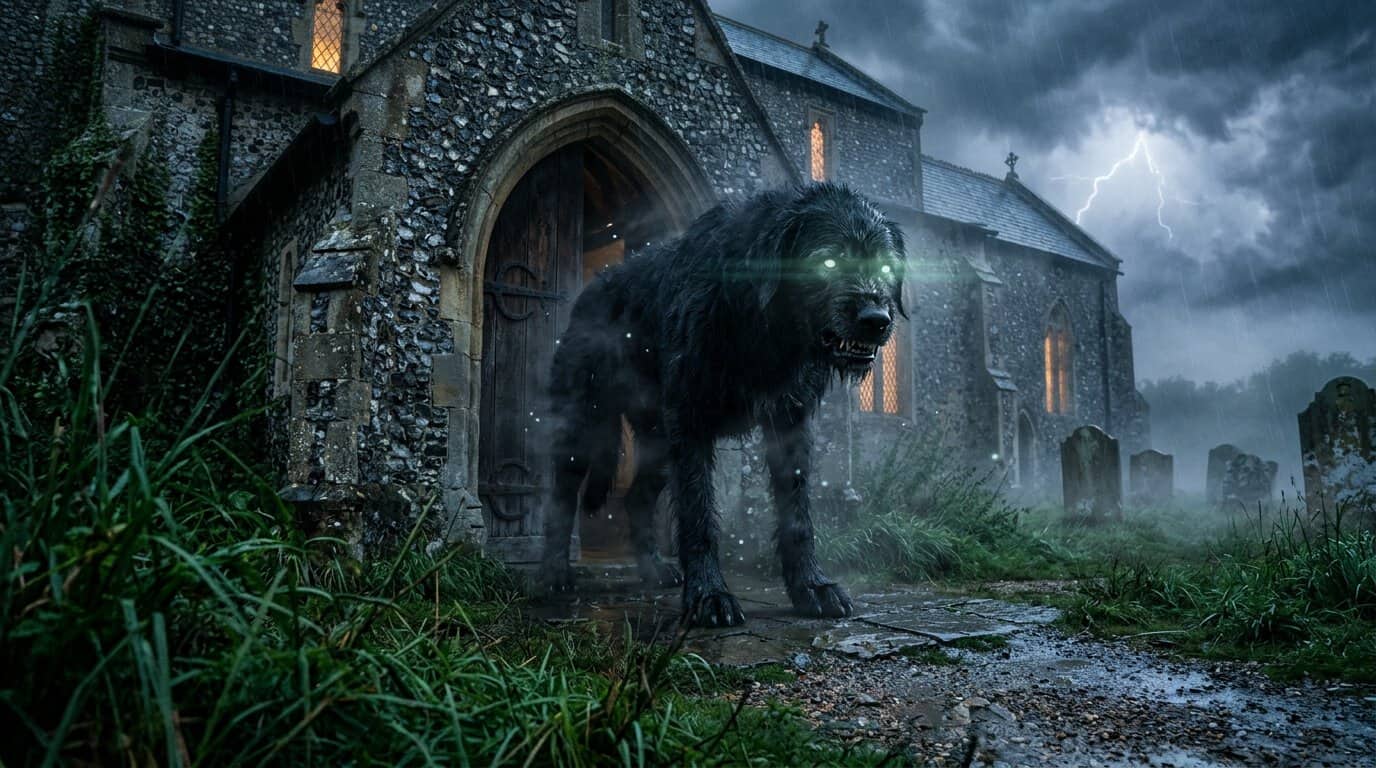
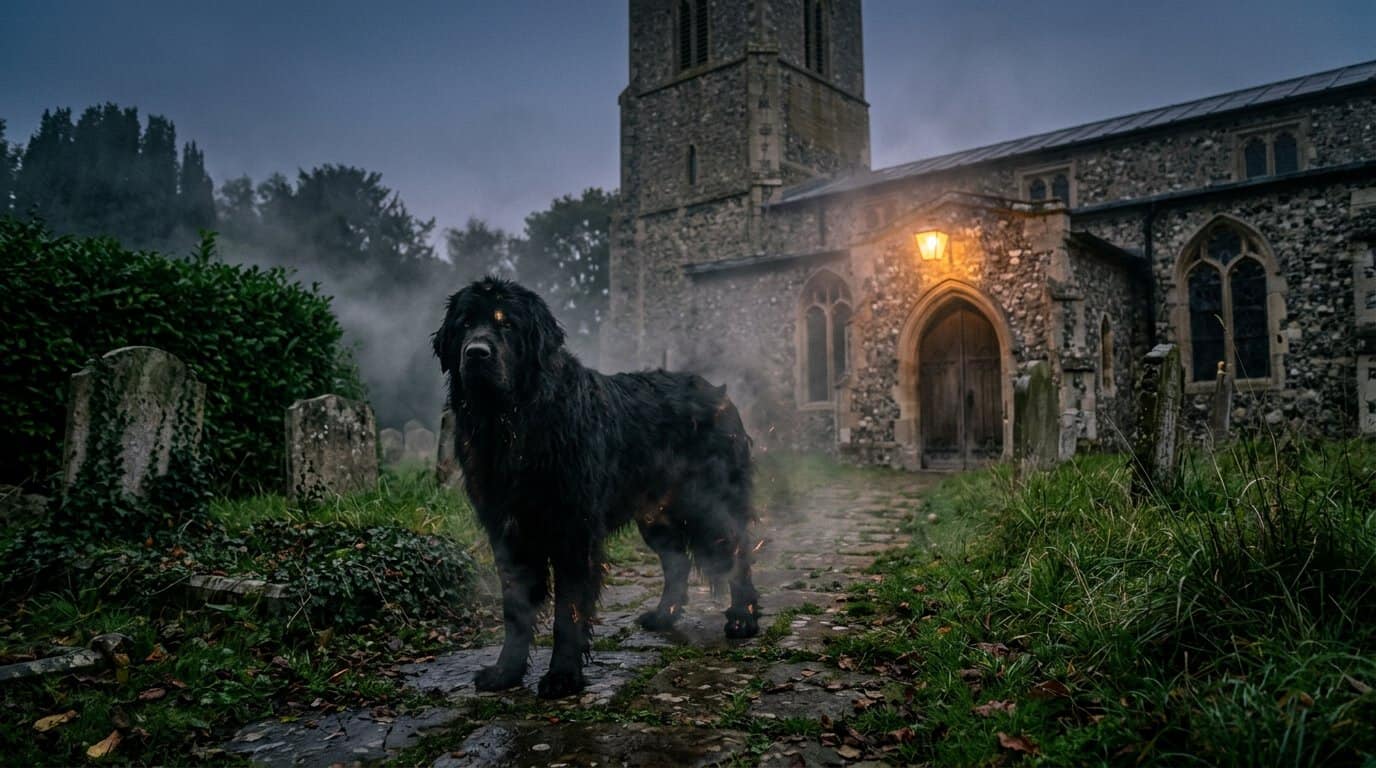
The Black Shuck legend tells of a huge, shaggy black dog with fiery eyes that prowls the countryside of Norfolk and Suffolk in eastern England. Its most famous appearance is recorded in a pamphlet describing a violent storm on the morning of 4 August 1577, when the churches at Bungay and Blythburgh were battered and a black, dog-like apparition was said to appear in the middle of the chaos. Today, some local versions cast the creature as a protector rather than a threat, showing how the legend has softened with each retelling.
Abraham Fleming’s twelve-page account was arranged from a written copy, as a Royal Holloway study of the pamphlet explains. Parish records later confirm that the storm was deadly, with two men, John Fuller and Adam Walker, named in the Bungay burial register. What, if anything, moved through those churches that morning remains the open question at the heart of the story.
Key Takeaways
- Abraham Fleming’s 1577 pamphlet describing a black dog during the storm at Bungay and Blythburgh was arranged from a written copy rather than from his own eyewitness observation.
- The Bungay parish records name John Fuller and Adam Walker as storm victims but never mention a dog, so the two deaths are well documented while the dog rests mainly on the printed account.
- The name Shuck appears in one of its early printed uses in Notes and Queries on 18 May 1850, where a contributor known as E.S.T. only suggested that it came from the old word shag.
- Some local versions of the Black Shuck legend portray the dog as a protector rather than a threat.
- The Bungay Black Shuck Festival keeps the legend alive, with a parade to Falcon Meadow planned for 2026 and two days of free activities.
Where Does the Black Dog Roam East Anglia?
Black Shuck haunts the flat, watery countryside of Norfolk and Suffolk, the two counties at the heart of East Anglia on England’s eastern coast.
The countryside here seems made for stories. Wide skies sit above reed beds, tidal marshes and the slow waterways of the Norfolk Broads, while small market towns gather around churches whose towers can be seen for miles across the fields. On a foggy evening, when the reeds hide the path and the church tower is the only landmark, it is easy to see how a dark shape could seem to rise out of the mist.
Descriptions of the creature stay remarkably consistent. It is a huge, black, dog-like apparition with a shaggy coat, far bigger than any dog a witness would be likely to have known. It usually appears without warning and vanishes just as quickly, leaving behind little more than a chill and a memory.
Churchyards have always been part of its story. An 1850 notice in the journal Notes and Queries described reports of a large shaggy dog visiting churchyards at midnight, not only in East Norfolk but also across the border in Cambridgeshire. The dog’s reputed range was never neatly confined to one county.
Yet the legend has never been one fixed story. Each village seems to have its own version, with different meeting places, different reasons for the dog’s visit and different endings. A 2024 article from National Parks on the folklore of the Broads notes that some local versions cast the dog as protective rather than threatening, a guardian rather than an omen of doom.
That split is part of what keeps the tradition alive. A storyteller in one parish may warn of meeting the dog on a lonely road at night, while another remembers it walking people safely home. Both share the same black shape, but they answer a basic question in opposite ways: is the dog something to fear, or something to trust?
What Happened at Bungay and Blythburgh in 1577?
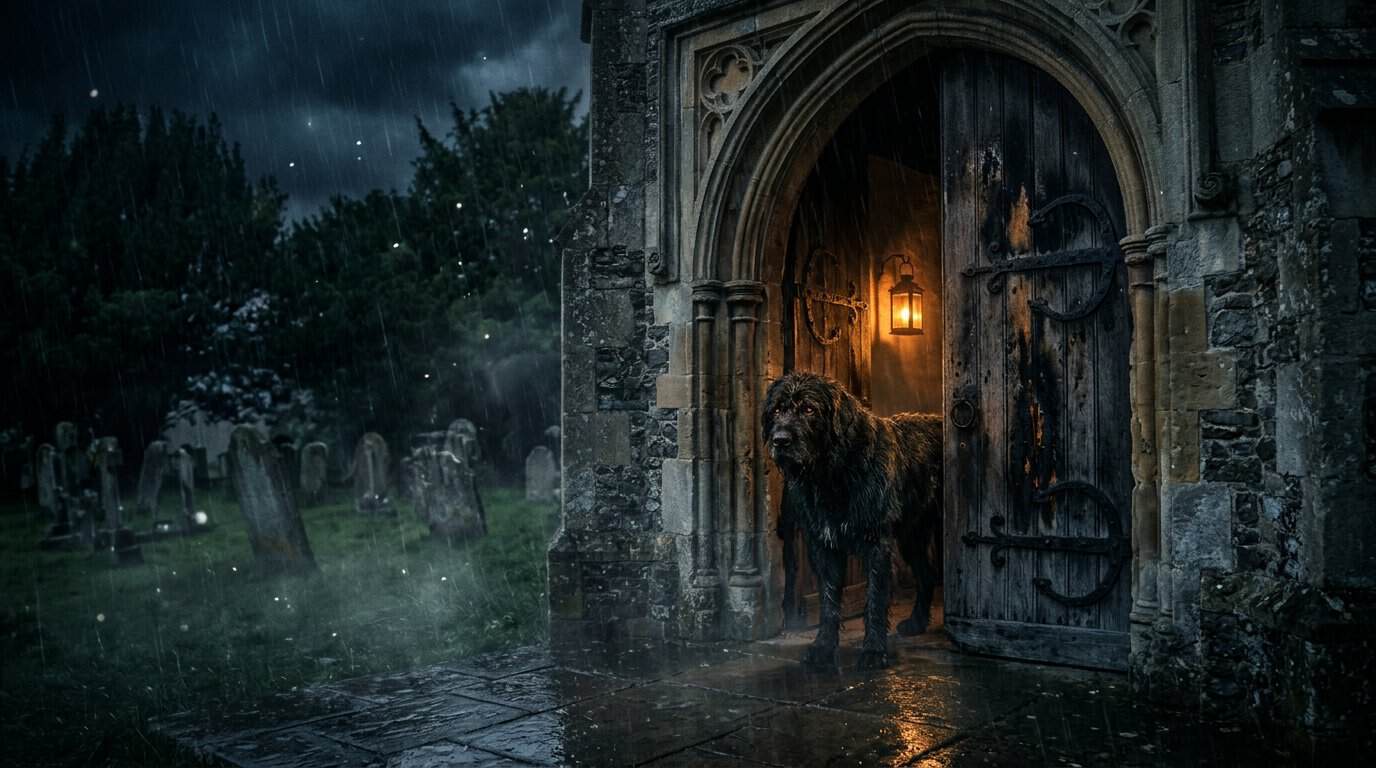
In the Suffolk towns of Bungay and Blythburgh, a violent storm on the morning of 4 August 1577 killed several people and damaged both churches. A printed pamphlet by Abraham Fleming described a huge black dog moving through the chaos. The pamphlet, titled A straunge and terrible wunder, places the storm between nine and ten o’clock in the morning, when the congregations were inside the churches.
Fleming describes the storm as a fury of thunder, lightning and wind that struck with little warning. At Bungay, the pamphlet reports two deaths and an injured survivor. In the middle of the destruction, the writer says, a black, dog-like apparition appeared, and the sight was seen as a sign that something unnatural had entered the building.
The story then moves a short journey away to Blythburgh, where the church of Holy Trinity suffered worse losses. The pamphlet records three deaths there, along with further injuries. The dog is described again at this second church, and Fleming reads the whole event in religious terms, as a warning sent to a sinful community.
The pamphlet itself was a small, cheap book. It ran to twelve pages and was printed in octavo, a format made by folding each large printed sheet into eight leaves, which made the book easy to carry and handle. It also included a woodcut illustration of the dog, an image cut into a block of wood, inked and pressed onto the paper.
Here the story becomes more complicated. Clare Painting Stubbs, in her Royal Holloway study of the pamphlet, found that Fleming arranged his account “according to the written copy.” In other words, he was assembling a report that someone else had already written down. He was not an eyewitness, and the pamphlet’s version of events passed through at least one earlier hand before reaching print.
Speed is another clue. The pamphlet was in circulation within about four weeks of the storm, and it may have appeared even sooner. A printer working that quickly suggests that news of the storm, and of the dog, was spreading fast through the region and that readers were eager for a full account.
So what should a reader make of it? The pamphlet gives a clear and dramatic picture, but it is shaped by the person who first wrote it down, by the printer who produced it, and by the religious beliefs of the time. Which parts reflect what people saw that morning, and which parts reflect what they feared or expected, is a question the pamphlet alone cannot fully answer.
Which Storm Deaths Appear in Church Records?
The parish records of St Mary’s, Bungay, name two men who died in the storm of 1577: John Fuller and Adam Walker. Their deaths appear in a source that has nothing to do with the pamphlet’s dramatic story, which makes these entries a valuable check on what the pamphlet says.
The first clue is a set of churchwardens’ accounts, the parish’s own record of money spent on church business. In August 1577 the accounts record a payment for laying out the bodies of two men killed in the storm. Laying out meant preparing the dead for burial, a practical task that a parish would pay for and write down. A Royal Holloway study of the pamphlet sets this entry beside the pamphlet’s account.
The burial register then gives the two men their names. Because the churchwardens and the register were kept by people going about their ordinary duties, these entries were not written to describe a miracle. They were written to keep track of costs and graves.
Two years later the parish recorded further trouble. A 1579 entry notes that a carpenter spent seven days repairing storm damage to a steeple window. The same entry recalls that two parishioners had died in the 1577 tempest, showing that the storm was still remembered in the parish’s own papers long afterwards.
Taken together, these records confirm several things. A violent storm struck Bungay, two people died, and the church itself was damaged. Those facts line up with the pamphlet’s report of two deaths at Bungay.
What the records do not contain is any mention of a dog. The churchwardens wrote about bodies, wages and broken glass, not about an apparition. None of the entries names a supernatural cause, and none suggests that anyone at the time linked the deaths to the black shape described in print.
A natural explanation fits the damage easily. A sudden tempest with heavy wind and lightning could bring down stonework, shatter a window and trap people in a crowded building. The parish records show the storm did exactly that.
Yet a question remains. Why would a churchwarden remember the two deaths in 1579 and still say nothing about the creature? Perhaps the dog was a story told by the people who had been there, and it never reached the account books. Or perhaps the dog belonged only to the printed version, added later to a tragedy that had already happened.
How Religious Tension Shaped the Bungay Story
In the late 1500s, England was still working out what its religion would look like. Under Queen Elizabeth I, the Church of England had been set up as a middle path, but many people remained torn between older Catholic customs and the stricter reforms pushed by Protestant preachers. For ordinary parishioners, that uncertainty was felt most keenly inside the parish church.
Sermons of the period often taught that God punished sin with plague, flood and fire. A sudden storm that broke over a congregation during a service was therefore easy to read as a message rather than as bad weather.
Christian Owen’s 2024 article in the Journal of Religious History starts from this atmosphere. Owen uses two sets of Bungay churchwardens’ accounts to test the 1577 story against the religious division and uncertainty of the age, asking how a town made sense of its losses while its own faith was being argued over.
Fleming’s pamphlet goes further than the parish papers. It reads the storm in religious terms, treating the deaths and the dog as parts of a spiritual lesson. The congregation is portrayed as a community that had strayed, and the storm as a judgment that could not be ignored.
Why a dog, though? A black, dog-like shape moving through a church could be read in several ways.
As a warning, it could signal that the community’s sins had invited something dangerous into its holy places. As a symbol, the dark creature might stand for evil, or for the unseen spiritual forces people feared but could not name. As a storyteller’s device, it was a vivid image that made a frightening morning easy to remember and retell, and it gave the moral a face.
These readings do not cancel each other out. A writer could mean all three at once, and a listener could hear them differently depending on whether they felt more afraid of God or of their neighbours. Readers may want to ask which reading feels closest to the pamphlet’s purpose, and whether the fear of judgment in that century shaped what people believed they had seen.
Where Did the Name Shuck Come From?
On 18 May 1850, the journal Notes and Queries ran a short notice titled “Shuck the Dog-fiend.” It described reports of a huge, shaggy black dog with fiery eyes that visited churchyards at midnight in East Norfolk and Cambridgeshire. The notice was one of the first times the creature was given the name Shuck in print, and it has been a starting point for readers ever since.
The notice also offered a guess about where the name came from. A contributor known as E.S.T. suggested that “Shuck” derived from “shag,” an old English word for a rough, hairy coat. He added that “shucky,” he believed, was Norfolk dialect for “shaggy,” which would tie the dog’s name directly to its appearance.
The idea is easy to picture. A dog with a matted black coat, seen half-hidden in a churchyard mist, would look shaggy to anyone who saw it. A local word for that look could easily cling to the creature, passed from one teller to the next until it became a name.
Yet the notice never treats this as settled. E.S.T.’s explanation is offered as a suggestion, and the writer leaves room for other possibilities. Dialect words travel by mouth far more than by dictionary, so a word used in one village may have meant something slightly different in the next, and spelling in 1850 was far from fixed.
Still, the match between the name and the creature is striking. Shaggy, rough and wild are the words that keep returning in descriptions of the dog. It may be that the name grew out of the look, and the look grew out of a fear of something too large and too untamed to be an ordinary animal.
What the notice cannot tell us is how long the name had been spoken before anyone wrote it down. Did “Shuck” live in farmyards and alehouses for generations, or was it a newer label attached to an older fear? The 1850 guess is a clue, not a verdict, and readers are left to decide how much weight it deserves.
Is the Black Shuck Still Celebrated Today?
Yes, the legend is still celebrated, most visibly in Bungay, where the town holds the Bungay Black Shuck Festival. The event turns a frightening storm story into a shared local tradition, with the dog treated as a town symbol rather than only as a warning.
The festival page for Bungay advertises a parade to Falcon Meadow in 2026. The festival also includes two days of free activities, so residents and visitors can join in without paying an entry fee.
For a tale that began with a deadly morning in 1577, the change is striking. A story once used to explain bodies carried out of a church now draws people into the streets for a parade. The festival shows how a community can keep a legend alive while leaving its meaning open.
Modern retellings tend to hold on to two sides of the dog at once. It remains fearsome, with its fiery eyes, enormous size and sudden appearance out of the fog. Yet it is also playful, a figure of fun that can be shown as a mascot, a prankster or a friendly guardian that walks travellers safely home.
That balance may explain why the dog still works so well. Children can enjoy it as a character, while adults can enjoy a shiver of fear without any real danger. Each generation seems to find the version it needs.
So which Black Shuck would you rather meet: the silent shape in a churchyard mist, or the grinning dog leading a parade through a small Suffolk town?
Weighing the Dog Between Record and Rumor
Try a simple test the next time you read a Black Shuck story. Sort its claims into three piles: what a dated parish record confirms, what a printed account asserts, and what a local teller has added along the way. Only the first pile can be treated as settled.
You can apply this to the Suffolk tale yourself. Start with the names. The Bungay burial entries for John Fuller and Adam Walker are the firmest ground in the whole story, so check whether the pamphlet’s account of two deaths at Bungay matches them. Then compare the three deaths reported at Blythburgh with whatever local records you can find, and notice how few of those entries mention a dog at all.
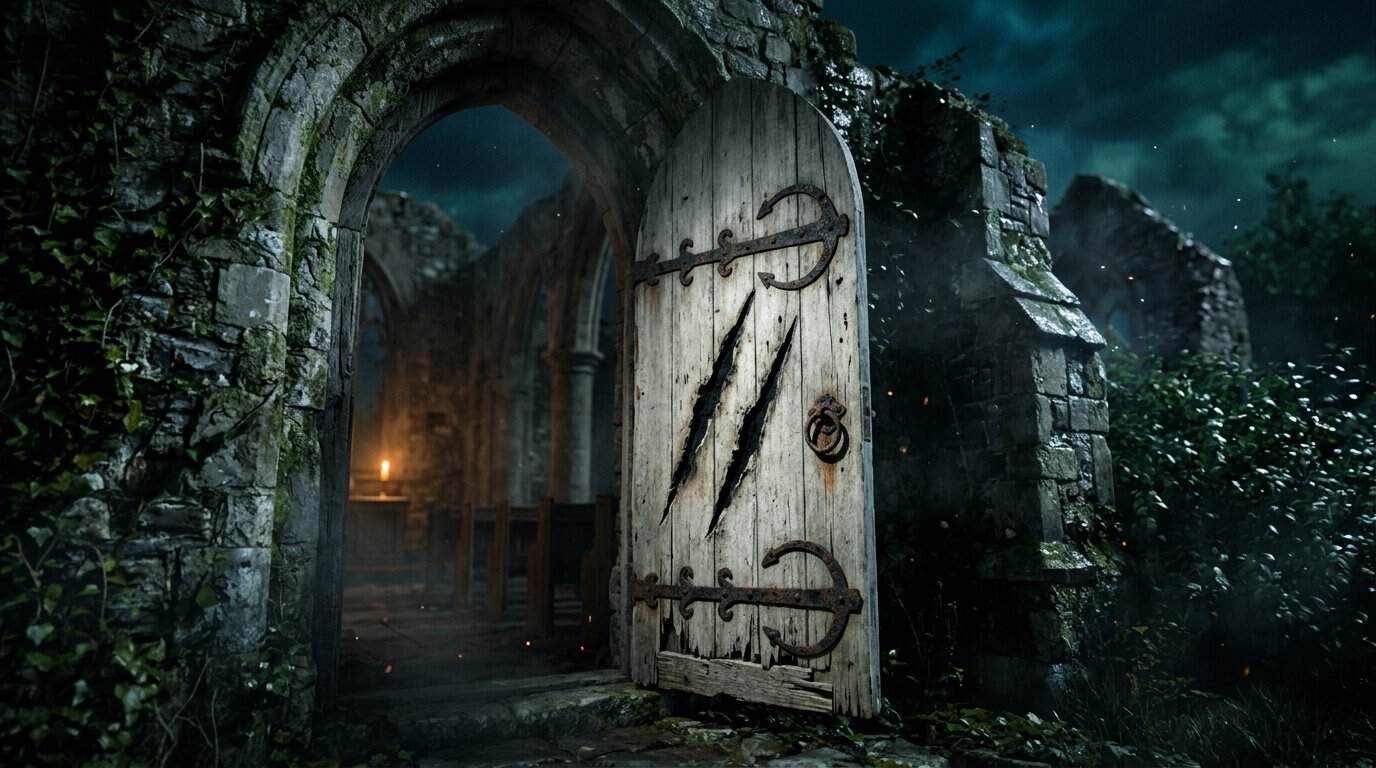
Finally, see the place for yourself. Holy Trinity Church in Blythburgh is a quiet village church, and its north door is traditionally pointed to as bearing scorch marks linked to the dog. Bring a notebook, look at the marks, and read any notices or guidebooks on site. Write down what you think is evidence and what is only atmosphere.
Then share what you found in the comments. Did the record or the rumor persuade you more?
Frequently Asked Questions
1. What do folklorists say about black dog legends outside East Anglia?
Black dog legends appear across Britain, not only in East Anglia. Yorkshire has the barghest, a monstrous dog said to haunt lonely roads, and other regions have their own spectral dogs. Many folklorists connect these creatures to older tales of ghostly hounds that roam at night, which suggests that people across the country shared a fear of dark roads and quiet graveyards.
2. What happens if you see Black Shuck?
Folklore gives no single answer, because each village tells the story in its own way. Some tellings warn that meeting the dog brings bad luck or death, while others say it guards travellers and walks them safely home. Most accounts agree that the sighting is brief and leaves a lasting chill.
3. Is Black Shuck a hellhound?
Black Shuck is often compared to a hellhound, a demonic dog from European folklore linked to sin and damnation. The 1577 pamphlet’s religious framing makes that comparison easy, since it treats the dog as a sign of divine judgment. Many local tellings, however, describe the creature simply as a huge black dog with no clear link to the devil.