
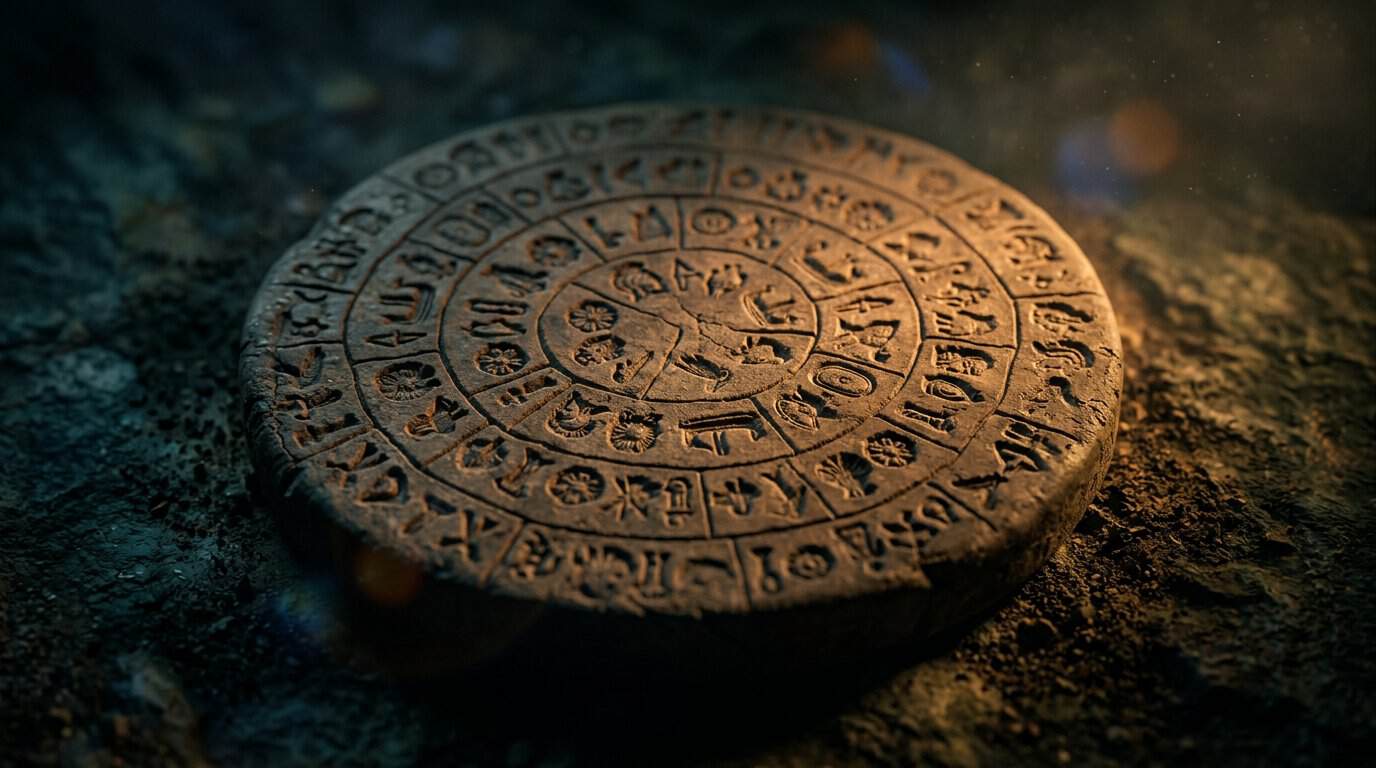
Phaistos Disc Mystery: Discovery, Symbols, And The Search For Meaning
The Phaistos Disc mystery centers on a small fired-clay disc covered in symbols that no one has reliably read. Found at Crete’s palace of Phaistos in 1908, the object appears connected to the Minoan world, yet its language, purpose, and exact age remain uncertain. More than a century later, no proposed translation has gained broad scholarly acceptance.
That uncertainty keeps the disc at the center of one of archaeology’s most enduring puzzles. Its repeating signs may record a prayer, message, ritual text, or something no current theory has identified. Evidence must separate promising clues from appealing guesses. The search for an answer reveals as much about how researchers investigate ancient mysteries as it does about the silent object itself.
Key Takeaways
- The Phaistos Disc, discovered by Luigi Pernier at Crete’s palace of Phaistos in 1908, is a fired-clay Minoan artifact whose exact date, origin, purpose, and language remain uncertain.
- Its roughly 241 stamped signs form about 61 groups across a spiral on both faces, but the reading direction and meaning of the 45 distinct sign types remain unresolved.
- No translation has gained broad scholarly acceptance because the disc is short and unique, lacks a bilingual inscription or confirmed duplicate, and cannot be reliably linked to Linear A, Linear B, or another known script.
- Proposed uses include a hymn, ritual text, calendar, administrative record, or special-purpose message, but responsible interpretation must distinguish evidence-based possibilities from speculative theories.
Luigi Pernier And The 1908 Discovery
In 1908, Italian archaeologist Luigi Pernier uncovered an object that would become one of Crete’s most enduring puzzles. The fired-clay disc was found in Room 101 of the northeastern complex at the Minoan palace of Phaistos, in southern Crete. Measuring about 16 centimeters across, it carries markings on both faces, arranged in a spiral that draws the eye toward the center. Unlike many inscriptions carved into stone, its symbols appear to have been pressed into soft clay with individual stamps before the disc was fired. The palace setting gives the find a strong archaeological context, even though its precise purpose remains unknown.
A visual timeline could follow the disc from its Minoan setting, through Pernier’s excavation, to its current display at the Heraklion Archaeological Museum. Close images of both faces reveal repeated figures, plants, tools, and geometric signs. These details invite comparisons with other undeciphered writing systems while warning against quick translations. Researchers continue to debate whether the disc records a language, a ritual text, a game, or something created elsewhere and brought to Crete. No proposed reading has gained broad scholarly agreement, so the Phaistos Disc mystery remains balanced between evidence from its discovery and the possibilities hidden in its unexplained symbols.
Phaistos Disc Symbols And Layout
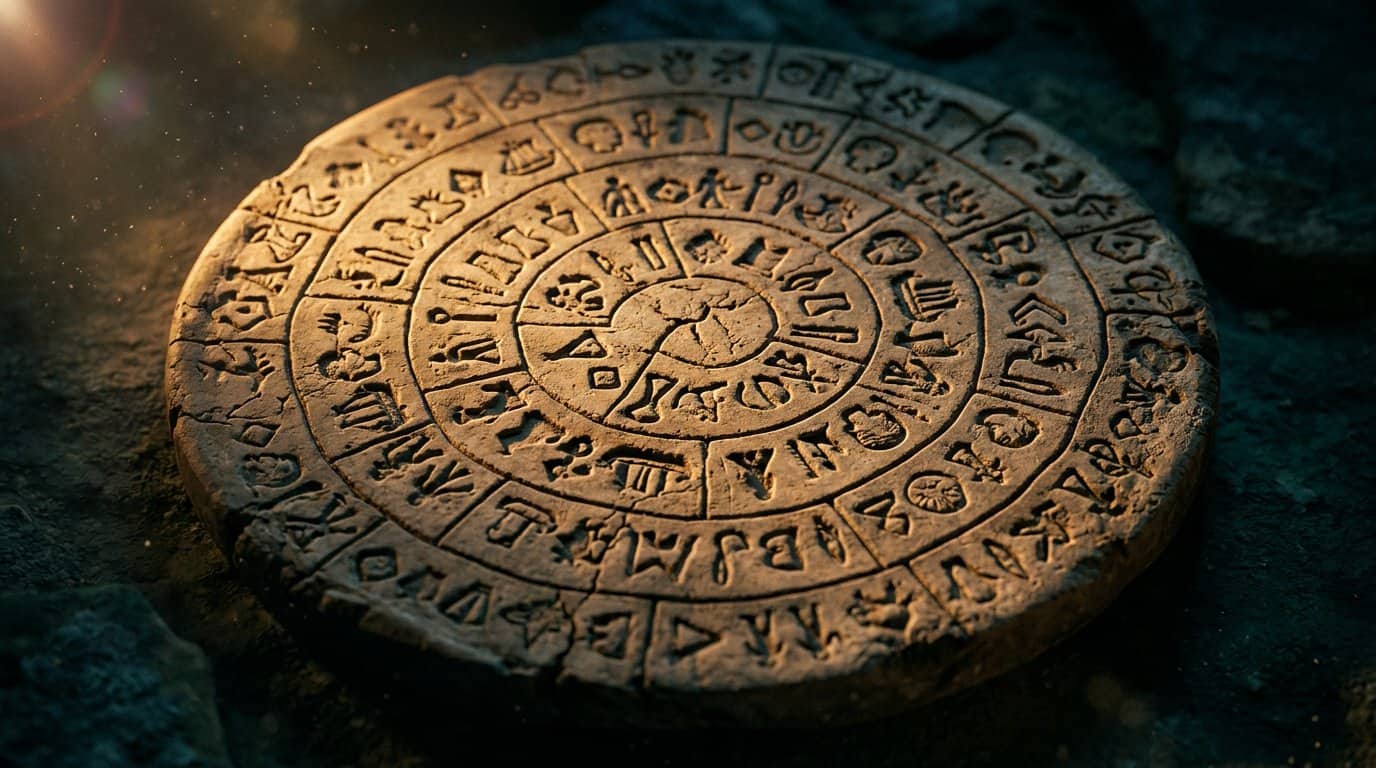
The Phaistos Disc’s mystery begins with its unusual visual design. It contains 45 distinct sign types in roughly 241 impressions, divided into approximately 61 symbol groups. Instead of being scratched into the clay, the signs were stamped with carved seals while the clay was still wet. This process suggests careful planning and deliberate production. The groups follow a spiral path across both faces, winding from the outer edge toward the center, although the precise reading order remains uncertain. Repeated marks may represent familiar words, names, or grammatical endings, but no interpretation has gained broad scholarly acceptance.

A closer look at the layout helps explain why the Phaistos Disc mystery continues to attract historians and researchers with more unusual theories. Some see a short ritual text, calendar, or administrative record, while others compare its repeated groups with a lost writing system related to Linear A, another undeciphered Minoan script. The Heraklion Archaeological Museum identifies the object as a fired-clay disc found by Luigi Pernier at Phaistos in 1908, supporting its place within the Minoan world, but its language and purpose remain unknown. Like the Linear A mystery, the disc offers clear patterns without enough confirmed examples to test a translation. Readers must weigh the archaeological evidence against the possibility of a message that has not yet found its key.
Dating Language And Minoan Connections
The Phaistos Disc was found in 1908 by Luigi Pernier during excavations at the Minoan palace of Phaistos in southern Crete. Its fine, fired clay and spiral rows of stamped signs place it within the wider world of Bronze Age Crete, although the surrounding archaeological layer does not establish its exact date. Many researchers place it somewhere in the second millennium BCE, possibly during the Middle Minoan period. Others caution that the disc could have been moved before it was buried. The object’s setting supports a Minoan connection, but it does not prove that it was made at Phaistos. As with other parts of the Phaistos Disc mystery, its age and origin remain open questions.
The symbols invite comparison with Linear A, the still-undeciphered script used by Minoan communities, and with Linear B, which was later adapted to write an early form of Greek. Yet the disc is not simply a clay version of either system. Its signs were pressed into the surface with repeated stamps and arranged along a spiral, while Linear A and Linear B were usually written by hand on tablets, sealings, and other objects. Some symbols may resemble images found in Minoan art, but visual similarity alone cannot establish a shared language or meaning. This contrast has encouraged the idea that the disc preserves a local writing tradition, a special-purpose text, or even a script brought to Crete from elsewhere.
Recent archaeological study has strengthened the case that the disc is a genuine ancient object connected to the Minoan world, but no proposed translation has gained broad scholarly acceptance. Its language, place of manufacture, exact date, and purpose remain debated. Suggestions range from a ritual text or hymn to a record, teaching device, or carefully made one-off message. Comparisons with Linear A may offer useful clues, yet they cannot turn an undeciphered script into a known language without more evidence, such as a bilingual inscription or a second confirmed example. For now, the disc stands beside other lost writing systems as both archaeological evidence and an invitation to test where careful analysis ends and speculation begins. Which clue seems most promising, its symbols, its archaeological setting, or its possible link to Minoan scripts?
Proposed Readings And Unusual Theories
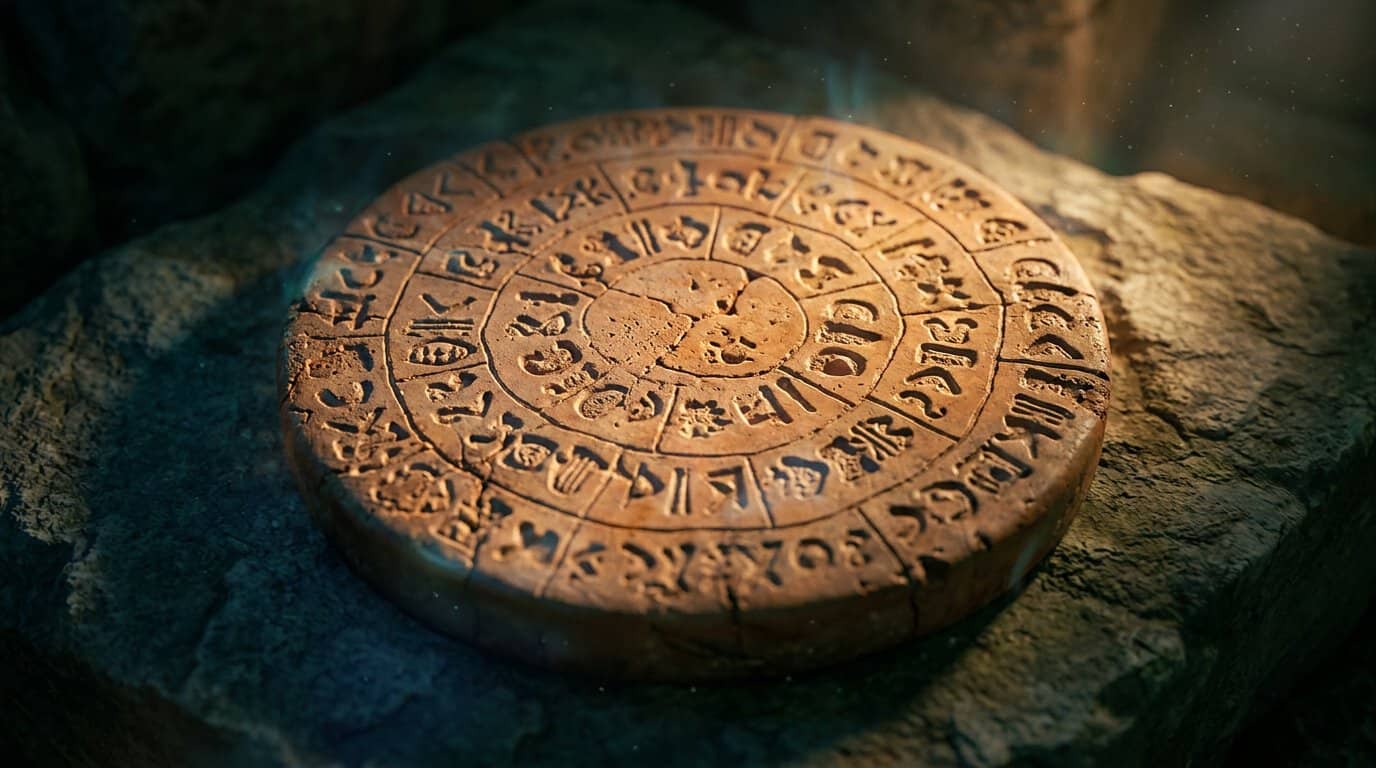
The most cautious readings treat the Phaistos Disc as a practical Minoan text rather than a hidden message from a lost civilization. Scholars have suggested a hymn, ritual instructions, calendar, or administrative record because the repeated signs and clear groupings may point to a structured writing system. The spiral layout, with stamped symbols arranged in sections, could reflect a text meant to be read in a set order, although the disc offers too little material for comparison with longer inscriptions. These ideas remain possible because they fit the object’s archaeological setting, but none explains every sign or proves which language the writer used.
More unusual theories look beyond ordinary writing and propose that the disc records astronomical observations, encodes a secret message, or preserves a lost language unrelated to known Minoan scripts. Astronomy might account for repeated patterns if some symbols represent stars, seasons, or cycles. A code could explain why the markings appear so carefully grouped. Yet these claims often depend on selecting symbols or sequences that support a preferred answer instead of testing the whole disc against independent evidence. Without a second example, bilingual text, or securely established sign list, even an attractive pattern cannot count as a verified translation.
The mystery becomes clearer when each theory is measured against the same visible facts: repeated signs, word-like clusters, the spiral path, and the disc’s limited length. A hymn or ritual text may explain repetition, an administrative message may explain compact groupings, and a calendar may explain order, but each leaves important questions unanswered. The disc is widely regarded as genuine Minoan material, yet its exact purpose, language, and place of manufacture remain unsettled, and it is still undeciphered. For now, the strongest conclusion is a careful one: the Phaistos Disc preserves an organized message whose meaning remains open to discovery.
Why The Phaistos Disc Remains Undeciphered
The Phaistos Disc offers only a brief message, arranged in a spiral and made from roughly 241 stamped signs. That is far less material than researchers usually need to identify a writing system with confidence. Found in 1908 by Luigi Pernier at the Minoan palace of Phaistos, the fired-clay object appears carefully made, yet its unusual format leaves open questions about how it was meant to be read. A longer text might reveal repeated words, grammar, or names, but the disc provides too few examples for reliable comparison. Even the direction of reading remains debated, adding another layer to the mystery.
Several obstacles stand between the disc and a secure translation. The language is unknown, the values assigned to many signs are uncertain, and no bilingual inscription exists to provide a clear ancient equivalent, as the Rosetta Stone did for Egyptian hieroglyphs. Researchers can compare its symbols with other Aegean scripts, including Linear A, but visual similarities do not prove that the signs represent the same sounds or language. Another possibility is that the disc was created as a one-time object for a ritual, message, or special display rather than as part of a larger writing tradition. If so, related texts may never have existed.
Current scholarly research generally treats the disc as a genuine Minoan artifact, and improved archaeological study has strengthened that position without solving its text. Proposed readings have linked it to prayers, calendars, royal records, and more unusual ideas, but none has gained broad scholarly acceptance because each depends on disputed sign values or unsupported assumptions about the language. The mystery remains open, but not unbounded. Evidence supports a real ancient object, while its meaning, purpose, and place of manufacture remain unresolved. That balance keeps the Phaistos Disc compelling and encourages fresh visual analysis without turning speculation into proof.
The Phaistos Disc Still Defies Decipherment
In 1908, Luigi Pernier’s excavation at the Minoan palace of Phaistos brought the small fired-clay disc into view, along with one of archaeology’s most enduring puzzles. Its carefully arranged spiral carries repeated images of people, animals, plants, tools, and geometric marks. These signs were pressed into the clay before firing rather than scratched afterward. That unusual method suggests planning and purpose, yet the symbols have never been matched to a widely accepted language or writing system. Researchers have proposed a hymn, calendar, administrative record, or ritual text, while more unusual ideas imagine a lost tradition from beyond Crete. Each theory highlights intriguing patterns, but none explains every sign, sequence, and detail well enough to settle the question.
The Phaistos Disc mystery rests as much on missing evidence as on the object itself. There is no second disc that clearly confirms its signs, no bilingual inscription to guide a translation, and continuing uncertainty about its exact date, place of manufacture, and intended use. Modern study has strengthened the case that the disc is a genuine Minoan artifact, but authenticity alone cannot reveal what its message meant. It may have been a practical record, ritual object, or message from a still-unknown writing tradition. The surviving evidence leaves each possibility open to discussion. Until a discovery provides firmer context, the most responsible approach is to remain curious without claiming certainty.
Frequently Asked Questions
1. What is the Phaistos Disc mystery?
The Phaistos Disc mystery centers on a small fired-clay disc covered with symbols that no one has translated with broad scholarly agreement. Its language, purpose, and exact age remain uncertain, although its discovery at the Minoan palace of Phaistos connects it strongly to ancient Crete. The signs could represent a prayer, ritual text, message, or another form of record.
2. When and where was the Phaistos Disc discovered?
Italian archaeologist Luigi Pernier discovered the disc in 1908 at the palace of Phaistos in southern Crete. It was found in Room 101, within the northeastern complex of the palace. This setting gives the object a clear archaeological context, even though its original purpose remains unknown.
3. What does the Phaistos Disc look like?
The disc is a fired-clay object about 16 centimeters across, with markings arranged in a spiral on both faces. Its signs include repeated figures, plants, tools, and geometric shapes. The unusual layout makes the disc visually distinctive and invites comparison with other undeciphered writing systems.
4. How were the symbols placed on the Phaistos Disc?
The symbols appear to have been pressed into soft clay with individual stamps before the disc was fired. This method differs from carving an inscription directly into stone or clay. The repeated stamped signs have led some researchers to compare the disc with an early form of movable type, although that comparison does not reveal its meaning.
5. How old is the Phaistos Disc?
The disc appears to belong to the Minoan world, but its exact age remains debated. Its palace setting provides important evidence, yet the object cannot be dated with complete certainty from appearance alone. A reliable date would help researchers connect its symbols to a particular period of Minoan history.
6. Has the Phaistos Disc been deciphered?
No proposed translation has gained broad scholarly acceptance. Researchers face major obstacles because the language is unknown, the disc is a unique object, and there is no confirmed bilingual inscription to provide a direct comparison. A convincing reading would need to explain the signs, their order, and the disc’s archaeological setting at the same time.
7. What might the Phaistos Disc have been used for?
Possible explanations include a prayer, ritual text, message, or another type of symbolic record. The repeating signs may contain language, but they could also serve a ceremonial or administrative purpose that modern readers do not yet recognize. Each theory must fit the spiral arrangement, stamped production method, and Minoan context.
8. Where can visitors see the Phaistos Disc today?
The Phaistos Disc is displayed at the Heraklion Archaeological Museum in Crete. Images of both faces show the spiral design and recurring figures more clearly than a brief description can. Seeing the object in its Minoan context helps explain why it remains both a valuable archaeological find and one of the ancient world’s most intriguing unsolved puzzles.