
The Library of Alexandria Fire: What Really Happened?
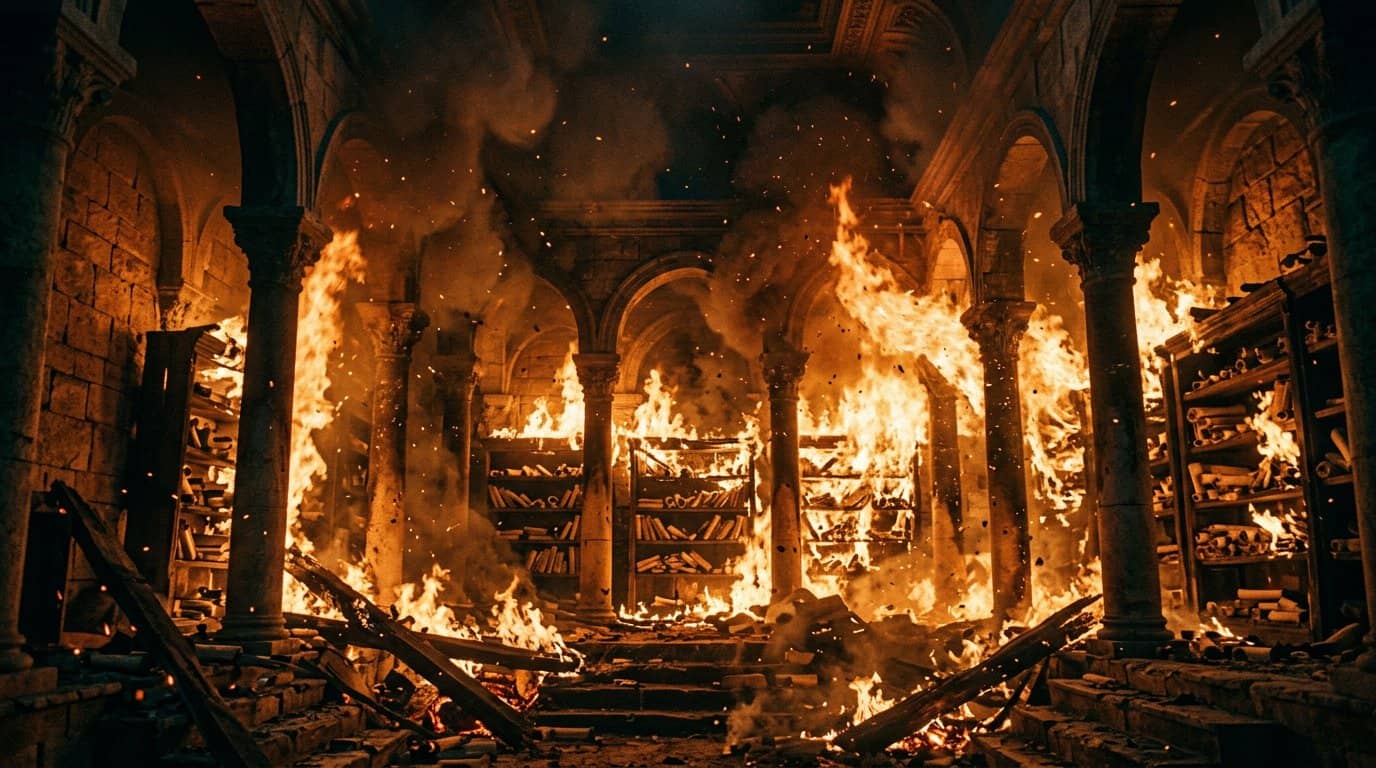
The Library of Alexandria fire is often imagined as a single blaze that erased the ancient world’s knowledge in one night. History suggests a more complicated story. Julius Caesar’s forces may have burned books in 48 or 47 BCE, but the library likely faded through repeated damage, neglect, and the loss of royal support. Its disappearance was probably not one dramatic ending, but a slow unraveling that continued for centuries.
That uncertainty makes Alexandria’s fate even more fascinating. Later violence, the destruction of the Serapeum in 391 or 392 CE, and the fragile nature of papyrus may have removed collections piece by piece. The famous story of an Arab army burning the library in 641 CE appeared much later and lacks support from contemporary records. Somewhere between documented events and enduring legend lies the truth about what vanished and what may have survived.
Key Takeaways
- The Library of Alexandria was likely not destroyed in one catastrophic fire; its collections faded over centuries through repeated damage, political instability, reduced royal support, neglect, and the deterioration of papyrus.
- Julius Caesar’s harbor fire in 48 or 47 BCE may have destroyed books stored nearby, but surviving ancient accounts do not prove that it consumed the main library.
- The destruction of the Serapeum in 391 or 392 CE may have eliminated another important collection, though the scale and contents of its library remain uncertain.
- The story that Arab forces burned Alexandria’s library in 641 CE emerged centuries later and lacks contemporary evidence, making it a legend rather than a documented final destruction.
Introduction To The Library Fire
The Library of Alexandria fire remains one of history’s most enduring mysteries. Popular retellings describe a single spectacular blaze that consumed the ancient world’s knowledge in one terrible night. Yet surviving evidence suggests a slower, more complicated story involving several collections, changing political fortunes, and multiple episodes of damage. Alexandria’s libraries were likely weakened over centuries rather than erased by one event. That uncertainty makes the mystery more fascinating, not less.
The investigation usually begins in 48 or 47 BCE, when Julius Caesar’s forces set fire to ships in Alexandria’s harbor during a military conflict. Ancient writers suggest that flames may have destroyed books stored nearby, but they do not clearly state that the main library vanished at that moment. Later troubles may have included declining state support, urban violence, the decay of fragile papyrus, and the destruction of the Serapeum in 391 or 392 CE. Each event may have removed part of Alexandria’s intellectual world, leaving no single date for its final disappearance.
The famous claim that Arab forces destroyed the library after conquering Alexandria in 641 CE appeared much later and is not supported by contemporary evidence. This chronological approach separates what ancient accounts actually record from legends that grew stronger over time. It also leaves room for a haunting possibility: much of the lost knowledge may have disappeared quietly through neglect and repeated upheaval rather than in one dramatic inferno. As the story unfolds, the question is not simply who burned the library, but how memory transformed a long decline into the legend of one fire.
Alexandria’s Libraries And Scholarly Centers
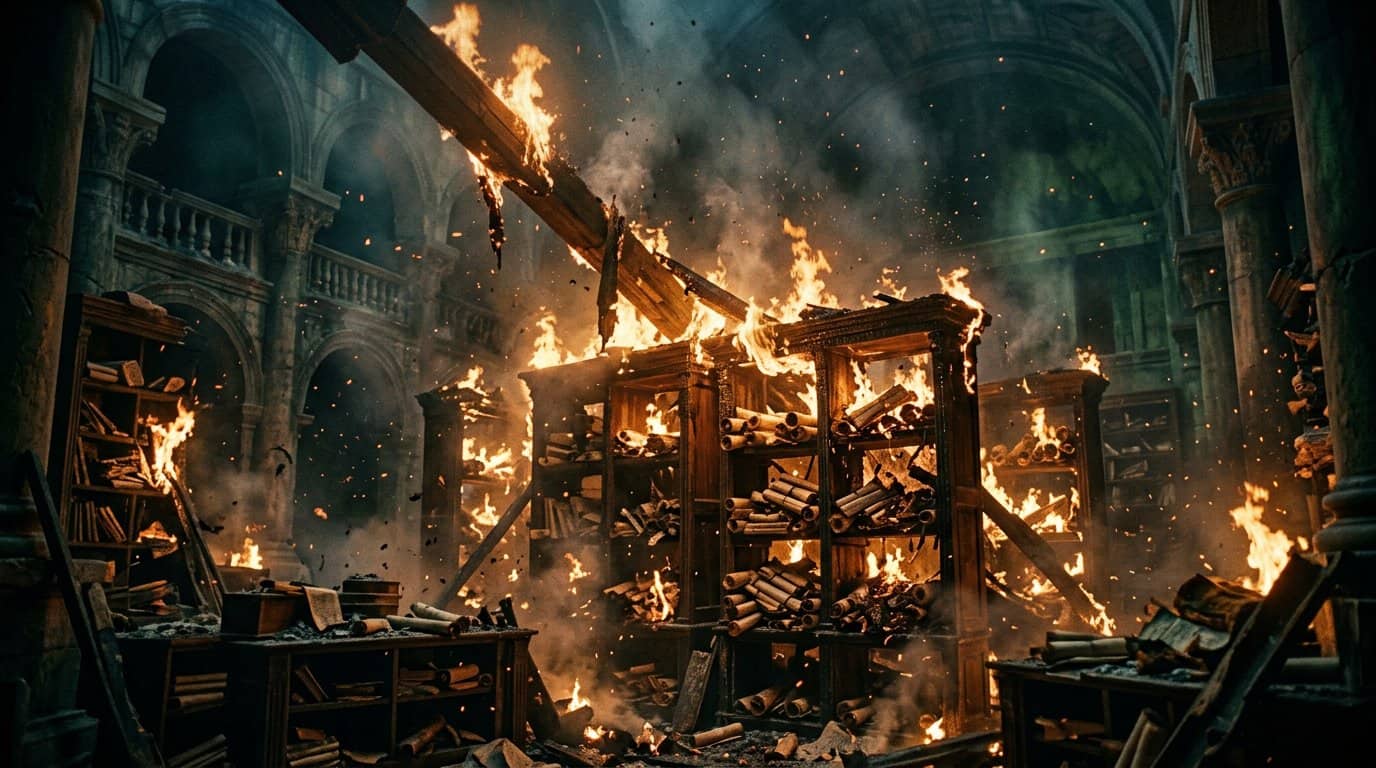
Alexandria’s fame rested on a network of scholarly institutions rather than one clearly defined library building. The Mouseion, or “shrine of the Muses,” brought Ptolemaic scholars together to study language, medicine, mathematics, astronomy, and literature. A second collection was associated with the Serapeum, a major temple complex that may have housed additional scrolls. Scholars worked from handwritten copies, compared different versions of old texts, and helped make Alexandria one of the ancient world’s great centers of learning. A visual map of ancient Alexandria could show how these institutions, the royal quarter, harbor, and temple district connected across the city.
The famous Library of Alexandria fire was probably not a single event that erased every scroll at once. Ancient writers, including Plutarch and Caesar himself, describe a military fire during Julius Caesar’s conflict in Alexandria in 48 or 47 BCE, when flames may have reached ships and nearby warehouses containing books. That blaze could have destroyed part of the city’s collections, but the evidence does not prove that it consumed the main library. Later damage, reduced royal support, political upheaval, and the slow decay of papyrus likely weakened the scholarly network over generations.
By the late fourth century, religious conflict and the destruction of the Serapeum in 391 or 392 CE may have removed more surviving texts, although the exact losses remain uncertain. The story that Arab forces destroyed the entire library after taking Alexandria in 641 CE appeared centuries later and is not supported by contemporary evidence. This longer decline makes the mystery more compelling, because important works may have vanished through many smaller losses rather than one dramatic catastrophe. As readers consider other lost-knowledge mysteries, which explanation seems more convincing: a forgotten series of fires and closures, or the possibility that one major disaster remains hidden behind the later legend?
Caesar’s Alexandrian War Fire
Julius Caesar’s Alexandrian War brought the Library of Alexandria into the path of a military crisis in 48 or 47 BCE. During fighting near the harbor, Caesar ordered his soldiers to set fire to enemy ships, and the flames spread toward the dockyards and nearby buildings. In The Civil War, Caesar describes damage to the harbor area, while Plutarch and Cassius Dio also record a fire connected with the naval battle. These accounts suggest that books and records stored in warehouses may have burned, but they do not clearly describe the destruction of every library collection. The episode fits the wider pattern explored in ancient warfare, where fire could quickly turn a tactical decision into an urban disaster.
Later retellings transformed this harbor fire into the story of one enormous blaze that erased the world’s knowledge in a single day. Seneca mentions thousands of books lost in a fire at Alexandria, but surviving accounts differ about the location, size, and contents of the collection involved. The main library may also have been part of a larger network linked to the Mouseion, royal institutions, private collections, and the Serapeum, rather than one easily defined building. Strabo’s description of Alexandria after Caesar’s campaign suggests that scholarly activity continued, although silence in an ancient source cannot prove that no major damage occurred. The evidence therefore supports a real loss of books without proving that Caesar destroyed the entire main library.
The larger mystery is how many smaller losses became woven into one dramatic legend. Later warfare, reduced state support, the fragile nature of papyrus, urban destruction, and the destruction of the Serapeum in 391 or 392 CE may have removed additional collections over the centuries. The much later story of an Arab army burning the library in 641 CE lacks contemporary support. This gradual decline offers a more complex path through the history of lost knowledge, where truth may survive beneath layers of political memory and storytelling. Caesar’s fire was probably one chapter, not the whole explanation. Which part of the story seems most convincing: the documented harbor blaze, or the possibility that later disasters were merged into a single unforgettable event?
Serapeum Destruction And Later Decline
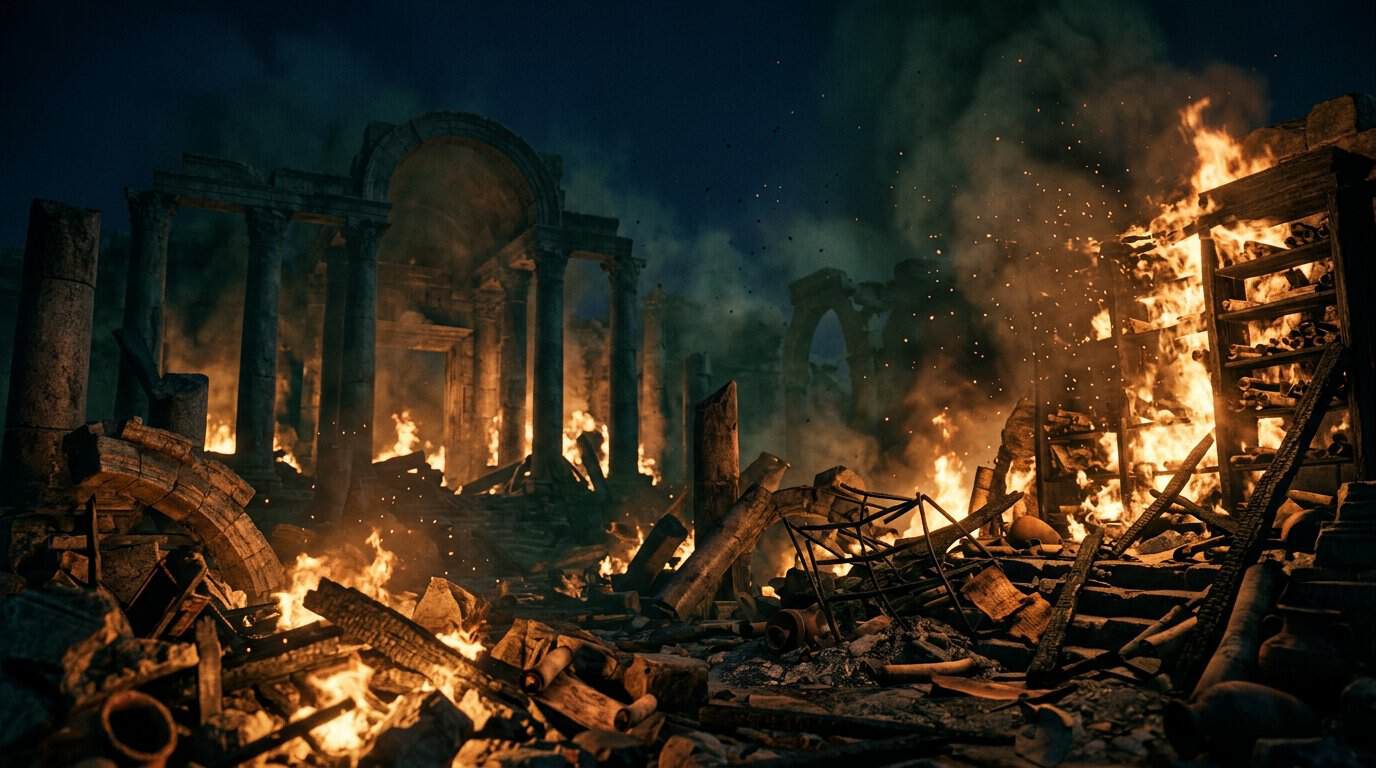
By the late Roman period, Alexandria’s libraries were weakened by more than fire. Political conflict, changing rulers, and reduced state support made it harder to maintain scholars, buildings, and copied texts. Julius Caesar’s military fire in 48 or 47 BCE may have destroyed books stored near the harbor, but ancient accounts do not prove that the main library vanished at that moment. Instead, the evidence points to a long decline in which damaged collections were not always replaced or carefully preserved.
The destruction of the Serapeum in 391 or 392 CE may have delivered another serious blow. Christian writers such as Socrates Scholasticus and Rufinus describe the temple’s destruction during religious conflict, and the Serapeum may have held a separate collection of books. Still, no surviving account confirms that it contained the entire Library of Alexandria or that every book there was burned. The event is best understood as a possible loss within a wider pattern of damaged institutions, rather than as proof of one final, all-consuming fire.
Even without a dramatic blaze, papyrus could disappear through neglect, damp, insects, war, and the simple failure to copy aging texts. The later story that Arab forces destroyed the whole library after conquering Alexandria in 641 CE appears centuries after the event and lacks support from contemporary evidence. This layered history leaves room for mystery, but it also suggests that Alexandria’s knowledge faded piece by piece across generations. Was the true tragedy not one spectacular fire, but the slow collapse of the world that had once protected its books?
The Arab Conquest Library Legend
The Arab conquest of Alexandria in 641 CE is often presented as the final, blazing chapter in the story of the Library of Alexandria. According to the tale, the caliph Umar ordered the surviving books burned, and the city’s bathhouses supposedly used the scrolls as fuel for months. Yet contemporary accounts of the conquest do not describe such an event, and no reliable sixth- or seventh-century source records a library fire ordered by Arab forces. The silence is striking, especially because a destruction on that scale would have been a major event for writers living near the time.
The story appears much later in the writings of authors such as Ibn al-Qifti, who lived centuries after the conquest. It may have grown from a desire to give Alexandria’s long decline one clear ending. By then, the city’s scholarly world had already endured repeated shocks, including Julius Caesar’s fire in 48 or 47 BCE, weakening state support, urban conflict, and the destruction of the Serapeum in 391 or 392 CE. The Library may also have existed as several collections rather than one grand building, making its disappearance gradual and difficult to date. These layers of loss were later compressed into a dramatic single-fire narrative.
That does not make the legend meaningless, because it preserves a memory of cultural loss even if its details are doubtful. The Arab conquest may have marked another stage in Alexandria’s transformation, but the available evidence does not show Arab soldiers destroying a surviving ancient library in one spectacular blaze. Instead, the mystery points toward a slower process in which neglect, decay, conflict, and scattered destruction erased knowledge over generations. The enduring question is not simply who burned the Library, but how a complicated history became one of the world’s most powerful stories about vanished wisdom.
Conclusion On Alexandria’s Lost Library
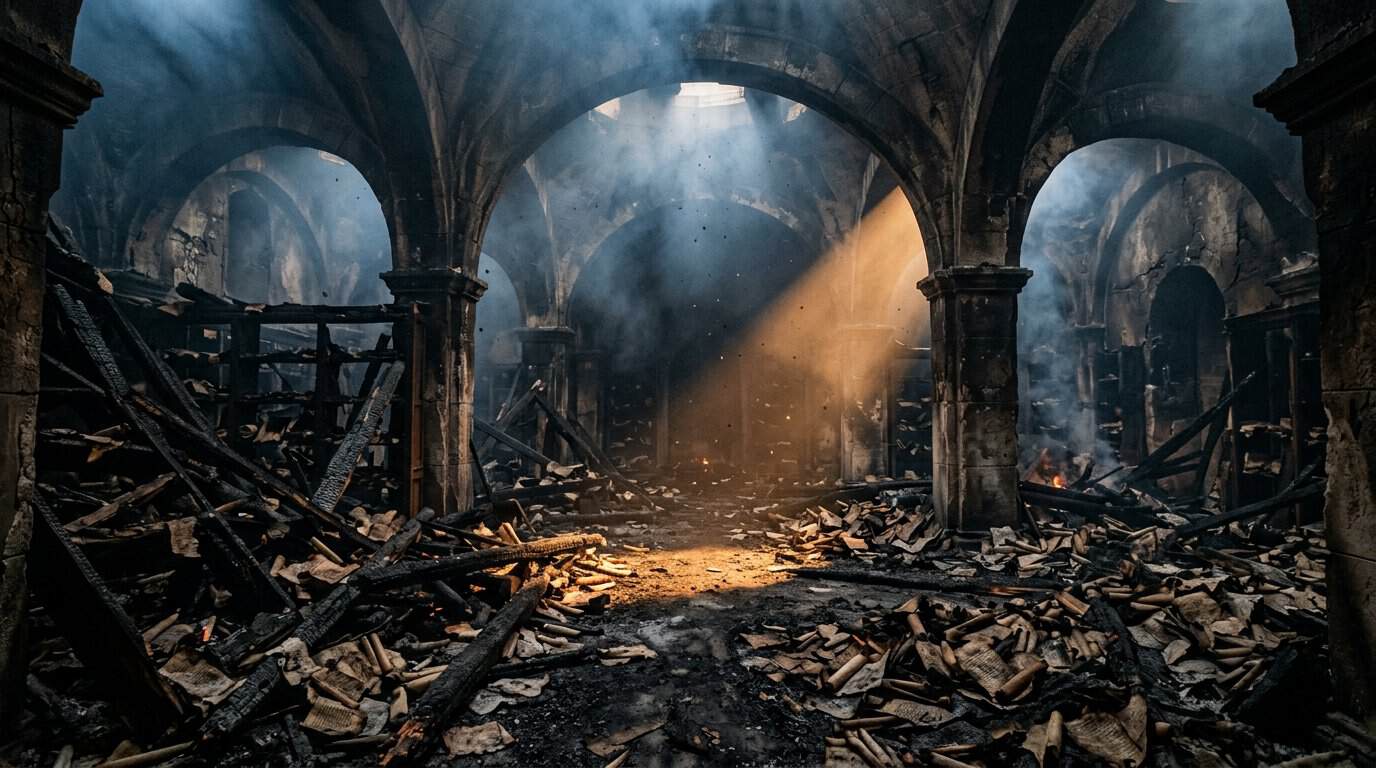
The strongest historical assessment is that Alexandria’s collections did not vanish in one dramatic night. Julius Caesar’s military fire in 48 or 47 BCE likely destroyed books stored near the harbor, but ancient accounts do not prove that it consumed the entire main library. Over the following centuries, political conflict, reduced state support, urban damage, and the fragile nature of papyrus steadily weakened Alexandria’s scholarly world. The destruction of the Serapeum in 391 or 392 CE may have erased another important collection, though the exact contents and fate of its books remain uncertain.
The later tale that Arab forces burned the library after conquering Alexandria in 641 CE is not supported by contemporary evidence and appears to have developed centuries afterward. That story may have survived because it offers a simple ending to a much more complicated loss. In reality, different collections may have disappeared at different times, while neglected texts faded, scattered, or were replaced by works that later generations chose to preserve. The mystery of the Library of Alexandria therefore rests less on a single confirmed fire than on the silence left by many years of damage and decline.
Alexandria’s lost library still captures the imagination because its disappearance raises a question larger than any one building. Was the world’s knowledge destroyed by a hidden catastrophe, or did it slip away gradually as institutions failed and generations stopped copying fragile texts? The surviving evidence favors a slow collapse, but it cannot reveal every missing volume or forgotten event. Readers can explore related mysteries of lost knowledge and decide whether the enduring legend reflects one missing moment or the cumulative cost of allowing knowledge to disappear.
How the Library Faded Over Centuries
The Library of Alexandria fire was probably not a single event that erased every book in one dramatic night. Julius Caesar’s military fire in 48 or 47 BCE may have destroyed books stored near the harbor, but ancient accounts do not prove that the main library vanished then. Over the following centuries, the collections likely weakened through repeated conflict, shrinking royal support, damaged buildings, and the fragile nature of papyrus. The destruction of the Serapeum in 391 or 392 CE may have removed another important center of learning, while the later story of Arab armies burning the library in 641 CE appears to be a much later legend without strong contemporary support.
What remains is not a simple tale of fire, but a longer mystery about how knowledge can disappear piece by piece. Ancient records support episodes of damage and loss, yet they leave room for questions about how many works survived, moved elsewhere, or quietly faded from use. Alexandria’s story therefore belongs beside other lost-knowledge mysteries, where evidence and legend overlap without fully settling the past. The search continues through surviving texts, archaeological clues, and careful reading of ancient writers, inviting readers to consider whether the greatest destruction came from one blaze or from centuries of neglect.
Frequently Asked Questions
1. What was the Library of Alexandria fire?
The Library of Alexandria fire refers to the possible destruction of books and collections linked to Alexandria’s famous libraries. Rather than one confirmed blaze, the evidence points to repeated damage, political decline, neglect, violence, and the natural decay of papyrus over several centuries.
2. Did Julius Caesar burn the Library of Alexandria?
Julius Caesar’s forces set fire to ships in Alexandria’s harbor during the civil war in 48 or 47 BCE. Ancient writers, including Plutarch and Seneca, suggest that nearby books or storage buildings may have burned, but they do not clearly prove that the main library was destroyed in that event.
3. Was the Library of Alexandria destroyed in one single fire?
There is no reliable evidence for one fire that erased the entire library in a single night. Alexandria had more than one important collection, and its intellectual centers likely weakened through repeated damage, reduced royal support, urban conflict, and the loss of caretakers.
4. What happened to the Serapeum library?
The Serapeum was a major temple complex that may have housed an important library collection. Christian violence led to its destruction in 391 or 392 CE, during the reign of Emperor Theodosius I, and this event may have removed books that survived earlier troubles. The exact size and contents of the collection remain uncertain.
5. Did Arab armies burn the Library of Alexandria in 641 CE?
The story that Arab conquerors burned the library in 641 CE is not supported by contemporary records. The tale appeared centuries later in medieval accounts, and historians generally treat it as a legend rather than a documented event, although some collections may already have disappeared by that time.
6. Why did the Library of Alexandria disappear?
The library likely faded because several pressures worked together. Political instability reduced royal funding, fires and violence damaged buildings, papyrus deteriorated in poor conditions, and changing institutions may have ended the steady copying and preservation of texts.
7. How do historians know what happened to the library?
Historians compare scattered accounts from writers such as Plutarch, Strabo, Seneca, Ammianus Marcellinus, and later chroniclers. Archaeology has not revealed a clear destruction layer proving one final fire, so the strongest conclusion comes from weighing written evidence, surviving fragments, and the known fragility of ancient libraries.
8. Did every book in the Library of Alexandria vanish?
No, the loss was serious but not total. Many ancient works had been copied in other cities, and later manuscripts, quotations, and fragments preserve parts of Alexandria’s intellectual world. What disappeared most completely was the full range of texts once gathered there, including works that left no surviving copy.