The Silver Arrow Of Stockholm Metro Folklore
Deep beneath the bustling streets of Stockholm, a shimmering metallic vision occasionally glides through the tunnels, far removed from the standard green cars of the metro. This is the silverpilen ghost train, a sleek, unpainted aluminum vessel that has haunted the dreams of commuters since the 1960s. While most passengers are looking for a quick ride home, those who spot this Silver Arrow often feel a sudden chill as it bypasses busy stations without slowing down.
Though it began as a real-life experimental model known as the C5, the train quickly evolved into something much more mysterious within Swedish folklore. Legends suggest that the train only stops for the lost or the dead, carrying its silent passengers to an abandoned station hidden deep in the forest. Whether it is a simple relic of transit history or a vessel for the supernatural, its cold, industrial appearance continues to spark curiosity in everyone who hears its high-pitched whistle.
Key Takeaways
- The Silverpilen transitioned from a real-life experimental C5 train model into a legendary phantom because its unpainted aluminum exterior and high-pitched motor contrasted sharply with Stockholm’s standard green fleet.
- Urban folklore centers on the abandoned Kymlinge station, a partially built forest stop where the ghost train supposedly carries the dead or traps living passengers in a timeless loop.
- The train’s physical retirement in the mid-1990s failed to end the legend, as reported sightings of a shimmering silver streak continue to persist in the Stockholm underground.
- The Silverpilen serves as a primary example of how unique industrial design and technical anomalies can birth enduring modern myths within urban infrastructure.
The Metallic Origins Of The C5 Model
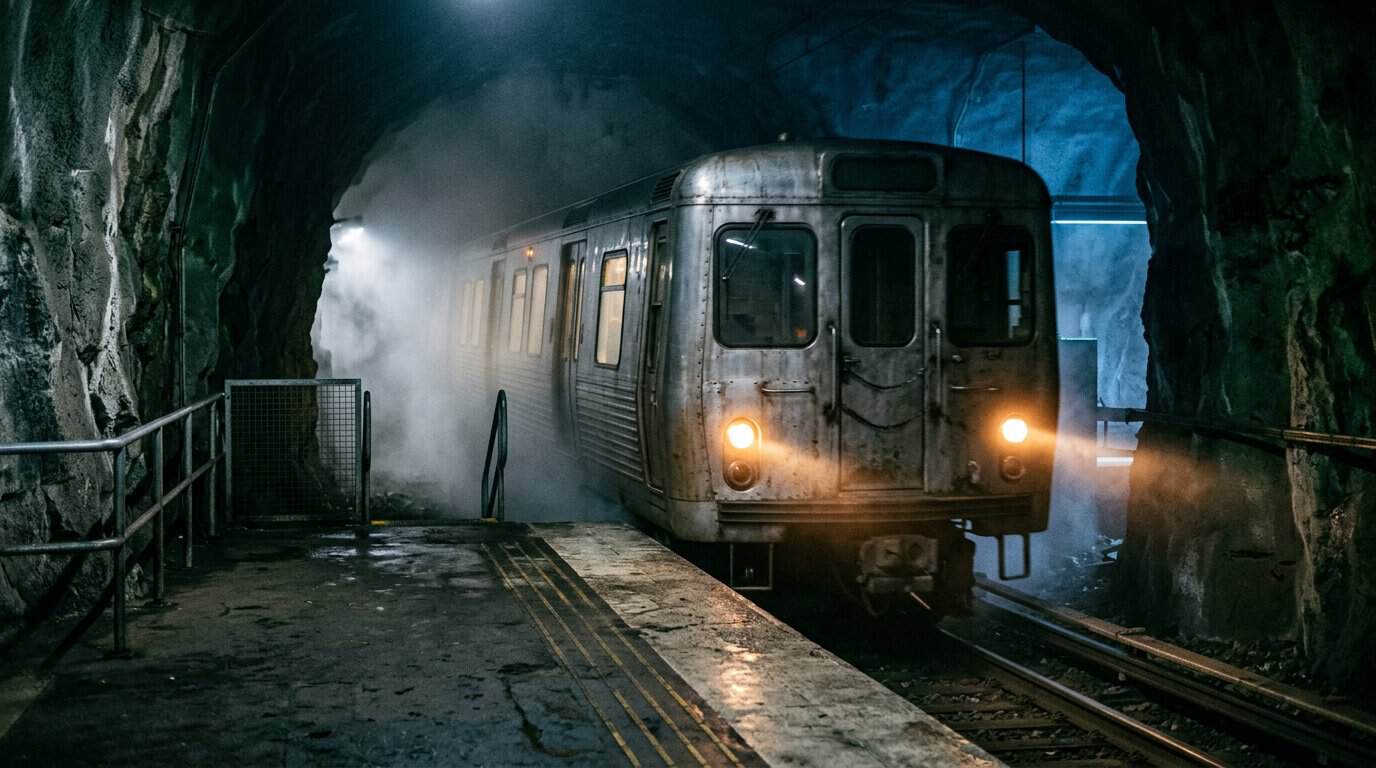
The Silverpilen, or Silver Arrow, began its life not as a ghost, but as a bold experiment in modern transit. In the mid-1960s, a specialized manufacturer produced a single eight car train known as the C5 model. While the rest of the Stockholm Metro fleet was painted a familiar, friendly green, this specific unit was left as unpainted, raw aluminum. This gave the train a cold and industrial appearance that looked strikingly different from anything else on the tracks. Its metallic skin and lack of colorful advertisements created a sterile, almost dystopian atmosphere for unsuspecting commuters.
Beyond its shimmering exterior, the C5 model functioned with several technical quirks that set it apart from the standard fleet. It featured external sliding doors designed to maximize interior space, and its motors produced a unique, high pitched whine that echoed through the tunnels. Because only one of these trains was ever built, it was a rare sight that often appeared without warning at quiet stations. Passengers who stepped inside found a bare environment that lacked the warmth of the typical carriages. These physical differences laid the groundwork for the train to transition from a technological curiosity into a legendary phantom vehicle.
The service life of the Silverpilen was relatively short, as it was eventually retired in the mid-1990s due to its high maintenance costs and specialized parts. However, its departure from the physical world only fueled the growing folklore surrounding its sightings on abandoned tracks. Even during its operational years, the train was often used as a backup or for late night runs, which contributed to its reputation as a mysterious ghost that only appeared to the lonely or the lost. By the time the last metallic car was taken out of service, the Silverpilen had already cemented its place in the paranormal history of Stockholm. What was once a simple engineering experiment had successfully transformed into one of the most enduring urban legends in international folklore.
Why The Silverpilen Became A Ghost Story
The legend grew from a perfect combination of rarity, timing, and setting. A passenger waiting alone beneath the city could see the silver color approaching through a tunnel and have only a few seconds to identify it. The unpainted cars reflected platform lights in a way that made the train appear brighter and less substantial than ordinary public transit. Its unusual motor sound added another layer of uncertainty, especially during the quiet period sometimes called the ghost hour, when stations were nearly empty and maintenance activity replaced the normal rush-hour noise.
In this environment, an ordinary sighting could easily become a story about ghost phenomena. A commuter might remember an empty carriage, a door that seemed to open too slowly, or a train that passed without appearing on the expected timetable. Later retellings gave those details a supernatural explanation. The Silverpilen became more than a strange vehicle. It became a moving boundary between the familiar railway network above and an imagined underworld beneath Stockholm, where ordinary rules of distance and time no longer applied.
Kymlinge Station And The Passengers Of The Dead
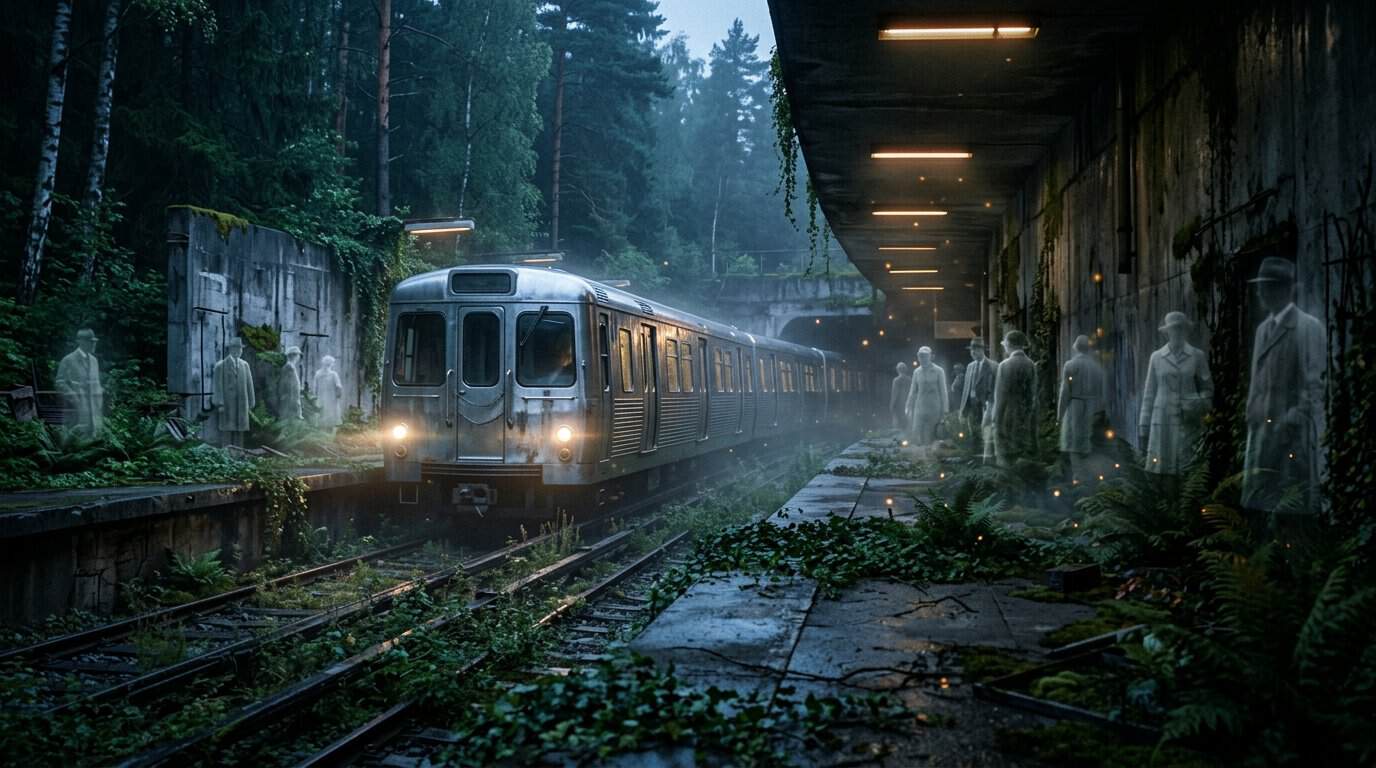
Nestled deep within the forests of Ursvik lies Kymlinge, a station that was built but never opened to the public. Known locally as the station where only the dead get off, this concrete shell serves as the primary setting for the most unsettling encounters with the Silverpilen. While standard metro trains speed past the dark platforms without stopping, witnesses claim that the unpainted aluminum ghost train frequently pulls into the station to discharge its spectral passengers. These commuters are described as pale, hollow eyed figures who have been riding the rails since the train first vanished from official records. The atmosphere at Kymlinge is reportedly heavy with a sense of timelessness, making it a focal point for those interested in the crossover between modern infrastructure and ancient hauntings.
Local folklore suggests that if you accidentally board the Silverpilen, you may find yourself trapped in a loop that lasts for months or even years. Passengers who have supposedly returned from such a journey describe a bare interior devoid of advertisements, where the only sound is the high pitched whine of the experimental motors. According to accounts collected by ethnologists like Bengt af Klintberg, the train does not follow a standard schedule and can appear on any line at any time. It is said that once you step onto the metallic floor of the C5 model, the doors seal shut and the next stop is always the abandoned Kymlinge station ruins. This legend transforms a failed engineering project into a vessel for international folklore, illustrating how urban environments can birth their own unique ghost stories.
The persistent sightings of the Silverpilen offer a fascinating look at how we process the mysteries of our own cities. Even though the physical C5 cars were retired and mostly scrapped by the late 1990s, the reports of a shimmering, silver streak moving through the tunnels continue to surface. Skeptics point to the unusual appearance of the original train as the source of the myth, yet the consistency of the stories keeps the legend alive. Whether it is a trick of the light on the aluminum walls or a genuine phantom vehicle, the Silverpilen remains a staple of Swedish paranormal study. Have you ever seen a train that didn’t belong on the tracks, or do you think these reported physical sightings are simply echoes of Stockholm’s industrial past?
A Swedish Legend In The Age Of Public Transit
Unlike older tales centered on castles, churchyards, or lonely roads, the Silverpilen belongs to a distinctly modern tradition of supernatural folklore. It travels through a system designed to be predictable, measured, and safe. That contrast helps explain its power as a Swedish legend. The metro is part of everyday life, yet its tunnels are hidden from view, and passengers rarely know what happens in sidings or service areas after the last scheduled train. The ordinary network therefore provides an ideal setting for a story about a vehicle that slips outside official maps.
Some versions of the tale connect the train with spökafton, a supposed ghost evening when the boundary between the living and the dead becomes unusually thin. In these retellings, the Silverpilen appears as a midnight train, carrying undead passengers away from the city. Other versions are less dramatic and describe a traveler who boards by mistake, rides through unfamiliar stations, and discovers that only minutes have passed for other people while years have passed inside the carriage. This time loop motif gives the story a universal fear: losing control of time during an ordinary journey.
Distinguishing Reality From The Paranormal Underground
The Silverpilen stands as a fascinating bridge between industrial history and the supernatural, born from a single experimental C5 model train that debuted in the mid-1960s. While standard Stockholm metro cars were painted a friendly green, this eight-car anomaly was left as raw, unpainted aluminum, giving it a cold and futuristic appearance. Its sliding doors were located on the outside of the frame, and the interior lacked the warm lighting or colorful advertisements found in common transit. This stark, metallic aesthetic made the train feel like a visitor from another dimension rather than a commuter vehicle. Because it was the only one of its kind, its rare and unpredictable arrivals on various lines naturally sparked a sense of unease among late-night travelers.
Folklore quickly transformed this mechanical outlier into a phantom vehicle that supposedly haunted the abandoned Kymlinge station. Local legends claimed that the Silverpilen only stopped for the dead or that passengers who boarded the train would lose track of time, disappearing for weeks or even years. These stories were bolstered by the train’s distinct, high-pitched motor and the fact that it often ran empty during off-peak testing hours. Even though transit records confirm the train was officially retired and largely dismantled in 1996, the legend persists in the Swedish consciousness. The metallic ghost remains a staple of international urban lore, proving that a unique design can easily turn a piece of machinery into a haunting mystery.
Does the Silverpilen still glide through the tunnels of Stockholm as a phantom of the past, or was it simply a victim of its own unusual appearance? Some believe that at least one car was preserved and still sits in a museum, while others swear they have seen a silver flash on the tracks long after midnight. This blend of documented history and eerie eyewitness accounts can make you question reality as the mystery stays alive for a new generation of urban explorers. We invite you to share your thoughts on whether a machine can truly leave a spiritual footprint behind. Have you ever seen a vehicle that felt like it belonged to another world, or do you think the mind simply plays tricks in the dark?
Memory, Museums, And The Surviving Train
Physical remnants help separate the documented train from the supernatural story. Transport enthusiasts can learn about Stockholm’s transit history through collections associated with Spårvägsmuseet, where preserved vehicles and technical displays show how changing materials, lighting, and motor technology shaped the city’s public transit. Seeing an authentic carriage in a museum setting can make the legend feel less mysterious, but it also reveals why the original train looked so unusual when it entered regular service.
The museum context does not necessarily weaken the myth. Instead, it gives the Silverpilen a tangible anchor. Visitors can inspect the doors, aluminum panels, and compact interior, then compare those details with stories about phantom passengers and impossible journeys. In that sense, preservation allows the train to occupy two worlds at once: it is an artifact of railway engineering and a symbol of the underworld imagined beneath Stockholm.
The Eternal Legacy of Stockholm’s Metallic Phantom
The Silverpilen stands as a haunting reminder of how easily a piece of modern machinery can transform into an enduring cultural icon. Even though the physical C5 train was retired from the Stockholm Metro decades ago, its memory continues to glide through the Swedish consciousness like a phantom through a tunnel. The unpainted, metallic exterior and the absence of advertisements created a blank canvas upon which the public projected their deepest fears and curiosities. It is this unique combination of cold industrial design and the eerie silence of abandoned stations like Kymlinge that keeps the legend alive. By blending historical reality with the supernatural, the Silver Arrow has secured its place as a cornerstone of international transit folklore.
While skeptics may point to logical explanations involving maintenance runs or experimental testing, the emotional resonance of the ghost train cannot be ignored. The stories of passengers boarding a train that never stops, or of a silver blur appearing on tracks where no service is scheduled, speak to a universal fascination with the unknown. These tales suggest that even in our highly mapped and monitored world, there are still corners where the strange and unexplained can thrive. The Silverpilen is no longer just a failed engineering project, but a portal into the fringe of Swedish history. It serves as a bridge between the sterile world of public transportation and the shadowy realm of urban myth.
What do you think about the metallic specter that haunts the Stockholm underground? Urban legends often thrive in the places we travel every day, turning mundane commutes into adventures in the paranormal. Perhaps your own city has a similar story of a bus that only appears in the fog or a subway car that carries a vanishing passenger from another era. We would love to hear about the local transit legends or phantom vehicles that define your corner of the world. Much like exploring the phantom clocks of other historical hoaxes, investigating these urban myths reveals the deep connection between human imagination and the built environment. Much like the Mary Celeste mystery, the Silverpilen continues to baffle those who seek a purely rational explanation for its presence. Share your stories and theories in the comments below to help us map out the mysteries of the modern world.
Frequently Asked Questions
1. What exactly is the Silverpilen ghost train?
The Silverpilen is a legendary unpainted aluminum train that was originally a real experimental model called the C5. While it served as a functional part of the Stockholm Metro, its metallic appearance and lack of green paint made it a haunting sight for commuters. Over time, it became a central figure in Swedish urban legends as a vessel that carries the spirits of the lost.
2. Why does the train look so different from other Stockholm metro cars?
This specific train was manufactured in the mid-1960s as a test for a more lightweight and cost-effective design. By leaving the aluminum exterior raw and unpainted, the design created a shimmering, industrial look that stood out against the standard green fleet. This cold, sterile aesthetic is largely responsible for the train’s reputation as a ghostly apparition.
3. Does the Silverpilen still run on the tracks today?
The official C5 model was retired from service in the mid-1990s, and most of its cars were scrapped or sent to museums. However, many people still report seeing a silver blur moving through the tunnels late at night. These sightings keep the legend alive, suggesting that the train may still exist in a spectral form.
4. What is the legend of the abandoned forest station?
Urban legends claim that the Silverpilen only stops for passengers who are destined never to return. These stories suggest the train travels to Kymlinge, a partially built and abandoned station located in a forest clearing. It is often described as a place where the dead disembark to wander the woods forever.
5. Is there a scientific reason for the high-pitched whistle people hear?
The unique sound of the Silverpilen was a result of its specific motor design and the way its external sliding doors interacted with the tunnel air. These technical features created a distinct, eerie whine that sounded very different from the modern trains people were used to hearing. This auditory signature likely fueled the belief that the train was something supernatural. Much like the ghostly choir heard in remote landscapes, these sounds often defy easy explanation.
6. Can I visit the Silverpilen in a museum?
Yes, parts of the original C5 train have been preserved for those who want to see the metallic legend in person. One of the cars is kept at a local transport museum, where visitors can experience the industrial interior without the fear of being whisked away. Following its physical retirement, seeing the physical evidence of the train helps bridge the gap between transit history and modern folklore. Much like the rumors surrounding the Philadelphia Experiment, the Silverpilen remains a captivating example of how technology and mystery intertwine.
7. Why do people associate the train with midnight?
Late-night travel naturally creates conditions that make unusual sights and sounds seem more intense. Fewer passengers, dim platforms, and long stretches between stations can turn an ordinary service into an unsettling experience. The midnight train is therefore an effective image in the legend, even when a reported sighting may have involved a late maintenance movement or a reflection from another vehicle.