Unraveling The Tunguska Event Cause In The Siberian Wilderness
On the morning of June 30, 1908, the sky above the Siberian wilderness suddenly split in two with a blinding light. A massive explosion followed, flattening over 80 million trees and knocking people off their feet hundreds of miles away. Despite the devastation, early explorers found no impact crater and no meteorite fragments, leaving the world to wonder about the true cause of the Tunguska event.
For over a century, researchers have trekked into the remote taiga to solve this baffling puzzle. While many scientists point to a stony asteroid exploding in mid-air, others suggest an icy comet or even stranger phenomena were at play. Examining the clues left behind reveals a fascinating mix of hard evidence and lingering questions about the most powerful impact in recorded history.
Key Takeaways
-
The Tunguska event of 1908 released energy comparable to a nuclear explosion, flattening 80 million trees across the Siberian wilderness without leaving a traditional impact crater.
-
Leading research indicates a stony asteroid airburst caused the destruction, detonating mid-air to create a radial blast pattern that left central trees standing but stripped of branches.
-
Microscopic silicate and magnetite spheres recovered from the soil support the stony meteorite theory, countering alternative explanations like icy comets or exotic physics.
The 1908 Blast And Kulik’s First Expedition
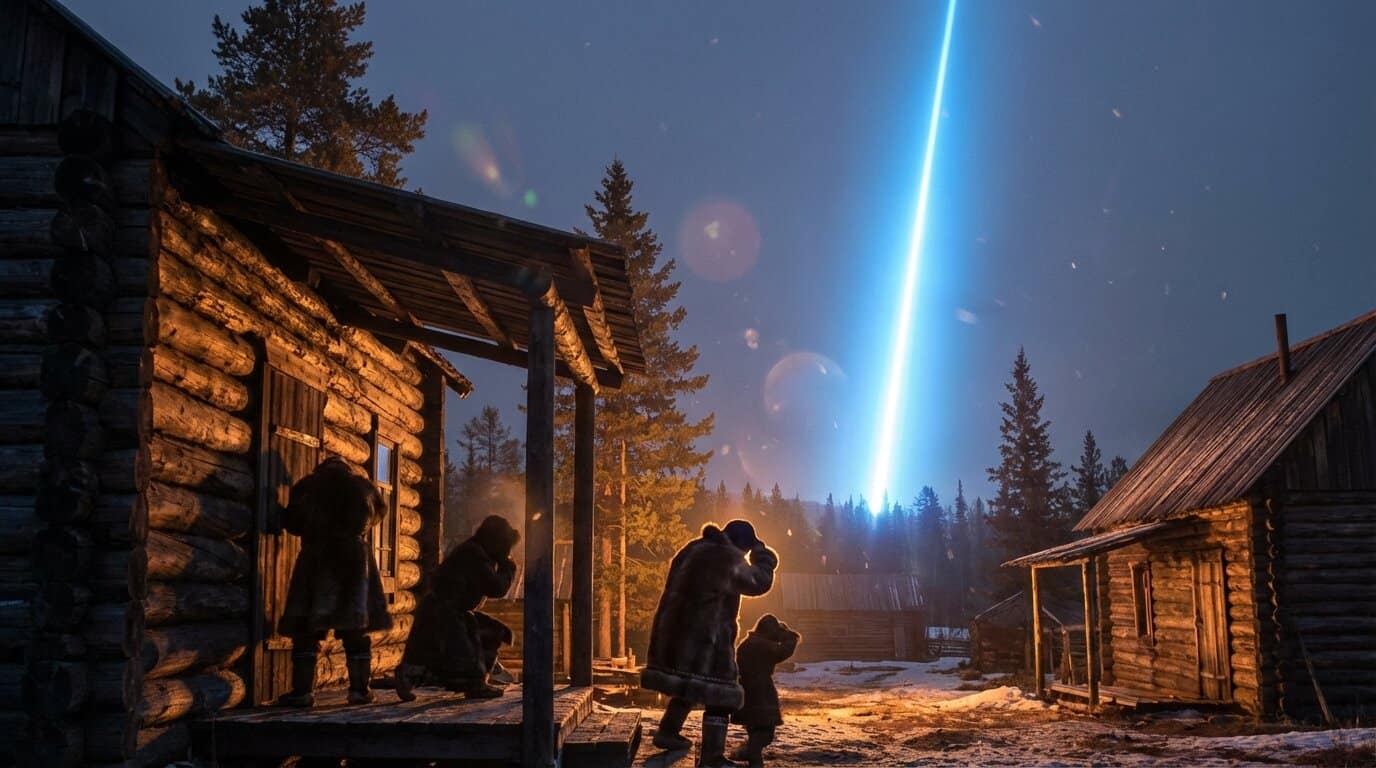
On the morning of June 30, 1908, the silence of the Siberian taiga was shattered by an explosion roughly a thousand times more powerful than the atomic bomb later dropped on Hiroshima. Witnesses nearly forty miles away at the trading post of Vanavara reported seeing a column of blue light moving across the sky before a massive sound wave struck them. The physical shock was so intense that it knocked people off their feet and shattered windows in towns hundreds of miles from ground zero. Seismic stations across Eurasia recorded the tremors, yet the remote location meant that no one went to investigate the cause immediately. For nearly two decades, the forest held its secrets while rumors of a visitation from the heavens swirled among the local Evenki people.
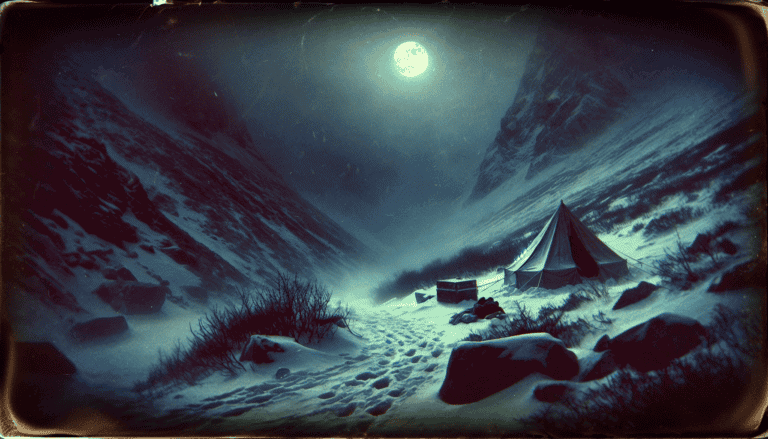
It was not until 1927 that Leonid Kulik, a Soviet mineralogist, finally led a team into the treacherous wilderness to uncover the source of the devastation. Driven by the belief that a massive iron meteorite had struck the earth, Kulik battled through mosquito swarms and frozen rivers to reach the epicenter. He fully expected to find a giant crater filled with valuable extraterrestrial metal that could help Soviet industry. Instead, what he found upon arrival baffled the scientific community and deepened the mystery for generations to come. While eighty million trees lay flattened in a radial pattern like matchsticks, the ground itself showed absolutely no sign of a collision point.
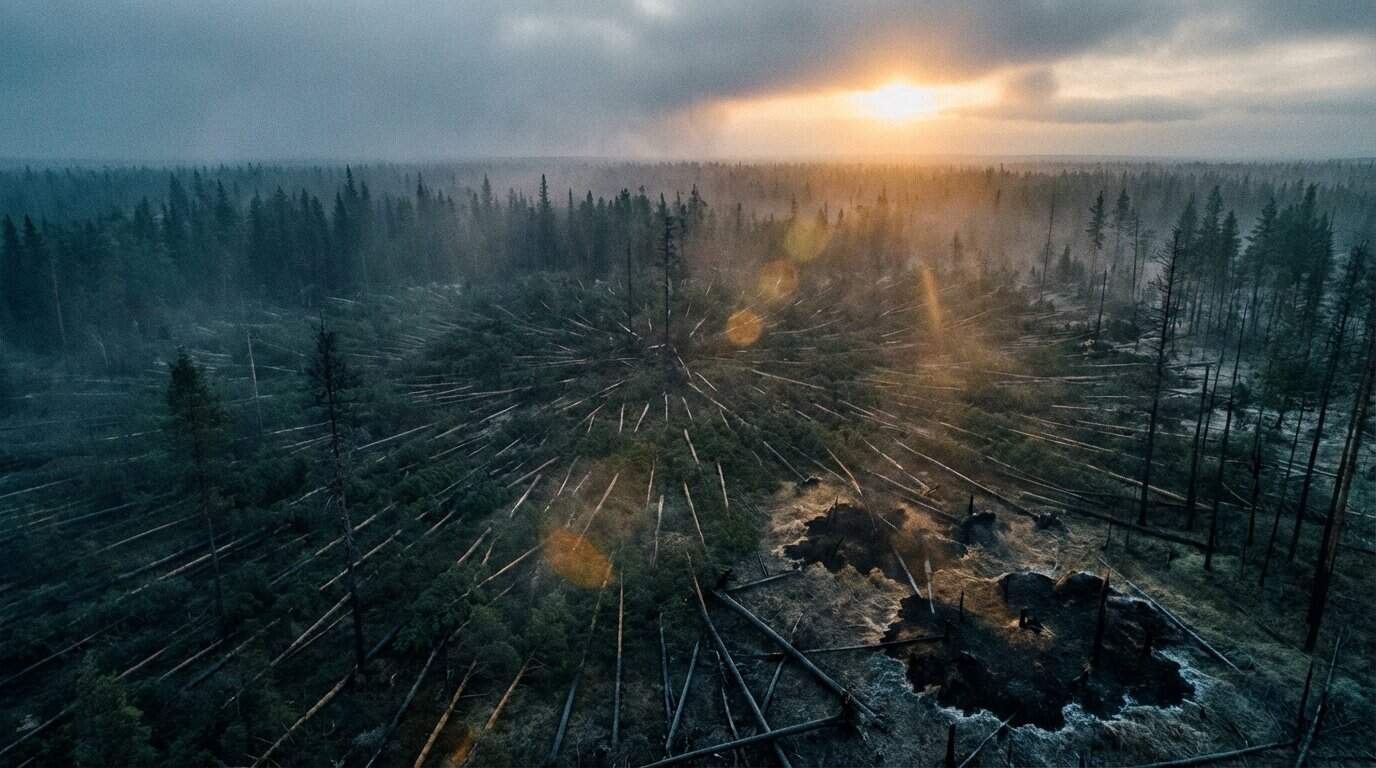
The center of the destruction site presented a confusing paradox for the expedition team. Directly below the calculated blast zone, a grove of trees remained standing upright but had been completely stripped of their branches and bark. Kulik searched extensively for fragments of the meteorite or a distinct impact pit, but the swampy terrain yielded nothing. This absence of a crater suggested that whatever caused the Tunguska event did not actually strike the surface of the Earth. Without a smoking gun or a physical meteorite, scientists were left to speculate about what kind of object could cause such damage from the sky alone.
Evidence For A Stony Meteorite Airburst
For decades, the missing crater baffled researchers who expected to find a giant hole in the earth. Modern science offers a compelling explanation that solves this puzzle without needing a physical impact site. Computer simulations conducted by Sandia National Laboratories suggest a stony asteroid hurtled into the atmosphere at incredible speeds. Instead of striking the ground, the intense pressure and heat caused the massive rock to explode several miles up. This phenomenon is known as an airburst and acts like a powerful bomb detonating in the sky.
The energy released during this mid-air detonation was likely strong enough to flatten the forest below instantly. Researchers at NASA have compared the blast to a large nuclear explosion that radiates outward with terrifying force. This downward thrust of air explains why the trees directly underneath the explosion remained standing but were stripped of their branches. Surrounding these upright trunks, millions of other trees were knocked down in a radial pattern pointing away from the center. This distinctive butterfly shape created by the fallen timber provides a ghostly map of the shockwave’s path.
Physical clues recovered from the Siberian soil support the idea of a rocky visitor rather than an icy comet. Expeditions in passing decades have recovered microscopic spheres of silicate and magnetite embedded in the peat. These tiny particles match the composition of stony meteorites often found elsewhere on the planet. If the object had been made of solid iron, it likely would have survived the atmospheric entry to create a traditional crater. Most experts now agree that a stony asteroid creates the perfect scenario for the sudden fragmentation seen at Tunguska.
The Comet Hypothesis And Lake Cheko
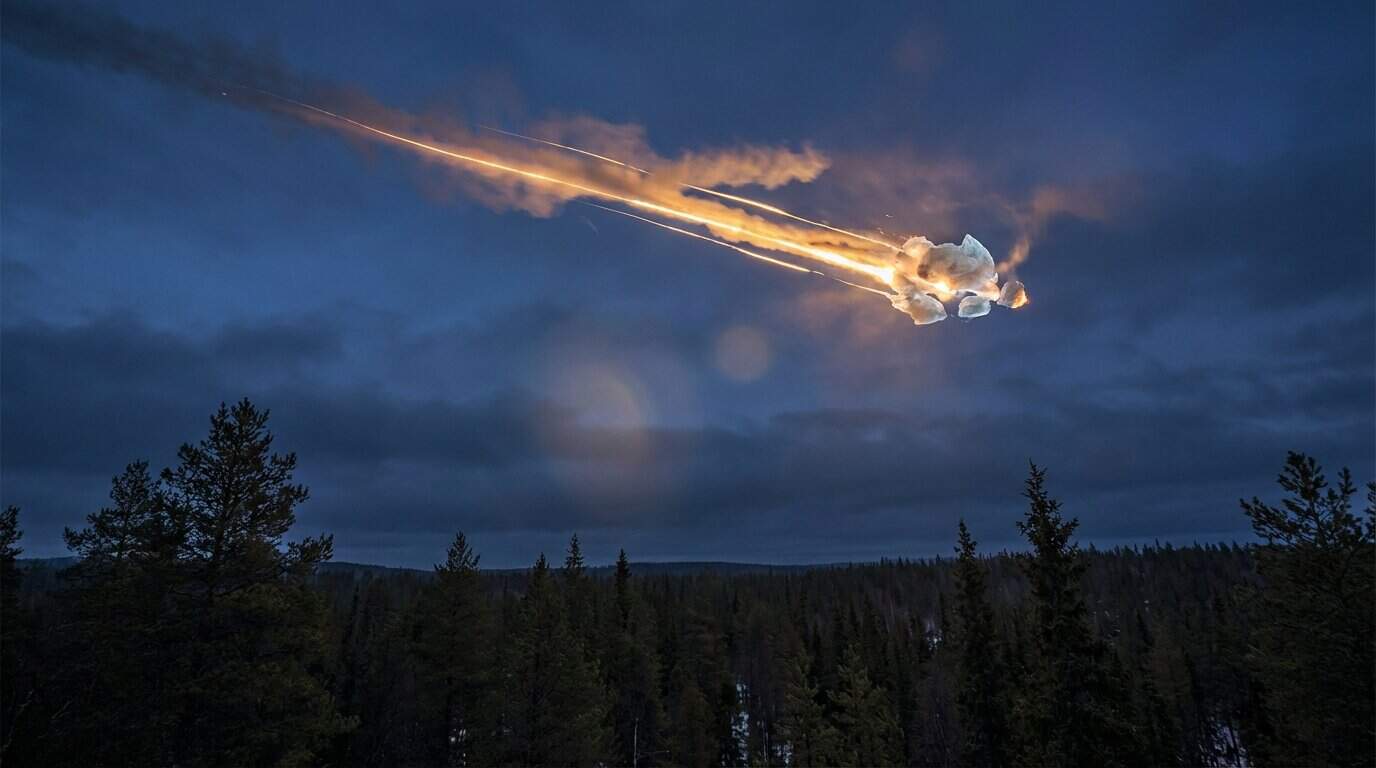
While the asteroid theory holds significant weight, some scientists look to the stars for a different culprit entirely. A competing idea suggests that the Tunguska event cause was actually a comet made largely of ice rather than stone or metal. Because comets are essentially dirty snowballs, such an object would likely vaporize completely upon entering the atmosphere due to intense friction. This rapid disintegration explains why early explorers failed to find any large meteorite fragments or a traditional impact crater at the scene. It paints a picture of a ghostly visitor that vanished into thin air after delivering a devastating blow to the Siberian taiga.
The search for a physical scar on the terrain took a fascinating turn when researchers turned their eyes toward Lake Cheko. Located about five miles from the explosion’s epicenter, this small body of water was curiously not marked on maps prior to 1908. A team from the University of Bologna, led by Luca Gasperini, proposed that the lake might actually be the impact crater everyone had been missing. They argued that its funnel-like shape is distinct from other flat-bottomed Siberian lakes and suggests a low-velocity impact by a fragment of the cosmic body. This theory offers a tangible solution to the missing crater problem that has puzzled experts for over a century.
Despite the compelling nature of the Lake Cheko theory, it faces stiff opposition from other members of the scientific community. Russian geologists have analyzed sediment cores from the lake bottom and claim the deposits are at least 280 years old, which predates the 1908 event. These findings suggest the lake is simply a natural formation that happened to be in the right place at the wrong time. However, proponents of the impact theory argue that the explosion could have contaminated the samples or altered the lake bed in complex ways. Until definitive proof surfaces, the true nature of Lake Cheko remains a polarizing piece of the Tunguska puzzle.
Speculative Theories From Antimatter To Tesla
While meteors and comets remain the top contenders, some researchers have looked for answers in the realm of exotic physics. In 1965, scientists suggested that antimatter drifting from space could have annihilated upon contact with the atmosphere to cause the massive blast. This theory gained traction because it neatly explained why no physical rock fragments were ever recovered from the epicenter despite the immense energy released. Another fascinating idea proposed in 1973 involved a miniature black hole passing through the Earth, though it likely would have caused an exit wound on the other side of the planet. Although these concepts are highly theoretical, they highlight just how desperate humanity is to find a perfect fit for the confusing evidence found at the site.
Perhaps the most captivating legend involves the famous inventor Nikola Tesla and his experiments with wireless energy. Some historians point out that Tesla was conducting high-voltage tests at his Wardenclyffe Tower around the same time the explosion occurred in Russia. The theory suggests that a misfire of a directed energy weapon or a test of global wireless power transmission might have accidentally targeted the remote Siberian wilderness. While no records exist to confirm Tesla fired a weapon that day, the coincidence in timing keeps this story alive in the minds of alternative history enthusiasts. It serves as a reminder of how the early 20th century was a time of both great destruction and boundless scientific optimism.
Solving the mystery of the Tunguska event cause ultimately requires balancing hard scientific data with the undeniable strangeness of the site. Most experts agree on a cosmic airburst, yet the lack of a crater and the conflicting eyewitness reports leave just enough room for doubt. The Siberian taiga continues to regrow over the scars of 1908, but the ground below still holds secrets that modern technology has yet to fully unlock. Whether it was a stony asteroid or a stray experiment, the event reminds us that our planet is vulnerable to forces beyond our control. What do you think really happened out there in the lonely forests of Russia?
Unraveling the Mystery of the Exploding Asteroid
The Tunguska event remains one of the most fascinating puzzles in modern history, standing as a testament to the raw power of the cosmos. After over a century of research, the most widely accepted explanation suggests that a stony asteroid entered the atmosphere and exploded before striking the ground. This airburst theory effectively explains why Leonid Kulik found a flattened forest but never discovered a traditional impact crater during his expeditions. While the absence of large meteorite fragments initially baffled researchers, the idea of complete vaporization offers a logical solution to the missing debris. This massive release of energy serves as a humbling reminder of what can happen when Earth crosses paths with space rocks.
Despite the consensus around an asteroid, alternative theories continue to challenge the official narrative and keep the debate alive among enthusiasts. Some scientists argue that an icy comet could have caused the blast, potentially explaining the bright night skies reported across Europe and Asia following the event. The controversial investigation of Lake Cheko as a possible impact site also adds another layer of intrigue to this Siberian mystery. Because no definitive piece of the cosmic object has ever been recovered, room remains for speculation about what truly happened that summer morning. Until undeniable physical proof is found, the Tunguska event will likely retain its aura of the unexplained.
Understanding the cause of the Tunguska event matters not just for history, but for predicting future threats from the sky. It bridges the gap between hard science and the enduring allure of the unknown, proving that our planet still holds secrets waiting to be uncovered. Whether it was a stony meteor, a vaporizing comet, or something even stranger, the event left an indelible mark on the Siberian wilderness. Theories will continue to evolve as new technology allows researchers to scan the taiga with greater precision. What do you think caused the sky to catch fire over the Tunguska river in 1908?
Frequently Asked Questions
1. What exactly was the Tunguska Event?
It was a massive explosion that occurred on June 30, 1908, over the remote Siberian wilderness. The blast flattened over 80 million trees and released energy roughly a thousand times more powerful than the atomic bomb dropped on Hiroshima.
2. What is the most likely Tunguska event cause?
Most researchers believe a stony asteroid or an icy comet exploded in mid-air before it could hit the ground. This massive airburst created a shockwave strong enough to flatten the forest without leaving a traditional impact crater.
3. Why did early explorers fail to find a crater?
Leonid Kulik and his team expected to find a giant hole in the earth, but the cosmic object likely disintegrated in the atmosphere. Instead of a crater, they discovered a vast area of fallen trees radiating outward from the epicenter.
4. Did anyone witness the explosion?
Witnesses at the Vanavara trading post described a blinding blue light splitting the sky followed by a massive wave of heat and sound. The physical shock was intense enough to knock people off their feet and break windows hundreds of miles away.
5. Why did it take so long to investigate the site?
The explosion occurred in an unforgiving and isolated part of the taiga that was incredibly difficult to access. It took nearly twenty years for the first scientific expedition to battle through the harsh terrain and reach the site in 1927.
6. Are there other theories about what caused the blast?
While an airbursting asteroid is the standard explanation, the lack of physical fragments keeps other theories alive. Some speculate about more exotic causes, ranging from natural gas explosions to even stranger phenomena that science has yet to fully explain.