
The Legend Flights Of North American Thunderbirds
High above the rugged peaks of the American wilderness, a shadow larger than a small airplane occasionally sweeps across the ground, leaving witnesses in a state of disbelief. The long and storied thunderbird sightings history bridges the gap between ancient Indigenous legends and modern mysteries. These massive, avian creatures are said to command the skies with wingspans that defy the laws of biology, creating a bridge between spiritual reverence and physical reality.
While many skeptics point toward misidentified vultures or eagles, the consistency of these reports across centuries suggests something more elusive might be soaring through the clouds. From the dusty trails of the Old West to forested mountain ranges, the stories remain remarkably similar in their description of a feathered behemoth. Exploring these accounts offers a glimpse into a world where the line between myth and nature begins to blur, inviting everyone to look at the horizon with a bit more wonder.
Key Takeaways
- The Thunderbird serves as a vital cultural bridge, originating as a divine protector in Indigenous oral histories before transitioning into a modern cryptozoological mystery.
- Historical and modern accounts, such as the 1890 Tombstone encounter and the 1977 Lawndale incident, suggest these creatures possess physical traits and predatory behaviors that defy the biological limits of known avian species.
- Persistent sightings across North America point to the possibility of relict populations of prehistoric giants, like the Teratorn or pterosaurs, surviving in remote, mountainous wilderness.
- While skeptics attribute sightings to misidentified condors or eagles, the consistent descriptions of massive, airplane-sized wingspans across centuries challenge conventional scientific explanations.
Indigenous Roots Of The Sacred Storm Bird
Long before modern explorers documented sightings of giant birds, the Indigenous peoples of North America shared deep connections with a supernatural force known as the Thunderbird. Across the Great Plains and the Pacific Northwest, various tribes described a creature so massive that it carried the weight of the storm on its back. These legends characterize the bird as a divine protector and a harbinger of change, possessing the power to create thunder by flapping its heavy wings. Its eyes were said to flash with the intensity of lightning, illuminating the dark clouds as it patrolled the skies. This ancient belief system established a framework for understanding the massive, avian shapes that people continue to report in the wilderness today.
The cultural significance of the Thunderbird varies between nations, yet the core image of a giant, powerful flyer remains remarkably consistent. For the Anishinaabe and Lakota people, the bird was often seen as a warrior spirit that fought underwater serpents to maintain the balance of the world. Artistic depictions on totem poles and in sacred carvings often show the creature with a curved beak and prominent crest, features that some researchers compare to prehistoric flying reptiles. These Indigenous oral histories were not merely myths to the people who told them, but rather a way to document real encounters with a force that defied conventional zoology. By treating these stories as historical records, we can see a long timeline of human interaction with something truly extraordinary in the clouds.
Modern cryptozoology often looks back at these Indigenous roots to find clues about the physical nature of these mysterious giants. While skeptics might suggest these legends are purely symbolic, the detailed descriptions of the bird’s behavior and size suggest a grounded observation of a living animal. Many tribal accounts describe the bird as being large enough to lift a whale from the ocean, a feat that points toward a creature with a wingspan far exceeding any known eagle or condor. By blending these sacred traditions with contemporary sightings, a clearer picture emerges of a persistent North American enigma. These stories remind us that the history of the Thunderbird is not just a collection of fables, but a documented legacy of a creature that has shared the continent with humans for centuries.
The Infamous 1890 Tombstone Epitaph Encounter
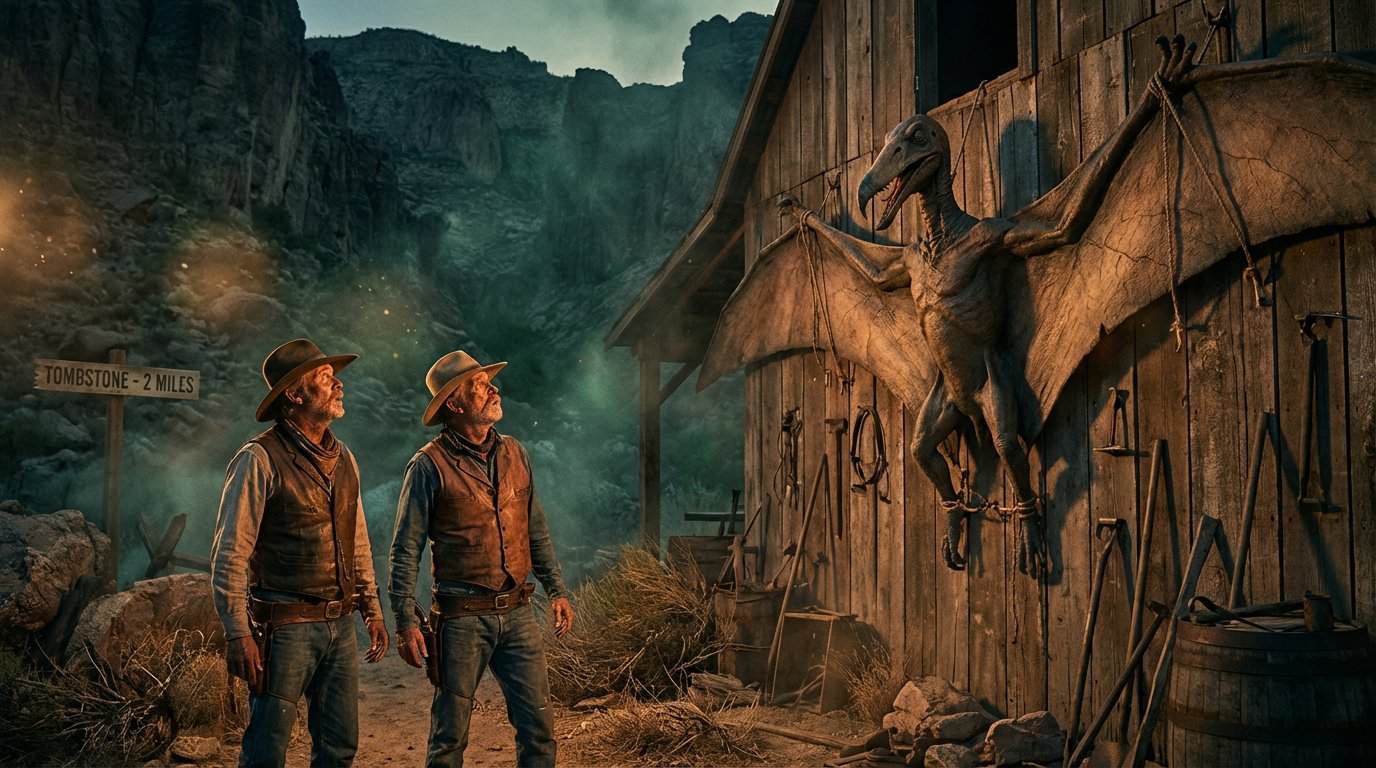
The dusty Arizona desert became the backdrop for one of cryptozoology’s most enduring mysteries in April 1890. According to a report published in the Tombstone Epitaph, two cowboys riding through the desert between the Whetstone and Huachuca mountains encountered a creature that defied all logic. This was no ordinary bird, but a massive, featherless beast with smooth skin and a prehistoric appearance that resembled a pterosaur. The witnesses claimed the creature was exhausted and struggling to fly, allowing them to pursue it on horseback. This Tombstone encounter remains a cornerstone of Thunderbird lore because it shifted the narrative from spiritual legend to a physical, biological event.
The details provided by the witnesses were both specific and startling, describing a wingspan that allegedly measured an incredible 160 feet. According to the original newspaper account, the creature possessed a head nearly eight feet long with thick, powerful jaws filled with sharp teeth. Its wings were described as thick membranes, much like those of a giant bat, rather than the feathered wings of the traditional Indigenous Thunderbird. While these dimensions seem impossible by modern biological standards, the story captured the public imagination and sparked decades of debate. Many researchers suggest this account may be the origin of the famous lost photograph mystery, where people across the country claim to remember seeing a picture of the slain beast pinned to a barn.
While skeptics often point to the sensationalist journalism style of the late 19th century as a reason for doubt, the Tombstone Epitaph story continues to fascinate those searching for the truth. The description of the creature aligns remarkably well with the physical characteristics of extinct pterosaurs, leading some to wonder if a small population of prehistoric reptiles survived in the remote American West. Others believe the cowboys may have encountered a truly massive bird that their minds struggled to categorize, resulting in an exaggerated tale. Regardless of whether the story was a tall tale or a genuine sighting, it serves as a vital bridge between ancient mythology and modern sightings. Do you think this encounter was a case of frontier fiction, or could a relic of the prehistoric past have truly soared over the Arizona desert?
Terrifying Modern Attacks In Lawndale Illinois
On a quiet July evening in 1977, the small town of Lawndale, Illinois, became the site of one of the most terrifying modern encounters in cryptozoology history. Ten year old Marlon Lowe was playing hide and seek in his backyard when two massive birds suddenly descended from the sky. Witnesses, including Marlon’s mother, Ruth, watched in horror as one of the creatures clamped its talons onto the boy’s shirt and lifted him several feet off the ground. The bird carried him for about thirty yards before the frantic screams and pursuit of the adults forced the creature to drop its human prey. While Marlon escaped with scratches and a ruined shirt, the psychological impact on the community was immediate and profound.
The physical description of these avian predators shocked both local law enforcement and wildlife experts who investigated the claims. Witnesses described the birds as having dark feathers, white ringed necks, and incredible wingspans that reached up to nine feet across. Many observers noted that the creatures resembled giant vultures or condors, yet their aggressive behavior towards a human child was entirely uncharacteristic of known North American species. Local newspapers and independent researchers documented the event, noting that the birds flew toward a nearby wooded area after the failed abduction. This Lawndale incident transformed the Thunderbird from a distant legend into a very real, modern threat for the residents of central Illinois.
Despite skepticism from some biological circles, the consistency of the eyewitness accounts suggests that something truly anomalous was in the air that summer. Critics often point to the possibility of a stray Andean Condor, yet the predatory intent shown by the birds remains a significant mystery that defies easy explanation. The Lawndale incident serves as a chilling reminder that the vast skies may still hold secrets that our current scientific understanding cannot fully map. It forces us to wonder if these legendary creatures are simply remnants of a prehistoric age that occasionally cross paths with our modern world. Do you believe these witnesses saw a misidentified bird, or could a prehistoric predator still be patrolling the Midwest?
Scientific Explanations Versus Unsolved Avian Mysteries

Modern science often points to the Andean Condor or the California Condor as the most likely candidates for Thunderbird sightings. These birds possess impressive wingspans that can reach up to ten feet, making them appear massive to an observer on the ground who lacks a clear sense of scale. Biologists suggest that under certain atmospheric conditions, a large bird soaring at high altitudes can easily be mistaken for something much larger than it actually is. However, skeptics of this theory argue that experienced outdoorsmen and Indigenous trackers would likely recognize a known scavenger. The sheer scale described in many reports, often comparing the creature to a small private airplane, continues to challenge the idea of simple misidentification.
While some researchers look toward known biology, others explore the possibility of relict populations of prehistoric giants like the Teratorn. These massive birds, which lived during the Pleistocene epoch, boasted wingspans of over twenty feet and fit the physical descriptions found in many historical accounts. Cryptozoologists often wonder if a small number of these creatures survived in remote, mountainous regions of North America, hidden away from human development. Much like the Bigfoot evidence debate, the persistent nature of these sightings suggests that people are seeing something that defies standard classification. Even without physical evidence like feathers or nests, the consistency of the descriptions across different centuries and cultures keeps the mystery alive.
The debate between rational explanation and the unknown creates a fascinating middle ground for those following the Legends of the Southwest and the unknown legend of the Thunderbird. While it is easy to dismiss a single sighting as a trick of the light, the collective history of these encounters points to a phenomenon that refuses to be ignored. Whether these creatures are flesh and blood animals yet to be cataloged or something more symbolic, they remain a powerful part of the American story. We are left to wonder if the skies still hold secrets that our modern maps have yet to chart. Do you believe these sightings are just cases of mistaken identity, or is there a giant avian predator still ruling the remote wilderness?
From Ancient Legends to Modern Encounters
The legacy of the Thunderbird remains a powerful bridge between ancient Indigenous wisdom and the curious world of modern cryptozoology. These massive winged beings have transitioned from sacred figures in oral traditions to the subjects of startling eyewitness reports that continue to baffle investigators today. While many skeptics are quick to point toward misidentified vultures or large herons, the consistent descriptions of massive wingspans and prehistoric features suggest a mystery that is far from solved. Much like the ancient roots of other regional folklore, the persistence of these stories across different cultures and centuries hints at a biological reality that may still be hiding in the vast, untamed skies of North America.
The enduring fascination with these giant birds invites deep reflection on the hidden corners of the natural world. Whether one views them as spiritual guardians, surviving prehistoric species, or simply a trick of the light, the impact of the Thunderbird on the human imagination is undeniable. There is a certain magic in considering that something so grand could still exist just out of sight, challenging our understanding of zoology. These sightings remind us that despite our modern technology, the wilderness still holds secrets that refuse to be easily categorized or dismissed. Much like the various prehistoric survivors discussed in other cryptid debates, the Thunderbird forces us to reconsider what might still be living in the shadows.
Does your own community have stories of giant birds or strange shadows passing over the landscape? Perhaps you have had a personal encounter or have heard a local legend that feels too vivid to be a mere myth. It is through these shared experiences and open discussions that the history of the Thunderbird continues to evolve. Please share your thoughts on whether these sightings are real or symbols of the unknown. Your insights help keep this fascinating piece of North American history alive as we look toward the horizon for answers. This search for truth often leads researchers to other regional tales, such as the Van Meter Visitor, which further illustrates the deep-seated human connection to winged anomalies.
Frequently Asked Questions
1. What exactly is a Thunderbird according to Indigenous traditions?
The Thunderbird is a powerful supernatural being described by many North American tribes as a divine protector that controls the weather. It is said to create thunder by flapping its massive wings and shoot lightning from its eyes during storms. For nations like the Lakota and Anishinaabe, these creatures represent a bridge between the physical world and the spiritual realm.
2. How large are the wingspans reported in these sightings?
Witnesses often describe birds with wingspans ranging from 15 to 20 feet, which is significantly larger than any known living bird. Some accounts even compare the shadow cast by the creature to that of a small private airplane. These measurements defy modern biological records, leading many to wonder if a prehistoric species could still exist.
3. Where do most Thunderbird sightings take place today?
While reports come from all over North America, the most frequent sightings occur near rugged mountain ranges and dense forests like the Pacific Northwest and the Appalachian Mountains. These remote areas provide the perfect cover for a large predator to remain hidden from human civilization. The Great Plains also have a long history of sightings tied to the arrival of massive summer storms.
4. Could these sightings simply be misidentified eagles or vultures?
Skeptics often suggest that people are seeing common birds like the California Condor or a Golden Eagle and misjudging their size. However, experienced observers and locals often insist that the scale and behavior of the Thunderbird are entirely different from any known species. The consistency of descriptions across different cultures and time periods suggests a unique phenomenon.
5. Is there any physical evidence that these giant birds exist?
Most evidence remains anecdotal, consisting of eye-witness testimonies and historical accounts passed down through generations. While some ancient petroglyphs and carvings clearly depict giant avian figures, feathers or nesting sites have yet to be confirmed by the scientific community. This lack of physical remains keeps the mystery firmly in the realm of cryptozoology.
6. Are Thunderbirds considered dangerous to humans?
In most legends and modern reports, the Thunderbird is viewed as a majestic and solitary figure rather than an aggressive predator toward people. They are often seen as guardians of the natural order that only use their power when the balance of nature is threatened. Most encounters involve the bird simply soaring at high altitudes, seemingly indifferent to the humans watching from below.