The Unexplained Mystery of the Bélmez Faces
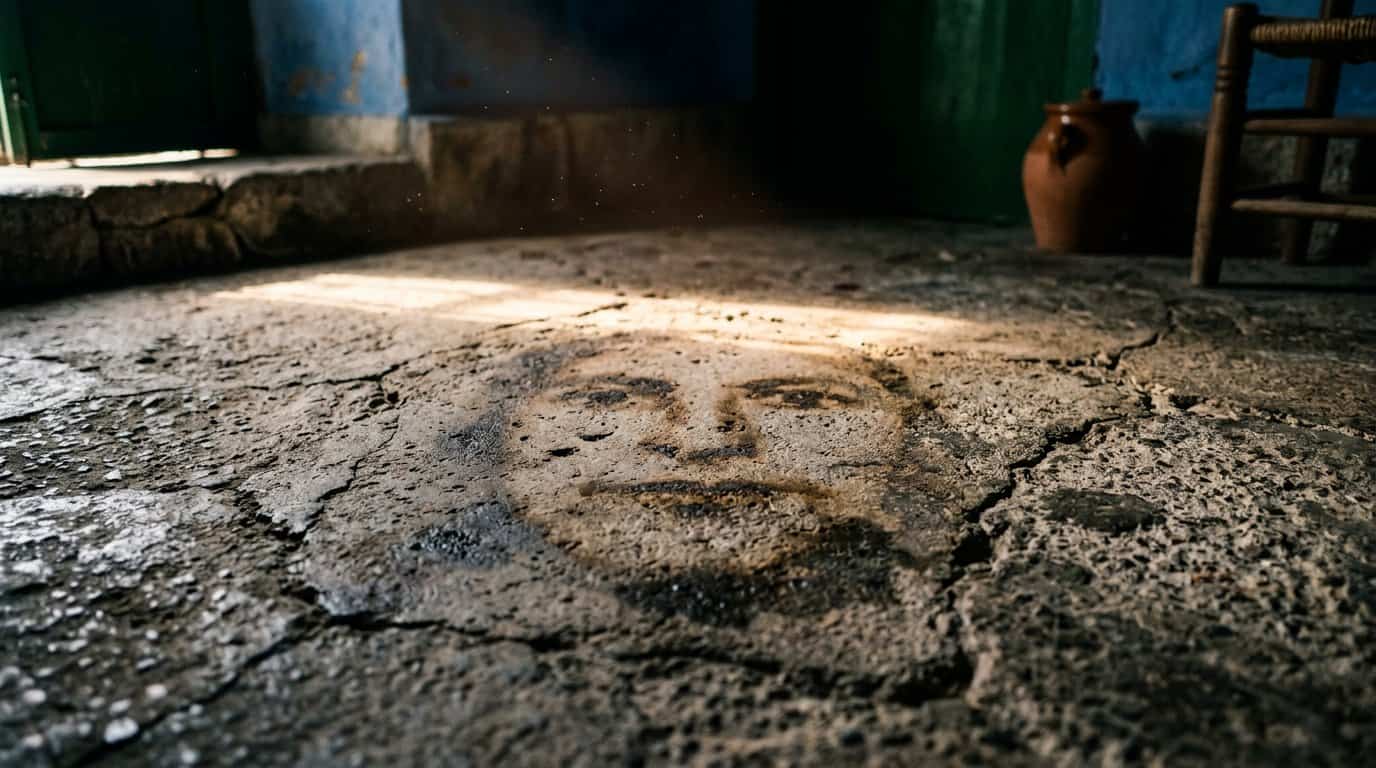
On a warm August day in 1971, a quiet Spanish kitchen became the center of an unbelievable event that still baffles people today. María Gómez Cámara looked down at her concrete floor and saw a dark, face-like image staring back up at her. This unsettling discovery marked the beginning of the Bélmez Faces mystery, a strange phenomenon that quickly spread throughout her home in Andalusia. Even after her family smashed the concrete slab with a pickaxe and laid down a fresh floor, the haunting images returned with changing expressions, ages, and forms.
For decades, scientists, researchers, and curious travelers have tried to figure out how these unsettling portraits appeared without any obvious cause. While skeptics point to potential chemical reactions or clever hoaxes, many unusual clues suggest there could be real truth behind the strange occurrences. The house sits on an ancient site with a rich history, leaving room for both scientific study and unexplained possibilities. Uncovering the story behind these shifting shapes offers a fascinating peek into one of Spain’s greatest modern enigmas.
Key Takeaways
- The Bélmez Faces mystery began in 1971 when mournful, human-like portraits spontaneously materialized on a concrete floor in Spain, continuously morphing and reappearing even after the surface was destroyed and repoured.
- Excavations beneath the affected kitchen floor revealed 13th-century human skeletons and an ancient medieval cemetery, providing a distinct historical backdrop to the ongoing manifestations.
- Decades of scientific testing and parapsychological investigation have failed to conclusively resolve the riddle, as chemical theories struggle to account for new expressions forming under sealed observational conditions.
The Initial Discovery at Calle Real 5
On a warm August morning in 1971, a quiet homemaker named María Gómez Cámara noticed something deeply unsettling while working in her kitchen at Calle Real 5. Right there on the hard concrete floor, a dark, ghostly pattern had materialized out of nowhere. The image strongly resembled the mournful face of a man, featuring visible eyes, a nose, and a mouth staring back at her. Word spread quickly through the small Spanish village of Bélmez de la Moraleda as curious neighbors gathered to see the strange mark for themselves. Dubbed “La Pava” by the locals, this unsettling apparition marked the beginning of one of the most intriguing unexplained phenomena in European history.
Disturbed by the eerie face under her feet, María and her family decided to take immediate action to get rid of it. Her husband and son grabbed a pickaxe, completely hacked away the affected patch of concrete, and laid down a fresh layer of cement. They assumed the issue was solved, but just a few days later, the exact same spot produced an even clearer image. Destruction had failed to stop the phenomenon, and soon additional faces began spontaneously forming across the kitchen floor. Local accounts from the period documented how these images seemed to alter their expressions, confounding everyone who witnessed them.
As news of the discovery spread, the private residence transformed into a central hub for investigation. Early researchers noted that standard chemical reactions or routine moisture problems could not easily explain how detailed facial features continuously reappeared through newly poured stone. Investigators preserved sections of the floor to test whether artificial dyes or paints had been used, yet the findings left plenty of room for paranormal possibilities. This unexpected persistence established the case as a classic mystery, highlighting an intriguing clash between scientific explanations and the supernatural. What began as a simple stain on a humble kitchen floor rapidly grew into a lasting riddle that still fascinates seekers of unexplained phenomena today.
Medieval Bones Beneath the Kitchen Floor
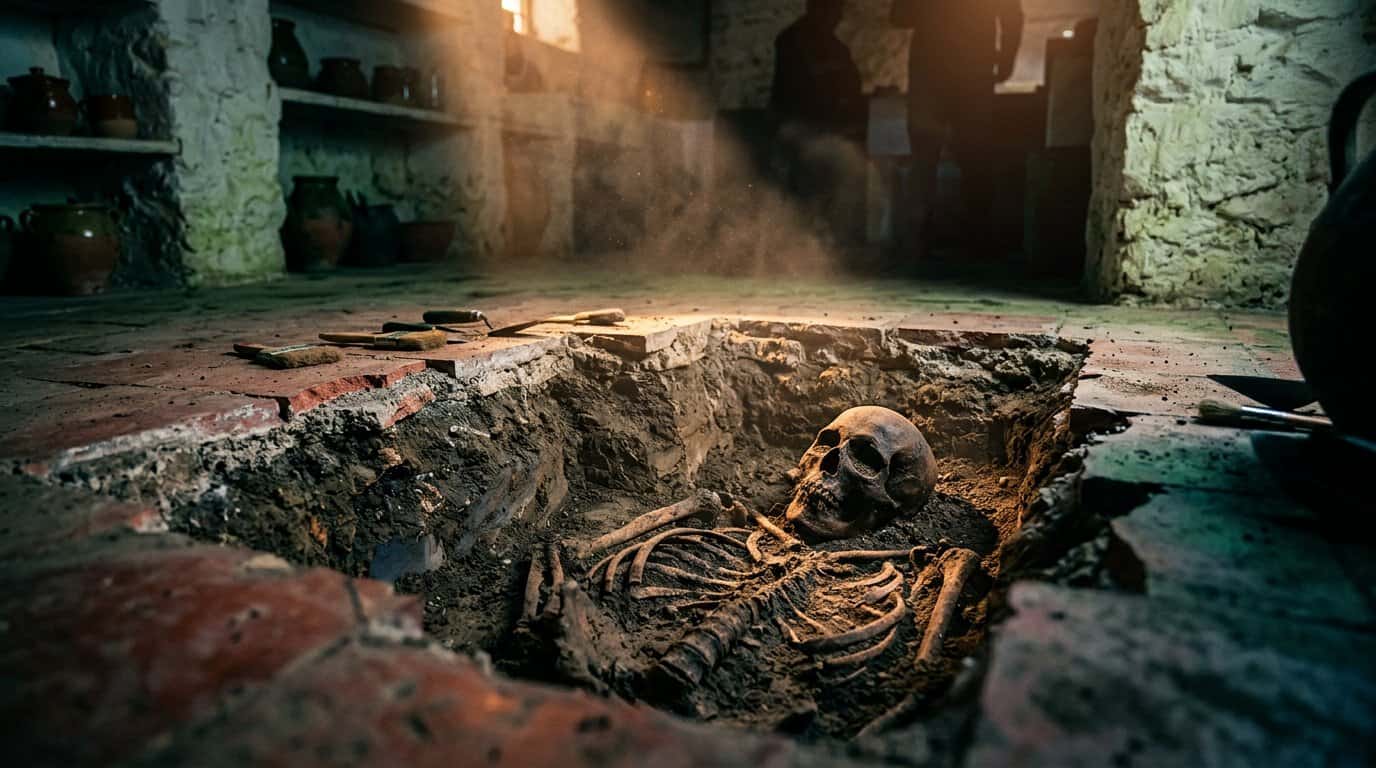
When local authorities and intrigued researchers decided to dig beneath the kitchen floor of Calle Real 5, they expected to find simple dirt or hidden chemical agents. Instead, removing the concrete revealed a startling historical discovery buried just a few feet below the surface. Excavators uncovered human skeletal remains that archaeologists later dated back to the 13th century. Further historical research revealed that the house had been constructed directly over a centuries-old medieval cemetery, possibly linked to the region’s ancient past. For many locals, finding these forgotten graves provided an immediate, chilling context for the strange faces forming on the floor above. It transformed what seemed like a bizarre isolated event into a story deeply rooted in real history.
Investigating teams quickly realized that the ground beneath the family kitchen held far more than just standard soil. Researchers and local historians carefully documented the site, unearthing multiple skeletons alongside medieval artifacts. Interestingly, several of the remains showed signs of trauma, leading to theories that tragic events had occurred on the land long ago. The presence of these bodies suggested that the kitchen was built directly over sacred ground. This physical evidence gave open-minded investigators a tangible connection between the location and the eerie manifestations.
- Multiple human skeletons buried directly beneath the kitchen floor
- Radiocarbon testing confirming the remains originated in the 13th century
- Historical documentation confirming the presence of an ancient cemetery
While skeptics argued that living above ancient graveyards was relatively common in historic European villages, the timing of the excavation sparked intense interest. Spanish researcher Germán de Argumosa and other early investigators noted that the faces began to emerge with even greater frequency after the soil was disturbed. Even after workers reburied the bones with dignity and poured a new layer of concrete, fresh images continued to appear. This stubborn persistence suggested that whatever caused the phenomena was not easily swept away with the physical remains. The discovery of the medieval cemetery added a layer of undeniable historical reality to a mystery that still fascinates investigators today.
Science and Parapsychology Clash Over Concrete
When the mysterious images first began spreading across the kitchen floor in Bélmez de la Moraleda, skeptics immediately searched for a down-to-earth explanation. Early scientific tests focused on whether chemical substances could have been applied to the concrete to react over time. Researchers like Spanish chemical analyst José Javier Alonso hypothesized that the facial shapes were produced by acid etching, salt reactions, or paint mixtures containing iron and zinc compounds. According to these physical theories, moisture rising through the foundation could interact with applied chemicals, causing dark, human-like stains to bloom across the slab. While some laboratory samples did reveal traces of chemical pigments, investigators were unable to fully replicate the fluid, self-transforming nature of the faces using those methods alone.
- Scientific Theories: Chemical staining, acid etching, and mineral oxidation reacting with concrete moisture over time.
- Parapsychological Theories: Subconscious thoughtographic projection, localized psychokinesis, and residual atmospheric energy.
Parapsychologists saw something far more profound happening beneath the quiet Andalusian home. Prominent investigators, including German professor Hans Bender and Spanish researcher Germán de Argumosa, suggested that the images were a form of thoughtography or subconscious psychic projection. Under this theory, the emotional energy of the homeowner, María Gómez Cámara, somehow acted as a human printer that projected vivid mental images directly onto the porous floor. Proponents pointed to how the facial expressions seemed to shift alongside Maria’s own moods and health as evidence of a deep psychic connection. This compelling idea framed the floor not as a canvas of fraud, but as a living mirror reflecting unexplained human consciousness and hidden energy.
The debate between strict scientific logic and parapsychological wonder remains unresolved to this day. Even after concrete samples were removed, sealed in glass containers, and kept under strict police supervision, new expressions still managed to appear on the floor. While skeptical analysts insist that mundane chemical processes or clever hoaxes can account for every line, believers highlight tests where no known organic binders or paints were detected. Ultimately, the floor of Calle Real 5 stands as a captivating meeting point where chemistry meets the mysteries of human consciousness. What do you think is really responsible for the uncanny faces that captured the world’s imagination?
An Unsolved Riddle Etched in Concrete
Decades after their initial discovery in a humble kitchen, the Bélmez faces remain one of Europe’s most captivating paranormal riddles. The ghostly images appearing on the concrete floor continue to blur the line between rigorous scientific analysis and mind-bending parapsychology. Chemical testing on concrete samples suggested potential paint residues or acidic reactions, yet researchers struggled to fully explain how these human-like features transformed over time. Investigators who sealed off the room under strict protocols were stunned when new facial expressions took shape on the concrete surface anyway. This lingering tug of war between chemical explanations and true spectral phenomena ensures the small Spanish village stays firmly on the map of world mysteries.
Skeptics often point to pareidolia, suggesting human minds simply organize random shadows and mineral stains into familiar faces. However, the sheer persistence of the patterns and their apparent emotional shifts defy such straightforward brush-offs. Whether fueled by localized psychological energy or mysterious subterranean reactions, the floor at Calle Real 5 has generated a unique legacy that spans generations. The story captures a deep curiosity about what might lie hidden beneath ordinary homes and beyond current scientific understanding. Ultimately, the strange markings serve as a fascinating meeting point where historical documentation, chemical testing, and paranormal investigation collide.
Every investigator who studies the evidence seems to walk away with a unique perspective on what took place in Andalusia. Some see a clever illusion or an unusual chemical reaction, while others view the floor as compelling evidence of spontaneous paranormal activity. The debate between material science and parapsychology continues to spark passionate discussions among mystery enthusiasts worldwide. Each theory offers intriguing arguments, yet none can completely close the case on these shifting floor portraits. Does the evidence point toward a genuine anomaly, or is this famous floor mystery simply a natural puzzle waiting for a final explanation?
Frequently Asked Questions
1. What is the Bélmez Faces mystery?
The Bélmez Faces mystery centers on a series of eerie, human-like images that spontaneously appeared on a concrete kitchen floor in southern Spain. First spotted in 1971, these ghostly shapes repeatedly reshaped themselves into different expressions, ages, and genders over several decades. Despite numerous scientific tests and investigations, the exact cause behind these shifting portraits remains one of Europe’s most captivating unsolved phenomena.
2. Where and when did the faces first appear?
The phenomenon began on a warm August morning in 1971 inside a home located at Calle Real 5 in Bélmez de la Moraleda, a quiet village in Andalusia, Spain. Homemaker María Gómez Cámara noticed a dark, mournful face forming on her concrete kitchen floor. The strange image quickly became a local sensation, drawing curious neighbors and researchers from across the globe.
3. What happened when the family removed the original face?
Disturbed by the dark figure on her floor, María’s family destroyed the original concrete slab with a pickaxe and laid down fresh cement. Remarkably, the eerie faces returned shortly after, appearing in new shapes and with different facial expressions. The new images continued to morph and multiply across the floor over time, deeply unsettling the family.
4. What are the primary scientific theories explaining the phenomenon?
Researchers and skeptics have suggested that the images could be the result of chemical reactions between concrete components, ambient moisture, and organic compounds. Other scientists explored whether the shapes were formed by deliberate application of acids, solvents, or light-sensitive chemicals. However, chemical testing over the years produced conflicting results, leaving plenty of room for unexplained possibilities.
5. Is there a historical connection to the site of the house?
Local history reveals that the house on Calle Real 5 was built over an ancient site dating back several centuries. During excavations beneath the kitchen floor, workers actually uncovered human remains, leading many to believe a deeper historical connection exists. This eerie discovery sparked theories that the faces might be tragic manifestations tied to the site’s forgotten past.
6. Could the Bélmez Faces simply be an elaborate hoax?
Skeptics have long argued that the faces were artificially created using chemical agents to attract attention. However, early investigators sealed the kitchen in plastic and stamped it with wax seals, yet new faces still formed under strict observation. While hoax theories persist, the lack of definitive proof keeps the mystery wide open.
7. Are the Bélmez Faces still visible today?
The uncanny images can still be viewed inside the original house in Bélmez de la Moraleda. Following the death of María Gómez Cámara in 2004, investigators noted that new faint faces continued to appear in the home. Today, the location remains a popular destination for curious travelers, paranormal enthusiasts, and researchers hoping to witness the mystery firsthand.