
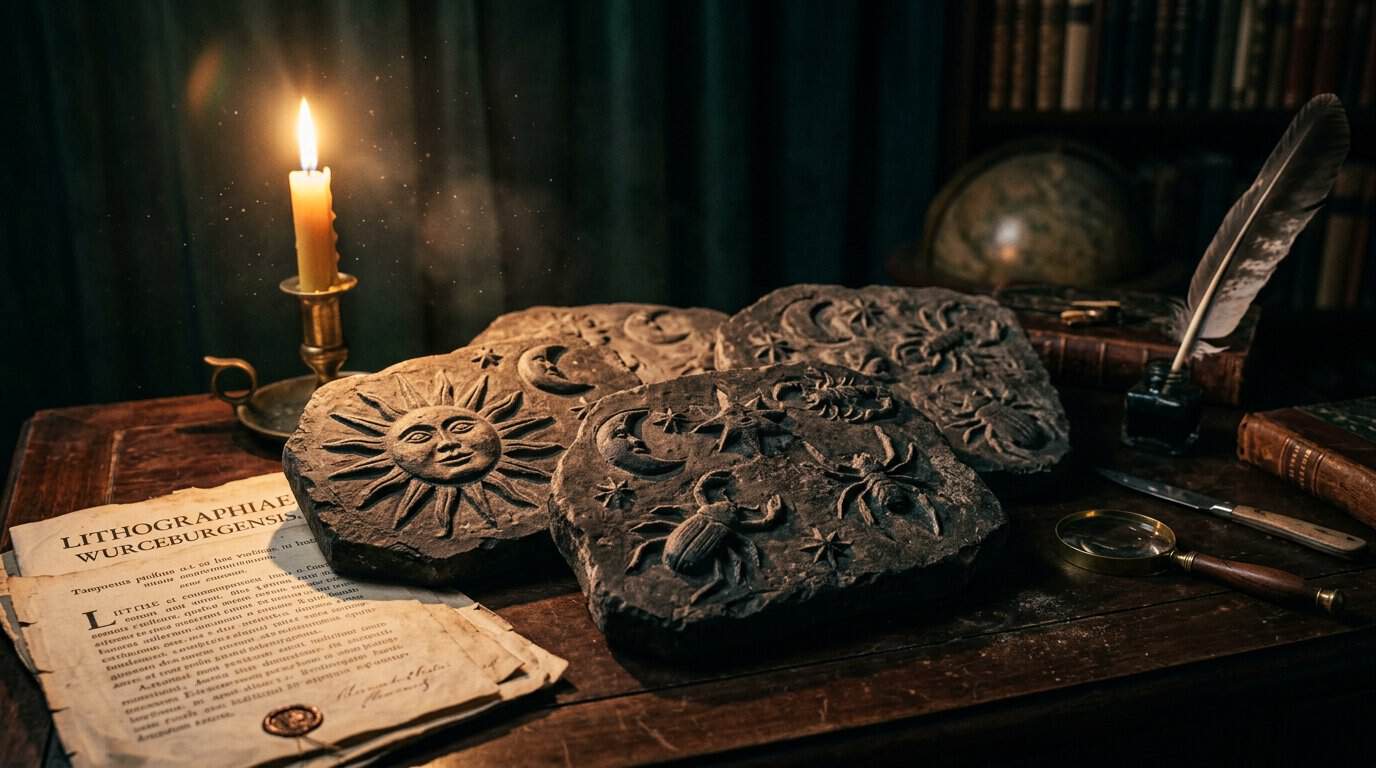
The Würzburg Lying Stones And The Great Fossil Hoax Of 1725
In 1725, Dr. Johann Beringer believed he had stumbled upon a treasure trove of prehistoric secrets that would rewrite the history of the natural world. Instead, he became the primary victim of the Lügensteine hoax, a calculated scheme designed to ruin his reputation. Thousands of strange stones were planted for the professor to find, featuring impossible carvings of spiders in webs, radiant suns, and even the name of God in ancient Hebrew.
What began as a thrilling scientific discovery quickly unraveled into a web of professional jealousy and elaborate deception. Two of Beringer’s own colleagues orchestrated the fraud, hiring local youths to stash the hand-carved fossils across the German countryside. This bizarre chapter in history serves as a timeless reminder of how easily passion can blind even the most educated minds to the truth.
Key Takeaways
- The Lügensteine hoax demonstrates that even the most educated experts are highly susceptible to confirmation bias when a discovery aligns with their personal desires or spiritual beliefs.
- Scientific progress requires a rigorous commitment to skepticism and critical thinking to prevent professional jealousy and elaborate deceptions from derailing objective truth.
- The publication of unverified findings can lead to irreversible professional ruin and stall the advancement of an entire scientific field by fostering an era of excessive doubt.
- The Beringer case serves as a timeless warning that the willingness to believe in the extraordinary often overrides the logical evaluation of evidence, a vulnerability that persists even in the modern era.
The Elaborate Deception Of The Lying Stones
The deception began in the hills of Würzburg, where J. Ignatz Roderick and Georg von Eckhart meticulously crafted a plan to humiliate their colleague, Dr. Johann Beringer. Driven by professional jealousy, the duo hired local youths to carve intricate figures into pieces of soft limestone and bury them in locations where Beringer frequently hunted for fossils. These were not typical prehistoric remains, as the stones featured incredibly detailed depictions of spiders in their webs, radiant suns, and even shooting stars. The sheer level of craftsmanship was designed to exploit Beringer’s enthusiasm for natural history and his desire for a groundbreaking discovery.
As Beringer continued his excavations, the findings became increasingly bizarre and seemingly miraculous. The perpetrators began including stones carved with Hebrew and Arabic letters, some of which even spelled out the name of God. To a modern observer, the idea of a fossilized name of God seems impossible, yet Beringer was so blinded by his passion that he viewed them as divine evidence of the natural world’s origins. He meticulously documented over two thousand of these strange stones, believing he had found a link between the physical earth and spiritual truth.
This elaborate hoax serves as a powerful reminder of how easily scientific progress can be derailed when critical thinking is replaced by confirmation bias. Roderick and von Eckhart went to extreme lengths to maintain the ruse, ensuring each new discovery felt like a piece of a larger, mystical puzzle. Even when rumors of a fraud began to circulate, Beringer’s commitment to his findings led him to publish a massive volume titled Lithographiae Wirceburgensis in 1726. It was only after the book was released that the devastating truth came to light, forever staining his reputation and providing a haunting lesson for future researchers.
Beringer And The Publication Of Lithographia Wirceburgensis

Despite receiving several anonymous warnings that the stones were mere fabrications, Beringer remained steadfast in his belief that he had discovered a divine treasure. His excitement blinded him to the mounting evidence of a prank, leading him to ignore colleagues who tried to point out the impossible nature of the carvings. To Beringer, the presence of Hebrew letters and celestial bodies on the artifacts was not a sign of forgery but a direct message from the heavens. He felt a sense of urgency to share these wonders with the world before anyone else could claim the glory. This unwavering confidence set the stage for a monumental blunder that would echo through scientific history for centuries.
In 1726, Beringer finally released his ambitious work titled Lithographia Wirceburgensis, a lavishly illustrated volume that documented the strange finds in exhaustive detail. The book featured high quality engravings of the fossils, depicting everything from radiant suns to insects trapped in stone webs. Beringer argued that these objects were not remains of living creatures but were instead sports of nature or miraculous creations placed by the hand of God. He spent a significant portion of his own fortune to ensure the publication was as prestigious and widely distributed as possible. By putting his theories into print, he inadvertently turned a private deception into a public spectacle that would eventually lead to his professional downfall.
The publication of this book serves as a powerful reminder of how easily a brilliant mind can be led astray by a lack of critical skepticism. Beringer was so focused on the possibility of a supernatural discovery that he failed to apply the rigorous testing required of a true scientist. While his colleagues Roderick and Eckhart were the architects of the fraud, it was Beringer’s own desire for fame that allowed the hoax to flourish. This historical case study highlights the thin line between open minded wonder and dangerous gullibility in the pursuit of knowledge. Do you think Beringer was truly a victim of his own ego, or was his passion for the unexplained simply too great for his era?
The Legal Scandal And Scientific Fallout
The deception reached a breaking point when Johann Beringer discovered a stone inscribed with his own name, finally shattering his belief in the artifacts. Realizing he had been the victim of a cruel joke, Beringer took his colleagues, J. Ignatz Roderick and Georg von Eckhart, to court in 1726 to restore his reputation. The trial transcripts reveal a bitter legal battle where the perpetrators attempted to blame one another for the scheme. This dramatic courtroom confrontation exposed the petty jealousies within the University of Würzburg and documented the meticulous efforts taken to plant over two thousand fake fossils. Ultimately, the court ruled in Beringer’s favor, but the damage to his professional ruin and the university’s honor was already absolute.
The fallout from the Lying Stones scandal sent shockwaves through the scientific community and served as a harsh lesson for early naturalists. For years afterward, the embarrassment caused by Beringer’s publication, Lithographiae Wirceburgensis, made scholars extremely hesitant to trust any new fossil discoveries. This era of skepticism slowed the progress of paleontology as researchers demanded much stricter evidence before accepting a find as genuine. Today, the surviving stones are kept in museums as a reminder of how easily personal bias can cloud scientific judgment. They stand as a permanent warning that even the most dedicated experts must apply critical thinking to every discovery they encounter.
This historical hoax forces us to wonder how many other miraculous finds throughout history might have been clever deceptions that were never caught. While Beringer was mocked for his gullibility, his story highlights the fine line between being an open-minded explorer and a victim of a well-crafted lie. It invites a deeper conversation about the role of trust in science and how we verify the truth in a world full of convincing fakes. Do you think modern scientific methods are enough to prevent a hoax of this scale from happening again today, or are we still vulnerable to sophisticated trickery? We invite you to share your thoughts on whether scientific curiosity is a strength or a weakness when facing the unknown.
Final section: Conclusion

The saga of the Würzburg Lying Stones serves as a powerful reminder that even the most educated minds can be blinded by their own enthusiasm. Dr. Beringer was so eager to uncover a groundbreaking connection between the natural world and the divine that he ignored obvious red flags, such as the impossible presence of Hebrew inscriptions on prehistoric fossils. This historical case illustrates that scientific progress relies not only on discovery but also on the rigorous application of critical thinking. When personal bias or a desire for fame takes the lead, the line between genuine evidence and elaborate fiction begins to blur. It is a cautionary tale that proves how easily a well planned deception can derail a career and stall the pursuit of truth.
Even in our modern era of high tech scanners and digital verification, the human element of science remains vulnerable to sophisticated trickery. We often look back at the eighteenth century and wonder how such a hoax could succeed, yet today’s experts face increasingly realistic deepfakes and manipulated data that test the limits of their perception. The core of the issue is not just the quality of the fake, but the willingness of the observer to believe in something extraordinary. This leaves us with a fascinating question regarding the future of scientific discovery. Do you believe that today’s specialists are truly immune to such elaborate hoaxes, or could a modern day Lügensteine be sitting in a museum right now, waiting to be unmasked?
The Cost of Professional Pride and Deception
The story of the Lying Stones serves as a powerful reminder of how easily human desire can cloud objective judgment. Dr. Beringer was so eager to uncover the secrets of the natural world that he failed to see the obvious signs of a prank right under his nose. His colleagues, driven by professional jealousy, managed to plant thousands of carved stones that defied every law of biology and geology. This historical case study highlights the delicate balance between having an open mind and maintaining a healthy sense of skepticism. It remains a captivating mystery because it shows that even the most educated individuals can be led astray by their own expectations.
Scientific progress often relies on the courage to explore the unknown, but it also requires a rigorous commitment to testing evidence. While Beringer’s career was nearly ruined by the publication of his findings, the incident eventually helped pave the way for more disciplined methods of fossil identification. The carved lizards and Hebrew inscriptions were clearly the work of human hands, yet they sparked a conversation about what truly constitutes a natural artifact. Today, these stones are kept in museums as symbols of a time when the boundaries of science were still being drawn. They invite us to look closer at the world around us and question whether what we see is reality or a clever illusion.
How do you think you would have reacted if you found a stone with your own name or a celestial symbol carved into it? It is easy to judge the past with modern knowledge, but the allure of a groundbreaking discovery is a feeling many can relate to. This hoax teaches us that critical thought is our best defense against deception, even when a discovery seems too magical to ignore. We encourage you to share your thoughts on whether modern science is still vulnerable to such elaborate tricks today. Join the discussion below and let us know if you believe some mysteries are better left as fascinating cautionary tales.
Frequently Asked Questions
1. What exactly were the Beringer Lügensteine?
The Lügensteine, or Lying Stones, were thousands of hand-carved limestone pieces designed to look like miraculous fossils. These stones featured impossible images like spiders sitting in webs, radiant suns, and even ancient Hebrew letters spelling out the name of God.
2. Who orchestrated this elaborate hoax against Dr. Beringer?
The deception was masterminded by two of Beringer’s own colleagues, J. Ignatz Roderick and Georg von Eckhart. Motivated by professional jealousy, they hired local youths to carve the stones and plant them in the hills of Würzburg for Beringer to find.
3. Why did a respected professor believe the stones were real?
Dr. Beringer was blinded by his immense passion for natural history and his eagerness to make a world-changing discovery. At the time, the scientific understanding of how fossils formed was still developing, which allowed his enthusiasm to override his critical judgment.
4. How were the fraudulent fossils discovered by Beringer?
Beringer frequently hunted for prehistoric remains in the countryside around Würzburg, Germany. The conspirators took advantage of his routine by burying the carvings in his favorite excavation spots, ensuring he would be the one to uncover the treasures.
5. What was the ultimate goal of the two colleagues?
The primary goal of Roderick and von Eckhart was to completely ruin Beringer’s professional reputation. They wanted to humiliate him publicly by tricking him into publishing a book about the fake fossils, making him a laughingstock in the scientific community.
6. What does this story teach us about scientific discovery?
The Beringer hoax serves as a timeless warning about how easily personal bias can cloud objective truth. It highlights the importance of skeptical inquiry and reminds us that even the most educated minds can be misled when they see only what they want to see.