
The Fujiwhara Effect Mystery And The Legend Of Divine Winds
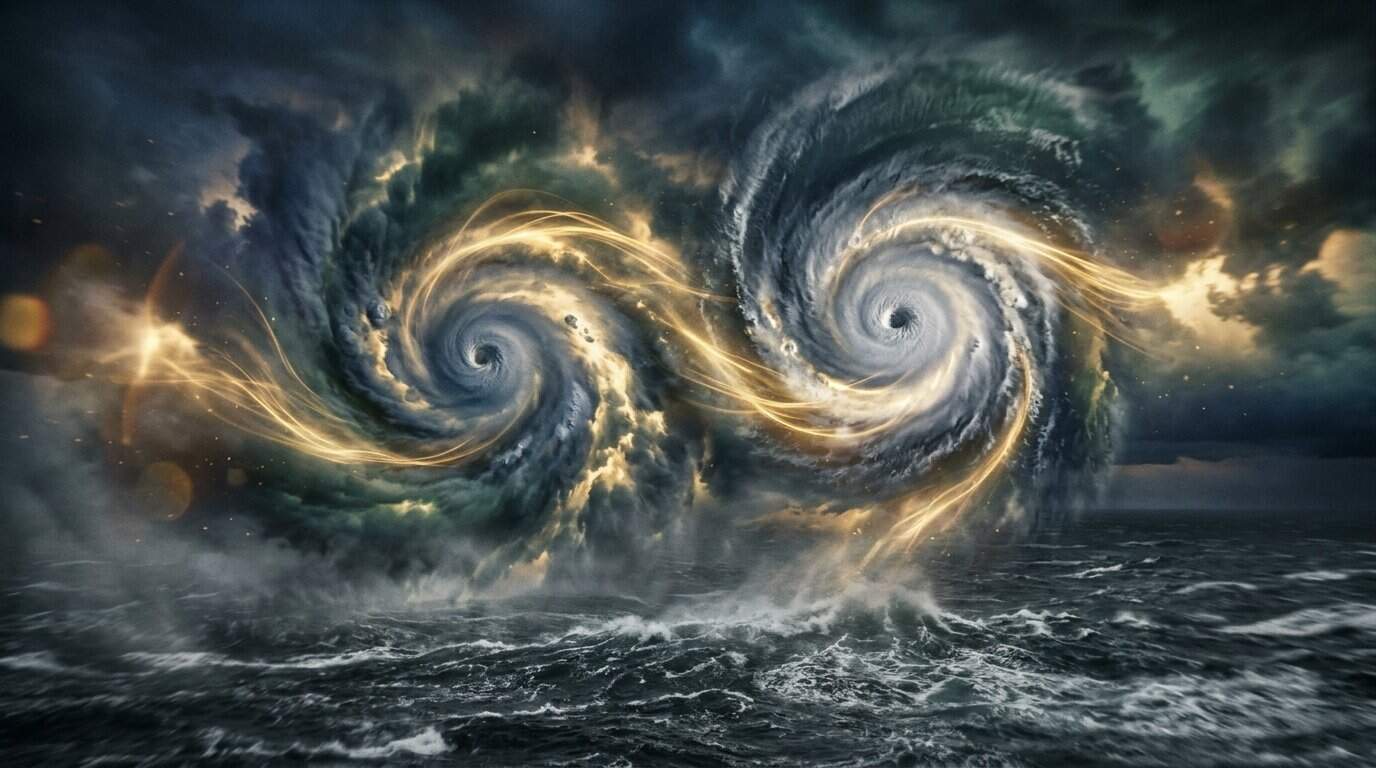
Imagine two massive hurricanes, each a powerhouse of wind and rain, suddenly catching sight of one another across the open ocean. Instead of simply passing by, they begin a haunting, synchronized spin around an invisible center, a phenomenon known as the Fujiwhara effect mystery. This atmospheric dance can lead to unpredictable paths, where storms might merge into a giant or slingshot each other into unexpected territory.
While scientists have watched these celestial orbits for over a century, the true nature of their interaction remains one of weather’s most captivating puzzles. Even with today’s most advanced technology, predicting exactly how two storms will react when they lock eyes is nearly impossible. It is a rare moment where the order of physics meets the chaos of the wild, leaving us to wonder what really happens when the world’s most powerful forces collide.
Key Takeaways
- The Fujiwhara Effect occurs when two tropical cyclones within 870 miles of each other begin a counter-clockwise orbit around a common center, creating a binary system that mimics celestial movements.
- This atmospheric interaction leads to extreme unpredictability, where storms may merge into a single massive entity, absorb one another, or slingshot into unexpected geographical territories.
- Modern meteorological science provides a foundation for ancient legends like the Japanese Kamikaze, suggesting these ‘divine winds’ were actually rare and violent storm collisions.
- Despite advanced satellite technology and computer modeling, the precise behavior and final path of interacting storms remain one of the most complex and enduring mysteries in weather science.
Sakuhei Fujiwhara And The Discovery Of Binary Storms
In 1921, a visionary Japanese meteorologist named Sakuhei Fujiwhara peered into a small water tank and witnessed something that looked more like a supernatural ritual than physics. He watched as two tiny swirling vortices, created by his own hand, began to drift toward one another in a rhythmic, circular motion. Rather than simply passing by or instantly colliding, the two whirlpools started to dance around a hidden central point as if pulled by an invisible thread. This experiment provided the first concrete proof that massive storms could sense one another across vast distances and enter into a chaotic embrace. Fujiwhara noticed that this interaction created a strange new energy, creating a binary system that felt uncannily similar to the movements of celestial bodies in deep space.
The discovery of this binary dance offered a scientific explanation for events that ancient mariners once attributed to the whims of gods or sea monsters. In Japanese history, the legendary Kamikaze, or divine winds, were often seen as purposeful forces that protected the islands from invasion. By demonstrating how two storms could merge or orbit one another, Fujiwhara showed that nature has a way of concentrating its power into unpredictable and seemingly intelligent patterns. This phenomenon occurs when tropical cyclones come within roughly 870 miles of each other, triggering a counter-clockwise rotation that can baffle even the most advanced modern forecasting equipment. The sheer unpredictability of these merging giants suggests that there is still a deep mystery at the heart of the atmosphere that we are only beginning to decode.
While the physics of the Fujiwhara Effect are now documented in textbooks, the phenomenon still carries an air of the unexplained due to how it defies standard weather patterns. When two storms begin their orbital lock, they can suddenly change direction or pick up speed in ways that seem to ignore the surrounding environment. This creates a sense of unease for those tracking the storms, as the binary system often behaves like a single, sentient entity with a mind of its own. Some researchers suggest that these interactions might even explain historical accounts of ships vanishing in clear weather, only to be swallowed by a sudden, localized surge of energy. Even today, as we look at satellite imagery of two typhoons spiraling around a common center, it is easy to see why ancient cultures viewed such sights as a sign of something truly otherworldly.
Divine Winds And Ancient Legends Of Storm Cannibalism
History often remembers the divine winds, or Kamikaze, as the miraculous storms that decimated the invading Mongol fleets of Kublai Khan in the late thirteenth century. While traditional accounts describe these events as a heavens sent intervention to protect Japan, the physical descriptions of the sea during these battles hint at something far more complex than a standard gale. Ancient scrolls and survivor stories depict a chaotic ocean where massive storms seemed to merge and swallow entire armadas whole. This terrifying behavior mirrors the modern understanding of the Fujiwhara Effect, where two powerful weather systems begin a deadly dance around one another. It is possible that the legendary protection of the islands was actually a rare and violent meteorological collision that created a singular, inescapable vortex of destruction.
The concept of storm cannibalism finds deep roots in maritime folklore, where sailors frequently spoke of living tempests that hunted in pairs. In many Pacific cultures, these dual storms were viewed as warring deities or monstrous entities that would lock in a struggle until one consumed the other. Sakuhei Fujiwhara, the scientist who eventually decoded this phenomenon in the early twentieth century, likely drew inspiration from these long standing cultural observations of the natural world. When two tropical cyclones wander within roughly eight hundred miles of each other, they lose their independent paths and begin a frantic orbit. To an ancient observer trapped on a wooden vessel, this synchronized rotation would look less like physics and more like a predatory ritual between two sentient giants.
These historical accounts provide a fascinating bridge between ancient superstition and the unpredictable nature of modern weather science. Even today, meteorologists find it incredibly difficult to predict which storm will dominate or if they will simply spin into a mutual collapse. This inherent uncertainty keeps the mystery of the divine winds alive, suggesting that the atmosphere holds secrets that even our best satellites struggle to map. Perhaps the legends of the Kamikaze were not just myths, but early eyewitness reports of a rare atmospheric phenomenon that changed the course of human history. Does the idea of two storms merging make the legend of the divine wind more believable to you, or does it take away from the magic of the story?
The Unpredictable Physics Of The Atmospheric Waltz
When two massive storms wander within 870 miles of each other, they begin a rhythmic, counter clockwise orbit that meteorologists call the Fujiwhara Effect. Named after Sakuhei Fujiwhara, who first observed this behavior in 1921 using water tank experiments, the phenomenon transforms predictable weather patterns into a chaotic game of tag. Modern computer models often struggle to calculate the exact center of this rotation, leading to sudden slingshot movements that can send a hurricane careening toward land unexpectedly. This atmospheric waltz creates a sense of unease for forecasters because the storms seem to possess a strange, shared intelligence. Even with our advanced satellite technology, the precise moment these giants will merge or repel one another remains a frustratingly beautiful mystery.
Beyond the mathematics of wind speed and pressure lies a deeper, more haunting connection to the ancient world. Throughout history, sudden shifts in storm paths have been credited with sinking entire fleets or protecting sacred islands, much like the legendary divine winds of Japan. Some researchers and fringe theorists suggest that these interacting vortices might tap into unseen energy corridors that defy our current understanding of physics. When a storm suddenly pivots or vanishes from a predicted track, it fuels long standing superstitions about local anomalies and disappearances at sea. While science points to complex fluid dynamics, the sheer unpredictability of these movements keeps the door open to more mystical interpretations.
The challenge for today’s weather experts is determining whether these storms will eventually collide or perform a graceful exit into the open ocean. Some interactions result in the larger storm simply absorbing the smaller one, while others create a permanent change in the Earth’s upper atmosphere. This volatility reminds us that despite our digital tools, nature still holds secrets of the deep sea that can bypass our best logical defenses. Each time a dual storm system appears on the radar, it serves as a reminder of the thin line between documented science and the unexplained. Do you believe these sudden atmospheric shifts are purely mechanical, or could there be a more profound force guiding the path of the world’s most powerful winds?
Navigating The Shadows Of The Great Storm Dance
The Fujiwhara effect creates a mesmerizing yet terrifying spectacle on the open ocean that has long been associated with the legendary divine winds of history. When two massive storms draw close enough to begin their rhythmic orbit, they transform from predictable weather patterns into a singular, rotating dance of destruction. This interaction often leads to sudden shifts in direction that defy even the most advanced modern forecasting models. For centuries, sailors who encountered these merging giants described them as living entities that seemed to hunt ships across the waves. These atmospheric anomalies provide a scientific foundation for the many tales of vessels that vanished without a trace into the heart of the storm.
Superstitions regarding the Great Storm Dance suggest that these merging cyclones act as gateways or magnets for maritime misfortune. While Japanese meteorologist Sakuhei Fujiwhara first documented the physics of this behavior in 1921, the eerie unpredictability of the final destination for these storms keeps the mystery alive. Some researchers believe that the intense electromagnetic changes during such a massive weather event could interfere with navigation tools, leading to the enigma of the Bermuda Triangle and the many strange disappearances reported over the years. This blend of atmospheric science and historical lore creates a compelling argument that nature still holds secrets we are only beginning to grasp. The overlapping paths of these storms often mirror the locations of famous maritime graveyards, leaving many to wonder if there is a deeper connection between the weather and the unknown.
Predicting where a Fujiwhara event will end is one of the greatest challenges facing meteorologists today because the storms can merge into a giant, bounce away, or spin in entirely new directions. This volatility fuels the fringe theory that these storms are influenced by more than just air pressure and temperature. When two titans of the sea collide, the resulting chaos creates a perfect environment for the unexplained to occur far from the safety of the shore. Whether it is a simple matter of complex physics or something more profound, the sight of two hurricanes locked in an embrace remains one of the most haunting sights on Earth. Do you believe these double storms are merely a natural wonder, or could they be responsible for the persistent legends of ships lost in the shadows?
Where Scientific Laws and Ancient Legends Dance
The Fujiwhara Effect serves as a fascinating bridge between the rigid laws of atmospheric physics and the haunting echoes of ancient folklore. While Sakuhei Fujiwhara provided the scientific framework for these dancing storms in the 1920s, the unpredictable nature of the phenomenon still mirrors the legendary divine winds that shaped history. By transforming two separate weather systems into a singular, rotating entity, this effect reminds us that nature possesses a dramatic flair that can feel intentional. It is this intersection of high-tech forecasting and old-world mystery that keeps the legend of the great dance alive in the modern imagination.
When these cyclonic giants begin their orbital embrace, they challenge even the most sophisticated computer models used by meteorologists today. This lingering unpredictability allows room for the same sense of wonder that led our ancestors to attribute strange weather to the whims of the gods or supernatural forces. Science has given us the mechanics of the interaction, but the sheer power and rarity of the event continue to fuel modern superstitions and curiosity. We are left to wonder if these atmospheric anomalies are merely coincidences of pressure and wind or if they represent a deeper, more complex rhythm of our planet.
Understanding the mechanics of the Fujiwhara Effect helps demystify the chaos, yet the experience of witnessing such a rare event remains deeply personal. Many people have stories of a storm that seemed to move with a mind of its own or a sudden shift in the wind that felt like more than just a change in the forecast. These moments of atmospheric strangeness often stay with us long after the clouds have cleared and the sun has returned. Much like the tales of Japan’s mischievous river spirits, these weather legends remind us of our enduring connection to the natural world. Have you ever experienced a weather event that felt truly otherworldly or witnessed a storm behave in a way that science couldn’t quite explain? Just as researchers investigate the Baltic Sea anomaly origin to understand strange underwater structures, we must continue to probe the skies for answers to these atmospheric puzzles.
Frequently Asked Questions
1. What exactly is the Fujiwhara effect?
The Fujiwhara effect is a rare atmospheric dance where two nearby hurricanes begin to orbit around a shared, invisible center. This interaction occurs when storms come within about 870 miles of each other, creating a binary system that mimics the movement of planets or stars. It is a moment where the raw power of nature shifts from linear movement into a haunting, synchronized spin.
2. Who originally discovered this strange weather phenomenon?
Sakuhei Fujiwhara, a pioneering Japanese meteorologist, first identified this behavior in 1921 through experiments with water tanks. He observed that swirling vortices would naturally drift toward one another and begin a rhythmic rotation rather than simply colliding. His work transformed what once seemed like supernatural sea myths into a documented scientific reality.
3. Can the Fujiwhara effect cause two hurricanes to merge into one?
Yes, if two storms get close enough and are of similar strength, they can eventually spiral into one another to form a singular, massive powerhouse. In other cases, a much larger storm might simply consume its smaller companion, absorbing its energy like a predator. This merging process is one of the most unpredictable and intense outcomes of the binary interaction.
4. Why is it so difficult for scientists to predict these storm paths?
Even with modern satellites, the way two storms influence each other involves a chaotic mix of wind speeds, pressure, and ocean temperatures. Small changes in the environment can cause the storms to suddenly slingshot away from each other or change direction entirely. This unpredictability makes the Fujiwhara effect one of the most enduring mysteries in modern meteorology.
5. How does the Fujiwhara effect relate to ancient legends like the Kamikaze?
In Japanese history, the legendary divine winds known as Kamikaze were often seen as supernatural interventions that protected the islands from invasion. Modern researchers look back at these events and wonder if the Fujiwhara effect played a role in creating such sudden and erratic weather shifts. It bridges the gap between ancient folklore and the complex physics of the natural world.
6. Is the Fujiwhara effect becoming more common today?
As ocean temperatures rise and provide more fuel for tropical systems, the likelihood of multiple storms existing in the same region increases. This creates more opportunities for these massive weather systems to cross paths and engage in their circular dance. While the phenomenon remains rare, the changing climate may make these dramatic atmospheric encounters a more frequent sight.