
The Bielefeld Conspiracy Origins And Germany’s Favorite Urban Legend
In the heart of Germany lies a bustling city of over 300,000 people, yet a persistent shadow of doubt hangs over its very existence. The strongbielefeld conspiracy origins trace back to a simple student party in 1993, where a sarcastic comment sparked one of the internet’s first and most enduring urban legends. What started as a clever jab at how people believe misinformation quickly spiraled into a global phenomenon that questions the reality of highway signs and maps.
The mystery deepened when a computer science student named Achim Held took the joke to the digital world, posting a set of three specific questions to an early online newsgroup. He argued that if you don’t know anyone from Bielefeld, have never been there, and don’t know anyone who has ever visited, then the city might just be an elaborate illusion. While official records and satellite images tell one story, the playful persistence of this theory suggests that sometimes, the most fascinating mysteries are the ones we create ourselves.
Key Takeaways
- The Bielefeld Conspiracy originated in 1993 as a satirical student prank by Achim Held, who used mundane coincidences like taped-over highway signs to mock the logic of genuine conspiracy theories.
- The legend’s persistence is built on a rhetorical ‘proof’ involving three questions—knowing someone from the city, having been there, or knowing a visitor—which exploits personal experience to create a self-sustaining loop of doubt.
- Bielefeld successfully transformed a potential PR challenge into a marketing triumph by offering a one million euro prize to anyone who could prove its non-existence, effectively ending the theory through communal humor.
- This phenomenon serves as a foundational case study in digital folklore, demonstrating how early internet communities like Usenet could turn a local joke into a globally recognized cultural myth.
Achim Held And The 1993 Kiel Student Party
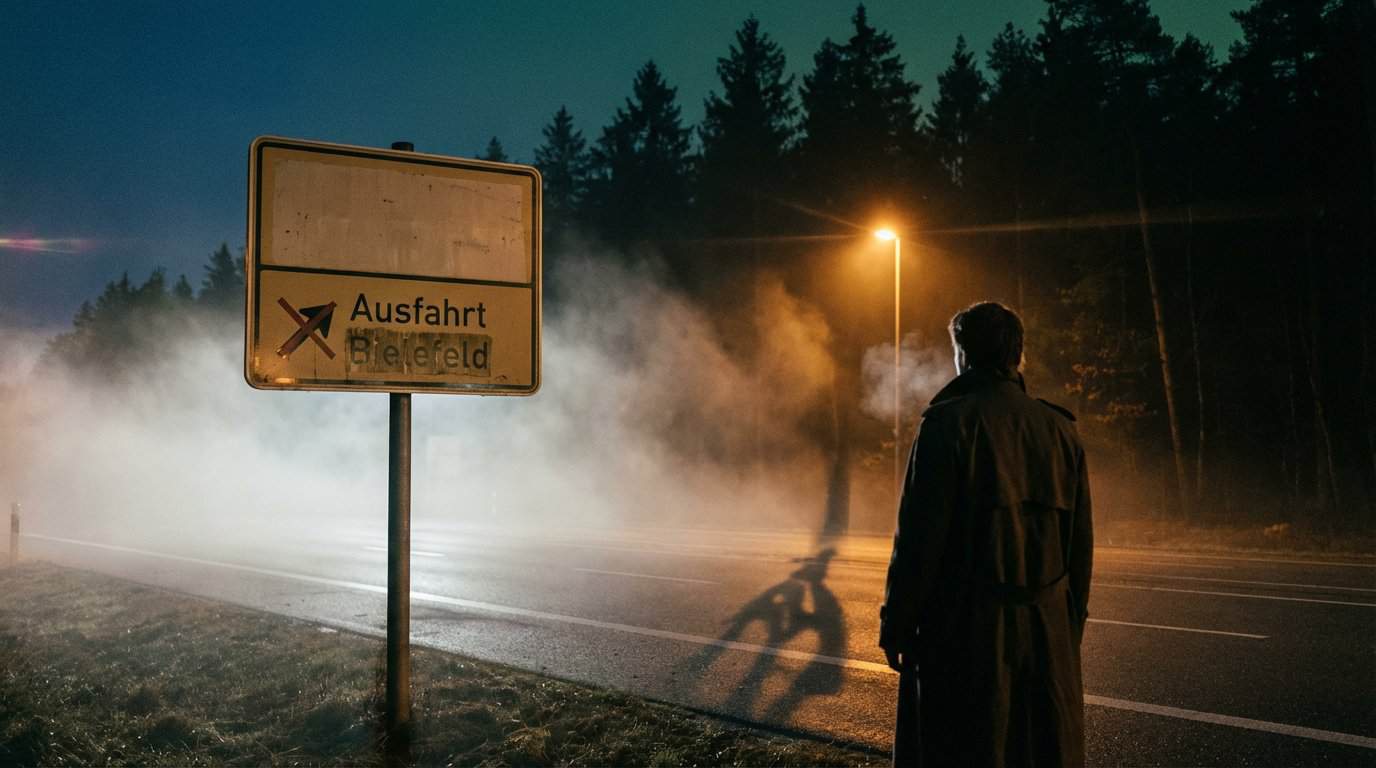
The legend began quite by accident during a casual student party in the city of Kiel back in 1993. Computer science student Achim Held was chatting with a fellow guest who mentioned they were from Bielefeld, a city in the North Rhine-Westphalia region. In a moment of playful wit, Held jokingly replied that such a place simply did not exist. This lighthearted exchange might have been forgotten if not for a strange coincidence that occurred shortly after on the German Autobahn. While driving with friends, Held noticed that several highway exit signs for Bielefeld were covered with thick construction tape.
This mundane roadwork provided the perfect evidence for a burgeoning mystery that Held and his friends began to weave together. They jokingly theorized that the taped-over signs were not for repairs, but were actually part of a massive cover-up by a mysterious entity known only as Them. According to a report by National Geographic, the group began to lean into the idea that the city was an elaborate illusion created to fool the public. What started as a clever jab at the logic of real-world conspiracy theorists soon took on a life of its own. The combination of a witty remark and a few rolls of gray tape laid the groundwork for Germany’s most enduring urban legend.
By the time Held shared his findings on the Usenet newsgroup de.talk.bizarre in May 1994, the joke had transformed into a structured sociological experiment. He presented three specific questions to prove the conspiracy: Do you know anyone from Bielefeld? Have you ever been there? Do you know anyone who has ever been there? Because most people answer “no” to at least one of these, the theory felt strangely plausible in a digital space hungry for quirky mysteries. This playful skepticism encouraged people to look at their surroundings with a sense of wonder and doubt. It serves as a fascinating reminder of how easily a simple coincidence can grow into a cultural phenomenon when fueled by imagination.
The Digital Spark On Usenet Newsgroup De Talk Bizarre

The digital environment of the early 1990s was a far cry from modern social media, yet it provided the perfect fertile ground for a legendary mystery to take root. On May 16, 1994, a computer science student named Achim Held shared a curious observation on the Usenet newsgroup de.talk.bizarre. What began as a witty remark at a party in Kiel soon transformed into a structured, satirical challenge to the existence of an entire German city. Held pointed to a set of strange coincidences, such as highway signs being obscured by construction tape, to suggest that Bielefeld was nothing more than an elaborate illusion. This post effectively served as the starting gun for one of the internet’s first truly viral urban legends.
At the heart of this growing intrigue was a shadowy and unnamed group referred to simply as SIE, which translates to “They” in German. According to the lore established on the Usenet forums, this mysterious entity was responsible for creating the facade of Bielefeld to hide something far more significant. The conspiracy theorists of the digital age jokingly debated whether SIE represented space aliens, the government, or even a secret organization using the city as a cover for a hidden base. By framing the argument around three simple questions, do you know anyone from Bielefeld, have you ever been there, and do you know anyone who has ever been there, the community created a self sustaining loop of curiosity.
The brilliance of the de.talk.bizarre post lay in how it mirrored the logic of genuine conspiracy theories while maintaining a playful, inquisitive spirit. As the thread grew, users from across the globe began contributing their own evidence of the city’s non existence, blending real world observations with imaginative fiction. This collective storytelling experiment proved how easily information could spread through early internet nodes, turning a local joke into a national phenomenon. Even today, the legend of SIE and their invisible city serves as a fascinating example of how digital communities can breathe life into a mystery. Have you ever checked a map and wondered if what you were seeing was truly there, or just a clever distraction?
The Three Questions Of The Bielefeld Proof
The brilliance of the Bielefeld Proof lies in its deceptive simplicity, relying on three specific questions that challenge the foundations of personal experience. To determine if the city is a fabrication, one must ask: Do you know anyone from Bielefeld? Have you ever been there? Do you know anyone who has ever been there? Because most people will naturally answer “no” to all three, the conspiracy gains an immediate, playful momentum. This rhetorical trap suggests that if you cannot personally verify the city’s existence, you are simply relying on the word of “Them,” a mysterious group responsible for the grand illusion.
This logical framework was first introduced by Achim Held on the Usenet newsgroup de.talk.bizarre in 1994, transforming a student joke into a structured sociological experiment. By framing the existence of a major city as a matter of belief rather than fact, Held highlighted how easily misinformation can take root when it mirrors the structure of real conspiracy theories. Even when someone claims to have visited the city, the “Proof” accounts for this by suggesting those individuals are actually in on the plot or were led to a decoy location. This circular reasoning makes the theory nearly impossible to debunk using its own internal logic.
What started as a satirical jab at the fringe elements of the internet soon became a beloved part of German culture, even prompting the city officials of Bielefeld to join in on the fun. National Geographic notes that the joke became so pervasive that even former Chancellor Angela Merkel once jokingly doubted the city’s existence during a televised speech. The three questions serve as a friendly reminder to question the information we consume every day, even when it seems as solid as a dot on a map. It invites us to wonder if our question reality is truly as certain as we believe it to be, or if there are other cities hiding in plain sight.
From Internet Satire To A Million Euro Prize
While many cities might take offense at being told they do not exist, Bielefeld chose to lean into the mystery with a sense of humor that captured the world’s attention. The legend grew so large that even former German Chancellor Angela Merkel once jokingly referenced the city’s elusive nature during a speech in Berlin. This official nod from a world leader transformed a simple student prank into a recognized piece of German cultural heritage. By refusing to fight the satire, the city’s marketing department turned a potential PR nightmare into a masterclass in community engagement. The playful ambiguity surrounding the city’s coordinates and highway signs only added more fuel to the curious fire.
The height of this sociological experiment arrived in 2019 when the city officials made a bold and brilliant move to settle the score once and for all. They offered a staggering one million euro prize to anyone who could provide indisputable evidence that Bielefeld truly does not exist. This challenge invited conspiracy theorists and internet sleuths from all over the globe to present their best logic and proof of a cover-up. Thousands of entries flooded in, ranging from complex mathematical equations to creative photo evidence of the supposed void. The campaign was a massive success, proving that the best way to handle a wild theory is to invite everyone into the joke.
Ultimately, the prize went unclaimed because no one could actually prove the city was an elaborate illusion or a secret base for extraterrestrials. The city held a mock funeral for the conspiracy to celebrate its official end, though the legend remains a favorite topic for curious minds. This transition from a Usenet post to a million euro challenge shows how a lighthearted mystery can unite a community through shared laughter. Even today, travelers visiting the area often post photos of themselves standing in front of city signs just to prove they made it to the other side of the myth. Do you think a city could actually be hidden in plain sight, or is the Bielefeld story the perfect example of how easily a fun idea can go viral?
From Student Satire to Digital Folklore
What started as a lighthearted joke between students has blossomed into a permanent fixture of German pop culture. The legend of the missing city serves as a fascinating case study in how a simple idea can gain momentum through the power of collective imagination. Even years after its inception, the myth remains so influential that local officials and high-ranking politicians have joined in on the fun. It highlights the strange way that digital folklore can bridge the gap between a satirical experiment and a genuine cultural phenomenon. This enduring legacy proves that some stories are simply too entertaining to ever truly disappear from the public consciousness.
The mystery of Bielefeld continues to spark curiosity because it plays with the thin line between reality and elaborate fiction. While logical explanations point toward a clever sociological prank, the sheer dedication of the community keeps the question alive in a way that feels almost magical. There is a certain charm in the idea that a bustling city of hundreds of thousands could somehow be a grand illusion. Whether seen as a lesson in critical thinking or a whimsical urban legend, the conspiracy offers a unique perspective on how we perceive the world around us. It reminds everyone that a little bit of mystery can make the everyday world feel much more adventurous.
Have you ever found yourself driving through the North Rhine-Westphalia region and wondered if the signs were leading you toward a ghost? Perhaps you have met someone who claims to be from this elusive location, only to find yourself questioning if their hometown is part of a massive cover-up. We want to hear about your own experiences or any strange coincidences you have encountered regarding this legendary city. Do you believe it is all just a clever social experiment, or is there a tiny part of you that wonders if the maps are hiding a secret? Share your thoughts and help us decide once and for all if this missing piece of Germany actually exists. This playful skepticism is not new to the region, as historical records like the 1561 Nuremberg UFO Battle show that Germans have been documenting and debating unexplainable phenomena for centuries.
Frequently Asked Questions
1. What exactly are the bielefeld conspiracy origins?
The origins trace back to a 1993 student party in Kiel, Germany, where a young computer science student named Achim Held made a sarcastic joke. After noticing highway signs for the city were taped over for construction, he jokingly proposed that the city was an elaborate illusion. This playful skepticism quickly evolved into one of the earliest viral internet mysteries.
2. Who is Achim Held and what was his role in the legend?
Achim Held was the computer science student who first popularized the theory on an early internet newsgroup called Usenet. He formulated three specific questions to challenge the city’s existence, transforming a casual party joke into a structured, digital phenomenon. His clever wit provided the framework that people still use today to playfully question the reality of Bielefeld.
3. What are the three questions used to prove the city doesn’t exist?
The theory relies on asking if you know anyone from Bielefeld, if you have ever been there yourself, or if you know anyone who has ever visited. If the answer to all three is no, the legend suggests the city is actually a cover-up. This simple logic has fueled decades of curiosity and lighthearted debate across the globe.
4. Was there any physical evidence that started the mystery?
A series of highway exit signs for Bielefeld were covered with thick construction tape while Achim Held was driving with friends. While this was actually standard roadwork, it served as the perfect visual evidence for the group to claim a massive cover-up was underway. This coincidence turned a simple observation into the foundation of a worldwide urban legend.
5. How did the theory spread before modern social media existed?
The mystery gained momentum through Usenet, an early online discussion system used by students and researchers in the 1990s. By posting his theories to these digital newsgroups, Held reached a global audience of early internet users who find the idea of a hidden city fascinating. This digital word-of-mouth allowed the legend to grow far beyond the borders of Germany.
6. Is there any truth to the claims that the city is an illusion?
While official maps, satellite imagery, and over 300,000 residents confirm the city is real, the legend persists because it highlights how easily misinformation can spread. It serves as a fascinating study in human psychology and our willingness to embrace a good mystery. Even the city officials eventually joined in on the fun, offering a reward to anyone who could prove its non-existence.